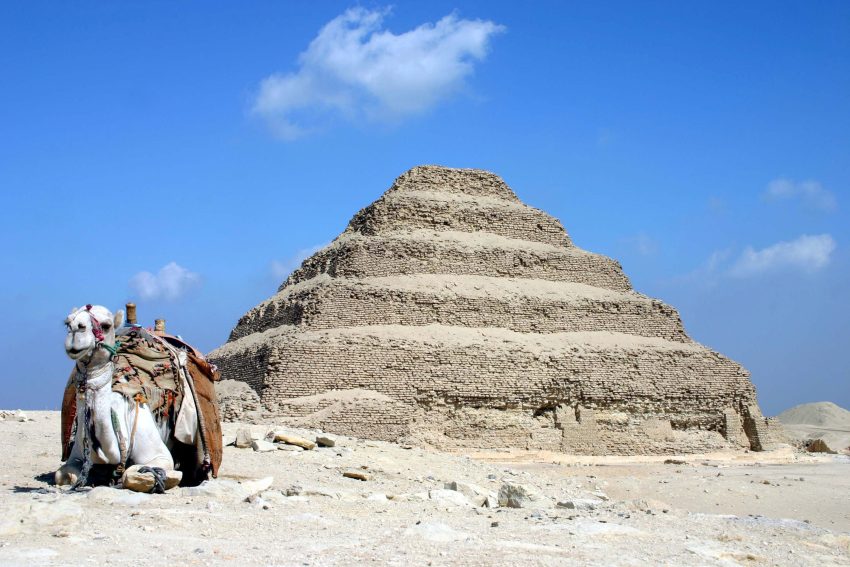
Saqqara in Cairo, Egypt, is a large archaeological necropolis in the Giza region southwest of the city. It is an open desert site rather than a single monument, with pyramids, courtyards, causeways, tombs, and underground galleries spread across a wide area. The best-known landmark is the Step Pyramid of Djoser, set inside a ceremonial complex that shows an early stage in pyramid design.
What makes Saqqara useful for visitors is the range it offers in one stop: royal pyramids, decorated tombs with carved scenes of daily life, and the Serapeum's long subterranean passages. The site works well for travellers who want a fuller picture of ancient Egyptian burial culture and do not mind a walking-heavy visit on uneven ground. It is less about one famous view and more about seeing a landscape of monuments that developed over many centuries.
Saqqara was one of the most important cemeteries of Memphis, and its name is commonly linked to Sokar, a Memphite deity associated with the dead and the necropolis. What makes Saqqara exceptional is its time depth: burials and monuments here span from Egypt's earliest dynasties through the Old Kingdom and beyond, which is why it often feels like an open-air museum of ancient Egyptian history rather than a single “site.”
The Step Pyramid of Djoser (Third Dynasty) is Saqqara's defining landmark and a genuine milestone in world architecture-an early experiment in monumentality that set the template for later pyramid development. Saqqara also contains pyramids of major Fifth and Sixth Dynasty kings, along with elite tombs whose carved scenes of daily life, ritual, and status remain among the most vivid windows into the Old Kingdom imagination.
Beyond royal pyramids, Saqqara’s importance continues into later periods, including New Kingdom tombs and the Serapeum-vast underground galleries linked to the cult of the Apis bulls, treated as sacred manifestations connected with Memphis’ religious life. In practical terms, that means your visit can shift quickly from towering pyramid silhouettes to intimate interiors, carved chapels, and subterranean spaces, all within one day.
Things to See and Do in the Saqqara
Start with the Step Pyramid Complex of Djoser and walk it slowly. The enclosure walls, courtyards, and ceremonial spaces make the experience feel like more than “just a pyramid,” and they help you understand how architecture, power, and religion were staged in the Old Kingdom. Even if you’ve already been to Giza, Djoser’s complex hits differently because it’s about beginnings: experimentation, scale, and the first big leap into pyramid-building.
Next, prioritise at least one set of decorated tombs if they’re open on the day you visit. Saqqara’s noble tombs are where the human detail lives-scenes of agriculture, crafts, feasting, and ritual that make ancient Egypt feel specific and lived-in rather than purely monumental. The atmosphere also tends to be calmer than Giza, which makes it easier to take your time without feeling rushed by crowds.
If you enjoy “odd, unforgettable” archaeology, add the Serapeum to your route. Its underground corridors and massive sarcophagi create a completely different mood from the sunlit pyramid plateau-cooler, darker, and more enigmatic, with the sense of descending into a sacred infrastructure rather than visiting a single chamber. Finally, consider the Imhotep Museum as a short, grounding stop that adds context to what you’ve just walked through, especially if you like having names, dates, and excavated objects to connect the dots.
How to Get to the Saqqara
The nearest airports are Cairo International Airport (CAI) and Sphinx International Airport (SPX), with SPX often convenient if you're staying on the Giza side of the city. For the best deals and a seamless booking experience, check out these flights to Cairo on Booking.com.
If you want to use rail for part of the journey, take a train to Giza Station (or Cairo's main station) and continue by taxi or ride-hailing to Saqqara, as there is no direct train to the site itself. Train schedules and bookings can be found on Omio.
Public transport is possible but not especially straightforward, usually involving a combination of metro/bus to Giza and then local transport onward. For most travellers, the simplest plan is to base in Cairo or Giza and arrange a half-day or full-day driver (or a guided day trip) that includes Saqqara and, if you like, nearby Memphis and Dahshur in one loop.
Best time to visit: Go early for cooler temperatures and better visibility, then use mid-late morning for tomb interiors while you still have energy and focus.
How long to spend: Plan 3-5 hours for Saqqara alone, or a full day if you're pairing it with Dahshur and Memphis.
Accessibility: Expect uneven ground, sand, and stepped entrances; Saqqara is best approached as a walking-heavy site with variable surfaces.
Facilities: Bring water and sun protection, and assume that some areas require separate tickets (certain tombs, the Serapeum, and specific add-on monuments) depending on what’s open and what you want to enter.
Where to Stay Close to the Saqqara
For a culture-heavy itinerary, the best base is central Cairo (Downtown/Tahrir or Garden City) so you can pair Saqqara with museums and historic neighbourhoods; for a pyramid-focused trip, stay in Giza near the plateau so you're closer to Saqqara, Dahshur, and early starts on the west bank.
For a classic pyramid-side stay with a sense of occasion, Marriott Mena House, Cairo is hard to beat for location and atmosphere. If you want a highly practical base for museums and day trips with a central address, Steigenberger Hotel El Tahrir Cairo is a reliable choice. For a more polished, quieter riverside base that still keeps you well connected, Kempinski Nile Hotel Garden City Cairo suits travellers who want comfort between big sightseeing days.
Is the Saqqara Worth Visiting?
Yes-if you care about archaeology, Saqqara is one of the most rewarding day trips from Cairo because it offers variety and context, not just iconic silhouettes. The Step Pyramid complex feels foundational in a way that's hard to overstate, and the tombs add human detail that balances the grandeur of royal monuments.
Honest pivot: if your Egypt schedule is extremely tight and you only want the single most famous pyramid view, you can focus on Giza and still feel satisfied. Saqqara is the upgrade for travellers who want depth, quieter exploration, and a better sense of how pyramid-building and elite burial culture evolved over time.
Ticket Office Saqquara, located in Saqqara, is the main entry for the Saqqara complex; visitors report friendly staff and an organized, cleaner site with helpful signage, an on-site museum and plenty of toilets. Tickets are easy to buy and an all‑inclusive option can save money, but be aware that some entrances (such as individual tombs) may not be covered by the standard site ticket and signage about inclusions could be clearer. The area is less crowded than Giza, recently renovated in parts, and there's frequent touting and requests for tips—many recommend deciding in advance whether to hire a guide to avoid confusion.
Crystal Dougherty
4 weeks ago
"Easy to get tickets. The all inclusive saves you money."
MikeLondonSE
a month ago
"29/1/26 Thursday late morningnnWe three middle aged guys from London were on our last full day in Northern Egypt around Cairo. Our third big day outwas at this complex, staying in Giza. We had looked up getting to and from it (on a budget) and left our hotel by the Giza ticket office for the nearby main dual carriageway through (tourist)town. There we got a Kareem (Egyptian Uber using their app) taxi at a very reasonable 170 which took us through some very squalid roads lined with (officially?) rubbish as an open landfill. Half an hour later we arrived at a very peaceful ticket office in one peace (the driver was slow but smooth as looking after his suspension) so we rounded up to 200. There were no crowds, hassle, scammers, bad manners or beeping. It was all very civilised. Once through security scanning devices we were into a relaxed outside area with a simple kiosk with a very chatty and friendly local selling tickets. A self serice machine was round the corner. We did not buy tickets online as we did not know the situation enough. It was nice bantering with the office guy and not expect to give him backsheesh. Maybe he should be selling small notes for a small cut (4x20 &1x10 for 100 etc.)? - see later. The locals pay in the tens for tickets so he should have change. I pretended to be a local student and he was having nothing of it, found asking with the joke though. We bought an 'all inclusive' ticket each for 1000 (excluding the Djoser Step Pyramid tunnels) as it seemed a good deal overal (although technically more expensive than Giza Plateau). We decided we were early enough to make our own way round the vast complex and NOT take a car offered (there were a few drivers around and the ticket man said he could arrange one). We declined their offers (not getting any quotes as we were not really interested). We are reasonably fit, it was January, relatively cool and we had water and sturdy shoes with us! We seemed to be the only people walking (although we passed by a couple of guys later on a road between two sites travelling clockwise). We made our way to the museum via an interpretation board with a good map on. Our own Gglmps and OrganicMaps gave us an idea of where we were via 5G. We walked to the Imhotep Museum, stopping off for a breather at the video presentation. This had no indication of how far it was in when we arrived for a sit down in the dark. It was useful though. The video stopped and a dozen of us left to go to the museum proper. A museum guardian checked our ticket so I asked if there was a paper map and pedestrian route we could follow. He did not understand. There was no map for pedestrians. The museumwas actually fascinating and better than the Coptic Museum in some ways. The exhibits were of course all Egyptian and included technically the first ever arcitectural diagram/plan ever discovered and an office of the archaeologists of the time who discovered so much. We left, taking advantage of the free toilets. It then became apparent how car oriented the whole site is (therefor unenvironmetally friendly) with the lack of pedestrian paths and waymarking being obvious. We knew our next stop was east beyond the museum but as pedestrians were had to walk west all the way back to the museum entrance to get the road to the next site east. We took a chance and cut across the bare ground, up a slope to save valuable time. There should have been steps directly by the museum entry/exit up to that road. Oh well. On that high road we passed an interesting dig that no doubt we were not meant to explore. A car stopped and offered us his taxi, on this private road. We walked up and round to find the first site. It was devoid of vehicles in the car park. A loud man popped out with a small boy and inspected our ticket. He was quite physical and noisy, showing us this that and the other...Maya... Maya...Bright Colours...Look Look! Yes it was interesting (and our first experience of guardian hassle) but he was just about comprehensible then at the end he expected his backsheesh, we gave him 20 and he wanted that from each of us... a government employee! He was not happy when we just walked off into the distance. A minibus of tourists arrived as we left...better luck this time... although they probably had hired a guide for a lot more money. We walked a lot from site to site, every guardian wanted a tip, nearly all wanted to take pictures of us as a group (and expected payment). I'm adept at group selfies so they were not happy! Signage was geared to car drivers, not pedestrians, and short cuts were not signposted, marked or laid out properly. A particularly quiet and calm woman in a tomb complex guided us from one tomb entrance to another, she got 15. After that we only had 200 notes left.... The Hemicycle of Greek Philosophers and Poets (by the Serapeum) we stumbled upon was a pit of incongruous statues with litter swirling around in it; rather sad. I think there is some history there. On the subject of litter... much less than Giza Plateau but still evident in the occasional flattened plastic bottles, cigarette packets and plastic bags flying strong the site. Most of the sites had a selection of separate bins for paper, metal, plastic and others but they did not seem to be used properly with a lot of cross contamination/abuse. They looked like they may never be emptied properly although probably counted as a tick for their environmental credentials. Some covered waiting areas had litter around including obvious new empty plastic bottles on the floor ruined the corner from a recyclingnbin. The guards/ticket inspector did not care. Maybe it was 'The Cleaner's' job? I even found a large old empty bag a few metres into a (crouching) tunnel entrance so returned with it to put in the bin, getting thanks from the staff. It's their job - maybe. On taking some obvious short cuts we saw a lot of pottery fragments scattered around, including bowl bases and cup and jug handles (I'm a potter). To remove them is probably a crime so most were photographed and left on walls or left to mingle with the (worse crime?) flattened and dusty plastic bottles. By 3:30 it became obvious that the all-inclusive ticket would not get us to some sites as they were too far away to the south in the time left. A decision to cut from one site straight to the Step Pyramid meant walking through a 'closed' site with an armed guard at the gate. I asked if we could go and he kindly allowed us through ...no backsheesh. We were all alone as usual until we got to the north west corner of the Step Temple and then the small crowds and decorated camels of the large square to the south. The entrance was closed as it was well after 16:00hrs. We expected the tombs near the Step Temple to be closed by 4:30 but some guardians were willing to let you in for backsheesh. We'd run out of small change so some guardians were not happy. At 4:50 we were still in the grounds of the Step Temple and looking at the gglmp to walk to the exit it was 20 minutes by road only! We decided to cross country and ended up following the workers, who knew the route well, past a causeway down a 'valley' and to the entrance/exit beyond an intriguing temple. Outside the exit we saw the workers leaving, some on bicycles.... now there is an eco-friendly idea for the Egyptian Government Tourism Dept... bicycle renting. This would be far better, maybe even electric bikes or scooters? Some entrepreneur would make a fortune. Maybe a little train (electric including topping up solar panels) between sites? Maybe a shuttle bus to the metro? No of course not...the motor car rules and vested interests continue to damage our planet, human health and maintain one of the most polluted cities in the world. At the GoBus terminal (the next day) we saw an electric four wheel scooter brave the traffic. They do exist and would be perfect to hire at Saqqara to cover all the sites on one day. I even saw a hire bike in the middle of Cairo's Abdul Moneim Riad Square ) north of old Egyptian Museum) under a huge flyover. I had never seen any being used. They were probably derelict or flat but served another tick for working towards Carbon Neutrality in 2050..not... (Sorry that's my field). Overall the whole day was good value for money and some of the interiors were spectacular although we missed seeing the hippo v alligator battle and a king fouling (?) in the reeds, probably because we had no guide or backsheesh left. We did see, however, Tut and his gf close up, multiple circumcisions, amputations, carved fingernails, seven types of olive oil, Maya (again and again...look, look..), skinny naked young men statues (museum). What was not present though, in terms of craftsmen, were the people who decorated the walls (selfies?) and their tools. Maybe they are in the GEM (maybe we missed that bit) or British Museum? I was wondering how tedious it must have been to inscribe each repeating hieroglyphic symbol. Maybe there were cut out stencils to reduce mistakes? Who knows? Another great mystery? Were the artists buried with the king, officers, wives, kids etc.. ? Sacrificed beforehand like the sacred cattle? Or buried/entombed alive? What a Life. What a Death. So many questions. Maybe too gory to answer (like the pyramids in Mexico). As for the huge Sarcophogi they must have built round them, although a cow one is left stranded in the corridor, the huge lid a few metres away. No explanation was available in any local interpretation. A must see though, although we chose not to go down the claustrophobic tunnels under the Step Temple. We saw plenty else. Note: You have to have a lot of small change on you! If you have a backpack on you it is really difficult going down some tunnels so crawling is the only option, expect dusty trousers and hands. Few washing/toilet facilities exist. It was about 5:15 when we left so we set about ordering a Kareem. The occasional speculating employee/taxi driver stopped by us saying 'no Uber here'... we were already booked with a Kareem with two minutes to go for the 230 journey to Tahrir Square. He arrived in his beaten up old black GrandEm (?) and demanded 800 to which we ever so politely declined. He did a U turn, hung around and eventually drove off. Meanwhile we walked to the canal junction (smelly in general but with a flock of sheep passing by for entertainment) and got an Uber instead that got us (almost) 'home' for 230 plus 70 tip for not diddling us! We got back to the hotel via a nice cheap meal overlooking the Giza Plateau ticket office and found that we had walked 13:5km that day. No wonder we were tired!..."
"Needs better signage/information on what the tickets include. The Saqarra site ticket does not include entrance inside any tombs. None of the stafftelling you that you ca ot enter a place are wearing uniform so it's hard to know if they are being truthful or trying the standard "it's closed" or "your ticket does not include this" trick. Lots of people giving misinformation looking to make a quick buck out of tourists as is sadly the case at all tourist sites in Egypt. Definitely worth seeing but probably more enjoyable with a guide if you want to make life easy for yourself...."
"Very different experience to the Giza pyramids and well worth the extra time (about 30mins south). Opportunity to walk inside which was a bit tricky,but well worth it...."
"Against all odds this place was more organized than the famous pyramids of Giza. It had places where you could throw your trash. It was evenseparated in different categories depending on the material (plastic, glass, trash). They had signs showing you the way for the monuments, it had also an on site museum and lots of WC. They had an on site sign for the prices, even for in site taxis. Now on the other side, you must pay attention because most of these are more than it seems. The prices for the taxi like everything else in Egypt is negotiable, so be careful on the bargain. Many people (not as many as in Giza) will harass you for tipping them. Their excuse will be that there are guards and they are going to open you the places (which by the way you already pay and must be open) in order for you to enter and see. They will also tell you many things for the story of the monuments like a guide even though you never asked. In my case all of the above happened but from the start i explained them that I do not need a guide. That didn't stopped them because they were following me (many times with police guards) believe that they will frightened me so they will get their tip. My opinion, be polite explain yourself from the begi ing and if things getting hard DO NOT be afraid demanding your rights. Now more tips for the road😀. Me and my wife didn't get any guide because usually we do our research before doing something so it is pretty much useless for us but in this site there are many things that are very difficult to find. So I will suggest you that if you want to fully explore everything do your research and try by your self otherwise try a guide (be careful who you choose and the price)or go without anything and live the moment 😁..."
"Menna, our guide, was truly inspiring and excellent with the children showing us the Saqqara Pyramids, the underground sarcophagus at the TetiPyramid and the fantastic tunnels at Serapeum. She gave us a real understanding of the history and thought processes involved in the creation of the tombs, artwork and hieroglyphs. A great experience!..."
Saqqara works best for families when you treat it as a “big shapes and short stories” visit rather than an all-day deep dive. Focus on the Step Pyramid and one tomb interior, then leave while attention is still high, especially in warmer weather.
If your kids are sensitive to heat or long walks, plan frequent water breaks and keep expectations flexible. Saqqara is more spread out than it looks on a map, so success usually comes from doing fewer things well, not trying to see everything.
Couples & Romantic Getaways
For couples, Saqqara is a strong change of pace from the city: open desert space, fewer crowds, and a feeling of discovery as you move between monuments. It's especially good if you enjoy slow travel-standing in a quiet courtyard, reading carved scenes together, and letting the landscape do the heavy lifting.
To keep it feeling romantic rather than exhausting, go early and finish with a relaxed lunch back in Cairo or Giza. Saqqara is at its best when you leave with energy, not when you push through the hottest hours out of stubbornness.
Budget Travelers
Saqqara is excellent value if you plan logistics carefully, because the main cost is transport rather than the visit itself. Sharing a driver with other travellers or joining a small group day tour can be cheaper than arranging private transport solo, while still saving you the friction of local connections.
If you're managing spending, pick your paid interiors deliberately rather than buying every add-on ticket out of habit. Saqqara is rewarding even from the outside, and you'll get more satisfaction from one or two meaningful entries than from rushing through five.
FAQs for Visiting Saqqara
Getting There
Saqqara is southwest of Cairo, in the wider Giza region, and it’s typically visited as a day trip. Travel time depends heavily on traffic, so starting early matters more than the raw distance.
The simplest option is a private driver, taxi, or organised tour that takes you directly to the site entrance. It removes the need for transfers and lets you pace the day around openings and heat.
Yes-Saqqara is commonly paired with Dahshur and Memphis because they sit on a natural loop. The key is to start early and keep the plan realistic so you’re not racing through the best parts.
Tickets & Entry
Not always-some monuments and tombs can require separate tickets or add-ons. It’s worth deciding in advance which interiors matter most to you so you don’t waste time on-the-spot.
Most travellers buy tickets on arrival without issue. Advance booking is mainly helpful if you prefer to reduce queue time during busier periods.
Yes, student pricing is commonly offered for foreign visitors with valid student identification. Bring your physical student ID, not just a digital copy.
Visiting Experience
Three hours can work if you focus on the Step Pyramid complex and one additional highlight. If you want tomb interiors and a calmer pace, aim for closer to half a day.
Yes, because it’s a different experience: older architecture, more variety, and far more “archaeological texture” across the landscape. Many travellers find Saqqara more memorable precisely because it feels less packaged.
A strong mini-route is Saqqara plus Memphis for context, then Dahshur for the Red and Bent Pyramids. It gives you a satisfying “evolution of pyramids” storyline in a single day.
Tours, Context & Itineraries
A guide adds real value if you want tomb scenes explained and a smart route through a large, complex site. If you’re happy exploring independently, you can still have an excellent visit as long as you plan your priorities.
Start with Djoser’s complex, then add one tomb interior if open, then finish with a single extra highlight like the Serapeum. That structure keeps the visit coherent and stops it turning into a scatter of monuments.
Photography
Yes-its open desert setting and fewer crowds make it easier to get clean compositions than at Giza. The best shots often come from stepping back and framing monuments against the emptiness of the plateau.
Morning light is usually kinder, and the air can look clearer before heat haze builds. Early arrival also improves your chances of quieter backgrounds and a calmer mood.
Accessibility & Facilities
It can be challenging because surfaces are uneven and distances between highlights can be long. If mobility is a concern, plan a shorter route focused on the most easily reached viewpoints.
Basic facilities exist around main areas, but you should plan as if services are limited and spread out. The most comfortable breaks tend to happen back in Cairo or Giza after the visit.
Food & Breaks Nearby
Most people eat back in Giza or Cairo where options are far better and more predictable. If you’re doing a full west-bank loop, your driver or guide will usually have a standard lunch stop that fits the route.
Safety & Timing
Early morning is usually best for comfort and atmosphere. Later visits can work, but heat and fatigue can blunt the experience at a site that rewards walking and attention.