Pompeii’s Forum
Roman Site in Pompeii
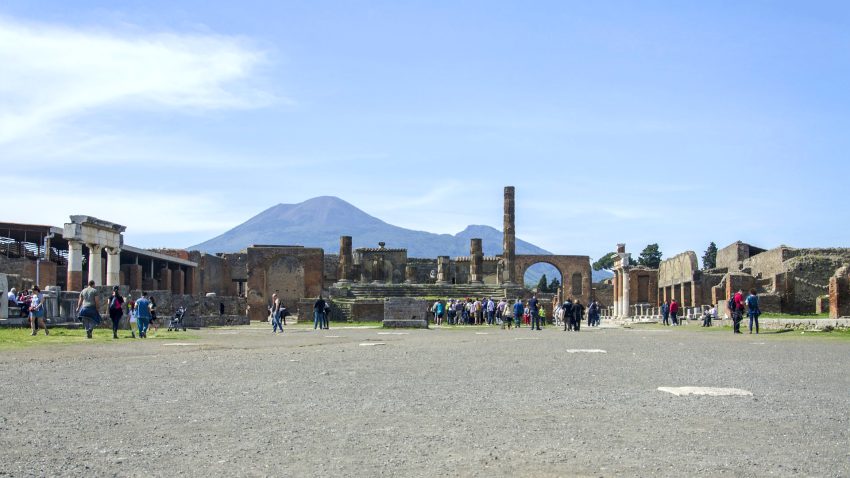
The Pompeii Forum is usually the first big space you walk into after entering the ruins, and it instantly sets the tone for the whole visit. Once the core of administration, justice, business, markets, and public worship, this vast rectangular square was the stage on which the city's political and commercial life played out. Today, even in ruins, it is one of the top attractions in Pompeii thanks to its photogenic columns, open views, and the dramatic backdrop of Vesuvius.
As you step onto the paving stones, it is easy to imagine the noise of traders calling out, citizens debating local issues, and priests moving between temples. The Forum began as a simple clay square lined with shops and shrines, then evolved over centuries into a monumental public space surrounded by porticoes, grand temples, the basilica, and the city hall. It is a great place to visit on a walking tour of Pompeii because so many of the city's key buildings are gathered around its edges, letting you understand the layout in a single sweeping view.
Table of Contents
- History and Significance of the Pompeii Forum
- Things to See and Do in the Pompeii Forum
- How to Get to the Pompeii Forum
- Practical Tips on Visiting the Pompeii Forum
- Where to Stay close to the Pompeii Forum
- Is the Pompeii Forum Worth Visiting
- FAQs for Visiting Pompeii Forum
- Nearby Attractions to the Pompeii Forum
History and Significance of the Pompeii Forum
In its earliest phase, the Pompeii Forum was a modest open area formed in clay, with a regular shape that lent itself naturally to gatherings and early market activity. The western side opened towards the Sanctuary of Apollo, while the eastern side was lined with a row of shops, already reflecting the blend of religious and commercial life that would define the square. As Pompeii grew in importance from the 3rd to the 2nd century BCE, the Forum was reshaped and monumentalised; its outline was regularised, porticoes were built along the sides, and the ground was paved with slabs of tuff to create a more formal civic stage.
At this point the axis of the square was carefully aligned with the façade of the Temple of Jupiter, giving the space a strong visual and symbolic focus. Looking north, people would have seen the temple rising at the end of the colonnades with Mount Vesuvius perfectly framed behind it, an impressive composition that underlined both religious authority and the city's relationship to its landscape. The Forum was not just a marketplace but the venue for city administration, legal proceedings, and meetings of local elites, making it the true heart of public life in Pompeii.
In the early Imperial age, the square received another upgrade when the surface was repaved with travertine slabs. Some of these stones still preserve grooves where bronze letters once fixed a large inscription, probably celebrating an emperor or major benefactor. Excavations started by Maria Carolina Bonaparte revealed that the area had been stripped of many of its decorative elements in antiquity, perhaps during later reuse or stone robbing. Even so, the surviving structures and details leave no doubt about the Forum’s grandeur, and its alignment with the present double-peaked silhouette of Vesuvius provides one of the most evocative views in the site, especially when you picture the volcano’s original conical shape rising higher into the sky before the AD 79 eruption.
Things to See and Do in the Pompeii Forum
When you enter the Forum, start by walking slowly along its length to absorb the overall layout. Look to one end to see the Temple of Jupiter, whose podium and column bases still dominate the northern side, and to the other end for the remains of the City Hall, where the city’s administrators once worked. Imagine the daily movement of magistrates, scribes, merchants, and ordinary citizens passing across the open space on their way to petitions, court cases, and deals.
On one flank you will find the basilica, which served as a combined law court and business hall. Even without its roof, the high walls and rows of columns give a sense of how imposing this interior would have felt during trials or commercial negotiations. Nearby are the granaries and storage buildings that once held supplies and goods, underlining how economic life revolved around this square as much as civic ritual. As you wander, try to spot traces of the travertine paving and any remaining cut marks where inscriptions once attached to the stone.
The Forum is also one of the best places to see in Pompeii for views of Vesuvius. Stand near the Temple of Jupiter and look beyond it to the volcano: from the two peaks visible today, draw imaginary lines up to reconstruct the classic cone that towered over the city before the eruption. It is a powerful exercise in imagination, and a reminder that the people of Pompeii had no idea their mountain was active until it exploded and froze their world in ash. Take time for photos, a few quiet moments of reflection, and a slow circuit under the surviving colonnades to fully appreciate the scale of the space.
How to Get to the Pompeii Forum
You reach the Pompeii Forum by entering the archaeological site of Pompeii in the modern town of Pompei, near Naples. The nearest major gateway is Naples International Airport, which offers frequent connections from across Italy and Europe and is the usual arrival point for visitors to the ruins. For the best deals and a seamless booking experience, check out these flights to Pompeii on Booking.com. From there, you can continue to Pompei by public transport, taxi, or rental car.
By train, the classic route is to travel from Napoli Centrale or Piazza Garibaldi on the Circumvesuviana line towards Sorrento and get off at Pompei Scavi Villa dei Misteri station, only a short walk from one of the main entrances to the archaeological park.Use Omnio to easily compare schedules, book train tickets, and find the best prices all in one place for a hassle-free journey across Italy. Regional trains also serve Pompei station in the modern town, from where you can walk or take local transport to the site.
If you choose to drive, the A3 motorway and local roads provide straightforward access to Pompei, with signposted parking areas near the park entrances.If you are looking to rent a car in Italy I recommend having a look at Discover Cars, first, as they compare prices and review multiple car rental agencies for you. Once inside the archaeological zone, simply follow the main streets or use the official visitor map to locate the Forum, which lies at the centre of the ancient city and is almost impossible to miss.
Practical Tips on Visiting the Pompeii Forum
- Suggested tips: Start or end your Pompeii visit at the Forum so you can use it as an orientation point, returning to it between exploring different districts of the city.
- Best time to visit: Early morning or late afternoon provides softer light, fewer crowds, and more comfortable temperatures for exploring the open square.
- Entrance fee: Adults: €22.00 (General Pompei Tickets)
- Opening hours: Daily: 9:00 - 15:30
- Official website: https://pompeiisites.org
- How long to spend: Allow at least 30 to 45 minutes in the Forum itself to explore the main buildings and viewpoints plus extra time if you linger for photos or breaks.
- Accessibility: Surfaces are uneven, with stone slabs and steps along the edges of the square some areas may be challenging for visitors with reduced mobility.
- Facilities: There are no major facilities directly in the square, but toilets, cafés, and water points are available elsewhere in the archaeological park, so plan rest stops accordingly.
- Photography tip: Stand near the Temple of Jupiter to frame columns and ruins with Vesuvius in the background, and look for angles that show the full width of the Forum and its colonnades.
- Guided tours: Consider joining a guided tour that includes the Forum to better understand which buildings were dedicated to politics, religion, trade, and justice.
- Nearby food options: For refreshments, use the cafés and kiosks within the site or head just outside the park entrances to the many restaurants and snack bars in modern Pompei.
Where to Stay close to the Pompeii Forum
Staying in modern Pompei lets you enter the archaeological park early and reach the Forum before the largest tour groups arrive. A convenient option close to one of the main entrances is Hotel Forum, which offers comfortable rooms and a short walk to the ruins. Another good choice is Hotel del Sole Pompei, where some rooms overlook the archaeological area and Vesuvius, making it an ideal base if you plan to spend a full day or more on site. For a friendly central stay, Hotel Diana Pompei places you near shops, restaurants, and transport links while keeping the Forum and other major ruins within easy walking distance.
Is the Pompeii Forum Worth Visiting
The Pompeii Forum is unquestionably worth visiting and should be near the top of your list for the site. It brings together the main threads of ancient urban life in one place, from politics and law to trade, religion, and social interaction. Standing among its columns with Vesuvius looming behind the Temple of Jupiter, you get a powerful sense of the city's former grandeur and of the sudden disaster that preserved it. For many visitors, the Forum is where Pompeii feels most alive, and it offers some of the most memorable views and photo opportunities in the entire archaeological park.
What Other Travellers Say...

Forum of Pompeii, Via Villa dei Misteri 2, is the expansive social and civic heart of the ancient town where ruins of temples, municipal buildings and the basilica surround a long rectangular square; visitors describe it as grand and haunting, with standing columns, temple vestiges and dramatic views of Mount Vesuvius that evoke daily Roman life. The site is well preserved and signposted and serves as a central gateway to other ruins, but it's large and can take days to explore; practical tips from visitors include wearing good walking shoes for cobbled surfaces, bringing water, noting there's little shade, and checking ticket or audio-guide arrangements carefully. Some found parking plentiful in low season and roads easy to navigate, though on-site payment options at booths may be limited to cash.


FAQs for Visiting Pompeii Forum
Nearby Attractions to the Pompeii Forum
- Temple of Jupiter: Dominating one end of the Forum, this temple framed with Vesuvius behind it was central to the city’s religious and political life.
- Basilica of Pompeii: A large hall just off the Forum used for law courts and business, showcasing impressive interior columns and surviving walls.
- Macellum: The ancient food market near the Forum, where stalls and counters hint at the bustle of daily trade.
- House of the Faun: One of Pompeii's largest and most luxurious aristocratic homes, with a famous dancing faun statue and important mosaics.
- Temple of Apollo: A sanctuary opening off the Forum’s western side, where columns and altars reveal the long-standing religious traditions of the city.
The Pompeii’s Forum appears in our Complete Guide to Visiting Pompeii!

Moira & Andy
Hey! We're Moira & Andy. From hiking the Camino to trips around Europe in Bert our campervan — we've been traveling together since retirement in 2020!
This website uses affiliate links which may earn a commission at no additional cost to you!
Planning Your Visit
Daily: 9:00 – 15:30
Adults: €22.00 (General Pompei Tickets)
Nearby Attractions
- Forum Baths (0.1) km
Roman Site - House of the Tragic Poet (0.2) km
Roman Site - Lupanar (0.2) km
Roman Site - House of the Faun (0.2) km
Roman Site - House of the Vettii (0.3) km
Roman Site - House of Menander (0.4) km
Roman Site - Villa of Diomedes (0.6) km
Roman Site - Villa dei Misteri (0.8) km
Roman Site - Mount Vesuvius (9.4) km
Hike - Positano (13.3) km
Town