Piazza Italia, Perugia
Square in Perugia
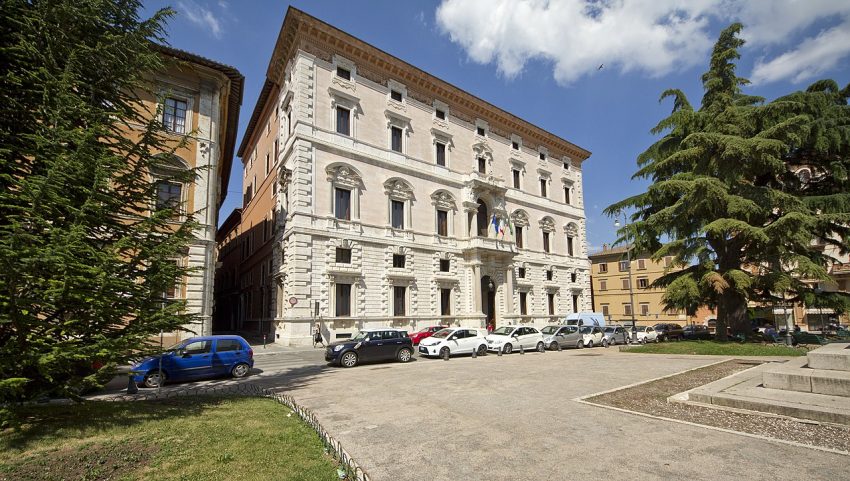
Arriving at Piazza Italia feels like emerging into the light after a journey through Perugia's buried past. You ride the escalators from the underground car park at Piazza Partigiani, pass through the massive Paolina Fortress, slip under the portico of the Government Palace (established in 1870), and suddenly step out into this broad, open square. Created to commemorate the events of 1860-1861 that led to the final unification of Italy, Piazza Italia symbolises the rebirth of the nation and the city's shift from fortress town to modern regional capital, making it one of the top attractions in Perugia for history minded travellers.
Around the square stand elegant 19th century buildings that rose after the demolition of the Paolina Fortress in 1861: the Albergo Brufani from 1880, the Bank of Italy from 1871, the Cesaroni Palace from 1897 and a residential condominium of 1872, the last two designed by Perugian architect Guglielmo Calderini, who also created Rome's Palace of Justice. Alongside them are older landmarks such as La Rosetta Hotel, dating back to 1716, and the 1724 Donini Palace with its magnificent frescoes. At the centre of the green space, a bronze statue of King Victor Emmanuel II, erected in 1890, anchors the square and underlines its role in celebrating Italian unity, making Piazza Italia a highlight of any walking tour of Perugia.
Table of Contents
- History and Significance of the Piazza Italia
- Things to See and Do in the Piazza Italia
- How to Get to the Piazza Italia
- Practical Tips on Visiting the Piazza Italia
- Where to Stay close to the Piazza Italia
- Is the Piazza Italia Worth Visiting
- FAQs for Visiting Piazza Italia
- Nearby Attractions to the Piazza Italia
History and Significance of the Piazza Italia
Piazza Italia sits directly above what was once part of the Paolina Fortress, the 16th century stronghold that dominated Perugia both physically and politically. In 1861, after the events that brought the city into the newly unified Kingdom of Italy, much of the fortress was demolished. The decision to construct a new square here was as symbolic as it was practical: tearing down the bastions of papal control and replacing them with an open civic space celebrating national unity.
The square was laid out specifically to commemorate the events of 1860-1861 that led to Italian unification, turning this high point on Perugia’s southern edge into a kind of terrace over the reborn nation. From its balustrades you look out over the valley and the Umbrian hills, a panorama that reinforces the sense of stepping into a more open, outward looking era. The Government Palace, completed in 1870 and reached via the portico you pass under coming up from Piazza Partigiani, adds another layer of symbolism, placing civic authority exactly where the old fortress once projected papal power.
Around the edges, a ring of late 19th century buildings defines the look of Piazza Italia. The Bank of Italy (1871) and the Albergo Brufani (1880) speak to Perugia's growing economic and touristic ambitions, while the Cesaroni Palace (1897) and the residential condominium (1872), both by Guglielmo Calderini, showcase a confident local architectural language from the same mind that designed Rome's Palace of Justice. Older structures like La Rosetta Hotel (1716) and Palazzo Donini (1724) with its splendid frescoes bridge the gap between the Baroque city and its new national role, tying the square's story back into the longer history of Perugia.
Things to See and Do in the Piazza Italia
A visit to Piazza Italia is as much about movement as it is about what you see when you arrive. Start at Piazza Partigiani and take the escalators through the remains of the Paolina Fortress, paying attention to the thick walls and vaulted spaces you glide past. Emerging under the portico of the Government Palace, you step into a deliberately framed perspective: the square opening before you, the valley beyond and the ring of 18th and 19th century buildings around you.
Once in the square, take a slow circuit to pick out its architectural players. On one side stands the Albergo Brufani, opened in 1880 and long one of Perugia's grand hotels, its façade reflecting the city's late 19th century aspirations to attract visitors and dignitaries. Nearby is the Bank of Italy building from 1871, a reminder that this was not just a symbolic space but also a financial and administrative hub. Seek out the Cesaroni Palace and the 1872 residential condominium, both designed by Guglielmo Calderini; knowing that he went on to design the Palace of Justice in Rome adds a touch of national context to their otherwise local presence.
Do not miss the older La Rosetta Hotel, founded in 1716, and Palazzo Donini from 1724, whose interior frescoes are among the city’s most refined. While you may not see the frescoes unless you join a special visit or event, just knowing they are there behind the façade enriches your sense of the square’s layered history. Finally, spend some time around the bronze statue of King Victor Emmanuel II in the central garden, erected in 1890. Its placement and date make clear that this is a place of memory for the unification of Italy, not just a traffic free viewpoint. Sit on a bench, look out over the balustrade and let the relationship between fortress, government, hotels and valley sink in.
How to Get to the Piazza Italia
Most visitors reach Perugia via San Francesco d'Assisi - Perugia Airport or larger hubs such as Rome and Florence, then continue into the city by bus, train or car. For the best deals and a seamless booking experience, check out these flights to Perugia on Booking.com. From the local airport, shuttle buses and taxis bring you to the lower part of town, where you can connect with local services up to the historic centre.
If you arrive by train, Perugia’s main station in the valley is served by regional and intercity lines.Use Omnio to easily compare schedules, book train tickets, and find the best prices all in one place for a hassle-free journey across Italy. From there, take the minimetro or a city bus up to the hilltop; Piazza Italia is one of the first major open spaces you will encounter once you enter the historic centre and is well signposted from central drop off points.
Travelling by car, follow the main routes into Perugia and park in one of the multi storey or terrace car parks around the historic core, such as those near Piazza Partigiani.If you are looking to rent a car in Italy I recommend having a look at Discover Cars, first, as they compare prices and review multiple car rental agencies for you. From the car park, follow the escalator system up through the Paolina Fortress and under the Government Palace portico; you will emerge directly into Piazza Italia, making the approach part of the experience.
Practical Tips on Visiting the Piazza Italia
- Suggested tips: Use Piazza Italia as your starting or ending point for exploring Perugia, since the escalators, views and central location make it a natural hub for walking routes.
- Best time to visit: Early evening is particularly atmospheric, with softer light over the valley and the buildings around the square gently lit; mornings are quieter if you want to photograph façades without too many people.
- Entrance fee: The square, viewpoints and access via the escalators are free.
- Opening hours: Piazza Italia is open at all hours as a public square.
- How long to spend: Plan 20-40 minutes to enjoy the square, read any plaques, admire the buildings and linger at the viewpoints, longer if you combine it with nearby palaces or a coffee stop.
- Accessibility: The escalators from Piazza Partigiani and the relatively level surface of the square make it one of the more accessible parts of the historic centre, though some side streets can still be sloping or cobbled.
- Facilities: The area around Piazza Italia has cafés, hotels, banks and shops, as well as public transport links, making it a practical place to pause, orient yourself and plan the rest of your day.
- Photography tip: Shoot from the balustrade towards the valley for wide landscapes, then turn back to frame the statue of Victor Emmanuel II against the façades of Albergo Brufani and the other 19th century buildings.
- Guided tours: Many city walking tours either start or finish here because of the escalator access and views; joining one can help you connect the square's unification story to Perugia's older layers at Rocca Paolina and Piazza IV Novembre.
- Nearby food options: The hotels and streets adjoining Piazza Italia are dotted with cafés and restaurants, ideal for a coffee on arrival from the escalators or an aperitivo as the sun sets over the valley.
Where to Stay close to the Piazza Italia
If you want to be right at the gateway to Perugia's historic centre, Piazza Italia is an excellent area to stay. A classic choice is Sina Brufani, the grand hotel overlooking the valley, which places you steps away from the square, the escalators and Rocca Paolina. For a long established option with historic character nearby, La Rosetta offers a traditional stay directly on or just off the square, ideal if you like being in the middle of things. If you prefer something slightly tucked away but still very close, Hotel Fortuna lies a short walk from Piazza Italia and gives you easy access to both the square and Corso Vannucci.
Is the Piazza Italia Worth Visiting
Piazza Italia is well worth including in your Perugia itinerary, especially if you are interested in how the city moved from fortress rule to a more open, unified national identity. The experience of riding the escalators through the Paolina Fortress, emerging under the Government Palace and stepping into a square framed by 18th and 19th century buildings tells that story almost wordlessly. With its statue of Victor Emmanuel II, grand hotels, palaces and far reaching views, Piazza Italia is one of the best places to visit in Perugia for understanding the modern chapter of the city's history and for orienting yourself before diving into its medieval streets.
What Other Travellers Say...

Rocca Paolina on Piazza Italia is a mid-16th‑century fortress turned cultural hub, offering an underground experience where former houses, streets and alleys have been absorbed into a compact, evocative subterranean “mini town.” Visitors describe dramatic stone arches, descending stairways and a theatrical atmosphere that reveals layers of the city; some note the entrance can be hard to find but mention an escalator access and that there is no entrance fee, making it an accessible, unusual place to explore beneath Perugia.


FAQs for Visiting Piazza Italia
Nearby Attractions to the Piazza Italia
- Rocca Paolina and the underground fortress: Directly below the square, with escalator access and atmospheric passages revealing Perugia's 16th century bastions.
- Corso Vannucci: The main pedestrian street of Perugia, leading from Piazza Italia into the heart of the historic centre with shops, cafés and historic buildings.
- Piazza IV Novembre and Fontana Maggiore: The city's central medieval square, dominated by the cathedral and the Palazzo dei Priori, a short walk from Piazza Italia.
- Palazzo dei Priori and National Gallery of Umbria: A Gothic civic palace housing one of Umbria's most important art collections, easily reached via Corso Vannucci.
- Perugia Aqueduct Walk: A scenic elevated path not far from the centre, offering atmospheric views over rooftops and the surrounding hills as a complement to the vistas from Piazza Italia.
The Piazza Italia appears in our Complete Guide to Visiting Perugia!

Moira & Andy
Hey! We're Moira & Andy. From hiking the Camino to trips around Europe in Bert our campervan — we've been traveling together since retirement in 2020!
This website uses affiliate links which may earn a commission at no additional cost to you!
Planning Your Visit
Piazza Italia is open at all hours as a public square.
The square, viewpoints and access via the escalators are free.
Nearby Attractions
- Rocca Paolina (0.1) km
Castle and Gallery - Civic Museum at Palazzo della Penna (0.1) km
Historic Building and Museum - Palazzo Baldeschi al Corso (0.2) km
Palace - Perugino Monument (0.2) km
Monument - Nobile Collegio del Cambio (0.3) km
Museum - Corso Vannucci (0.3) km
Street - Palazzo del Capitano del Popolo (0.3) km
Palace - National Gallery of Umbria (0.3) km
Gallery - Nobile Collegio della Mercanzia (0.3) km
Historic Building and Museum - National Archeological Museum of Perugia (0.3) km
Museum