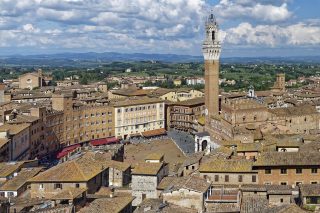
Palazzo Pretorio, Arezzo
Historic Building and Palace in Arezzo

Just steps from Piazza Grande, on Via dei Pileati, stands the stately Palazzo Pretorio, one of the top sights in Arezzo for those intrigued by the city's layered history. The palace's weathered stone façade, studded with carved coats of arms, reflects centuries of changing power and civic pride. Once the seat of the Captain of Justice, later a prison, and finally a museum, Palazzo Pretorio encapsulates Arezzo's transformation from a medieval stronghold into a city of art and culture.
The building's imposing exterior belies the complexity within. Formed by merging several medieval residences once belonging to noble families such as the Albergotti, Lodomeri, and Sassoli, the palace is a living record of Arezzo's architectural evolution. It's a highlight of any walking tour of Arezzo, drawing visitors who want to uncover the city's lesser-known yet deeply atmospheric corners.
History and Significance of Palazzo Pretorio
The story of Palazzo Pretorio begins in the 13th century when this part of Arezzo was occupied by prominent noble families. Over time, their separate houses were combined into one grand building that became the seat of the Capitano di Giustizia - the Captain of Justice - an important figure responsible for maintaining law and order in the city. In the early 15th century, the Municipality of Arezzo purchased the palace, converting it into a prison, a role it held for more than 500 years.
When the prison finally closed in 1926, the palace underwent extensive restoration led by local architect Giuseppe Castellucci. His vision was to restore the building's 16th-century character, stripping away later additions while preserving its historical integrity. The work was completed in 1934, and Palazzo Pretorio was reborn as the Medieval Museum of Arezzo, preserving the memory of the city's long and complex civic history.
The palace’s façade remains one of its most striking features. Dozens of carved coats of arms - symbols of the podestà and captains who governed from here since 1434 - adorn its stone surface. These emblems form a kind of sculpted chronicle, offering insight into the city’s political lineage. Inside, the restoration reveals Arezzo’s layered architectural history, with Gothic arches, stone vaults, and Renaissance courtyards all coexisting under one roof.
Things to See and Do in Palazzo Pretorio
Visitors to Palazzo Pretorio can explore a variety of fascinating spaces that bring Arezzo's medieval past vividly to life. On the ground floor, a small private chapel preserves traces of a fresco depicting the Annunciation, offering a delicate contrast to the building's austere stone walls. The northern side of the palace opens into a beautiful courtyard framed by a reconstructed loggia, rebuilt by Castellucci in the early 20th century to mirror its Renaissance appearance.
While the Medieval Museum once occupied the palace, its spirit lingers in the architecture and decorative details that still adorn the rooms. The building itself serves as a museum of history, where each stone tells part of Arezzo's story - from its days of justice and imprisonment to its rebirth as a cultural treasure. This spot is one of the best places to see in Arezzo for travelers who enjoy exploring authentic, less-touristed landmarks that reveal the city's civic and artistic identity.
How to Get There
Palazzo Pretorio is located about 100 meters from Piazza Grande, in the heart of Arezzo's historic centre. From Arezzo railway station, it’s a 10-15 minute uphill walk following signs toward Piazza Grande. For those arriving by car, parking is available at Parcheggio Pietri or Parcheggio Eden, both within walking distance. Its central location makes it easy to visit alongside other major landmarks such as the Basilica of San Francesco and the Cathedral.
Practical Tips on Visiting Palazzo Pretorio
- Best time to visit Palazzo Pretorio: Spring and autumn offer mild temperatures for walking and sightseeing.
- Entrance fee in Euros: Around 4-6 EUR when open for special exhibitions.
- Opening hours: Typically 10:00-18:00; hours may vary during exhibitions or restoration periods.
- Official website: www.discoverarezzo.com
- How long to spend: About 30-45 minutes to explore the courtyard, chapel, and façade.
- Accessibility: Ground floor accessible; upper levels reached by stairs only.
- Facilities: Restrooms available nearby in Piazza Grande.
- Photography tip: Capture the façade in morning light to highlight the carved coats of arms.
- Guided tours: Offered occasionally through the Arezzo tourist office, especially during museum events.
- Nearby food options: Cafés and trattorias around Piazza Grande serve Tuscan favourites with views of the square.
Is Palazzo Pretorio Worth Visiting?
Yes - Palazzo Pretorio is one of the things to do in Arezzo for those who want to explore the city's authentic medieval atmosphere. Its mix of architectural styles, civic symbolism, and quiet beauty makes it a fascinating stop just steps from the city's main square. Though less famous than the Basilica of San Francesco or Casa Vasari, it offers a unique perspective on Arezzo's governance and artistic evolution, rewarding visitors who appreciate history in its most tangible form.
Nearby Attractions to Palazzo Pretorio
- Piazza Grande - Arezzo's most beautiful square, surrounded by arcades and Renaissance buildings.
- Basilica of San Francesco - Home to Piero della Francesca's masterpiece, The Legend of the True Cross.
- Arezzo Cathedral - A striking Gothic church with frescoes and stained glass by Renaissance masters.
- Palazzo della Fraternita dei Laici - An architectural gem housing civic art and a historic astronomical clock.
- Casa Vasari - The painter Giorgio Vasari's home, decorated with his own frescoes and personal designs.
What Other Travellers Say...

Pretorio Palace on Via dei Pileati in Arezzo is a striking historic complex that now houses the city library and previously hosted a medieval museum; visitors note its impressive façade decorated with numerous coats of arms, carved frames and an inner courtyard with grass where you can sit and take in the atmosphere, and many find it an interesting, pleasant place to visit.


The Palazzo Pretorio appears in our Complete Guide to Visiting Arezzo!

Moira & Andy
Hey! We're Moira & Andy. From hiking the Camino to trips around Europe in Bert our campervan — we've been traveling together since retirement in 2020!
This website uses affiliate links which may earn a commission at no additional cost to you!
Planning Your Visit
Nearby Attractions
- Palazzo della Fraternita dei Laici (0.1) km
Museum and Palace - Fondazione Ivan Bruschi - Casa Museo dell'Antiquariato Ivan Bruschi (0.1) km
Museum - Church of Santa Maria della Pieve (0.1) km
Church - Piazza Grande (0.1) km
Square - Cathedral of Arezzo (0.2) km
Cathedral - Palazzo dei Priori in Arezzo (0.2) km
Palace - San Francesco Basilica (0.2) km
Church - Medici Fortress (0.3) km
Castle - Church of San Domenico (0.4) km
Church - Casa Vasari Museum (0.5) km
Museum