Doge's Palace, Venice
Palace in Venice
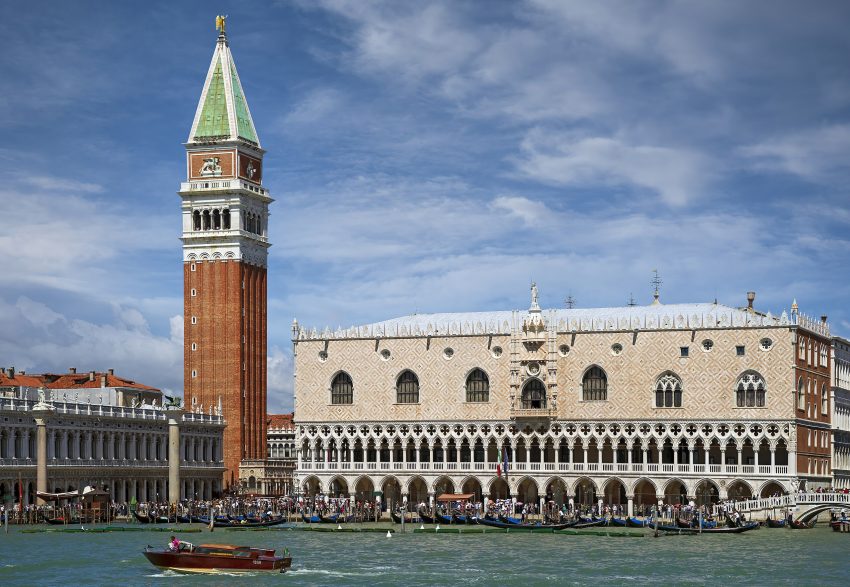
Doge's Palace (Palazzo Ducale) is Venice's grand stage of power: a Venetian Gothic masterpiece that once housed the Doge, the Republic's institutions, and the machinery of justice, all wrapped into one spectacular building on the edge of the lagoon. From the outside it's instantly recognisable-pink-and-white patterned stone, lace-like arcades, and a façade that looks almost delicate until you remember it was designed to project authority to the entire Mediterranean world.
Inside, the experience is part art gallery, part political thriller. You move through gilded state rooms and vast chambers built to impress ambassadors, then slip toward darker spaces-armouries, corridors of decision-making, and the prisons linked by the Bridge of Sighs. It's one of the best places to visit in Venice if you want a single stop that captures the city's beauty and its hard-edged history, and it fits perfectly into a walking tour of Venice because it sits right where the city's iconic sights converge.
Table of Contents
- History and Significance of the Doge’s Palace
- Things to See and Do in the Doge’s Palace
- How to Get to the Doge’s Palace
- Practical Tips on Visiting the Doge’s Palace
- Where to Stay Close to the Doge’s Palace
- Is the Doge’s Palace Worth Visiting?
- For Different Travelers
- FAQs for Visiting the Doge’s Palace
- Nearby Attractions to the Doge’s Palace
History and Significance of the Doge’s Palace
The story begins in the early medieval period, when Venice’s leaders established a ducal seat close to the basilica and the water, binding political power to religious symbolism and maritime identity. Over centuries, fires, expansions, and political reforms reshaped the palace, but the purpose remained consistent: this was the nerve centre of the Republic, where diplomacy, law, and state ceremony were staged with deliberate grandeur.
The major Gothic rebuilding that defines the palace today gathered pace in the 14th and 15th centuries, producing the famous “light above, strength below” effect: airy loggias and patterned stonework resting on a formidable structure that still feels like a fortress. Later Renaissance interventions refined key areas after destructive fires, but Venice made a telling decision as tastes changed-rather than “modernising” the palace into something classical, it preserved the Gothic identity that had become inseparable from the Republic's image.
After the fall of the Republic in 1797, the building's role shifted as Venice passed through successive regimes. In the 20th century it became a museum, transforming a working seat of power into a place where visitors can read the Republic's story through architecture, art, and the very rooms where decisions were once made.
Things to See and Do in the Doge’s Palace
Begin in the central courtyard, where the palace feels surprisingly calm compared with the bustle of St Mark's Square. It's the best place to appreciate the building's layered styles and the scale of the complex, and it sets you up for what comes next: rooms designed to overwhelm with prestige and symbolism.
The state rooms are the headline act. Look for ceilings that feel like paintings turned into architecture, immense canvases commissioned to glorify Venice, and the grand chambers where the Republic staged its authority. The Great Council spaces are especially memorable, not just for their size but for what they represent: governance performed as spectacle, with art as political messaging.
Then pivot to the darker edge of the experience: the armoury, corridors, and prisons. Crossing the Bridge of Sighs is a classic moment, but what lingers is the contrast-how quickly the palace shifts from luminous ceremony to controlled confinement, making the Republic's power feel complete rather than purely ornamental.
How to Get to the Doge’s Palace
The nearest airports are Venice Marco Polo Airport (VCE) and Treviso Airport (TSF), both with direct connections into Venice via bus and water transport links. For the best deals and a seamless booking experience, check out these flights to Venice on Booking.com.
By train, arrive at Venezia Santa Lucia station and continue on foot if you want a scenic first walk, or use the vaporetto to reach the St Mark’s area efficiently. Use Omnio to easily compare schedules, book train tickets, and find the best prices all in one place for a hassle-free journey across Italy.
Buses and airport shuttles typically terminate at Piazzale Roma, where you can either walk (longer but rewarding) or switch to vaporetto lines toward San Marco for the simplest route with luggage.
If you're travelling by car, you'll park at Piazzale Roma or Tronchetto and continue into Venice on foot or by vaporetto, since the historic centre is car-free. If you are looking to rent a car in Italy I recommend having a look at Discover Cars, first, as they compare prices and review multiple car rental agencies for you.
Practical Tips on Visiting the Doge’s Palace
- Entrance fee: Standard ticket €30 (reduced €15) until 31 December 2025; standard ticket €35 (reduced €15) from 1 January 2026. Online early-purchase pricing (30+ days ahead) is usually cheaper.
- Opening hours: (Summer) 1 April – 31 October: Daily: 09:00–19:00. Last admission 18:00. (Winter) 1 November – 31 March: Daily: 09:00–18:00. Last admission 17:00.
- Official website: http://www.palazzoducale.visitmuve.it/
- Best time to visit: Go at opening time or late afternoon to dodge the biggest tour waves, and aim for a weekday if you want calmer rooms for lingering over the paintings.
- How long to spend: Plan 2-3 hours for the main route at a comfortable pace, longer if you want to read the story panels and fully absorb the state rooms.
- Accessibility: Expect lots of walking and some historic constraints; if mobility is a concern, prioritise the main circuit and ask staff about the smoothest route through key rooms.
- Facilities: Bring water, use restrooms before you start the core circuit, and plan your meal either just before or after to avoid breaking your momentum inside.
Where to Stay Close to the Doge’s Palace
For a culture-heavy itinerary, the best base is San Marco or the lagoon-edge Castello streets so you can start early at the major sights and return easily between stops; if your priority is a quieter, more local feel with better-value dining, Cannaregio is often the smarter base while still keeping St Mark’s within reach.
For a classic “wake up next to the lagoon” splurge within an easy walk of the palace, Hotel Danieli delivers pure Venetian drama. If you want elegant comfort with a slightly calmer feel but still close to the action, Londra Palace Venezia is a strong pick for views and convenience. For a well-located, characterful stay near St Mark’s with easy access to shops and vaporetto stops, Hotel Saturnia & International works well for an on-foot itinerary.
Is the Doge’s Palace Worth Visiting?
Yes, even in a city overflowing with world-class sights. Doge's Palace isn't just “another beautiful building”-it's Venice's political heart made visible, where architecture and art were used as tools of statecraft, and where the Republic's glamorous public face sits uncomfortably close to its prisons and punishments.
It's also one of those rare attractions that stays interesting even when it's busy, because the scale and detail reward a slower pace. If you want one museum-ticket experience that genuinely explains Venice, this is the one to prioritise.
What Other Travellers Say...

Doge's Palace, on Piazza San Marco in Venice, is an ornate Gothic complex famed for lavish rooms, gilded ceilings and spectacular frescoes and paintings, with highlights including grand halls, an armoury and a weaponry collection; visitors say you should buy tickets in advance, allow two hours or more to explore, and consider a guided tour to learn the history, then continue on the narrow Bridge of Sighs to see the prison, with a café on site for a break.


For Different Travelers
Families with Kids
This can work brilliantly for families if you treat it as a story-driven visit rather than an art marathon. Frame it around “how Venice ran a whole republic,” then use vivid moments-secret corridors, the armoury, and the prison link-to keep attention high.
To make it manageable, pick a handful of must-sees and keep moving, saving long reading for later. A short break on the waterfront afterward helps reset energy before continuing with the rest of the day.
Couples & Romantic Getaways
For couples, the palace is at its best when you lean into the theatre: gilded rooms, sweeping views near the lagoon, and that slightly eerie shift into the prison spaces. It’s a shared experience that sparks conversation, especially if you take your time in the most spectacular chambers rather than rushing for photos.
Pair it with a slow evening walk along Riva degli Schiavoni or a vaporetto ride at dusk. The palace gives you the “big hit” of Venice, and the waterfront gives you the softer, romantic afterglow.
Budget Travelers
This is a paid sight, but it can still be excellent value if you treat it as your main “big ticket” museum day and build the rest around free experiences. Combine it with wandering St Mark’s area, crossing into quieter lanes, and enjoying lagoon views that cost nothing.
If you want to keep costs controlled, plan ahead so you’re not adding multiple extra paid add-ons on the day. One well-chosen ticket here can replace several smaller museum entries elsewhere.
History Buffs
History lovers should go beyond the headline rooms and read the palace as a machine of government. Watch how art reinforces political legitimacy, how spaces funnel crowds and dignitaries, and how the justice system was physically integrated into the same complex that staged state grandeur.
If you can, add a specialised itinerary that reveals behind-the-scenes rooms and a more procedural side of Venetian governance. It deepens the visit from “beautiful” to genuinely revealing.
FAQs for Visiting the Doge’s Palace
Getting There
Tickets & Entry
Visiting Experience
Tours, Context & Itineraries
Photography
Accessibility & Facilities
Nearby Attractions to the Doge’s Palace
- St Mark's Basilica: Venice's most famous church, packed with mosaics and symbolism that pairs perfectly with the palace next door.
- St Mark's Campanile: The best “big picture” viewpoint for seeing Venice's rooftops and the lagoon's scale in one sweep.
- Bridge of Sighs viewpoint: A classic exterior angle where you can photograph the link between palace and prisons from the waterfront.
- Museo Correr: A strong companion museum for understanding Venice's civic identity, art, and daily life beyond the palace.
- Biblioteca Marciana Monumental Rooms: An elegant, quieter stop for architecture and atmosphere right on the edge of St Mark's Square.
The Doge's Palace appears in our Complete Guide to Visiting Venice!

Moira & Andy
Hey! We're Moira & Andy. From hiking the Camino to trips around Europe in Bert our campervan — we've been traveling together since retirement in 2020!
This website uses affiliate links which may earn a commission at no additional cost to you!
Planning Your Visit
(Summer) 1 April - 31 October: Daily: 09:00-19:00. Last admission 18:00.
(Winter) 1 November - 31 March: Daily: 09:00-18:00. Last admission 17:00.
Standard ticket €30 (reduced €15) until 31 December 2025; standard ticket €35 (reduced €15) from 1 January 2026. Online early-purchase pricing (30+ days ahead) is usually cheaper.
Nearby Attractions
- Bridge of Sighs (0.1) km
Bridge - Piazzetta di San Marco (0.1) km
Square - Biblioteca Marciana (0.1) km
Historic Building and Library - Basilica di San Marco (0.1) km
Basilica - St Mark's Campanile (0.1) km
Tower - Piazzetta dei Leoncini (0.2) km
Square - St Mark's Square (0.2) km
Square - St Mark’s Clock Tower (0.2) km
Tower - Caffè Florian (0.2) km
Café - Procuratie Nuove (0.2) km
Historic Building


