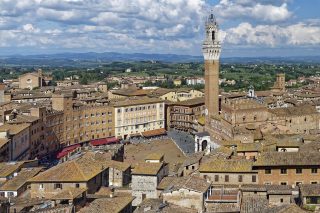
Palazzo della Fraternita dei Laici, Arezzo
Museum and Palace in Arezzo

Dominating the sun-drenched Piazza Grande, the Palazzo della Fraternita dei Laici is one of the must-see places in Arezzo, blending architectural elegance with centuries of civic service. Its harmonious mix of Gothic and Renaissance design tells the story of a city that valued both faith and intellect, while the building itself continues to embody Arezzo's humanitarian spirit. Since its foundation in the 14th century, the palace has been home to the Fraternita dei Laici, a lay brotherhood dedicated to charity and culture that still operates today.
Beyond its architectural beauty, the palace holds treasures that reveal the city's long-standing commitment to art, learning, and community. From the Aristotelian-Ptolemaic clock that crowns its façade to the sculptures and artworks housed inside, every corner of the Palazzo della Fraternita dei Laici reflects Arezzo's Renaissance brilliance. It's a highlight of any walking tour of Arezzo, offering both grandeur and depth in equal measure.
Table of Contents
- History and Significance of Palazzo della Fraternita dei Laici
- Things to See and Do in Palazzo della Fraternita dei Laici
- How to Get There
- Practical Tips on Visiting Palazzo della Fraternita dei Laici
- Is Palazzo della Fraternita dei Laici Worth Visiting?
- Nearby Attractions to Palazzo della Fraternita dei Laici
History and Significance of Palazzo della Fraternita dei Laici
Construction of the Palazzo della Fraternita dei Laici began in 1375, with the building's evolution stretching over nearly two centuries. The façade was completed between 1550 and 1560, crowned by a unique astronomical clock designed in 1552 by Felice di Salvatore Vannucci. This clock, still in operation today, displays lunar phases - an ingenious example of Renaissance engineering that has fascinated visitors for centuries. Later architectural additions, including the section designed by Giorgio Vasari, strengthened the palace's connection to Arezzo's artistic elite.
The Fraternita dei Laici itself predates the palace, having been founded in 1262 as a charitable institution that cared for the city’s poor and sick. By the 18th century, it had expanded its role to include education and culture, leading to the opening of the palace library in 1781 under the patronage of Grand Duke Pietro Leopoldo di Lorena. The building thus represents both civic virtue and artistic ambition - a perfect encapsulation of Arezzo’s identity through the ages.
Things to See and Do in Palazzo della Fraternita dei Laici
Inside, visitors can explore a remarkable collection of artworks and historical objects spanning the 14th to 19th centuries. The palace museum, known as the Fraternita Palace Museum, displays paintings, sculptures, antique furniture, and archival materials acquired through donations and bequests over the centuries. The collection offers a fascinating glimpse into Arezzo's evolving artistic and social life.
Among the highlights is the sculptural group depicting the Madonna della Misericordia, Saints Lorentino and Pergentino - patrons of the Fraternity - alongside Saint Donatus and Pope Gregory X, protectors of Arezzo. This ensemble, crafted by the talented Renaissance sculptor Bernardo Rossellino, perfectly conveys the sense of civic devotion that defines the institution. Visitors can also see the original painting of Christ by Spinello Aretino, once displayed above the palace's central portal and now preserved in the National Museum of Medieval and Modern Art.
The palace's architecture is equally captivating. From the balcony overlooking Piazza Grande, visitors can appreciate not only the geometric precision of Vasari's later additions but also the unique astronomical clock - a symbol of Arezzo's blend of art and science. This spot is one of the best places to see in Arezzo for those interested in the city's humanist legacy and the intersection of religion, art, and civic life.
How to Get There
Palazzo della Fraternita dei Laici is located on Piazza Grande, the historic heart of Arezzo. It's about a 15-minute walk from Arezzo railway station, following Via Guido Monaco and Via Giorgio Vasari into the old town. For those arriving by car, parking is available at Parcheggio Pietri or Parcheggio Eden, from which it's an easy uphill walk to Piazza Grande. As one of the top attractions in Arezzo, the palace is often visited on walking tours of the city that include the Basilica of San Francesco and the Cathedral.
Practical Tips on Visiting Palazzo della Fraternita dei Laici
- Best time to visit Palazzo della Fraternita dei Laici: Spring and early autumn for pleasant weather and fewer crowds.
- Entrance fee in Euros: Around 6-8 EUR; combination tickets may include nearby museums.
- Opening hours: Typically 10:00-18:00; closed on Mondays.
- Official website: www.discoverarezzo.com
- How long to spend: Around 1 hour to explore the museum and architecture.
- Accessibility: Main galleries are accessible; upper floors may require climbing stairs.
- Facilities: Restrooms, gift shop, and guided tour services available.
- Photography tip: Capture the palace’s façade in the late afternoon when sunlight enhances its golden stone.
- Guided tours: Offered by the Arezzo tourism office, often in conjunction with Piazza Grande visits.
- Nearby food options: Cafés and trattorias around Piazza Grande serve traditional Tuscan cuisine with outdoor seating.
Is Palazzo della Fraternita dei Laici Worth Visiting?
Absolutely. The Palazzo della Fraternita dei Laici is not only one of the things to do in Arezzo but also a living symbol of the city's civic and artistic heritage. Its fascinating blend of Gothic and Renaissance styles, coupled with its museum collections and functioning astronomical clock, make it a place where art, science, and history come together beautifully. Whether you come for the architecture, the sculptures, or simply the view over Piazza Grande, the palace offers a rewarding and authentic experience of Arezzo's cultural soul.
Nearby Attractions to Palazzo della Fraternita dei Laici
- Basilica of San Francesco - Home to Piero della Francesca's celebrated fresco cycle, The Legend of the True Cross.
- Arezzo Cathedral - A stunning Gothic church with Renaissance frescoes by Piero della Francesca.
- Church of San Domenico - Famous for Cimabue's wooden Crucifix and peaceful atmosphere.
- Casa Vasari - The Renaissance painter's own home, beautifully decorated by his hand.
- Bruni Ciocchi Palace - Houses the Municipal Picture Gallery with masterpieces from the Middle Ages to the 19th century.
What Other Travellers Say...

Palazzo della Fraternita dei Laici on Via Giorgio Vasari houses a small municipal museum and a working rooftop clock tower; visitors praise the rooftop terrace for its views over Piazza Grande and surrounding town, though some find the museum modest and note the stairs to the terrace can be hard to spot (follow the route past the ticket checker to reach the upper level), while others mention occasional disputes over admission policies.


The Palazzo della Fraternita dei Laici appears in our Complete Guide to Visiting Arezzo!

Moira & Andy
Hey! We're Moira & Andy. From hiking the Camino to trips around Europe in Bert our campervan — we've been traveling together since retirement in 2020!
This website uses affiliate links which may earn a commission at no additional cost to you!
Planning Your Visit
Every day / 10.30am - 6.00pm
€ 5,00
Nearby Attractions
- Piazza Grande (0.1) km
Square - Church of Santa Maria della Pieve (0.1) km
Church - Palazzo Pretorio (0.1) km
Historic Building and Palace - Fondazione Ivan Bruschi - Casa Museo dell'Antiquariato Ivan Bruschi (0.1) km
Museum - Cathedral of Arezzo (0.2) km
Cathedral - Palazzo dei Priori in Arezzo (0.2) km
Palace - San Francesco Basilica (0.3) km
Church - Medici Fortress (0.3) km
Castle - Church of San Domenico (0.5) km
Church - Casa Vasari Museum (0.5) km
Museum