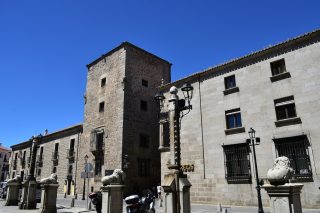
Palacio de Monterrey, Salamanca
Palace in Salamanca

The Palacio de Monterrey is one of Salamanca's most elegant “stop-you-in-your-tracks” buildings, set on Plaza de Monterrey just a short stroll from the university streets and the old town's main lanes. Built in the 16th century for the III Count of Monterrey and still linked to the House of Alba today, it's a compact masterclass in Salamanca's Plateresque taste-ornate without feeling fussy, formal without feeling cold. It's one of the top attractions in Salamanca for travelers who love architecture that rewards slow looking.
Even if you come for the façade, the visit quickly becomes about the details: the square plan that feels disciplined and aristocratic, the four towers that add a fortress-like edge, and the chimneys and carved animals that give the roofline personality. It also slots naturally into a walking tour of Salamanca because it sits right where you're likely to be wandering anyway, between monumental sights and everyday streets.
Table of Contents
- History and Significance of the Palacio de Monterrey
- Things to See and Do in the Palacio de Monterrey
- Practical Tips on Visiting the Palacio de Monterrey
- Where to Stay Close to the Palacio de Monterrey
- Is the Palacio de Monterrey Worth Visiting?
- For Different Travelers
- FAQs for Visiting Palacio de Monterrey
- Nearby Attractions to the Palacio de Monterrey
History and Significance of the Palacio de Monterrey
The Palacio de Monterrey belongs to Salamanca's golden architectural vocabulary, when noble families used stonework and symbolism to project influence as clearly as any written document. The palace's later fame is part of the story too: it was widely admired in the 19th century, inspiring a wave of imitation that helped shape what people now call the Monterrey or Neo-Plateresque look. In other words, this building didn't just reflect a style-it helped define how that style was remembered.
Its layout underlines that mix of prestige and purpose. The palace is organized around a disciplined square plan, extended toward the rear with two parallel wings, and built up across three floors with four commanding towers that anchor the silhouette. From the plaza, it reads as both aristocratic residence and urban stronghold, which is exactly the late-medieval-to-Renaissance message: cultivated power, well defended.
Today, the palace’s significance is also practical and cultural. Rather than feeling like a sealed-off relic, it’s visited through carefully structured routes-often with an audioguide and, at times, guided tours-so the building’s history can be understood through its spaces rather than just admired from a distance.
Things to See and Do in the Palacio de Monterrey
Start outside and give the façade your full attention before you go in. The upper gallery, with its arcades and medallions, is the kind of feature you can photograph in seconds but appreciate for much longer once you notice how it balances symmetry with ornament. The towers and chimneys-decorated with lions and fantastical creatures-are worth a second look too, because they add a playful edge to an otherwise stately exterior.
Inside, the best approach is to move slowly and let the palace “build” its story room by room. Plateresque architecture is as much about framing-doorways, staircases, thresholds-as it is about big rooms, so pay attention to how spaces connect and how the building directs your gaze. If you opt for a guided tour, it tends to bring out the human layer: who lived here, how the palace functioned, and what details you might otherwise skim past.
Finally, treat the palace as a contrast stop in your day. After churches, cloisters, and university halls, Monterrey gives you a different Salamanca: noble, domestic, and designed to impress through craftsmanship rather than sheer scale.
Practical Tips on Visiting the Palacio de Monterrey
- Entrance fee: Self-guided visit with audioguide €7. Guided tour €10 (Tue–Fri) / €12 (Sat–Sun).
- Opening hours: (Summer: April to October) Tuesday–Sunday 10:30–14:30 and 16:00–20:00 (Winter: November to March) Tuesday–Thursday 10:30–14:30; Friday–Sunday 10:30–14:30 and 16:00–18:00 Closed Mondays (except public holidays). Free visit: Tuesday 10:30–11:00 (advance online booking required).
- Official website: https://www.palaciodemonterrey.com/
- Best time to visit: Late morning is ideal for a calm, unhurried visit, while late afternoon works well if you want softer light on the façade before and after you go inside.
- How long to spend: Plan 60-90 minutes for the self-guided route, or closer to 90-120 minutes if you want a guided tour and time to linger over exterior details.
- Accessibility: Expect stairs and historic surfaces; this is best treated as a step-heavy visit, so check the official site if you need the most accessible route options.
- Facilities: Facilities are limited compared with large museums, so plan your longer breaks around nearby cafés and the university quarter, where options are abundant.
Where to Stay Close to the Palacio de Monterrey
For a culture-heavy itinerary, base yourself in the Old Town near Plaza Mayor and the university/cathedral quarter so you can walk to the main sights with minimal detours; if your focus is nightlife and evening atmosphere, stay close to Plaza Mayor so you can keep the late hours effortless without relying on taxis.
A strong, heritage-forward option nearby is NH Collection Salamanca Palacio de Castellanos, which keeps you in the historic core with an easy walk to Monterrey and the cathedral area. For a quieter boutique stay with a more tucked-away feel, Hotel Rector is well placed for scenic walks and a calmer return at night. If you want to be right by the city’s social heart for evening tapas and late strolls, Catalonia Plaza Mayor Salamanca is a practical, central base.
Is the Palacio de Monterrey Worth Visiting?
Yes, particularly if you enjoy architecture that communicates status through detail rather than sheer size. Monterrey is a palace you can “read”: towers that signal power, ornament that signals wealth, and a façade that rewards anyone willing to look beyond the first photo.
It’s also a very efficient visit. You don’t need a full day or a deep specialist background to get something meaningful from it, and because it sits so centrally, it’s easy to fit into a wider old-town loop without backtracking.
If you're choosing between several paid interiors, Monterrey stands out for its distinctive Plateresque identity and the fact that it offers a noble-house perspective on Salamanca-different in tone from the university and cathedral visits, and complementary rather than repetitive.
What Other Travellers Say...

Monterrey's palace at Pl. de Monterrey, 2 in Salamanca is a well‑preserved Renaissance palace dating from around 1500 that now operates as a museum tied to the Alba family; visitors praise its ornate exterior and impressive interiors, note that visits often involve an audio or taped guided tour (with occasional guided tours on set days), that photography is restricted inside except from the top of the tower, and that tours can take around 45–60 minutes and include stairs — check opening times and pay an entry fee before visiting.


For Different Travelers
Families with Kids
For families, Monterrey works best when you make the visit a visual hunt rather than a long history lesson. The towers, the animal details on chimneys, and the strong geometric shapes give kids something concrete to look for, which makes the palace feel like a discovery rather than a formal museum.
Keep the pacing flexible by treating the interior route as “as long as interest lasts,” then rewarding the effort with a snack stop nearby in the university streets or Plaza Mayor. Salamanca is compact, so it's easy to balance one structured visit with plenty of outdoor wandering.
Couples & Romantic Getaways
For couples, the Palacio de Monterrey is a refined, unhurried stop that feels especially good as part of a slow day of wandering. The building is elegant without being overwhelming, and the plaza setting makes it easy to pause, take in the façade, and move on at your own rhythm.
Pair it with late afternoon light and an evening stroll toward Plaza Mayor. The palace adds a sense of “old Salamanca” glamour to the day, and it's a satisfying contrast to the livelier squares and tapas routes later on.
Budget Travelers
Budget travelers can still enjoy Monterrey even if they choose not to go inside, because the exterior is genuinely one of Salamanca’s best architectural sights. If you do pay for one or two interiors in the city, Monterrey is a good candidate because it’s distinctive and central, reducing the chance you’ll feel it was “just another building.”
Build the rest of the day around free highlights: façades, courtyards you can see from public spaces, and long walks through the old town. Salamanca’s best atmosphere is outdoors, and Monterrey fits neatly into that style of sightseeing.
History Buffs
History-focused travelers will appreciate Monterrey as a statement of noble identity and urban power rather than purely decorative architecture. The palace sits at the intersection of lineage, politics, and image-making, where carving and layout mattered because they communicated authority in public space.
A guided tour is often the best choice if you want that context to land clearly, because it connects the building’s features to the people behind them. Even without a guide, the palace rewards close looking if you enjoy interpreting symbols, coats of arms, and the message a façade is trying to send.
FAQs for Visiting Palacio de Monterrey
Getting There
Tickets & Entry
Visiting Experience
Tours, Context & Itineraries
Photography
Food & Breaks Nearby
Safety & Timing
Nearby Attractions to the Palacio de Monterrey
- Plaza Mayor: Salamanca's grand Baroque square, best for evening atmosphere and a relaxed tapas circuit.
- University of Salamanca: The famous historic façade and courtyards at the heart of the city's academic identity.
- Casa de las Conchas: A shell-covered mansion that's quick to visit and perfectly placed on an old-town loop.
- Cathedral of Salamanca: Two adjoining cathedrals that showcase the city's layered Romanesque-to-Baroque story.
- Convento de San Esteban: A monumental convent with an impressive façade and a quieter, reflective interior mood.
The Palacio de Monterrey appears in our Complete Guide to Visiting Salamanca!

Moira & Andy
Hey! We're Moira & Andy. From hiking the Camino to trips around Europe in Bert our campervan — we've been traveling together since retirement in 2020!
This website uses affiliate links which may earn a commission at no additional cost to you!
Planning Your Visit
(Summer: April to October) Tuesday-Sunday 10:30-14:30 and 16:00-20:00
(Winter: November to March) Tuesday-Thursday 10:30-14:30; Friday-Sunday 10:30-14:30 and 16:00-18:00
Closed Mondays (except public holidays).
Free visit: Tuesday 10:30-11:00 (advance online booking required).
Self-guided visit with audioguide €7. Guided tour €10 (Tue-Fri) / €12 (Sat-Sun).
Nearby Attractions
- Convento de la Purísima - Las Agustinas (0.1) km
Church, Convent and Historic Building - Parroquia de la Anunciación del Señor (0.1) km
Church and Religious Building - Church of Saint Benedict (FSSPX) (0.1) km
Church, Historic Building and Religious Building - Capilla de la Vera Cruz (0.2) km
Church, Historic Building and Religious Building - Iglesia de San Martín de Tours (0.2) km
Church, Historic Building and Religious Building - Plaza Mayor (0.2) km
Square - Casa de las Conchas (0.3) km
Historic Building - La Clerecía (0.3) km
- Salamanca Central Market (0.3) km
Market - Salina Palace (0.3) km
Palace