Nine Holy Cannons, Hue
Historic Site in Hue
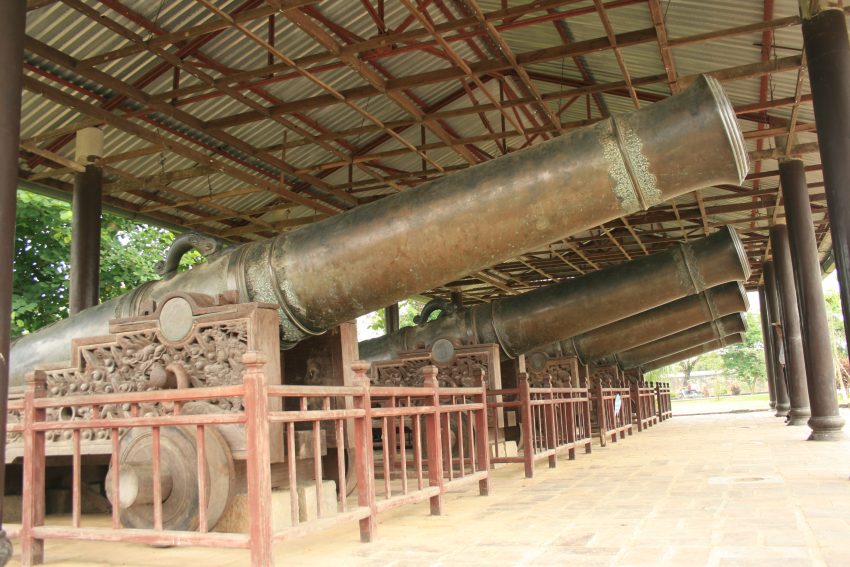
The Nine Holy Cannons, or Cửu Vị Thần Công, stand proudly beside Hue's Flag Tower, forming one of the most distinctive landmarks within the Imperial City landscape. Cast between 1803 and 1804 under Emperor Gia Long, these enormous bronze weapons were created not for war but as protective symbols embodying imperial authority. Their immense size, intricate details, and storied origins make them one of the top attractions in Hue.
Each cannon is an extraordinary work of art. Measuring over five metres in length and weighing around 17,000 pounds, they represent the four seasons and the five elements-Spring, Summer, Autumn, Winter, Wood, Fire, Earth, Metal, and Water. Their inscriptions, decorative motifs, and finely crafted forms reflect a sophisticated level of artistry rarely matched in Vietnamese bronze work. Recognised nationally as a treasure of Vietnam, the Nine Holy Cannons offer a compelling blend of symbolic power and craftsmanship.
Table of Contents
- History and Significance of Nine Holy Cannons
- Things to See and Do in Nine Holy Cannons
- How to Get to Nine Holy Cannons
- Practical Tips on Visiting Nine Holy Cannons
- Where to Stay close to Nine Holy Cannons
- Is Nine Holy Cannons Worth Visiting?
- FAQs for Visiting Nine Holy Cannons
- Nearby Attractions to Nine Holy Cannons
History and Significance of Nine Holy Cannons
Commissioned by Emperor Gia Long shortly after his victory over the Tay Son Dynasty, the cannons were cast from bronze weapons and utensils collected during the conflict. Their creation symbolised unity, restored order, and the dawn of a new imperial era under the Nguyen Dynasty. The casting process began on January 31, 1803, and involved loyal commanders whose virtues were explicitly associated with the success of this prestigious mission.
Originally placed at the Moon Gate, the primary entrance to the Imperial City, the cannons played a ceremonial role as guardians of the fortress. Although they appear formidable, they were designed exclusively as symbolic protectors rather than functional artillery. Their inscriptions, titles, and detailed engravings commemorate both the conflict with the Tay Son and the triumph of the early Nguyen rulers.
In 1917, during Emperor Khai Dinh’s reign, the cannons were relocated to their current positions flanking the Flag Tower. Their prominent placement underscores their importance as visual emblems of Hue’s historic and cultural identity. When they were designated a National Treasure in 2012, it reinforced their significance not just as artistic achievements but as enduring markers of national heritage.
Things to See and Do in Nine Holy Cannons
Visitors can walk along the platforms on either side of the Flag Tower to view the cannons up close. Their sheer scale becomes more impressive the closer you get, with the bronze surfaces still showing beautiful patina from centuries of exposure. Observing the cannons in sequence reveals the symbolic order of the four seasons and five elements, offering insight into Nguyen cosmology.
The engraved inscriptions, decorative floral motifs, and qilin-inspired head straps are worth examining in detail. Their craftsmanship represents a pinnacle in Vietnamese bronze casting, blending symbolism with technical skill. The wooden stands and iron braces, though simple, highlight the functional design that allowed these ceremonial cannons to rotate much like real artillery.
From the cannon platforms, visitors also have excellent views of the Flag Tower and surrounding citadel walls. The area offers one of the best perspectives for understanding the defensive layout of the Imperial City, especially when combined with a later walk toward the Noon Gate or the riverfront.
How to Get to Nine Holy Cannons
Phu Bai International Airport is the nearest airport to Hue and lies about 16 kilometres from the city centre. For the best deals and a seamless booking experience, check out these flights to Hue on Booking.com. It offers domestic connections from major cities such as Hanoi and Ho Chi Minh City.
Hue Railway Station, only a short distance from the Imperial City, provides convenient train services linking Hue with Da Nang, Hanoi, and Ho Chi Minh City. Train schedules and bookings can be found on Omio. It is an easy ride from the station to the Flag Tower area where the cannons are located.
Travelling by car is straightforward, with nearby parking areas outside the citadel walls. Once inside the Imperial City precinct, the Nine Holy Cannons can be reached on foot by following the paths toward the Flag Tower.
Practical Tips on Visiting Nine Holy Cannons
- Suggested tips: Visit early or late in the day to avoid the heat, as the area around the Flag Tower offers little shade.
- Best time to visit: Morning or late afternoon when the light is ideal for photography.
- Entrance fee: Viewable from outside, but accessing the surrounding area is included in the Imperial City ticket.
- Opening hours: Typically 8:00-17:30 for the Imperial City precinct.
- How long to spend: Around 15-30 minutes, depending on your interest in the details.
- Accessibility: Mostly accessible, though some steps and uneven stone surfaces may require caution.
- Facilities: Nearby restrooms and small shops are available within the Imperial City area.
- Photography tip: Capture the cannons with the Flag Tower rising behind for a dramatic historical composition.
- Guided tours: Many tours include the cannons as an introductory highlight before exploring the main citadel.
- Nearby food options: Restaurants and cafés near the main gates offer convenient dining options.
Where to Stay close to Nine Holy Cannons
Staying nearby offers easy access to both the cannons and the wider Imperial City. The elegant Azerai La Residence provides a refined riverside experience just a short distance away. For a boutique option, Le Domaine de Cocodo offers personalised service and comfortable rooms close to the historic district. Travellers seeking charm and convenience might also enjoy Villa Hue, known for its peaceful gardens and proximity to the city’s cultural highlights.
Is Nine Holy Cannons Worth Visiting?
The Nine Holy Cannons are absolutely worth visiting, especially for travellers interested in history, symbolism, and the artistic achievements of the Nguyen Dynasty. Their monumental scale, exquisite craftsmanship, and strategic location near the Flag Tower make them one of the most impressive outdoor features of the Imperial City. Whether you're exploring the area independently or as part of a tour, they provide a compelling introduction to Hue's rich imperial past.
What Other Travellers Say...

Nine Holy Cannons, located inside the Citadel walls near the Flag Tower, are a set of nine large ceremonial cannons placed by the imperial court as symbolic guardians of the palace; four near Ngan Gate are said to represent the seasons and five by Quang Duc Gate the five elements. Visitors note their massive size—about five meters long and around ten to eleven tons each—and admire the well-preserved, intricately carved cannon bodies that were used for court ceremonies rather than combat; the site is easy to combine with a tricycle tour of the area and can be viewed up close.


FAQs for Visiting Nine Holy Cannons
Nearby Attractions to Nine Holy Cannons
- Flag Tower: The towering symbol of imperial authority.
- Noon Gate (Ngo Mon): The grand southern entrance to the Imperial City.
- Imperial City walls: Expansive fortifications offering excellent vantage points.
- Thai Hoa Palace: The ceremonial heart of Nguyen imperial power.
- Purple Forbidden City: The private residence of the Nguyen emperors.
The Nine Holy Cannons appears in our Complete Guide to Visiting Hue!

Moira & Andy
Hey! We're Moira & Andy. From hiking the Camino to trips around Europe in Bert our campervan — we've been traveling together since retirement in 2020!
This website uses affiliate links which may earn a commission at no additional cost to you!
Planning Your Visit
Nearby Attractions
- Meridian Gate (0.2) km
City Gate - Phu Van Tower (0.3) km
Historic Building - Thai Hoa Palace (0.3) km
Palace - Noon Gate (0.3) km
City Gate - Halls of the Mandarins (0.4) km
Historic Building - The Royal Theatre (0.4) km
Historic Building - Forbidden Purple City (0.4) km
Historic Building - Perfume River (0.4) km
River - Nhat Thanh Lau (0.4) km
Historic Building - Hien Lam Pavilion (0.5) km
Historic Building