Necropolis of Palazzone & Hypogeum of Volumni, Perugia
Historic Site in Perugia
Just outside Perugia in the hamlet of Ponte San Giovanni, the Necropolis of Palazzone and its star monument, the Volumni Hypogeum, offer one of the clearest windows into Etruscan life and death anywhere in Umbria. Set on a low hill that once overlooked the road down to the Tiber, this burial ground holds more than 200 tombs, including the noble family hypogeum of the Velimna-Volumni clan, whose multi-room underground “house of the dead” feels startlingly intimate and architectural. It is one of the must-see places in Perugia if you are curious about the civilisation that predated Rome.
Today the site is carefully laid out for visitors, with a modern entrance building that doubles as an Antiquarium, displaying hundreds of Hellenistic cinerary urns and themed exhibits on Etruscan social and daily life. From there, a long staircase leads down into the Volumni Hypogeum itself, where rock-cut rooms, travertine inscriptions and family urns in travertine, terracotta and alabaster evoke nearly two millennia of use. The combination of hillside necropolis, atmospheric hypogeum and compact museum makes this a highlight of any walking tour of Perugia and its surroundings.
Table of Contents
- History and Significance of the Necropolis of Palazzone and Volumni Hypogeum
- Things to See and Do in the Necropolis of Palazzone and Volumni Hypogeum
- How to Get to the Necropolis of Palazzone and Volumni Hypogeum
- Practical Tips on Visiting the Necropolis of Palazzone and Volumni Hypogeum
- Where to Stay close to the Necropolis of Palazzone and Volumni Hypogeum
- Is the Necropolis of Palazzone and Volumni Hypogeum Worth Visiting?
- FAQs for Visiting Necropolis of Palazzone and Volumni Hypogeum
- Nearby Attractions to the Necropolis of Palazzone and Volumni Hypogeum
History and Significance of the Necropolis of Palazzone and Volumni Hypogeum
The Necropolis of Palazzone occupies a strategic slope above the ancient road that descended from Perugia to a ford on the Tiber, linking the Etruscan city with wider trade and communication routes. Over time, more than 200 tombs were cut into the hill here, forming one of the largest and best-preserved Etruscan burial grounds in the area. Many of these burials belonged to families tied to a smaller settlement that likely controlled the river crossing below, underscoring how closely political power and funerary display were linked.
Within this wider necropolis, the Volumni Hypogeum stands out as the premier noble tomb. Owned by the wealthy Velimna (Latin Volumni) family, it dates to the Hellenistic period and reflects a society that had already absorbed many Roman influences while preserving strong Etruscan traditions. The tomb’s layout, organised like a Roman house around an atrium with side cubicula (bedrooms), alae (wings) and a tablinum (reception room), shows how domestic architecture became a template for commemorating the dead and asserting family identity in stone.
The site remained hidden until 1840, when road works accidentally broke into the Volumni Hypogeum. Subsequent excavations, led by Count Baglioni, the owner of the surrounding land and Villa del Palazzone, revealed the scale of the necropolis and brought to light an extraordinary concentration of urns and grave goods. The burial area took its modern name from his villa, while the carefully preserved hypogeum and Antiquarium have turned what was once private family memory into a shared heritage site for anyone interested in Etruscan civilisation.
Things to See and Do in the Necropolis of Palazzone and Volumni Hypogeum
Your visit begins in the entrance building constructed after the discovery of the hypogeum. Originally designed as an Antiquarium, it now serves as both gateway and museum, housing hundreds of Hellenistic cinerary urns. Many of these are typical Perugian productions in travertine, with stylised figures reclining on lids and relief scenes on their fronts, while others in terracotta and alabaster come from Volterra, linking Perugia’s funerary culture to that of other Etruscan centres. The thematic displays here use literary sources and archaeological finds to reconstruct Etruscan daily life, social structure and beliefs about death.
From the Antiquarium, a long modern staircase descends into the Volumni Hypogeum itself. At the entrance, a massive architrave topped by a travertine closing slab carries an Etruscan inscription naming the Velimna family and referring to the tomb’s construction. Passing beneath it feels like stepping from the modern world into a carefully preserved Etruscan house. The rectangular atrium has a ceiling carved to resemble a wooden, double-pitched roof, and side doors open into the cubicula, which echo the bedrooms of a real home while serving as burial chambers.
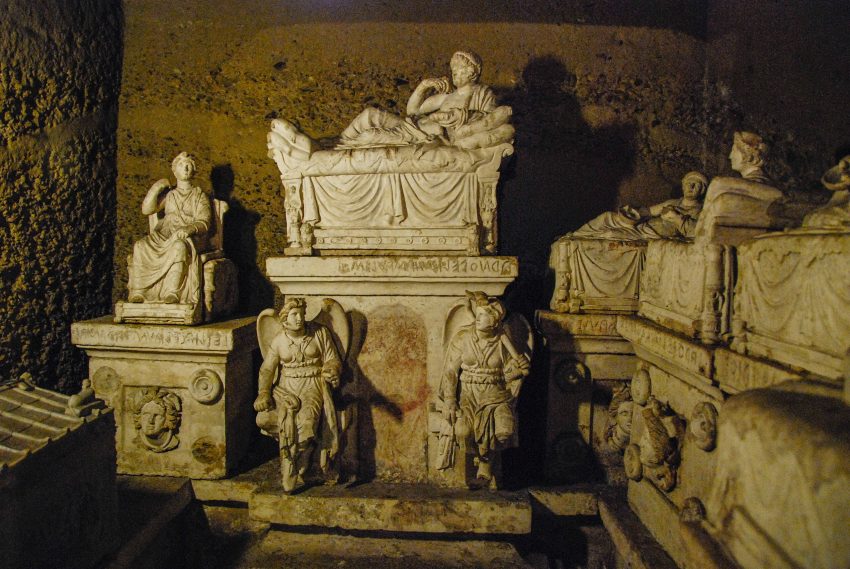
At the rear lies the tablinum, the most important room in the complex, flanked by two alae. This central space symbolises family authority and continuity and holds the burial urns of seven members of the Velimna-Volumni line, six Etruscan and one Roman. The most elaborate urn is that of Arnth Velimnas Aules, depicted semi-reclining on a kline with the painted door to Hades at the base, while on the right stand the urns of other male relatives and on the left the urn of the daughter Veilia, shown seated in a feasting pose. The final urn, dating to the 1st century AD, is marble, shaped like a small temple and inscribed in both Etruscan and Latin, vividly recording the family’s transition into the Roman world.
How to Get to the Necropolis of Palazzone and Volumni Hypogeum
The necropolis lies in Ponte San Giovanni, a short distance southeast of Perugia, and is easy to combine with a day in the city or a wider tour of Umbria. The nearest major airports are Perugia San Francesco d'Assisi and, further away, Florence and Rome, all with connections that allow you to reach Perugia by train, coach or hire car before continuing to Ponte San Giovanni. For the best deals and a seamless booking experience, check out these flights to Perugia on Booking.com.
From Perugia’s main railway station, regular regional trains and local services stop at Ponte San Giovanni, from where it is a brief taxi ride or a longer walk to the archaeological area.Use Omnio to easily compare schedules, book train tickets, and find the best prices all in one place for a hassle-free journey across Italy. Alternatively, local buses run from Perugia towards Ponte San Giovanni and nearby stops, making the site accessible even without a car.
If you are travelling by car, reaching the necropolis is straightforward via the E45 and local roads that connect Perugia with Ponte San Giovanni and the Tiber valley, with parking available near the entrance to the archaeological area.If you are looking to rent a car in Italy I recommend having a look at Discover Cars, first, as they compare prices and review multiple car rental agencies for you.
Practical Tips on Visiting the Necropolis of Palazzone and Volumni Hypogeum
- Suggested tips: Start in the Antiquarium to understand the funerary context, then descend to the hypogeum; if possible, visit with a guide or audio guide to fully appreciate the inscriptions and room functions.
- Best time to visit: Late morning or early afternoon works well; the underground chambers stay relatively cool, making them comfortable even in summer.
- Entrance fee: Adults: €3.00
- Opening hours: Daily: 09:00 - 17:30
- Official website: https://www.musei.umbria.beniculturali.it/musei/ipogeo-dei-volumni-e-necropoli-del-palazzone/
- How long to spend: Plan around 60-90 minutes to explore the Antiquarium, descend into the hypogeum and spend time studying the urns and architectural details.
- Accessibility: Access to the hypogeum involves a long staircase and uneven underground floors; visitors with limited mobility may find it challenging and may prefer to focus on the Antiquarium displays at ground level.
- Facilities: Basic visitor services such as ticketing and information are available on site; for cafés, restaurants and additional amenities, head into Ponte San Giovanni or central Perugia.
- Photography tip: Use the entrance arch and stair as framing elements, then look for close-ups of inscriptions, sculpted figures on the urn lids and the painted door to Hades on Arnth Velimnas’s urn; respect any restrictions on flash or tripod use.
- Guided tours: Check in advance for guided visits or special thematic tours, which often provide deeper insights into Etruscan society, religion and the transition to Roman customs.
- Nearby food options: Combine your visit with a meal or snack in Ponte San Giovanni or back in Perugia, where you will find plenty of trattorias, bars and cafés.
Where to Stay close to the Necropolis of Palazzone and Volumni Hypogeum
Staying in Perugia’s historic centre gives you the best mix of atmosphere and convenience, with easy access by car, train or bus to Ponte San Giovanni and the necropolis. A long-established option with panoramic views is Sina Brufani, which makes it simple to pair underworld Etruscan explorations with evenings in Perugia’s hilltop streets. For something smaller and characterful, Hotel Fortuna places you just off Corso Vannucci, ideal if you plan to combine the hypogeum with visits to the city's museums and churches. If you prefer a boutique feel in a historic building, Hotel Priori Secret Garden offers a charming base within walking distance of Perugia’s main sights and straightforward links down to Ponte San Giovanni.
Is the Necropolis of Palazzone and Volumni Hypogeum Worth Visiting?
If you have any interest in Etruscan culture, ancient architecture or the deep history of Perugia, the Necropolis of Palazzone and Volumni Hypogeum are absolutely worth visiting. The combination of a well-organised site, a richly stocked Antiquarium and an underground tomb that still feels like a family house frozen in time is rare and memorable. Standing in the tablinum surrounded by urns that chart the Velimna-Volumni lineage from Etruscan to Roman eras gives you a powerful sense of continuity and change, making this one of the best places to visit in Perugia for travellers who want to go beyond the usual medieval highlights.
What Other Travellers Say...

Ipogeo dei Volumni e Necropoli del Palazzone in Perugia offers well‑preserved underground Etruscan tombs with carved funerary art and numerous urns on display, accompanied by a small nearby museum that provides context and hands‑on reproductions related to Etruscan dining; visitors note the hypogeum is accessed from the main building where the ticket office is, there's a bar/café across the street, parking sits a short walk down the curvy state road so watch for traffic, and while access inside the tombs can occasionally be restricted, the site remains a rewarding way to explore ancient Umbrian history.


FAQs for Visiting Necropolis of Palazzone and Volumni Hypogeum
Nearby Attractions to the Necropolis of Palazzone and Volumni Hypogeum
- Perugia Undercity and Rocca Paolina: Atmospheric underground streets and fortress remains beneath Perugia, revealing later layers of the city's history.
- Etruscan Arch and Walls of Perugia: Monumental gateways and masonry from the city's Etruscan phase, complementing what you see at Palazzone.
- Duomo di Perugia San Lorenzo: The city's main cathedral, with its own archaeological areas that illustrate the long continuity of worship on the hilltop.
- Perugia Aqueduct Walk: A scenic elevated path along the former medieval aqueduct, offering views over rooftops and the surrounding hills.
- Basilica di San Pietro: A richly decorated abbey church on the edge of Perugia, filled with artworks by Perugino and other Renaissance masters.
The Necropolis of Palazzone & Hypogeum of Volumni appears in our Complete Guide to Visiting Perugia!

Moira & Andy
Hey! We're Moira & Andy. From hiking the Camino to trips around Europe in Bert our campervan — we've been traveling together since retirement in 2020!
This website uses affiliate links which may earn a commission at no additional cost to you!
Planning Your Visit
Daily: 09:00 – 17:30
Adults: €3.00
Nearby Attractions
- Basilica di San Pietro (2.7) km
Abbey and Basilica - National Archeological Museum of Perugia (3.3) km
Museum - Civic Museum at Palazzo della Penna (3.5) km
Historic Building and Museum - Rocca Paolina (3.6) km
Castle and Gallery - Piazza Italia (3.6) km
Square - Palazzo del Capitano del Popolo (3.7) km
Palace - Palazzo Baldeschi al Corso (3.7) km
Palace - Perugino Monument (3.7) km
Monument - House Museum of Palazzo Sorbello (3.8) km
Museum - Corso Vannucci (3.8) km
Street