Mieu Temple, Hue
Historic Building in Hue
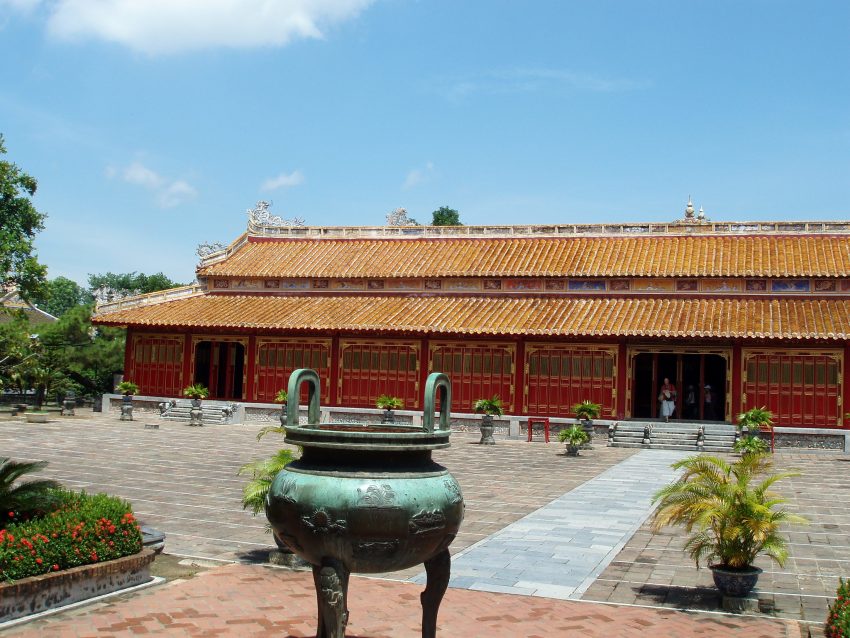
The Mieu Temple, also known as Thế Miếu or Thế Tổ Miếu, is one of the most spiritually important sites within the Imperial City of Hue. Built between 1822 and 1823 by Emperor Minh Mang, it stands as a grand Confucian ancestral shrine dedicated to honoring the emperors of the Nguyen Dynasty. With its yellow glazed roof tiles, quiet courtyards, and richly adorned altars, it is one of the must-see places in Hue.
Inside the temple, altars are arranged to pay homage to Nguyen emperors from Gia Long to Khai Dinh. Not all rulers are represented-some had reigns too brief, while others were added only after major political shifts, creating a layered narrative within the shrine. The adjacent Nine Dynastic Urns, cast between 1835 and 1837, stand as monumental bronze symbols of imperial power and continuity, echoing ancient Chinese traditions of authority.
Table of Contents
History and Significance of The Mieu Temple
Constructed during a period of consolidation under Emperor Minh Mang, The Mieu Temple was designed to reaffirm Confucian values and imperial legitimacy. Minh Mang sought to strengthen dynastic identity by honoring his predecessors and establishing a sacred space for ritual worship. The temple's placement within the Imperial City reflects its importance as a spiritual anchor in the ceremonial landscape.
The altars inside are dedicated to the emperors from Gia Long to Khai Dinh, each adorned with lacquered panels and gilt ornamentation. Originally topped with gold ingots, the altars now feature symbolic offerings and portraits or photographs of the respective rulers. Notably, some emperors-such as Duc Duc, Hiep Hoa, and Bao Dai-do not have altars, either because of short reigns or their later political circumstances. The altars of the three anti-French emperors, Ham Nghi, Thanh Thai, and Duy Tan, were only added after Vietnam’s independence in 1954, reflecting evolving national perspectives.
The Nine Dynastic Urns, positioned just outside the temple, were commissioned by Minh Mang as lasting representations of imperial strength. Modeled after the legendary Nine Tripod Cauldrons of ancient China, these urns symbolise the power and unity of the Nguyen dynasty. Each urn is dedicated to one of the first nine emperors and features intricate engravings depicting landscapes, animals, plants, and symbols associated with Vietnam’s geography and culture.
Things to See and Do in The Mieu Temple
Stepping into the temple courtyard, visitors will immediately notice the serene symmetry of the complex, with its sweeping roofs of yellow glazed tiles standing as a symbol of imperial authority. The interior altars are beautifully arranged, each offering insight into the lives and legacies of Nguyen rulers. Visitors can take time to examine the gilt designs, lacquered woodwork, and portraits that tell the story of nearly a century and a half of imperial rule.
The Nine Dynastic Urns are among the greatest artistic achievements of the Nguyen dynasty. Each urn bears detailed engravings that symbolize aspects of Vietnam’s natural world-from mountains and rivers to animals and flora. Visitors can walk between the urns, observing the individual motifs and appreciating the craftsmanship that went into their creation. The urns also serve as a symbolic reminder of the unity and structure of the Vietnamese empire under Nguyen leadership.
The peaceful courtyard surrounding The Mieu Temple invites quiet exploration. The nearby Hien Lam Pavilion rises prominently above the complex, completing the ceremonial ensemble that honors both emperors and their meritorious mandarins. Taking time to explore the entire area offers a deeper understanding of how imperial rituals shaped life in the Forbidden Purple City.
How to Get to The Mieu Temple
Hue is served by Phu Bai International Airport, located around 16 kilometres from the city centre, with frequent domestic flights connecting it to major Vietnamese cities. For the best deals and a seamless booking experience, check out these flights to Hue on Booking.com.
Hue Railway Station provides convenient connections to Da Nang, Hanoi, Ho Chi Minh City, and other destinations across Vietnam. Train schedules and bookings can be found on Omio. From the station, taxis or ride-hailing services can transport visitors quickly to the Imperial City.
Travelling by car is straightforward, with designated parking outside the Citadel's main gates. Once inside the Imperial Enclosure, pathways lead directly toward the southwest corner where The Mieu Temple complex is located.
Practical Tips on Visiting The Mieu Temple
- Suggested tips: Take time to read the inscriptions and examine the intricate decorations on the Nine Dynastic Urns.
- Best time to visit: Morning or late afternoon for comfortable temperatures and gentle light.
- Entrance fee: Included in the Imperial City ticket.
- Opening hours: Generally 8:00-17:30, varying by season.
- Official website: https://www.hueworldheritage.org.vn
- How long to spend: Around 30-45 minutes exploring the temple and urns.
- Accessibility: Mostly accessible, though paths may be uneven in places.
- Facilities: Restrooms and refreshment stalls are available elsewhere in the Imperial City.
- Photography tip: Capture the urns in a line for a dramatic architectural composition.
- Guided tours: Many tours include The Mieu Temple for its historical depth and symbolism.
- Nearby food options: Cafés and restaurants can be found near the Citadel’s outer walls.
Where to Stay close to The Mieu Temple
Staying near the Citadel allows easy access to The Mieu Temple and other historical sites. The elegant Azerai La Residence offers refined riverside accommodation just minutes away. For a boutique atmosphere with spacious rooms, Le Domaine de Cocodo is an appealing option. Another convenient choice is Villa Hue, set in pleasant grounds close to the city’s main attractions.
Is The Mieu Temple Worth Visiting?
The Mieu Temple is absolutely worth visiting for anyone interested in imperial history, Confucian traditions, and the cultural legacy of the Nguyen Dynasty. The atmospheric shrine, together with the monumental Nine Dynastic Urns, offers a vivid sense of how rulers were honored and remembered. As one of Hue's most important ceremonial spaces, it provides one of the city's most enriching historical experiences.
What Other Travellers Say...

The To Temple is a large, colorful walled temple complex in the southwest corner of the Imperial City, featuring the three-tiered Hien Lam Pavilion on the south side and the solemn To Mieu Temple with shrines to each Nguyen emperor across a central courtyard that holds the Nine Dynastic Urns; a northern gate leads to the smaller Hung To Mieu reconstruction. Visitors note the complex is extensive and well restored, offers ceremonial happenings at times (best visited early to avoid crowds), and while impressive for its scale and ancestral shrines some find nearby mausoleums more surprising.


FAQs for Visiting The Mieu Temple
Nearby Attractions to The Mieu Temple
- Hien Lam Pavilion: A towering memorial honoring emperors and mandarins.
- Nine Dynastic Urns: Monumental bronze urns symbolizing imperial legacy.
- Thai Hoa Palace: The ceremonial heart of the Imperial City.
- Noon Gate (Ngo Mon): The grand southern entrance to the Citadel.
- Purple Forbidden City: The former private residence of the Nguyen emperors.
The Mieu Temple appears in our Complete Guide to Visiting Hue!

Moira & Andy
Hey! We're Moira & Andy. From hiking the Camino to trips around Europe in Bert our campervan — we've been traveling together since retirement in 2020!
This website uses affiliate links which may earn a commission at no additional cost to you!
Planning Your Visit
Nearby Attractions
- Hung Mieu Temple (0.0) km
Historic Building - Hien Lam Pavilion (0.1) km
Historic Building - Dien Tho Residence (0.2) km
Historic Building - Thai Hoa Palace (0.2) km
Palace - Halls of the Mandarins (0.3) km
Historic Building - Meridian Gate (0.3) km
City Gate - Forbidden Purple City (0.3) km
Historic Building - Cung Truong Sanh (0.4) km
Historic Building - Nhat Thanh Lau (0.4) km
Historic Building - The Royal Theatre (0.4) km
Historic Building