Metallic Tower of Fourvière, Lyon
Tower in Lyon

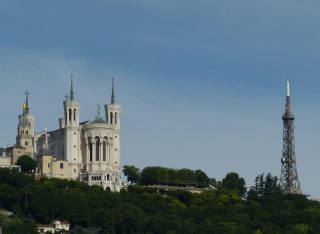
Perched high on Fourvière Hill, the Tour métallique de Fourvière is one of the top sights in Lyon, instantly recognisable on the skyline with its delicate lattice steel structure. Built between 1892 and 1894, this 210-ton tower was Lyon's proud symbol of modern engineering, echoing the spirit of the Eiffel Tower while giving the city its own industrial icon. Today it rises to 101 metres thanks to a TV antenna added later, and from below in the city you'll often spot it standing like a metallic crown behind the Basilica of Notre-Dame de Fourvière.
Although you can no longer ride an elevator to the top, the tower's story is still very much alive. During the 1914 Exposition Universelle in Lyon, the Tour métallique de Fourvière featured a restaurant and an elevator that carried visitors to a spectacular viewing platform, making it one of the must-see places in Lyon for anyone curious about the future of technology. Public access ended in 1953 when the tower became a dedicated television transmission mast, but the area around it remains a great place to visit on a walking tour of Lyon, with panoramic viewpoints, green spaces, and easy access to the basilica and Parc des Hauteurs.
Table of Contents
- History and Significance of the Tour métallique de Fourvière
- Things to See and Do in the Area Around the Tour métallique de Fourvière
- How to Get to the Tour métallique de Fourvière
- Practical Tips on Visiting the Tour métallique de Fourvière
- Where to Stay close to the Tour métallique de Fourvière
- Is the Tour métallique de Fourvière Worth Visiting?
- FAQs for Visiting Tour métallique de Fourvière
- Nearby Attractions to the Tour métallique de Fourvière
History and Significance of the Tour métallique de Fourvière
The Tour métallique de Fourvière emerged at a time when cities across Europe were embracing iron, steel, and ambitious engineering projects. Built between 1892 and 1894, the tower was Lyon's answer to the Eiffel Tower in Paris: an overt declaration that the city, too, was modern, innovative, and technically savvy. Its lattice-style structure and prominent hilltop location made it an instant landmark, visible from almost every corner of the city and symbolically tying Lyon's future to the new age of metal and machines.
The tower really came into its own during the 1914 Exposition Universelle in Lyon. Equipped with a restaurant and an elevator that could carry up to 22 people to the top, it quickly became a star attraction, offering sweeping views over the city and the surrounding plains. For visitors at the time, riding to the summit was as much about experiencing cutting-edge technology as it was about enjoying the panorama. This mix of entertainment, engineering, and spectacle perfectly captured the mood of the era.
As broadcasting technology advanced, the tower's role shifted. A TV antenna was added, increasing its height from its original 85.9 metres to 101 metres, and by the mid-20th century it had been fully repurposed as a television transmission tower. Public access ended on 1 November 1953, but the structure continued to serve an important technical function, helping transmit signals across the region. Standing at 372 metres above sea level on Fourvière Hill, it still marks the highest point in Lyon, and its familiar silhouette remains a reassuring constant in the ever-changing cityscape.
Things to See and Do in the Area Around the Tour métallique de Fourvière
Even though the tower itself is no longer open to visitors, the area around it offers plenty to see and do. Begin at the Basilica of Notre-Dame de Fourvière, just a short walk away, where terraces and viewpoints give you some of the finest views over Lyon's rooftops, rivers, and distant hills. From these vantage points, the Tour métallique de Fourvière often appears just behind the basilica, its metal framework rising above the treeline, and you can appreciate how the two landmarks share the same dramatic ridge.
Walk a little further along the paths of Fourvière Hill and you’ll come close to the fenced-off base of the tower. While you can’t go inside, standing beneath it still gives an impressive sense of scale and structure. Look up through the lattice of steel and imagine the days when visitors were lifted to the top in clanking elevators for what must have been a thrilling, wind-swept view. The contrast between the technological aesthetic of the tower and the nearby religious architecture of the basilica makes this part of Fourvière particularly striking.
From the tower area, you can easily connect to Parc des Hauteurs, a network of walkways and terraces that link various viewpoints and historic sites along the hill. These paths offer beautiful perspectives over the Saône, Vieux Lyon, and the Presqu'île, with the metallic tower often peeking through the trees in the background. Combine your visit with the nearby Roman theatres and the Gallo-Roman Museum, and you'll have a rich mix of ancient, religious, and industrial heritage all within walking distance of each other.
How to Get to the Tour métallique de Fourvière
If you're arriving by air, you'll land at Lyon-Saint Exupéry Airport (LYS), which has good connections across Europe and beyond; from the airport, take the Rhônexpress tram into central Lyon, then connect to the metro and head to Vieux Lyon - Cathédrale Saint-Jean before riding the funicular up to Fourvière and walking to the tower area. For the best deals and a seamless booking experience, check out these flights to Lyon on Booking.com.
Travelling by train, you'll arrive at either Lyon Part-Dieu or Lyon Perrache. From Part-Dieu, take the metro to Bellecour and then on to Vieux Lyon - Cathédrale Saint-Jean, where you can switch to the Fourvière funicular; from Perrache, you can either walk to the funicular station via the riverfront or take a short metro or tram ride and then continue by funicular up the hill to reach the basilica and the nearby tower. You can use SNCF Connect to check schedules, compare routes, and purchase tickets for National (SNCF ) and regional trains (TER). For a more streamlined experience, we recommend using Omio, which allows you to easily compare prices, schedules, and book tickets for both National and Regional travel across all of Europe, all in one place.
If you're coming by car, it's usually easiest to park on the Presqu'île or near Vieux Lyon in an underground car park, then use the funicular or walk up to Fourvière rather than trying to drive right to the top of the hill, where roads are narrow and parking is limited. If you are looking to rent a car in France I recommend having a look at Discover Cars, first, as they compare prices and review multiple car rental agencies for you.
Practical Tips on Visiting the Tour métallique de Fourvière
- Suggested tips: Treat the tower as part of a wider Fourvière outing-combine it with the basilica, Parc des Hauteurs, and the Roman theatres for a full hilltop experience.
- Best time to visit: Aim for clear days in the morning or late afternoon when the light is soft and views over Lyon from the nearby terraces are at their best.
- Entrance fee: Free — the tower exterior and surrounding viewpoints can be enjoyed without charge, though you cannot go inside the structure.
- Opening hours: The paths and viewpoints around the tower are generally accessible throughout the day; funicular and site opening times may vary by season. The tower is not open for public visits
- How long to spend: Allow 30-60 minutes to walk around the area and enjoy the viewpoints, longer if you combine it with the basilica, park, or nearby Roman sites.
- Accessibility: The hilltop area includes slopes, steps, and uneven paths; the funicular makes access easier, but some viewpoints may still be challenging for visitors with reduced mobility.
- Facilities: Cafés, toilets, and small shops are available near the basilica and funicular stations, but there are no facilities directly at the base of the tower.
- Photography tip: For the best shots, photograph the tower from a little distance with the basilica or treetops in the frame; evening light can give the metal structure a warm glow.
- Guided tours: Some walking-tours of Fourvière include information about the tower's engineering and role in broadcasting, even if they don't enter the fenced-off area.
- Nearby food options: Head towards the basilica area, Vieux Lyon, or down to the riverside for a wide choice of restaurants, bouchons, and cafés after your hilltop visit.
Where to Stay close to the Tour métallique de Fourvière
For a stay with easy access to Fourvière Hill and sweeping views over Lyon, Villa Florentine is an excellent choice, set on the slopes between Vieux Lyon and the basilica, with the tower just a scenic walk away.
If you prefer to base yourself in the heart of the old town and ride up the hill as needed, Cour des Loges Lyon, a Radisson Collection Hotel places you amid Renaissance courtyards and cobbled lanes, just a short stroll from the funicular that climbs to Fourvière and the tower area.
For a more relaxed atmosphere near the Saône, Collège Hôtel offers quirky, school-themed decor within walking distance of both Vieux Lyon and the funicular, making it simple to combine riverside strolls with visits to Fourvière and its metallic landmark.
Is the Tour métallique de Fourvière Worth Visiting?
Even though you can’t climb the Tour métallique de Fourvière anymore, it’s absolutely worth including in your time on Fourvière Hill. As an emblem of 19th-century engineering and a key element of Lyon’s skyline, it adds a distinctive industrial note to a hill otherwise dominated by religious and ancient sites. Visiting the area around the tower, taking in the views, and seeing how its iron silhouette punctuates the horizon gives you a fuller sense of Lyon’s layered identity-part spiritual, part historic, and part proudly modern.
What Other Travellers Say...

Metallic tower of Fourvière sits on a hill at 8 Mont Nicolas de Lange in Lyon and is an industrial‑style structure built for the Exposition Internationale in 1894, offering views over the city; visitors say it resembles a smaller version of the Eiffel Tower, can be reached at its base but cannot be climbed, and is a handy landmark to notice from the nearby basilica though many find it underwhelming compared with larger towers.


FAQs for Visiting Tour métallique de Fourvière
Nearby Attractions to the Tour métallique de Fourvière
- Basilica of Notre-Dame de Fourvière - Lyon's iconic hilltop church with richly decorated interiors and some of the best city views from its terraces.
- Parc des Hauteurs - A network of elevated walkways and paths linking viewpoints, cemeteries, and historic sites along the Fourvière ridge.
- Ancient Theatre of Fourvière - A grand Roman theatre still used for performances, offering a dramatic link to Lyon's ancient past.
- Odeon of Lyon - A smaller Roman performance space next to the main theatre, designed for music and oratory in a more intimate setting.
- Gallo-Roman Museum of Lyon-Fourvière - A hillside museum with artefacts, models, and exhibits that explain the Roman history of Lugdunum and its hilltop monuments.
The Metallic Tower of Fourvière appears in our Complete Guide to Visiting Lyon!

Moira & Andy
Hey! We're Moira & Andy. From hiking the Camino to trips around Europe in Bert our campervan — we've been traveling together since retirement in 2020!
This website uses affiliate links which may earn a commission at no additional cost to you!
Planning Your Visit
The paths and viewpoints around the tower are generally accessible throughout the day; funicular and site opening times may vary by season. The tower is not open for public visits
Free - the tower exterior and surrounding viewpoints can be enjoyed without charge, though you cannot go inside the structure.
Nearby Attractions
- Basilica of Notre-Dame de Fourvière (0.2) km
Basilica - Parc des Hauteurs (0.2) km
Park - La Tour Rose (The Pink Tower) (0.4) km
Historic Building and Tower - Musée Gadagne (0.4) km
Museum - Longue Traboule (0.4) km
Historic Building - Place de la Basoche (0.4) km
Square - Gallo-Roman Museum of Lyon-Fourvière (0.4) km
Museum - Vieux Lyon (0.5) km
Area - Miniature and Cinema Museum (0.5) km
Museum - Place du Change (0.5) km
Square