Jesuitenkirche, Lucerne
Church in Lucerne
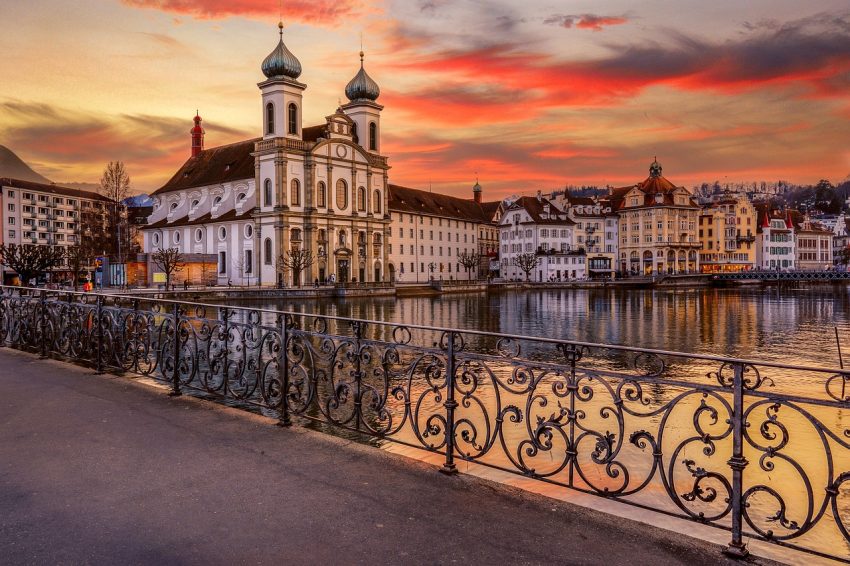
Standing proudly along the Reuss, Jesuitenkirche (Jesuit Church) is the soft, rose-and-cream Baroque landmark you keep catching out of the corner of your eye as you wander along the river. Built from 1666 under the patronage of Ludwig Pfyffer von Altishofen and dedicated to Francis Xavier, it marked the arrival of the Jesuits and the Counter Reformation in Lucerne. Today its onion-domed towers and elegant façade are as much a part of the city's skyline as Chapel Bridge, and stepping inside feels like walking into a shell of light and plasterwork. It is easily one of the must-see places in Lucerne if you enjoy art, architecture and a bit of quiet reflection between sightseeing stops.
Inside, the church is a study in lightness and detail. Delicate rose and white stucco curls over walls and vaults, framing side chapels and windows so that the whole space feels airy rather than heavy. The great pink high altar, which looks like marble but is actually crafted from stucco and plaster, glows at the far end of the nave, while the second side chapel on the right is dedicated to Brother Klaus, whose life-sized statue in a simple brown habit offers a striking contrast to the surrounding ornament. Combined with its riverside setting, Jesuitenkirche is a great place to visit on a walking tour of Lucerne, especially if you time your visit for a quieter moment when the city noise fades at the threshold.
Table of Contents
- History and Significance of the Jesuitenkirche
- Things to See and Do in the Jesuitenkirche
- How to Get to the Jesuitenkirche
- Practical Tips on Visiting the Jesuitenkirche
- Where to Stay close to the Jesuitenkirche
- Is the Jesuitenkirche Worth Visiting?
- FAQs for Visiting the Jesuitenkirche
- Nearby Attractions to the Jesuitenkirche
History and Significance of the Jesuitenkirche (Jesuit Church)
Jesuitenkirche owes its existence to the arrival of the Jesuits in Lucerne in the 17th century, invited and supported by Ludwig Pfyffer von Altishofen. Their presence signalled the city's strong alignment with the Counter Reformation at a time when confessional lines were reshaping much of Europe. The church, dedicated to the missionary Francis Xavier, was begun in 1666 and quickly became a flagship Baroque project, designed to impress, inspire and clearly communicate Catholic identity through art and space.
Artisans from Italy and Austria were brought in to realise the ambitious interior and exterior, which is why the building feels so closely connected to the great Baroque churches further south. Yet Jesuitenkirche is still very much of Lucerne: its position on the riverfront, the way it dialogues with the surrounding bridges, squares and houses, and its role in local religious life all tie it to the city's everyday rhythms. Over the centuries it has witnessed processions, sermons, political shifts and quiet, private moments of prayer, anchoring faith and culture side by side.
The church’s significance today is twofold. Architecturally, it is often described as Switzerland’s most splendid Baroque church, a benchmark for the style within the country. Historically and spiritually, it stands as a reminder of how strongly the Counter Reformation shaped Lucerne’s identity, from education and politics to art and music. Stepping inside, you feel both aspects at once: the visual drama of stucco and altars, and the underlying seriousness of purpose that motivated their creation.
Things to See and Do in the Jesuitenkirche (Jesuit Church)
Begin with the exterior, ideally from the opposite side of the Reuss. From there you can see how the church’s twin towers and dome-like roofs rise above the riverside façades, and how its light-coloured walls catch the changing light over the water. Cross one of the nearby bridges and approach the entrance slowly, noticing how the church sits slightly set back from the riverbank, framed by the promenade and neighbouring buildings.
Inside, let your eyes adjust and drift upwards. The rose and white stucco work is one of the church’s great pleasures: soft, curling forms that trace the lines of arches and vaults without overwhelming them. The main altar at the front, with its pink “marble” structure crafted from plaster and stucco, is a perfect example of Baroque illusion-rich and substantial in appearance but surprisingly light in material. Spend a few minutes simply sitting in a pew, taking in the balance of colour, light and texture from different positions in the nave.
Then explore the side chapels, each with its own focus and decoration. The second chapel on the right, dedicated to Brother Klaus (Nicholas of Flüe), stands out thanks to its life-sized statue of the hermit in a plain brown habit instead of an elaborate altarpiece. That simplicity, set within such an ornate setting, makes his figure particularly striking. As you move through the church, look for smaller details too: painted medallions, stucco angels, organ pipes, and the way natural light plays across the plasterwork at different times of day. Taken together, these elements make Jesuitenkirche one of the top attractions in Lucerne for anyone who enjoys reading history through architecture.
How to Get to the Jesuitenkirche (Jesuit Church)
From abroad, most visitors arrive via Zurich Airport, which offers frequent international connections and lies about an hour from Lucerne by direct train or motorway. For the best deals and a seamless booking experience, check out these flights to Lucerne on Booking.com. Basel and Bern airports are also options if you are combining Lucerne with other Swiss cities as part of a longer journey. For the best deals and a seamless booking experience, check out these flights to Lucerne on Booking.com.
Once in Lucerne, reaching Jesuitenkirche is very easy. From the main railway station, it is just a few minutes' walk: cross the Reuss via the station bridge or Chapel Bridge, turn along the riverfront, and the church appears almost immediately with its distinctive twin towers and pale façade. Train schedules and bookings can be found on Omio. The central location means you can visit spontaneously while exploring the Old Town, or slot it neatly between other nearby sights.
If you are travelling by car, follow signs into Lucerne’s city centre and use one of the public car parks near the station or Old Town, then continue on foot to the riverfront; the church itself sits in a pedestrian-friendly area where walking is by far the easiest way to get around.
Practical Tips on Visiting the Jesuitenkirche (Jesuit Church)
- Suggested tips: Step inside for a quiet pause even if you are short on time; the cool air, soft colours and calm atmosphere make a refreshing contrast to the busy riverfront.
- Best time to visit: Early morning or late afternoon tend to be quieter and often offer especially beautiful light filtering through the windows and across the stucco.
- Entrance fee: Free entry; donations towards maintenance and church activities are appreciated.
- Opening hours: Generally open daily during daylight hours, with some sections occasionally closed during services, rehearsals or concerts.
- Official website: https://jesuitenkirche-luzern.ch/
- How long to spend: Around 20-40 minutes is usually enough to appreciate the architecture, altars and chapels, longer if you sit for reflection or attend a service or concert.
- Accessibility: The church entrance is close to street level, but there may be a small step and some uneven flooring; overall, access is manageable for most visitors, though wheelchair users may wish to check details in advance.
- Facilities: There are no major visitor facilities inside beyond seating and basic information; cafés, shops, public toilets and the tourist information office are all located nearby in the surrounding streets.
- Photography tip: Take a few photos from across the river to capture the church in its urban context, then, inside, focus on details such as the pink altar and stucco work, avoiding flash to respect the space.
- Guided tours: Consider joining a city walking tour that includes Jesuitenkirche if you would like more context on the Jesuits, the Counter Reformation and the church's artwork.
- Nearby food options: The riverfront and adjoining lanes are lined with cafés and restaurants, making it easy to combine a visit with a drink or meal overlooking the Reuss.
Where to Stay close to the Jesuitenkirche
Staying near Jesuitenkirche puts you right in the heart of Lucerne, with the river, Old Town and main station all within a few minutes' walk. Hotel des Balances sits just upstream along the Reuss, offering stylish rooms and a celebrated riverside terrace, and it is only a short stroll to the church. For a classic, central base, Ameron Luzern Hotel Flora lies between the station and the river, making it easy to reach Jesuitenkirche, Chapel Bridge and the lakefront on foot. If you prefer a more traditional feel in the historic core, Hotel Wilden Mann combines period charm with good access to both the Old Town and the riverside promenade leading to the church.
Is the Jesuitenkirche Worth Visiting?
Jesuitenkirche is absolutely worth visiting, even if you only have a short time in Lucerne. Architecturally it offers one of the finest Baroque interiors in Switzerland, with its rose-and-white stucco and pink altar creating a light, uplifting atmosphere that feels very different from more austere churches. Historically it tells an important story about the arrival of the Jesuits and the Counter Reformation in the city. Combined with its easy riverside location and the simple pleasure of stepping into a cool, quiet space just steps from the bustle, this spot is one of the best places to visit in Lucerne for travellers who appreciate art, history and a touch of serenity.
What Other Travellers Say...

Jesuitenkirche Luzern on Bahnhofstrasse 11A is a sizable Baroque Catholic church on the left bank of the Reuss noted for its painted ceilings, rich furnishings and striking white, black and gold interior; visitors praise the calm, serene atmosphere, impressive altar and fine acoustics that make it a popular concert venue, and many note that entry is free and it's an easy walk from the station.


FAQs for Visiting the Jesuitenkirche
Nearby Attractions to the Jesuitenkirche
- Chapel Bridge and Water Tower - Lucerne's famous covered wooden bridge and octagonal tower spanning the Reuss, just a short walk upstream.
- Old Town Lucerne - A compact maze of cobbled lanes, frescoed façades and lively squares directly across the river from the church.
- Lake Lucerne promenade - Scenic lakeside paths a few minutes away, with views to Pilatus and the surrounding mountains.
- Museum Rosengart Collection - A modern art museum near the station showcasing works by Klee, Picasso, Cézanne and others, easily reached on foot.
- Hofkirche St. Leodegar - Lucerne's twin-towered lakeside church with a Renaissance interior, a pleasant stroll along the lake from Jesuitenkirche.
The Jesuitenkirche appears in our Complete Guide to Visiting Lucerne!

Moira & Andy
Hey! We're Moira & Andy. From hiking the Camino to trips around Europe in Bert our campervan — we've been traveling together since retirement in 2020!
This website uses affiliate links which may earn a commission at no additional cost to you!
Planning Your Visit
Generally open daily during daylight hours, with some sections occasionally closed during services, rehearsals or concerts.
Free entry; donations towards maintenance and church activities are appreciated.
Nearby Attractions
- Ritterscher Palace (0.1) km
Palace - Lucerne Town Hall (0.1) km
Town Hall - Weinmarkt (0.1) km
Square - Kornmarkt (0.2) km
Square - Hirschenplatz (0.2) km
Square - Museum Rosengart Collection (0.2) km
Arts Venue - Chapel Bridge and Water Tower (0.2) km
Bridge - History Museum (0.3) km
Museum - Peter's Chapel (0.3) km
Church - Fritschi Fountain (0.3) km
Fountain