Jamnik, Bled
Church and Viewing Point near Bled
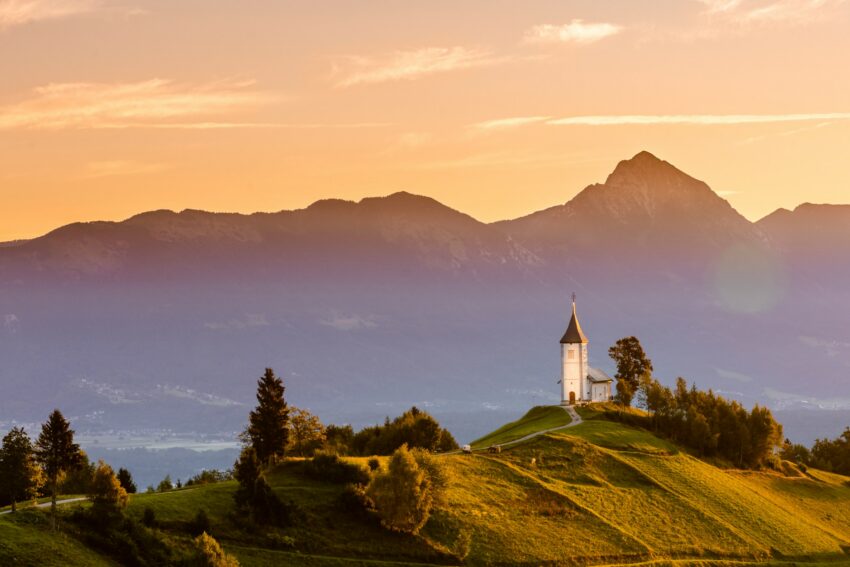
Set high above the village of Jamnik on the slopes of the Jelovica plateau, the Church of St. Primus and Felician is the image many travelers associate with rural Slovenia. It stands on a narrow grassy ridge with a wide mountain backdrop, and the setting is every bit as striking in person as it appears in photographs. From here, you can look across the Ljubljana Basin toward the Karawanks and the Kamnik-Savinja Alps, which explains why it has become such a classic viewpoint.
What makes this place special is not just the church itself, but the mood around it. Jamnik feels small, quiet, and deeply tied to the landscape, so a visit is as much about the atmosphere as the architecture. It is the kind of stop that works equally well as a quick scenic detour, a photography stop at sunrise or sunset, or part of a longer countryside outing from Kranj, Radovljica, or Lake Bled.
Table of Contents
- History and Significance of the Church of St. Primus and Felician
- Things to See and Do in the Church of St. Primus and Felician
- How to Get to the Church of St. Primus and Felician
- Practical Tips on Visiting the Church of St. Primus and Felician
- Where to Stay Close to the Church of St. Primus and Felician
- Is the Church of St. Primus and Felician Worth Visiting?
- For Different Travelers
- FAQs for Visiting Church of St. Primus and Felician
History and Significance of the Church of St. Primus and Felician
The church in Jamnik is an old pilgrimage and village landmark whose origins go back at least to the late medieval period, with later Baroque remodelling shaping much of what visitors see today. Its long-standing presence on this exposed ridge gave it both spiritual significance and a powerful visual identity, and over time it became one of the defining churches of Upper Carniola. Although small in scale, it carries the kind of historic continuity that makes Slovenia's hilltop churches so appealing.
Its significance today is as much cultural as religious. The church has become one of the most photographed locations in Slovenia, celebrated not only for its architecture but also for its almost theatrical position above the valley. Tourism boards in the region consistently highlight Jamnik for its views and for the church's role as a symbol of the landscape, which has elevated it far beyond the status of a simple rural chapel.
There is also a strong emotional pull here. Even travelers with little interest in church interiors or religious history often find Jamnik memorable because it represents a classic Slovenian blend of faith, countryside tradition, and mountain scenery. It is one of those places where the history is inseparable from the setting, and that combination gives it lasting appeal.
Things to See and Do in the Church of St. Primus and Felician
The main draw is the famous exterior view of the church rising above the ridge with the Alps behind it. This is the classic Jamnik image, and many visitors come specifically for photography. Light conditions change the experience a lot, so early morning and late afternoon are especially rewarding, when the surrounding slopes and mountains feel softer and more dramatic.
Once you arrive, spend time taking in the panorama rather than rushing off after one photo. The viewpoint stretches across a broad sweep of northern Slovenia, and there is a panoramic board nearby to help identify the peaks and settlements in the distance. On a clear day, the sense of space is remarkable, and it is easy to understand why this spot is so often singled out in regional tourism material.
It is also worth pairing the stop with a short walk or countryside drive. Jamnik is often combined with Kropa, a historic iron-forging village below the plateau, or with a scenic outing through the Radovljica and Kranj area. That makes the church ideal not as a standalone all-day attraction, but as a memorable highlight within a broader day trip.
How to Get to the Church of St. Primus and Felician
Reaching Jamnik is straightforward once you are already in Upper Carniola, but it is not the sort of attraction you usually arrive at by accident. The nearest main airport is Ljubljana Jože Pučnik Airport, from which you can drive toward Kranj and continue into the hills toward Jamnik. For most travelers, the easiest approach is to make this part of a day trip from Kranj, Radovljica, Bled, or Ljubljana. For the best deals and a seamless booking experience, check out these flights to Bled on Booking.com.
If you are using public transport, the practical rail hubs are in Kranj, Radovljica, or Lesce, but you will usually need to combine the train with a taxi, local road transfer, or onward hike. The regional rail line runs through Radovljica and Lesce, which makes those towns useful stepping stones even though the church itself is not directly by a station. You can easily check schedules and book tickets through the Slovenian Railways. However, for a smoother experience, we recommend using Omio, which simplifies the booking process and lets you compare prices and schedules all in one place.
By bus, it is best to first reach a larger nearby town such as Kranj or Radovljica and continue from there, as direct public transport to the ridge is limited. Many travelers choose to combine bus travel with a short local taxi transfer or a rural walk, especially if they are already exploring nearby villages.
Driving is the easiest option by far, especially if you want flexibility for viewpoints, weather, and timing. The roads through the countryside are scenic, and Jamnik can be reached from Kropa by car or on foot.
Practical Tips on Visiting the Church of St. Primus and Felician
- Entrance fee: Free.
- Opening hours: Exterior and viewpoint accessible throughout the day. The church interior is usually closed outside services, and no official regular visitor hours are clearly posted.
- Official website: https://www.visitkranj.com/en/sights/jamnik/
- Best time to visit: Early morning and late afternoon are the best times for atmosphere, softer light, and the strongest mountain views. Clear days make a big difference here, so check the weather before you go.
- How long to spend: Around 30 minutes is enough for a quick stop, but allow 1-2 hours if you want to linger, take photographs, or combine it with a short walk.
- Accessibility: The final approach is easier by car than by public transport, and the rural setting may be less convenient for travelers with limited mobility. Ground conditions can also vary with season and weather.
- Facilities: Facilities on-site are limited, so it is best to treat Jamnik as a scenic stop rather than a full-service attraction. Bring water and plan café or restaurant breaks in nearby villages or towns.
Where to Stay Close to the Church of St. Primus and Felician
For most travelers, Kranj is the best base if you want to stay near the main sights of the area while keeping easy road access to Jamnik, but Radovljica or Bled can work better if your trip is focused more on mountain scenery, lake views, and a wider Upper Carniola itinerary.
Kranj makes a practical base because it is close enough for an easy outing and gives you a proper town setting with restaurants, transport links, and other attractions. Hotel Actum is a good pick if you want something central and characterful, while Elegans Hotel Brdo suits travelers who want a quieter stay with easy road access.
If you prefer a more atmospheric regional base, Radovljica and Bled are both strong choices. Linhart Hotel works well for travelers who like staying in a historic old town, while Hotel Park makes sense if Jamnik is just one stop within a broader Bled-based trip.
Is the Church of St. Primus and Felician Worth Visiting?
Yes, absolutely, if you appreciate scenery, photography, and small places with a strong sense of setting. Jamnik is not a major museum-style attraction with long exhibitions or elaborate visitor infrastructure, but that is exactly why it works so well: the reward is the view, the atmosphere, and the memorable simplicity of the site.
The honest pivot is that travelers who want large interiors, extensive interpretation, or lots of facilities may find it too slight for a dedicated long journey. This is a place that shines most when folded into a day of scenic driving, hiking, or countryside sightseeing rather than treated as a full-day destination on its own.
What Other Travellers Say...
Reviewers consistently praise the spot for its memorable, scenic views and picturesque hilltop church, often calling it worth visiting if you’re nearby. Several note practical considerations: parking is limited and you still need to walk to reach the church. Photographers mention lighting can be challenging in the morning due to backlight, with better conditions pre-dawn or in the evening, and weather can affect the experience.


For Different Travelers
Families with Kids
Jamnik works well for families who want an easy scenic stop without committing to a long museum visit or a complicated itinerary. Kids often enjoy the open setting and the sense of being high above the valley, though parents should keep an eye on footing and weather because the site is rural rather than heavily managed.
It is best for families as a short break within a broader day trip. Pairing it with somewhere more active or food-focused nearby usually makes the outing feel more balanced, especially for younger children with limited patience for viewpoints alone.
Couples & Romantic Getaways
For couples, Jamnik is one of those places that feels quietly cinematic. The church, the ridge, and the mountain backdrop create a setting that is especially rewarding at sunrise, sunset, or in misty conditions when the whole landscape feels softened and more intimate.
It also fits naturally into a slower travel day. A drive through Upper Carniola, a scenic stop here, and dinner in a nearby town makes for a simple but very memorable romantic outing.
Budget Travelers
Jamnik is excellent for budget travelers because the attraction itself is free and the real appeal comes from the landscape rather than ticketed experiences. If you already have a car or are building a day around nearby towns, it adds a lot of value for very little cost.
The main thing to plan carefully is transport. Public transport connections are less convenient than to bigger Slovenian sights, so budget travelers will get the best value by combining Jamnik with other stops in the region rather than treating it as a one-stop mission.
History Buffs
History-minded visitors may find the church modest in scale, but it still has real appeal because of its medieval origins and later Baroque remodelling. The site also helps explain a broader Slovenian pattern, where hilltop churches became focal points of local identity, worship, and landscape memory.
It is not a deep interpretive site with large displays, so expectations should be adjusted accordingly. The payoff for history buffs is in understanding the church as part of a lived rural tradition rather than as a heavily curated monument.
FAQs for Visiting Church of St. Primus and Felician
Getting There
Tickets & Entry
Visiting Experience
Tours, Context & Itineraries
Photography
Accessibility & Facilities
Food & Breaks Nearby
Safety & Timing
The Jamnik appears in our Complete Guide to Visiting Bled!

Moira & Andy
Hey! We're Moira & Andy. From hiking the Camino to trips around Europe in Bert our campervan — we've been traveling together since retirement in 2020!
This website uses affiliate links which may earn a commission at no additional cost to you!
Planning Your Visit
Exterior and viewpoint accessible throughout the day. The church interior is usually closed outside services, and no official regular visitor hours are clearly posted.
Free.
Nearby Attractions
- Lake Bled (13.5) km
Church and Lake - Bled Island (13.6) km
Island - Bled Castle (13.7) km
Castle - Skofja Loka (13.9) km
Town - Ojstrica Viewpoint (14) km
Viewing Point - Vintgar Gorge (15.1) km
Natural Phenomenon - Poglej Church (15.5) km
Cave - Lake Bohinj (27.3) km
Lake - Triglav National Park (32.7) km
National Park - Franciscan Church of the Annunciation (33.5) km
Church