Etruscan Arch, Perugia
City Gate and City Walls in Perugia
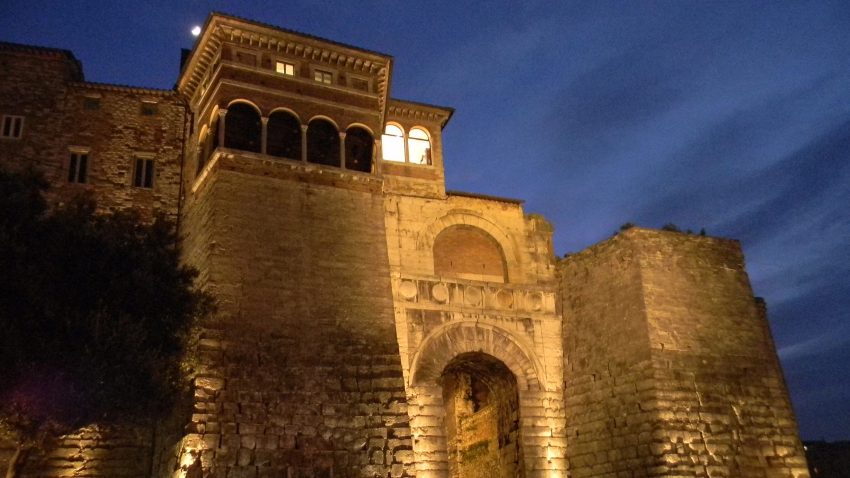
Perugia's Etruscan walls and Etruscan Arch are where the city's deep past is written in stone, wrapping around the historic hilltop like an ancient embrace. Dating back as far as the fourth and third centuries BC, the walls still trace a three kilometre perimeter, rising and falling with the terrain and folding inward in the lower parts so that, from above, the line of fortifications forms a clover like outline, making this one of the top sights in Perugia for anyone who loves archaeology and city history.
As you follow the surviving stretches, you begin to understand how carefully the town was planned: six main gates projecting routes off towards Gubbio, Rome, Orvieto, Chiusi and Cortona, minor postierle threading pedestrians and water out of the city, and two main axes cutting across the hilltop. Standing beneath the Etruscan Arch with its massive travertine blocks, tower flanks and ancient inscriptions, it is easy to see why this is a highlight of any walking tour of Perugia and a place where the Etruscan and Roman city feels remarkably close.
Table of Contents
- History and Significance of the Perugia Etruscan Walls and Arch
- Things to See and Do in the Perugia Etruscan Walls and Arch
- How to Get to the Perugia Etruscan Walls and Arch
- Practical Tips on Visiting the Perugia Etruscan Walls and Arch
- Where to Stay close to the Perugia Etruscan Walls and Arch
- Is the Perugia Etruscan Walls and Arch Worth Visiting
- FAQs for Visiting Perugia Etruscan Walls and Arch
- Nearby Attractions to the Perugia Etruscan Walls and Arch
History and Significance of the Perugia Etruscan Walls and Arch
Perugia was one of the principal Etruscan towns, and its walls remain a textbook example of how this sophisticated civilisation defended and organised its cities. Built mainly in the third century BC, with older sections from the fourth century BC, the walls were laid out in travertine blocks shaped into squares and trapezoids and stacked in neat courses without mortar. In some places the original stones are still visible, complete with quarry marks indicating their intended positions, a direct link to the craftsmen who cut and set them.
The wall circuit is about three kilometres long and once fully encircled the Etruscan settlement, adjusting to the contours of the hill. In the lower areas, the line folds inward, so the overall plan resembles a clover, a practical response to the terrain that also created a subtly varied defensive profile. Six major gates tied the town to the wider region, channelling roads to Gubbio, Rome, Orvieto, Chiusi and Cortona, while smaller postierle served pedestrians and drainage, handling the everyday flows of people and water that kept the city alive.
Within this framework, the Etruscan planners laid out two principal axes. The north south cardo linked the Etruscan Arch and Porta Marzia, while the east west decumanus connected Arco dei Gigli and Porta Trasimena, the gate towards Lake Trasimeno. These lines structured movement, trade and ceremony across the hilltop. The walls were strong enough that in 310 BC they stopped the Roman consul Fabius Maximus Rullianus in his campaign against the Etruscans, a reminder that Perugia was not just well placed but well fortified long before it became part of the Roman world.
Things to See and Do in the Perugia Etruscan Walls and Arch
The Etruscan Arch, sometimes called the Beautiful Gate, is the natural starting point. Set on the northern side of the walls where the ancient Via Amerina left the town, it was rebuilt in the mid third century BC as part of a wider programme that extended that road to Perugia. Two trapezoidal towers about twenty metres high flank the arch and project from the walls, while the archway itself cuts slightly obliquely through the fortification, giving the ensemble extra visual tension as you approach.
Above the arch a stone frame is decorated with shield shaped circles and half pilasters capped with Ionic style capitals, a refined architectural language that later inspired motifs on the Palazzo dei Priori. Look closely at the vault and you can still see dark grey fire marks, scars from the civil war in the first century BC when Perugia was burned during Octavian's campaign, a brutal conflict that ended with the young general's victory and paved the way for his later rule as Augustus. The smaller upper arch, now filled with bricks, may once have accommodated a war machine during that period of siege and assault.
From the square in front of the arch, follow Via Cesare Battisti to trace the old perimeter, watching for stretches where the great travertine blocks reappear beneath later buildings. In some spots the walls are free standing, in others they form the foundations or back walls of houses, weaving the Etruscan structure into the fabric of the later city. As you walk, try to imagine the six main gates controlling access, the minor postierle handling foot traffic and water, and the cardo and decumanus cutting through the town above you. This sort of exploration, piecing the ancient circuit together with modern streets, is one of the things to do in Perugia that really helps the city's layered history click into place.
How to Get to the Perugia Etruscan Walls and Arch
Most visitors will arrive via Perugia San Francesco d'Assisi Airport or larger hubs such as Rome Fiumicino, from where you can connect to Perugia by train, bus or car. For the best deals and a seamless booking experience, check out these flights to Perugia on Booking.com. From the local airport it is a short transfer by shuttle or taxi into the city, while from Rome you can combine a longer train or coach journey with a scenic climb up to the historic centre.
Perugia is well linked by rail, with services from Rome, Florence and other Umbrian towns arriving at Perugia's main station in the valley.Use Omnio to easily compare schedules, book train tickets, and find the best prices all in one place for a hassle-free journey across Italy. From there, the minimetro or local buses take you up to the historic core, where it is a short walk through medieval streets to reach the Etruscan Arch and other surviving stretches of the walls. Long distance buses also connect Perugia with regional towns and cities, usually dropping you near the same lower area served by local transport.
If you prefer to drive, major roads lead towards Perugia from Florence, Rome and the surrounding Umbrian countryside, with signed exits guiding you to multi storey or surface car parks below the historic centre.If you are looking to rent a car in Italy I recommend having a look at Discover Cars, first, as they compare prices and review multiple car rental agencies for you. Once parked, you can ride the minimetro or walk up into the old town, then explore the walls and arch entirely on foot, which is by far the best way to appreciate their scale and relationship to the streets.
Practical Tips on Visiting the Perugia Etruscan Walls and Arch
- Suggested tips: Wear comfortable shoes, as exploring the walls means dealing with slopes, cobbled streets and stairways, and bring water, especially in summer.
- Best time to visit: Spring and autumn offer mild weather and clearer views, while early morning or late afternoon light is ideal for seeing details in the stone and taking photos.
- Entrance fee: Walking the walls and viewing the Etruscan Arch is generally free; some nearby museums or sites may charge a modest fee.
- Opening hours: The walls and arch can be seen at any time, though nearby museums and information points follow regular daytime opening hours.
- How long to spend: Allow at least one to two hours to see the Etruscan Arch, follow part of the wall line and pause for views and photos along the way.
- Accessibility: The historic centre is steep and sometimes uneven, so access can be challenging for visitors with limited mobility; look for escalators, lifts and the minimetro to reduce climbs where possible.
- Facilities: Cafés, shops and toilets are scattered throughout the old town near the walls and arch, but it is wise to plan comfort breaks around squares and main streets.
- Photography tip: Stand back to capture the full height of the arch and its towers, then move in close to photograph quarry marks, inscriptions and fire stains that tell the story of Perugia’s more turbulent moments.
- Guided tours: Consider joining a guided walking tour focused on Etruscan and medieval Perugia to get detailed explanations of the walls, gates and urban layout that are easy to miss alone.
- Nearby food options: Use the squares close to the Etruscan Arch and the main streets leading towards Corso Vannucci for cafés and trattorias where you can refuel between sections of your wall walk.
Where to Stay close to the Perugia Etruscan Walls and Arch
To make the most of Perugia’s Etruscan remains, it is worth staying in or near the historic centre so you can wander the walls and arch at different times of day. A classic choice is Sina Brufani, a long established hotel with panoramic views and easy access to the upper town. For a more intimate feel, Hotel Fortuna offers characterful rooms just a short walk from Corso Vannucci and the lanes that lead towards the Etruscan Arch. If you prefer a boutique style base tucked into historic streets, Hotel Priori Secret Garden places you within comfortable walking distance of the main Etruscan sites and the rest of the old town.
Is the Perugia Etruscan Walls and Arch Worth Visiting
If you are interested in how ancient cities were planned and defended, Perugia's Etruscan walls and arch are absolutely worth seeking out. They are not isolated ruins on a hilltop but structures still intertwined with the living city, shaping streets and views in ways that become clearer the more you walk. Between the clover like perimeter, the monumental Etruscan Arch and the inscriptions that chart Perugia's shift from Etruscan stronghold to Roman colony, you get a vivid sense of continuity that makes this one of the best places to visit in Perugia for history minded travellers.
What Other Travellers Say...

Etruscan Well at P.za Ignazio Danti 18 in Perugia is a compact, atmospheric site where visitors descend slippery steps into an ancient well after watching a short introductory video; the underground chamber is cool and intimate (room for about ten people) with water still dripping down the walls, and there's a separate museum entrance and a small waiting room showing the documentary — it's a brief visit that some find well worth the modest fee while others consider it skippable, and note that opening can be inconsistent so you may encounter closures.


FAQs for Visiting Perugia Etruscan Walls and Arch
Nearby Attractions to the Perugia Etruscan Walls and Arch
- Piazza IV Novembre and Fontana Maggiore: The heart of Perugia's historic centre, with a beautiful medieval fountain and views of the cathedral and Palazzo dei Priori.
- Palazzo dei Priori: A powerful civic palace whose architecture echoes motifs from the Etruscan Arch, now home to museums and art collections.
- Perugia Cathedral San Lorenzo: The city's main church, overlooking Piazza IV Novembre and offering a contrasting layer of medieval and Renaissance history.
- Rocca Paolina: A fascinating underground fortress built in the sixteenth century, where you can walk through vaulted passages carved into the hill.
- Corso Vannucci: Perugia's main pedestrian street, perfect for an evening passeggiata after a day spent tracing the ancient walls.
The Etruscan Arch appears in our Complete Guide to Visiting Perugia!

Moira & Andy
Hey! We're Moira & Andy. From hiking the Camino to trips around Europe in Bert our campervan — we've been traveling together since retirement in 2020!
This website uses affiliate links which may earn a commission at no additional cost to you!
Planning Your Visit
The walls and arch can be seen at any time, though nearby museums and information points follow regular daytime opening hours.
Walking the walls and viewing the Etruscan Arch is generally free; some nearby museums or sites may charge a modest fee.
Nearby Attractions
- Acquedotto Medievale (0.1) km
Aqueduct - House Museum of Palazzo Sorbello (0.2) km
Museum - Etruscan Well (0.2) km
Historic Site - Cathedral of San Lorenzo (0.2) km
Cathedral - Underground Perugia (0.3) km
Historic Site - Fontana Maggiore (0.3) km
Fountain - Piazza IV Novembre (0.3) km
Square - Palazzo dei Priori (0.3) km
Town Hall - Nobile Collegio della Mercanzia (0.3) km
Historic Building and Museum - National Gallery of Umbria (0.3) km
Gallery