Dewailly Clock, Amiens
Statue in Amiens
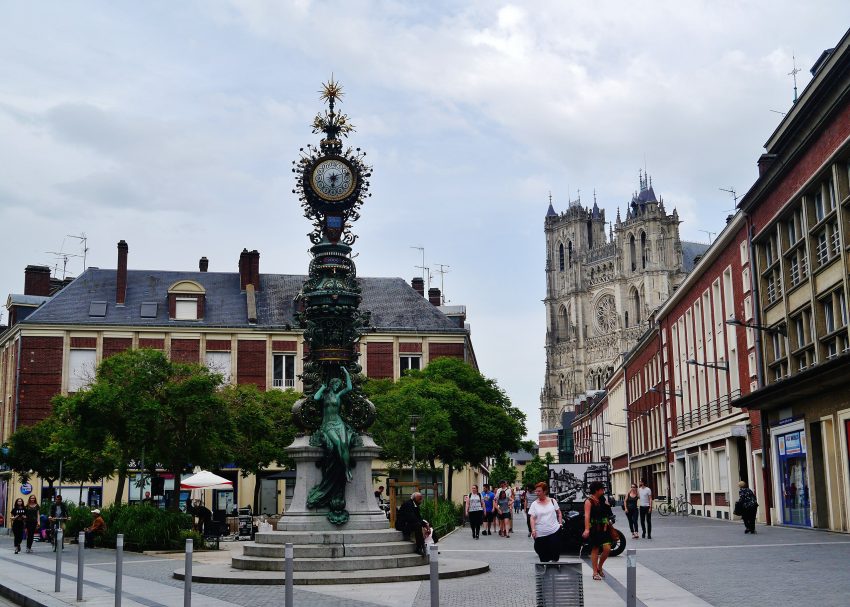
The Dewailly Clock is an outdoor public clock in central Amiens, near Place Gambetta and the city's main pedestrian streets. Designed by architect Émile Ricquier in the late 19th century, it combines an ornate iron column, three clock faces, and a bronze allegorical statue by Albert Roze.
The monument matters less for scale than for local character. Visitors notice the floral metalwork, the figure of Le Printemps, and the nickname Marie sans chemise, which has stayed part of Amiens’ everyday memory. It is best for walkers, photographers, and visitors who enjoy small civic monuments with a specific story.
History and Significance
A Public Clock for Amiens
The clock takes its name from Louis Dewailly, a former mayor of Amiens who left money to the city for a public timepiece. At a time when many residents did not own watches, the project had a practical purpose as well as a civic one.
Émile Ricquier, also associated with the Cirque Jules Verne, designed the clock in 1896. His column used decorative ironwork with scrolls and floral detail, while the three clock faces made the time visible from several directions.
Le Printemps and Marie sans chemise
In 1898, sculptor Albert Roze added the bronze figure known as Le Printemps. The statue’s pose and light clothing led to the local nickname Marie sans chemise, a name that helped make the monument part of Amiens’ everyday language.
The statue outlasted the original setting. After wartime damage and later removal of the clock structure, the bronze figure survived and became the key original element in the later reconstruction.
Reconstruction in 1999
The clock seen today is a faithful late-20th-century reconstruction rather than the complete 19th-century original. It was reinstalled in 1999, close to its earlier position, returning a familiar city landmark to the centre of Amiens.
This mix of original sculpture and recreated structure is part of the site's interest. It reflects both the losses Amiens suffered in the 20th century and the city's decision to restore a small but recognisable piece of its streetscape.
Things to See and Do
The main reason to stop is to look closely at the clock as an object, not just pass it on the way to larger sights. Stand back far enough to see the three clock faces, the tall iron column, and the bronze figure together, then move closer to pick out the decorative metalwork around the shaft.
I would also take a moment to circle the monument, because the statue reads differently depending on the angle and light. In the evening, the clock faces and metalwork can feel more defined, while daylight gives better detail on the figure of Le Printemps.
The stop works well as a pause between the cathedral area, the shopping streets, and the route toward Saint-Leu. There is no interior to enter and no formal visit to structure, so treat it as a short urban detail rather than a main activity.
How to Get to the Dewailly Clock
Amiens has no major commercial airport; Paris Beauvais Airport is the closest practical option, while Paris Charles de Gaulle offers broader international connections. For the best deals and a seamless booking experience, check out these flights to Amiens on Booking.com.
Amiens station has regional rail links, including direct TER services from Paris Gare du Nord, and the clock is a short walk through the centre. You can use SNCF Connect to check schedules, compare routes, and purchase tickets for National (SNCF ) and regional trains (TER). For a more streamlined experience, we recommend using Omio, which allows you to easily compare prices, schedules, and book tickets for both National and Regional travel across all of Europe, all in one place.
If arriving by car, use central parking such as Parking des Jacobins or Parking du Perret and walk, since the streets around the monument are better handled on foot. If you are looking to rent a car in France I recommend having a look at Discover Cars, first, as they compare prices and review multiple car rental agencies for you.
Where to Stay Close
For most visitors, the best base is central Amiens between the cathedral, the station, and the pedestrian streets, especially if the trip is focused on culture and short walks rather than driving. This area keeps the Dewailly Clock, Notre-Dame Cathedral, restaurants, and Saint-Leu within easy reach.
Mercure Amiens Cathedrale Hotel works well for travelers who want to stay close to the cathedral and the older centre. Hotel Marotte suits visitors looking for a more independent central hotel with private parking available for an extra charge. ibis Styles Amiens Centre is a practical choice for train arrivals, with a location close to Amiens station and the city centre.
Is the Dewailly Clock Worth Visiting?
The Dewailly Clock is worth a short stop if you are already walking through central Amiens, especially if you like civic monuments, Art Nouveau detail, or small pieces of local memory. It is not a priority if you have very limited time and are choosing between major sights, because the visit usually takes only a few minutes and there is no interior, exhibition, or ticketed experience.
What Other Travellers Say...
Espace Dewailly, at 3 Place Louis Dewailly in Amiens, is a well-maintained municipal venue featuring a lovely cloister, pleasant functional rooms and a large amphitheater used for cultural and social events; visitors praise its Harry Potter–style interior, enjoy summer festivals and special events like craft beer tastings where admission can be free and samples are sold, and note the site is worth viewing from the courtyard on Rue Frédéric Petit; open Monday to Friday 8:00–17:30, closed weekends.





Practical Tips on Visiting the Dewailly Clock
- Best time to visit: Early morning is quieter, while late afternoon and evening give softer light on the bronze statue and ironwork.
- How long to spend: Allow 10 to 20 minutes, or a little longer if you want photos from several angles.
- Accessibility: The monument stands in a central pedestrian area and can be viewed from street level without steps.
- Facilities: There are no dedicated visitor facilities at the clock, but cafés, shops, and public services are nearby in the city centre.
FAQs for Visiting the Dewailly Clock
Getting There
Tickets & Entry
Visiting Experience
Tours, Context & Itineraries
Photography
Accessibility & Facilities
Food & Breaks Nearby
Safety & Timing
The Dewailly Clock appears in our Complete Guide to Visiting Amiens!

Moira & Andy
Hey! We're Moira & Andy. From hiking the Camino to trips around Europe in Bert our campervan — we've been traveling together since retirement in 2020!
This website uses affiliate links which may earn a commission at no additional cost to you!
Nearby Attractions
- Maison du Pèlerin (0.2) km
Historic Building - Hotel de Ville - Amiens (0.2) km
Historic Building - Belfry of Amiens (0.2) km
Tower - Cathédrale Notre-Dame d'Amiens (0.2) km
Cathedral - Convent of the Grey Sisters (0.5) km
Convent - Man on his Buoy (0.5) km
Sculpture - Musée de Picardie (0.5) km
Museum - Quartier St Leu à Amiens (0.5) km
Area - Tour Perret (0.6) km
Tower - Maison de Jules Verne (0.7) km
Historic Building