Chamber of St. Paul and Cell of St. Catherine, Parma
Monastery in Parma
Tucked away behind high walls and reached along a leafy path, the Chamber of St Paul and the adjoining Cell of St Catherine feel a world apart from the busy streets of central Parma. These two interconnected rooms formed part of the private apartment of Abbess Giovanna da Piacenza in the Benedictine nuns' monastery, rebuilt in the late 15th century. Today they reveal, in an almost secret setting, how two very different painters transformed a convent interior into one of the must-see places in Parma for lovers of Renaissance art and refined, humanistic decoration.
Visiting the complex, you move from Alessandro Araldi's more traditional early 16th century frescoes to Correggio's astonishing, playful and intellectually rich Chamber of Abbess Giovanna, completed in 1519. Vaults dissolve into painted foliage and open oculi, putti lean over balustrades with hunting symbols, and mythological figures glow in monochrome lunettes, while the adjacent Cella di Santa Caterina unfolds quieter scenes from the life of Saint Catherine. The whole experience feels like stepping inside the private imagination of an abbess steeped in Neoplatonic ideas, and it is a highlight of any walking tour of Parma that looks beyond the main piazzas.
Table of Contents
- History and Significance of the Chamber of St Paul and Cell of St Catherine
- Things to See and Do in the Chamber of St Paul and Cell of St Catherine
- How to Get to the Chamber of St Paul and Cell of St Catherine
- Practical Tips on Visiting the Chamber of St Paul and Cell of St Catherine
- Where to Stay close to the Chamber of St Paul and Cell of St Catherine
- Is the Chamber of St Paul and Cell of St Catherine Worth Visiting?
- FAQs for Visiting Chamber of St Paul and Cell of St Catherine
History and Significance of the Chamber of St Paul and Cell of St Catherine
The story of these rooms is closely tied to the Benedictine convent of San Paolo, rebuilt in the late 15th century when Parma’s religious houses were at the height of their influence. Within this cloistered world, Abbess Giovanna da Piacenza emerged as a powerful and cultured figure, commissioning artworks that reflected both her spiritual role and her humanist education. The rooms that now form the heart of the visitor route were once part of her private apartment, meaning that the frescoes you see today were created for a highly select audience of nuns and guests rather than for public display.
In 1514, Alessandro Araldi was engaged to decorate one of these chambers. His work follows established Renaissance and late medieval conventions, with a vault set against a deep blue background and adorned with candelabras, roundels, squares and lunettes. These frames hold scenes from the Old and New Testaments, creating a visual cycle that reads like an illustrated catechism. The style is refined, orderly and still rooted in the traditions of Roman painting of the period, offering a bridge between older devotional habits and the new currents that were beginning to reshape Italian art.
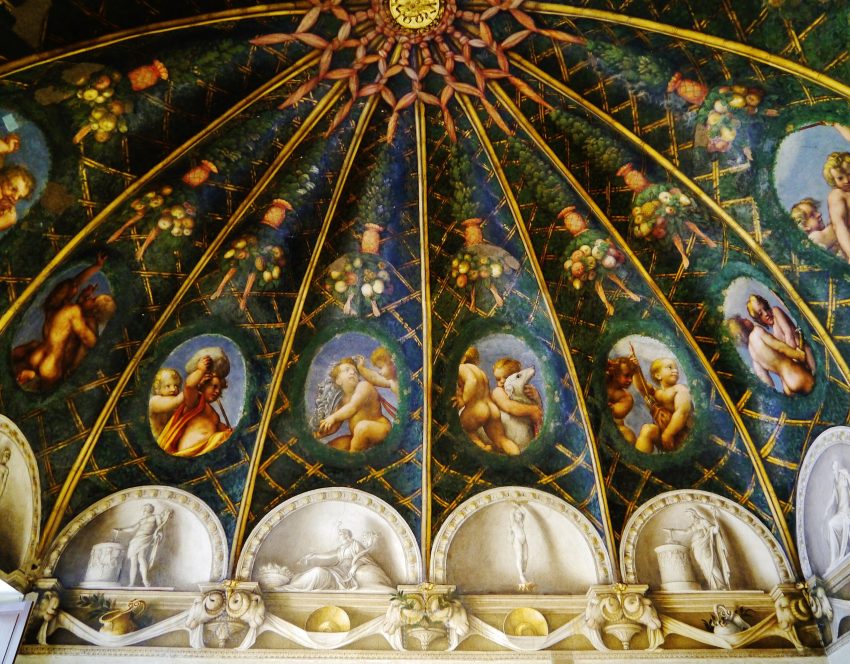
Just a few years later, Correggio was brought in to decorate the neighbouring chamber, now known as the Camera della Badessa (Chamber of the Abbess). Completed in 1519, his frescoes introduced a distinctly humanistic pictorial language to Parma. Using painted vegetal patterns and illusionistic openings, he effectively erased the late Gothic umbrella vault's structural creases, transforming the ceiling into a continuous, airy space in line with Neoplatonic ideas about beauty and harmony. Together with the nearby Cella di Santa Caterina, where Araldi painted episodes from the life of Saint Catherine, these rooms show how a once-secluded convent became a cutting-edge laboratory for Renaissance experimentation.
Things to See and Do in the Chamber of St Paul and Cell of St Catherine
Your visit begins with the walk along the tree-lined path that leads to the former Benedictine convent, already setting a contemplative tone. Once inside, you first encounter Araldi’s room, where the vault is covered in a network of painted candelabras and ornamental motifs on a blue field. Take your time to look at the roundels, squares and lunettes that frame scenes from both the Old and New Testaments; this is where Araldi’s affinity with Rome’s decorative language is most evident, and spotting familiar stories in the small narrative panels is half the fun.
From here, you pass into Correggio’s Chamber of Abbess Giovanna, where the mood changes immediately. The abbess’s triple lunar coat of arms sits at the conceptual centre of the design, from which sixteen segments radiate outwards. Within the oval openings, putti lean over painted balustrades amidst interlaced branches and leaves, each holding allegorical hunting symbols that point to the abbess’s refined, courtly tastes. Look closely at the sixteen monochrome lunettes that correspond to each oculus: they depict mythological figures lit from below, mimicking sculpted reliefs and playing clever games with light and shadow on the curved surfaces.
Do not miss the fireplace, where Diana appears driving a chariot, an image widely interpreted as a stand-in for Abbess Giovanna herself, poised for a symbolic hunt. Nearby, a smaller room preserves a copy of Araldi’s Last Supper, linking these private spaces back to core Christian narratives. Finally, walk out to the Cella di Santa Caterina at the edge of the garden. Here Araldi’s frescoes show scenes from Saint Catherine’s life, including her disputation before Emperor Maximin and an image of the saint with Saint Jerome. The guided tour of the Chamber of San Paolo ties all of this together, explaining the rise of the convent complex in the 15th and 16th centuries and the roles of abbesses Cecilia Bergonzi and Giovanna da Piacenza in shaping this remarkable artistic ensemble.
How to Get to the Chamber of St Paul and Cell of St Catherine
The Chamber of St Paul and Cell of St Catherine are located within the former Benedictine convent of San Paolo in central Parma, so they are easy to reach once you are in the city. Parma itself has a small airport and is also conveniently accessed from larger hubs such as Bologna or Milan, with onward travel by regional train, coach or hire car into the city. For the best deals and a seamless booking experience, check out these flights to Parma on Booking.com. From your arrival point, local buses and taxis can bring you close to the historic centre, from where it is a short walk to the convent complex.
If you are travelling by train within Italy, Parma sits on main rail lines linking Milan, Bologna and other northern cities, making it a straightforward stop on a wider itinerary.Use Omnio to easily compare schedules, book train tickets, and find the best prices all in one place for a hassle-free journey across Italy. From the railway station, you can either walk into the centre in around 15-20 minutes or use a local bus to get closer, then follow signs or a map to the former convent of San Paolo and its garden entrance.
Arriving by car, follow the A1 motorway or regional routes into Parma and then signs for the centro storico, leaving your vehicle in one of the central car parks on the edge of the old town.If you are looking to rent a car in Italy I recommend having a look at Discover Cars, first, as they compare prices and review multiple car rental agencies for you. From there, it is a pleasant walk through the historic streets to the convent entrance, and the tree-lined approach to the chambers makes a gentle, atmospheric start to your visit.
Practical Tips on Visiting the Chamber of St Paul and Cell of St Catherine
- Suggested tips: Book or check guided tour times in advance, as access is often by scheduled visit; a guide really helps decode the symbolism in Correggio’s and Araldi’s frescoes.
- Best time to visit: Late morning or early afternoon usually offers a calm atmosphere and good natural light filtering into the rooms, enhancing the painted surfaces.
- Entrance fee: €8.00
- Opening hours: Opening hours: Monday, Thursday and Friday from 9.30am to 5.30pm (last entry at 5pm); Saturday, Sunday and holidays from 9.30am to 6.30pm (last entry at 6.00pm); closed Tuesday and Wednesday. Opening during public holidays for Easter and Easter Monday, 25 April, 1 May, 2 June 2023. Open on Tuesday 15 August and 31 October 2023.
- Official website: https://parmawelcome.it/en/place/chamber-of-saint-paul-and-saint-catherines-cell/
- How long to spend: Plan 45-60 minutes for the guided visit, which usually covers Araldi’s room, Correggio’s chamber and the Cella di Santa Caterina.
- Accessibility: Access involves a garden path and historic interiors that may include steps and uneven floors; visitors with reduced mobility should confirm practical details when booking.
- Facilities: Facilities on site are limited; for toilets, cafés and shops you will rely on nearby streets in the centre of Parma.
- Photography tip: If photography is allowed, focus on details like the putti in the oculi, the Diana fireplace and sections of the zoophorus-style decoration, using a higher ISO to cope with low light.
- Guided tours: The official guided tour of the Chamber of San Paolo is the best way to access the rooms and understand their connection to the abbesses and the wider convent complex.
- Nearby food options: After your visit, head into the surrounding streets for cafés and trattorias where you can reflect on the art over a plate of local pasta or a selection of Parma’s famed cured meats.
Where to Stay close to the Chamber of St Paul and Cell of St Catherine
Choosing accommodation in Parma’s historic centre makes it easy to reach the Chamber of St Paul and Cell of St Catherine on foot. For a stay steeped in history, Palazzo Dalla Rosa Prati places you by the cathedral and baptistery, a pleasant walk from the convent and many other sights. If you prefer a boutique feel on a quiet central street, Hotel Button offers friendly, characterful rooms within easy walking distance of the chambers and the main squares. For more contemporary comfort with straightforward access to the old town, Grand Hotel de la Ville Parma provides modern facilities and a relaxed stroll into the historic core and San Paolo complex.
Is the Chamber of St Paul and Cell of St Catherine Worth Visiting?
Yes, the Chamber of St Paul and Cell of St Catherine are very much worth visiting, especially if you are interested in Renaissance art, women's patronage or the more intimate side of Parma's cultural history. Here you can see, at close quarters, how Araldi and Correggio responded to an abbess who wanted her private apartment to reflect both her devotion and her intellectual world. The combination of sophisticated illusionistic painting, mythological and biblical narratives and the tranquil convent setting makes this ensemble feel like a hidden gem rather than a mass-tourism stop, offering a rewarding contrast to the more monumental attractions of Parma.
What Other Travellers Say...
Camera di San Paolo e Cella di Santa Caterina, at Strada Macedonio Melloni 3 in Parma, occupies decorated chambers of the former abbess's apartments in a 16th-century Benedictine convent and offers a small number of beautifully painted rooms showcasing art tied to Correggio; visitors praise the stunning, historic interiors and friendly staff but note the site is compact, can be slightly tricky to find (enter through white pillars and walk to the end), and some feel the admission price is high compared with free churches nearby.



FAQs for Visiting Chamber of St Paul and Cell of St Catherine
The Chamber of St. Paul and Cell of St. Catherine appears in our Complete Guide to Visiting Parma!

Moira & Andy
Hey! We're Moira & Andy. From hiking the Camino to trips around Europe in Bert our campervan — we've been traveling together since retirement in 2020!
This website uses affiliate links which may earn a commission at no additional cost to you!
Planning Your Visit
Opening hours: Monday, Thursday and Friday from 9.30am to 5.30pm (last entry at 5pm); Saturday, Sunday and holidays from 9.30am to 6.30pm (last entry at 6.00pm); closed Tuesday and Wednesday.
Opening during public holidays for Easter and Easter Monday, 25 April, 1 May, 2 June 2023. Open on Tuesday 15 August and 31 October 2023.
€8.00
Nearby Attractions
- Diocesan Museum (0.1) km
Museum - Baptistery of Parma (0.2) km
Baptistery - Pilotta Palace (0.2) km
Museum and Palace - Regio Theatre (0.2) km
Historic Building and Theatre - Teatro Farnese (0.2) km
Historic Building and Theatre - Cattedrale di Parma (0.2) km
Cathedral - Basilica Santa Maria della Steccata (0.3) km
Basilica - Monastic Complex of San Giovanni Evangelista (0.3) km
Monastery - Piazza Garibaldi (0.4) km
Square - Parco Ducale (0.7) km
Park