Arco da Rua Augusta, Lisbon
Historic Building and Viewing Point in Lisbon
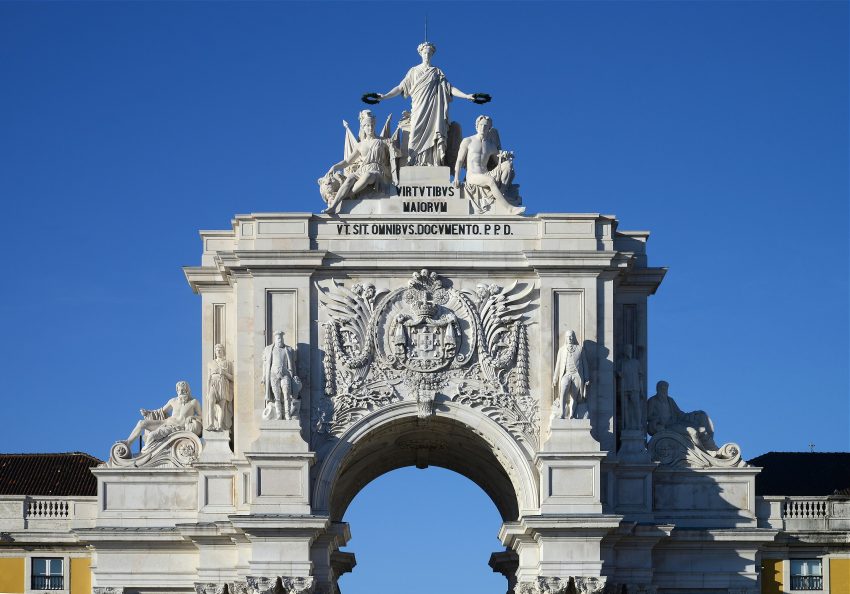
Standing at the entrance to Praça do Comércio, the Arco da Rua Augusta is where Lisbon's grand riverside square meets the busy pedestrian heart of the Baixa. For decades, people have walked beneath its sculpted figures without ever seeing the view from the top, but since 2013 visitors have been able to ride the lift and climb the final stairs to a panoramic terrace. From here, the grid of Pombaline streets, the yellow arcades of the square, and the shimmer of the Tagus unfold in a full 360-degree sweep, making this one of the must-see places in Lisbon if you love cityscapes.
The arch itself is loaded with symbolism. Built to celebrate Lisbon's rebirth after the devastating 1755 earthquake, fire, and tsunami, it carries a Latin inscription celebrating “the virtues of the greatest,” a tribute to the resilience and achievements of the Portuguese people. High above, Glory crowns Genius and Valour in sculptures by Célestin Anatole Calmels, while below them stand figures like the Marquis of Pombal, Vasco da Gama, Viriato, and Nuno Álvares Pereira, carved by Victor Bastos. This spot is a highlight of any walking tour of Lisbon, linking the riverside, the Baixa grid, and the elegant Rua Augusta into one unforgettable viewpoint.
Table of Contents
- “History and Significance of Arco da Rua Augusta,”
- Things to See and Do in Arco da Rua Augusta
- How to Get to Arco da Rua Augusta
- Practical Tips on Visiting Arco da Rua Augusta
- Where to Stay close to Arco da Rua Augusta
- Is Arco da Rua Augusta Worth Visiting?
- FAQs for Visiting Arco da Rua Augusta
- Nearby Attractions to Arco da Rua Augusta
“History and Significance of Arco da Rua Augusta,”
The Arco da Rua Augusta grew out of the massive reconstruction project that followed the 1755 earthquake, which destroyed much of central Lisbon. Under the direction of the Marquis of Pombal, a new, rational city plan was laid out for the Baixa, with broad avenues, regular blocks, and the monumental Praça do Comércio facing the river. The idea of a triumphal arch marking the transition from the square into the new city was part of this vision, symbolising not only physical rebuilding but also a new, more ordered and confident Lisbon.
Construction, however, proceeded slowly and in stages. The facades around the square were completed first, and for many years the arch existed in a simpler, less decorated form. It was only in the late 19th century that the arch gained its current sculptural richness, with additional elements added to complete the composition and turn it into a true monument. The inscription “Virtutibus Maiorum Ut Sit Omnibus Documentum” (“To the virtues of the greatest, that it may serve as a lesson to all”) was chosen to underline the idea that the courage and resilience shown after the disaster should inspire future generations.
Artistically, the arch blends neoclassical themes with distinctly Portuguese references. Calmels' group at the top depicts Glory crowning Genius and Valour, while the lower statues by Victor Bastos highlight historical figures associated with statecraft, exploration, and resistance. The Marquis of Pombal represents enlightened governance and reconstruction; Vasco da Gama stands for maritime exploration; Viriato evokes ancient Lusitanian resistance; and Nuno Álvares Pereira recalls the military victories that secured Portugal's independence. Together, they turn the Arco da Rua Augusta into a stone narrative about identity, memory, and the city's rebirth.
Things to See and Do in Arco da Rua Augusta
The first thing to appreciate is the arch’s position. Stand back in Praça do Comércio and look towards Rua Augusta: the arch perfectly frames the pedestrian street and its black-and-white calçada pavements. From this angle you can see the full sculptural group at the top, with Glory and her laurel wreaths above the central clock, and the flanking statues aligned over the arcades. It is worth walking around the square to see how the arch shifts in relation to the river, the statue of King José I, and the surrounding yellow buildings.
Inside, a modern lift carries you most of the way up, followed by a short staircase to the terrace. The viewpoint is compact but spectacular. On one side you look straight down Rua Augusta into the Baixa, with Castelo de São Jorge rising on the hill behind; on the other, the Tagus, the ferries, and the 25 de Abril Bridge fill the horizon. Looking back into Praça do Comércio, you get a rare bird's-eye view of the statue, arcades, and symmetrical facades. It is a simple experience-just a terrace and the sky-but one that delivers a powerful sense of how Lisbon's lower town is laid out.
Don't skip the small exhibition in the Clock Room. Here you can learn about the arch's history, the 1755 earthquake, and the phases of construction that led to the monument we see today. The mechanism of the clock itself is a nice detail for anyone interested in engineering or heritage preservation. Even if you only stay a short time, the combination of exhibition, sculptures, and viewpoint means there is enough to make the Arco da Rua Augusta one of the top attractions in Lisbon for visitors wanting both context and a memorable view.
How to Get to Arco da Rua Augusta
Arco da Rua Augusta sits at the northern edge of Praça do Comércio, right in the heart of downtown Lisbon, so it is easy to reach from almost anywhere in the city. Most international travellers arrive at Lisbon Humberto Delgado Airport, which is linked to the centre by metro, bus, taxi, and rideshare, making it straightforward to get into Baixa and walk to the arch along the river or through the grid of streets. For the best deals and a seamless booking experience, check out these flights to Lisbon on Booking.com.
If you are arriving by train, long-distance services from elsewhere in Portugal generally terminate at Santa Apolónia or Oriente, both connected to the city’s metro network. Train schedules and bookings can be found on Omio. From these stations, you can take the metro towards Baixa-Chiado or Terreiro do Paço and then stroll a short distance to Praça do Comércio; the arch is impossible to miss once you reach the square or Rua Augusta. Trams and buses serving the riverfront also stop nearby, making it easy to include the arch in a wider day of sightseeing.
Travelling by car into central Lisbon is possible but not always the most relaxing option, as streets can be busy and parking limited. If you are looking to rent a car in Portugal I recommend having a look at Discover Cars, first, as they compare prices and review multiple car rental agencies for you. If you do drive, look for underground car parks near Baixa or along the river and then continue on foot. Many visitors find it more convenient to combine public transport with walking, not least because exploring the Baixa and the surrounding neighbourhoods is best done at street level.
Practical Tips on Visiting Arco da Rua Augusta
- Suggested tips: Buy your ticket and head up early in the day or closer to sunset for softer light and fewer crowds; check weather and visibility, as the terrace is fully exposed.
- Best time to visit: Late afternoon and early evening offer beautiful golden light over the Baixa and the Tagus, while weekday mornings tend to be quieter outside peak season.
- Entrance fee: Adults: €4.50
- Opening hours: Daily: 10:00 - 19:00
- Official website: https://www.visitlisboa.com/en/places/arco-da-rua-augusta
- How long to spend: Around 30-60 minutes is enough time to explore the exhibition, enjoy the terrace, and take photos from different angles.
- Accessibility: There is an elevator inside, but you must climb a short flight of stairs to reach the very top; the surrounding streets and square are mostly flat but paved with traditional cobblestones.
- Facilities: Expect a small ticket area and basic services nearby; for toilets, cafés, and shops you can use the many options in Praça do Comércio and along Rua Augusta.
- Photography tip: Bring a wide-angle lens for the terrace views and try framing Rua Augusta and the castle in the same shot; at night, the illuminated square and arch can make for striking long-exposure images.
- Guided tours: Some walking tours of the Baixa and riverfront include the arch or at least stop beneath it, which can provide extra historical context before you head up on your own.
- Nearby food options: Praça do Comércio and Rua Augusta are lined with cafés and restaurants, from quick coffee stops to sit-down meals, making it easy to pair your visit with a drink or snack.
Where to Stay close to Arco da Rua Augusta
Staying near the Arco da Rua Augusta puts you right in the middle of Lisbon's historic Baixa, with easy access to trams, metro stations, and many of the city's major sights. For a polished, central base close to the square, Pousada de Lisboa, Praça do Comércio offers elegant rooms in a beautifully restored historic building facing the river. If you prefer something stylish but more intimate, Brown’s Central Hotel sits just off Rua Augusta, a short stroll from the arch, with design-led interiors and a cosy bar. Another convenient choice is My Story Hotel Ouro, set in the heart of the Baixa grid and ideal if you want to wander from your door to the arch, the riverfront, or the nearby hills without ever needing a taxi.
Is Arco da Rua Augusta Worth Visiting?
If you enjoy city views and understanding how a place is laid out, Arco da Rua Augusta is absolutely worth visiting. The terrace offers a compact but memorable panorama over Lisbon's lower town, castle, and river, and the symbolism of the arch itself adds a layer of historical meaning to what could otherwise be “just” a viewpoint. Combined with the easy access from Baixa and the ability to fold it into a wider day of exploring the city centre, it quickly becomes one of the things to do in Lisbon that feels both effortless and rewarding.
What Other Travellers Say...

Arco da Rua Augusta, at R. Augusta 2 in Lisbon, is an ornate triumphal arch fronting a wide pedestrian street and plaza; visitors praise its grand, well‑kept architecture, sculpted figures at the summit and lower reliefs, and recommend going up for panoramic city views over Praça do Comércio, the Tagus and downtown rooftops. The area is very photogenic — mornings around 8–9am are quieter for unobstructed shots (including the LISBOA sign), while evenings bring bustling al fresco restaurants — and the broad street usually leaves space to stop for pictures without getting in others' way.


FAQs for Visiting Arco da Rua Augusta
Nearby Attractions to Arco da Rua Augusta
- Castelo de São Jorge: Hilltop castle with historic ruins and sweeping views over Lisbon's rooftops and the Tagus.
- Santa Justa Lift: Ornate iron elevator linking Baixa to the Chiado and Carmo area, offering another classic viewpoint over downtown Lisbon.
- Lisbon Cathedral (Sé de Lisboa): Romanesque-Gothic cathedral on the climb up to the castle, one of the city's oldest and most important religious buildings.
- Baixa and Rua Augusta: Lively pedestrian streets lined with shops, cafés, and traditional pavements, connecting the riverfront to Rossio Square.
- Praça do Comércio: Grand riverside square framed by arcades and government buildings, a central point for exploring the Baixa and the Tagus waterfront.
The Arco da Rua Augusta appears in our Complete Guide to Visiting Lisbon!

Moira & Andy
Hey! We're Moira & Andy. From hiking the Camino to trips around Europe in Bert our campervan — we've been traveling together since retirement in 2020!
This website uses affiliate links which may earn a commission at no additional cost to you!
Planning Your Visit
Daily: 10:00 – 19:00
Adults: €4.50
Nearby Attractions
- Lisbon Cathedral (0.4) km
Cathedral - Teatro Nacional de São Carlos (0.4) km
Theatre - Elevador de Santa Justa (0.5) km
Viewing Point - Carmo Convent (0.5) km
Convent - Praça do Rossio (0.6) km
Square - São Jorge Castle (0.7) km
Castle - Miradouro de São Pedro de Alcântara (1.0) km
Viewing Point - National Pantheon (1.3) km
Historic Building - São Vicente de Fora (1.3) km
Monastery - Museu Nacional de História Natural e da Ciência (1.6) km
Museum