Self-Guided Walking Tour of Graz (+Maps!)
This website uses affiliate links which earn a small commission at no additional cost to you.
Graz is the kind of city that rewards slowing down. Its grand façades, tucked-away courtyards, riverside views, and hilltop skyline are close enough together that walking feels like the natural way to experience it. If you want the best things to see in Graz without constantly jumping on trams, a self-guided route lets you connect the highlights at your own pace.
This walking tour is designed to be straightforward: a logical loop through the historic core, across the river, and up to the viewpoints, with plenty of options to shorten or extend depending on your energy and interests. With maps to keep you oriented, you can focus on the details that make Graz memorable-architectural contrasts, lively squares, and those little local spots you'd otherwise stroll past.
Most importantly, it stays flexible. You can start early for quieter streets, drift into museums when the weather turns, or build in long coffee breaks when a terrace looks too good to ignore. It’s your day, your route, and your rhythm.
How to get to Graz
By Air: Graz Airport is compact and easy to navigate, with quick onward connections into the city by public transport, taxi, or rideshare. If flights are limited or pricey, many travelers also consider flying into a larger nearby hub and continuing overland, which can open up more schedules and often better fares. Plan to arrive with enough buffer if you're picking up a rental car or connecting to a train the same day. For the best deals and a seamless booking experience, check out these flights to Graz on Booking.com.
By Train: Graz is well connected by rail, and arriving by train drops you into a convenient transport hub with straightforward links into the centre. If you're coming from other Austrian cities, trains are frequent and comfortable, and it's an easy way to avoid parking and traffic. Booking ahead can help on popular routes and peak weekends, especially if you want the best-value tickets. You can easily check timetables and book train tickets through the ÖBB (Austrian Federal Railways) website. However, for a smoother experience, we recommend using Omio, which simplifies the booking process and lets you compare routes, prices, and departure times all in one place.
By Car: Driving can be practical if you're combining Graz with regional stops, countryside sights, or a broader road trip. The main consideration is parking-central areas can be limited, and hotel garages often need advance booking, so it's worth choosing accommodation with parking if you plan to keep the car overnight. Once you're in the centre, you'll likely walk and use public transport instead of driving between sights. If you are looking to rent a car in Austria I recommend having a look at Discover Cars, first, as they compare prices and review multiple car rental agencies for you.
By Bus: Long-distance coaches can be a good budget option, especially for cross-border routes or when train prices spike. They usually terminate at or near major transport interchanges, from which you can connect onward by tram, bus, or taxi. Just factor in arrival times, as late-night services can make last-mile transport slightly less convenient.
How to get around the city: Graz is very walkable in the central districts, and this tour is designed so you can do most of it on foot. For anything further out-or if you want to save energy for the hilltop viewpoints-trams and buses are reliable and simple to use, and cycling is also popular where bike lanes allow. A common strategy is to walk the core, use public transport for one longer hop, then finish the day back on foot.
A Short History of Graz
Early Graz and the Rise of a Trading Town
Graz grew from a strategic settlement into a prosperous town as trade, craft guilds, and river commerce strengthened its economy. This early prosperity still reads in the fabric of the old streets: enclosed courtyards, sturdy townhouses, and the kind of urban layout that prioritised markets and defensible routes. As civic life expanded, public squares became the stage for everyday exchange-an influence you still feel when you move between the main plazas and the lanes that feed into them.
Graz in the Late Medieval and Renaissance Period
As regional power and wealth increased, Graz developed the kind of representative architecture that signalled confidence and ambition. Landmark buildings and fortified elements shaped the skyline and the way the city functioned, particularly around hilltop positions and key routes. The city's artistic and architectural language also shifted, with Renaissance tastes influencing façades, courtyards, and ceremonial spaces-an evolution that's easy to spot when you compare ornate details, window styles, and the changing character of the streets as you walk.
Baroque Graz and a City of Splendour
The Baroque era left Graz with much of the visual drama that visitors remember: grand churches, theatrical interiors, and façades designed to impress. Religious and civic patrons invested in buildings that projected status and stability, and that investment shaped the experience of moving through the historic centre-your route naturally pulls you from one “statement” space to another. Many of the city's most photogenic exteriors and interior highlights reflect this period's taste for spectacle and symbolic power.
Graz in the 19th Century and the Modern City Takes Shape
Industrial growth and expanding transport links brought a different kind of change, pushing development outward and modernising infrastructure. Public spaces and institutions gained importance, and the city’s planning began to reflect new priorities: movement, commerce, and civic identity. This is when contrasts became more pronounced-historic cores alongside newer quarters-creating the layered cityscape that makes a walking tour feel like you’re moving through distinct chapters.
20th Century Graz, Renewal, and Contemporary Identity
The 20th century brought disruption and rebuilding, and later a renewed focus on preserving the character of the old town while embracing contemporary design. That tension-heritage alongside bold modern interventions-has become part of Graz’s identity. It’s why you can move in minutes from medieval lanes and ornate façades to striking modern architecture and cultural venues, and why the city’s major sights feel connected not just geographically, but historically, as responses to different moments in time.
Where to Stay in Graz
To make the most of visiting Graz and this walking tour then you consider stay overnight at the centre. The easiest base is the Old Town area, where you can step outside and begin walking immediately, return for breaks, and enjoy the evening atmosphere without worrying about transport. In and around the historic core, consider Hotel Daniel Graz for a stylish, practical stay, NH Graz City for a dependable central option, and Palais-Hotel Erzherzog Johann if you want a classic setting close to major sights.
If you like being near the river and want quick access both to the historic centre and to modern cultural spots, the Lend and Gries side can be a strong choice, with a slightly more local, lived-in feel and good food options. It’s also handy if you’re arriving by train and want a straightforward base before diving into the old streets. Look at Hotel Wiesler for a design-forward stay right by the river, or Radisson Hotel Graz for a comfortable base that keeps you well connected.
For a quieter feel with an easy walk or short tram ride into the centre, the areas around Stadtpark and the university can work well, especially if you want leafy streets and a calmer evening vibe. This can be a smart compromise if you prefer to sleep away from the busiest lanes but still want to start the tour without hassle. Consider Parkhotel Graz for a more upscale, tranquil option near green space, or Hotel Gollner for a well-located stay that sits between quiet streets and the central walking routes.
If you’re driving, prioritise accommodation with parking and use public transport or walking once you’ve arrived. Staying just outside the tightest central streets can make arrivals and departures simpler, while still keeping you close to the start of the route. Options like Austria Trend Hotel Europa Graz can be convenient for access and onward travel, while still letting you reach the core quickly when it’s time to begin exploring.
Your Self-Guided Walking Tour of Graz
Discover Graz on foot with our walking tour map guiding you between each stop as you explore its elegant historic streets, riverfront views, and the city's standout landmarks. With clear wayfinding and a route that links the highlights naturally, you can keep moving when you're in the flow-or linger when a courtyard, museum, or café pulls you in. As this is a self guided walking tour, you are free to skip places that don't fit your interests, swap in extra viewpoints, and take coffee stops whenever you want, turning the day into a flexible itinerary that matches your pace.
1. Hauptplatz
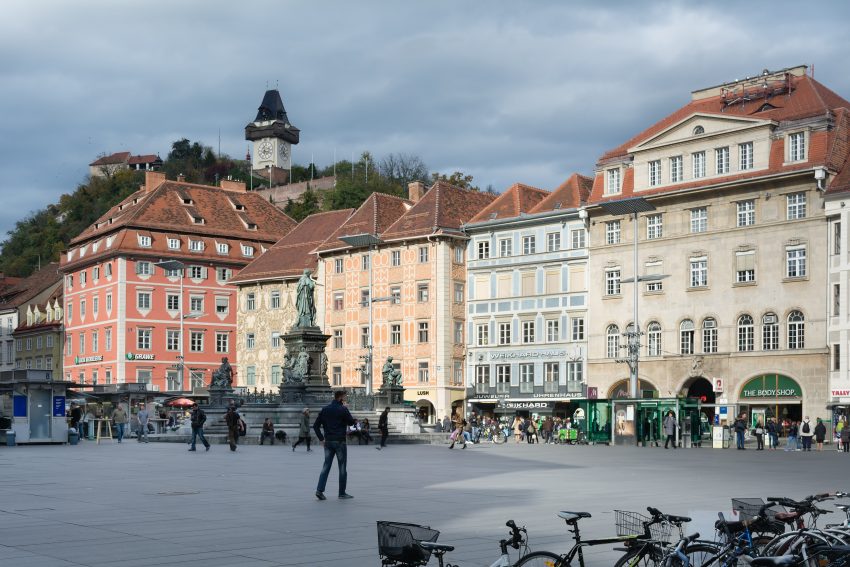
Hauptplatz has been the civic heart of Graz since the medieval town took shape. Regional tourism sources date the square’s creation to around 1160 under Duke Ottokar III, and the setting still reads as a catalogue of Graz’s historic prosperity: late Gothic, Baroque, and Biedermeier façades ring a space that has functioned for centuries as the city’s natural meeting point and marketplace.
That “public stage” role also has a harsher history. Graz Tourismus notes that, up to the late 18th century, Hauptplatz was used for public punishments and even executions; for minor offences people could be displayed in humiliating ways such as in a cage or on a wooden “donkey,” while higher-ranking condemned individuals were executed inside the town hall. This is one of those places where the elegant architecture doesn’t fully hide what civic authority looked like in practice.
What you should actually look for when you’re there is the way old and new planning choices sit together. The square was reshaped into the broad, open event space you see now and officially opened in mid-November 2002 (the redesign decision itself dates back to the early 1990s), which is why the central area feels unusually uncluttered for an old town main square. From there, use the Rathaus façade as your visual anchor and take in the monument-fountain dedicated to Archduke Johann, which dominates the middle of the square and adds a distinctly 19th-century note to a much older urban setting.
Location: Hauptpl., 8010 Graz, Austria | Hours: 24 Hours. | Price: Free.

2. Rathaus
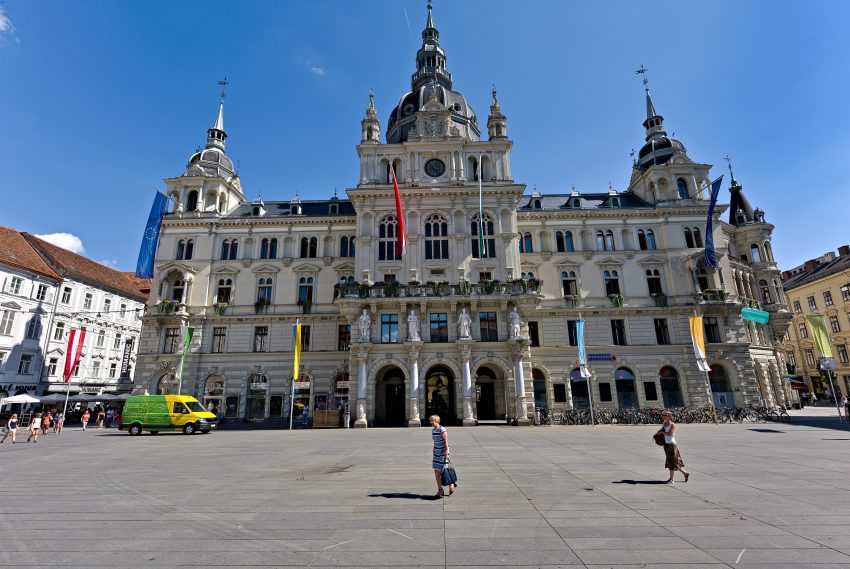
Graz’s Rathaus reflects the city’s growth and self-confidence over time. The city administration moved into a Renaissance town hall around 1550, then replaced it with a larger classical building in 1803.
The current historicist building was completed in 1893, designed by Viennese architects Wielemans and Reuter as Graz expanded rapidly in the 19th century. A memorable detail is that a few narrow houses remain “jammed” into the Herrengasse side because their owners refused to sell—an odd little kink in an otherwise monumental façade.
Inside, the two-storey session hall preserves high-quality late-19th-century features such as the coffered ceiling and gallery, so it’s worth stepping in if it’s accessible when you visit. Even from outside, it’s a good building to use as a visual anchor for the whole square.
Location: Rathaus, Hauptpl. 1, 8010 Graz, Austria | Hours: Monday – Thursday: 08:00–15:00. Friday: 08:00–12:30. Closed on Saturday, Sunday. | Price: Free. | Website
3. Landeszeughaus
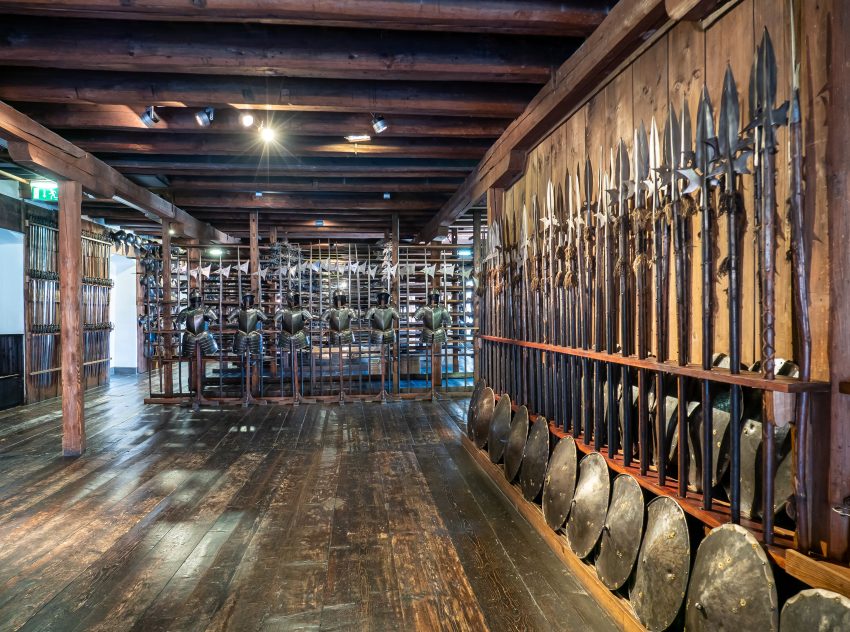
The Landeszeughaus (Styrian Armoury) is closely tied to the region’s military and political history. The Styrian estates had this “regional armoury” built in 1642–44 to plans by Antonio Solar, and it served as a major arms depot in the southeast of the Habsburg Empire.
Today it’s described as the world’s largest preserved historical armoury, displaying around 32,000 objects dating from the 15th to the 18th centuries. The scale is the point: it reads less like a small museum collection and more like an intact storehouse of an earlier defensive system.
What to see is essentially the building’s core experience: floor after floor of weapons and armour in a functional historic setting, where the density and repetition make the historical reality feel tangible rather than abstract.
Location: Herrengasse 16, 8010 Graz, Austria | Hours: Winterschließzeit (January 7 – March 31, 2026): Closed. (Summer) April 1 – October 31, 2026; Tuesday – Sunday: 10:00–18:00. (Winter) November 1, 2026 – January 6, 2027; Tuesday – Sunday: Entry by guided tour only. Guided tours: Tuesday – Sunday: 11:00 (DE) & 12:30 (EN) & 14:00 (DE). | Price: Adults: €13; Seniors/disabled visitors/groups (12+): €11; Ages 19–25 (students/apprentices): €6.50; Ages 6–18: €3; Under 6: free; Family (2 adults + up to 2 children under 14): €26. | Website
4. Glockenspiel
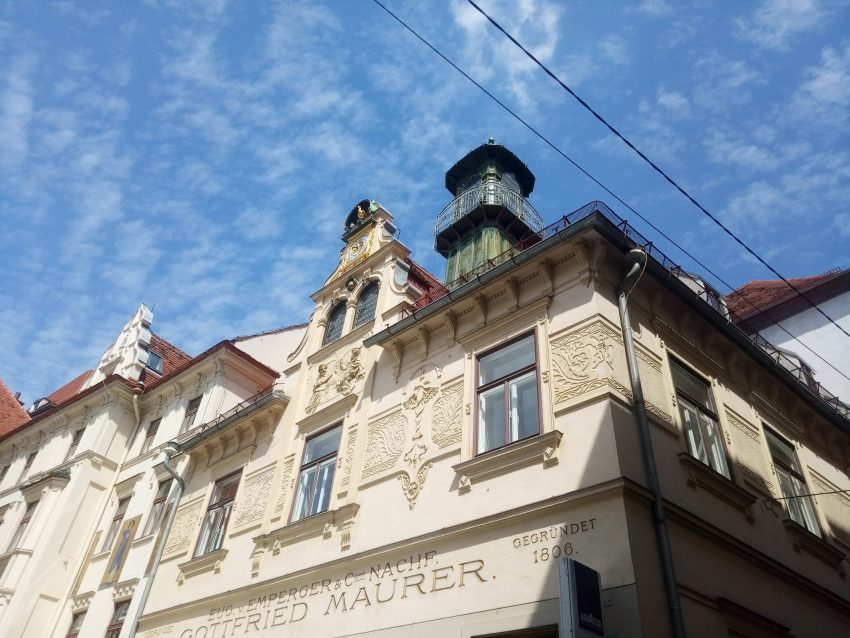
The Glockenspiel exists because a local businessman fell in love with the idea of a carillon elsewhere in Europe. In 1884 the spirits producer Gottfried Maurer bought a house on what was then the “Fliegenplatzl” and had a carillon installed after encountering them on travels to North Germany and Belgium.
The 24 bells chimed for the first time on Christmas Eve 1905, and in 1929 Maurer bequeathed the carillon to the city on the condition that it would continue to exist. During World War II, the bells stopped chiming.
What to see is the brief, theatrical moment when sound and movement turn an ordinary little square into a miniature performance space. It’s best treated as a timed stop: arrive a bit early, pick a vantage point where you can see the figures clearly, and let the sequence play out.
Location: Glockenspielpl. 4, 8010 Graz, Austria | Hours: 24 Hours. | Price: Free.
5. St. Catherine's Church and Mausoleum
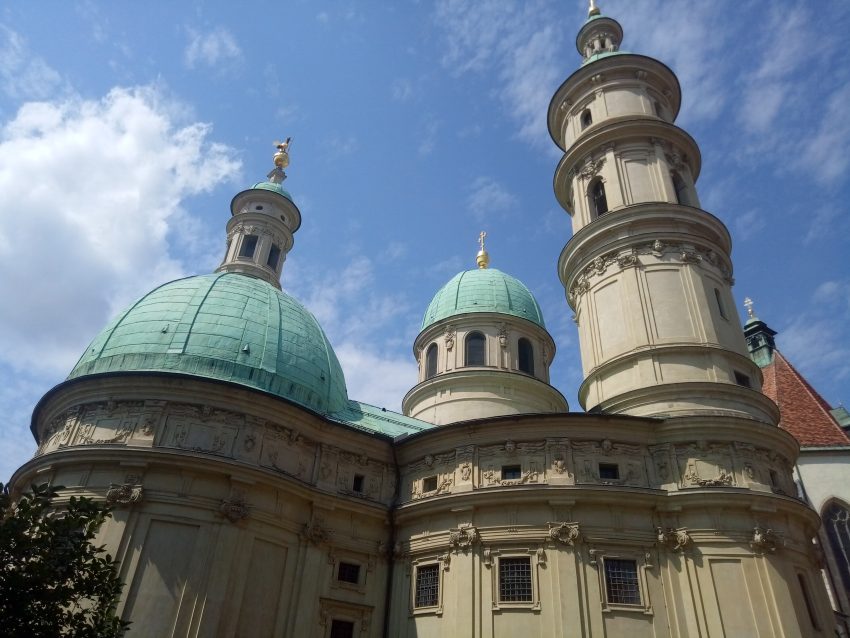
This complex is rooted in Habsburg dynastic ambition and early-17th-century Graz. In 1614 Ferdinand commissioned his Italian court painter and architect to build a mausoleum with an adjacent St. Catherine’s Church beside today’s cathedral, aiming for one of the most important buildings of its era in Austria.
Architecturally, a key historical claim is the oval dome over the tomb chapel: Graz Tourismus notes it was the first of its kind built outside Italy, and the façade shows a taste at the threshold between Renaissance and Baroque.
When you visit, focus on how tightly the ensemble is composed: church and mausoleum read as a single statement. The experience is less about one “must-see object” and more about absorbing the symbolic weight of the site—imperial patronage, Catholic display, and the transition in style all in one place.
Location: Burggasse 3, 8010 Graz, Austria | Hours: (Summer) April 1 – October 31; Tuesday – Sunday: 09:00–18:00. (Winter) November 1 – March 31: Closed. | Price: Free. | Website
6. Cathedral of St. Giles
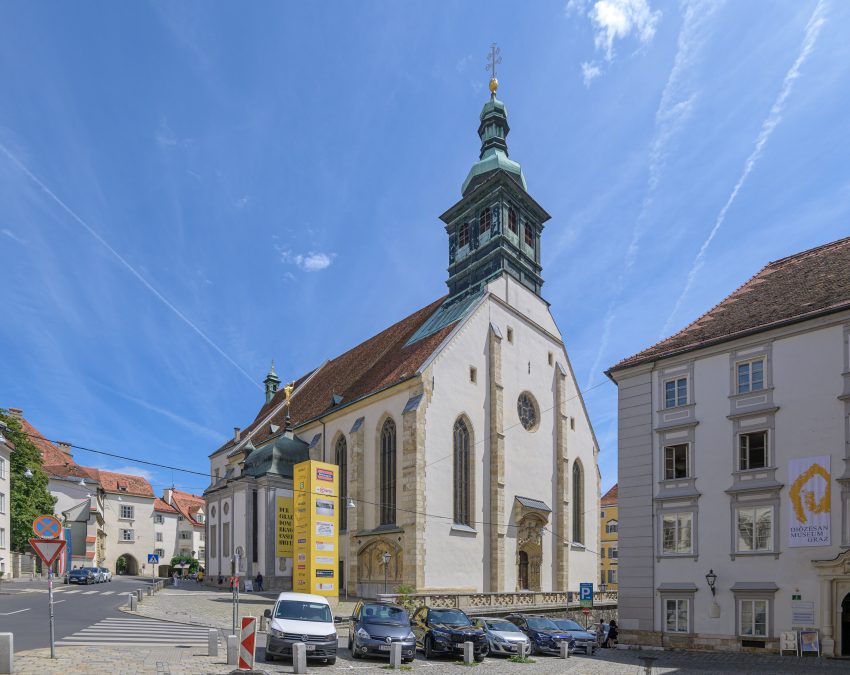
Graz Cathedral is a direct reminder of the period when Graz functioned as an imperial city. Emperor Frederick III erected the church together with his new residence, with late-Gothic construction beginning in 1438; later, as a Jesuit church, it was refurbished in Baroque style, and since 1786 it has been the cathedral for Styria.
One of its most historically specific features is on the exterior: the preserved “Gottesplagenbild” fresco, which refers to the disasters of 1480—locusts, war, and the Black Death—framed as a plea for forgiveness and reconciliation.
Inside, what to see is the deliberate mix: Gothic architecture with richly executed Baroque furnishings. Look for the fresco fragment of St. Christopher that reportedly resembles Frederick III wearing the Styrian ducal crown, and note how the Jesuit period shaped the interior’s grandeur.
Location: Bürgergasse 1, 8010 Graz, Austria | Hours: Check official website. | Price: Free; donations appreciated. | Website
7. Diözesanmuseum
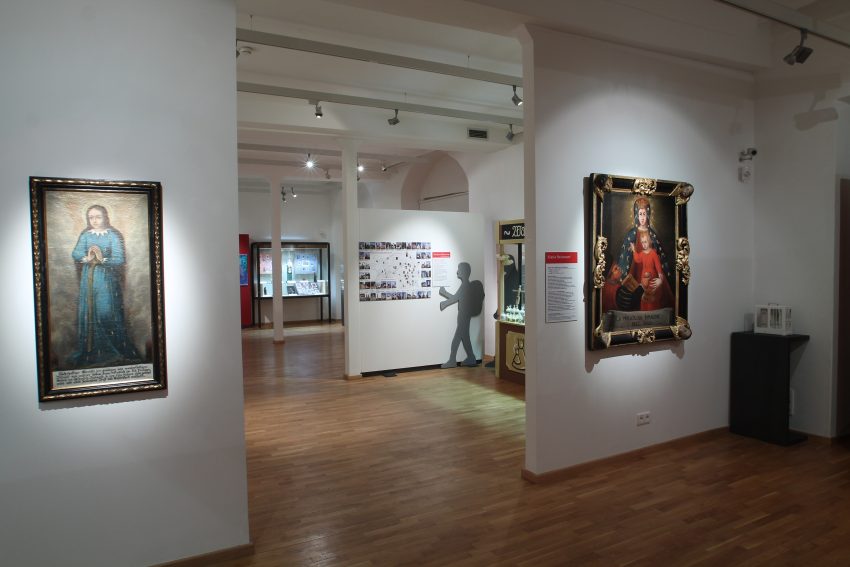
The Diözesanmuseum Graz is the diocesan museum of the Diocese of Graz-Seckau, founded in 1932 on the initiative of Prince-Bishop Ferdinand Pawlikowsky and Johannes Mandl (its first custodian). It began life in three stacked chapels at Graz Cathedral, and from the start it was conceived as a diocesan museum rather than a cathedral treasury museum—partly because Graz doesn’t have a traditional “Domschatz” in the way some cathedral cities do.
Its history is marked by disruption and reinvention. The museum was largely closed from 1938 due to Nazi repression, and in 1942 (during air-raid evacuation measures) parts of the collection were dispersed for safekeeping; it reopened in 1948 but then drifted into a long quiet phase with limited public visibility. A major “new beginning” came in the late 20th century with improved storage and conservation conditions, followed by a general refurbishment in 2002 and, after the Minorites site lease ended, a relocation process that culminated in the opening of the current museum at the Priesterseminar in March 2010.
What to see today is an edited concentration of Styrian church heritage: sacred artworks and religious treasures presented as both art and evidence of local Catholic life, with a permanent display complemented by rotating special exhibitions. The museum explicitly frames itself as a place of “artistic dialogue” that connects the church’s past and present, and it also features focused “spotlight” presentations that unpack individual works in more depth.
Location: Bürgergasse 2, 8010 Graz, Austria | Hours: Tuesday – Friday: 09:00–17:00. Saturday: 11:00–17:00. Closed on Sunday, Monday. | Price: Adults: €6; Reduced: €5.50; Children: €2; Students (up to 25): €2; Family (2 adults + children): €11; Family (1 adult + children): €5.50. | Website
8. Burgtor
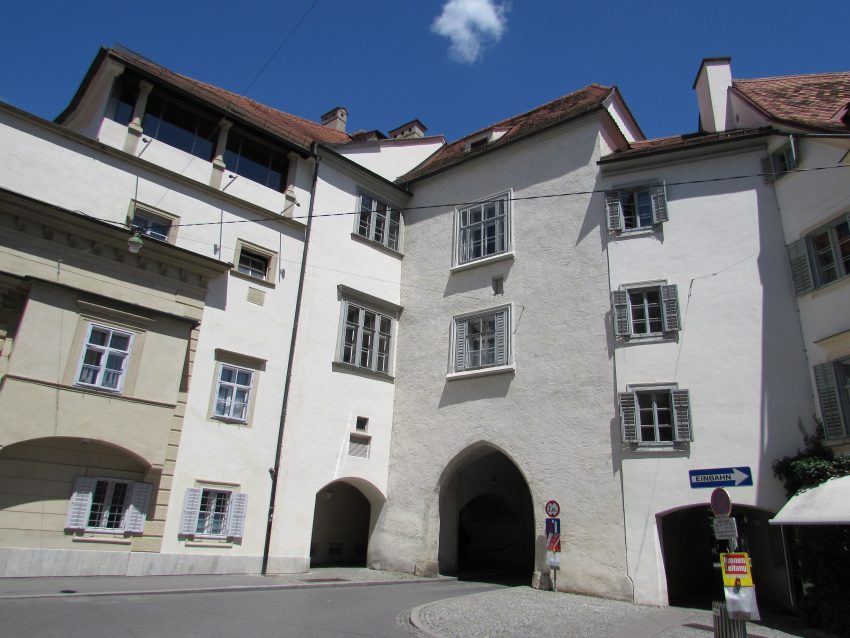
Burgtor is one of the key surviving gateways from Graz’s old fortifications, sitting at the edge of the historic core where Hofgasse meets Erzherzog-Johann-Allee. In the context of the UNESCO-listed historic centre, it’s specifically noted as a Gothic town gate with Renaissance arcades, part of the preserved line of defences around the castle bastion (today the castle garden) and adjacent walls.
Historically, the gate is documented as an older “town gate” that was moved to its present position under Emperor Frederick III, with sources dating the gate at this location to either 1336 or 1346 (the latter tied to its first recorded mention). It later took on the name Burgtor after the Graz Burg (castle) was built nearby in 1440, and it was also known by names such as Pfarrtor and St.-Gilgen-Tor in different periods.
What to look for on site is the contrast in fabric and function. The city-facing side reads as a comparatively plain Gothic gate, while the park-facing side presents the more decorative Renaissance treatment, including the arcaded structure that gives the “Gothic gate + Renaissance arcades” description its literal meaning. Stand on both sides, then take a moment in the passage itself: the experience is less about a single object and more about seeing how a medieval defensive threshold was reshaped and re-presented as the city expanded and the fortifications evolved.
Location: Burgtor, Erzherzog-Johann-Allee, Graz, Austria | Hours: 24 Hours | Price: Free | Website
9. Sporgasse
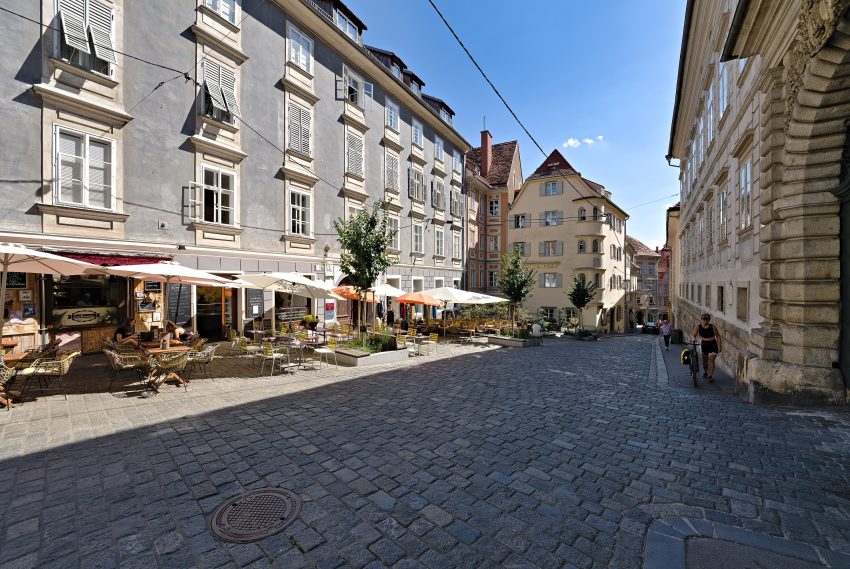
Sporgasse is often described as older than Graz itself in terms of its route history. According to the street’s historical summary, in Roman times this line carried the Strata hungarica, a trade road linking toward Savaria (today Szombathely), and the street later became part of Graz’s urban fabric.
Its name comes from medieval crafts: “Sporgasse” derives from the spur-makers and weaponsmiths who were based here, and a form of the lane name is recorded as early as 1346 before being shortened around 1600.
What to see is the streetscape itself: it’s largely pedestrian and unusually good for reading Graz’s architectural layers in a single run. Even without going building-by-building, the contrast between older façades and later styles is the reward for simply walking its gentle rise.
Location: Sporgasse, 8010 Graz, Austria | Hours: 24 Hours. | Price: Free.
10. Franziskanerkirche
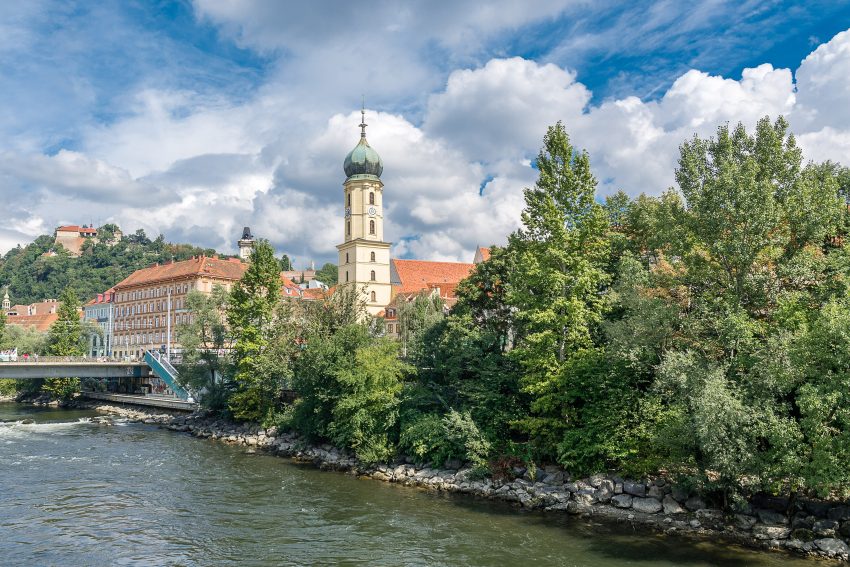
The Franciscan complex sits on some of the oldest religious foundations in the city: Graz Tourismus describes it as the oldest monastery in Graz, founded in 1239 (as a Minorites monastery), in a strategically important position near the former town walls.
That strategic role shaped its appearance. The prominent tower—unusual for a mendicant order—was built in the 17th century as a fortified tower on the orders of the city authorities, and the church later absorbed further historical shocks, including bomb damage to the chancel in World War II followed by a rebuilt contemporary interior.
What to see is the combination of spaces: the Gothic structure, the calmer cloister areas open to visitors seeking silence, and the post-war artistic interventions (including light through stained glass and modern elements in the chancel) that make the building feel historically “layered,” not frozen in one era
Location: Franziskanerpl. 14, 8010 Graz, Austria | Hours: Check official website. | Price: Free; donations appreciated. | Website
11. Kunsthaus
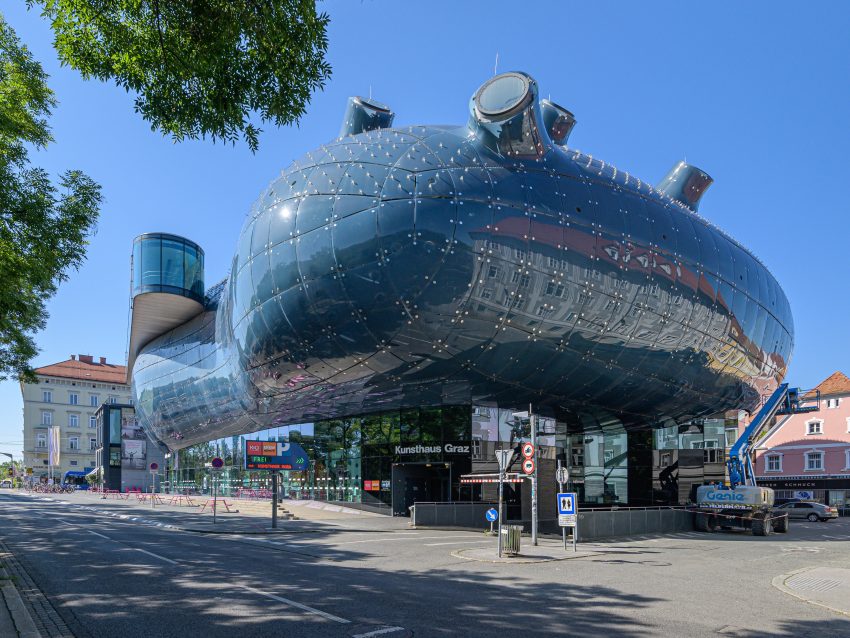
Kunsthaus Graz is a deliberately modern landmark in a historic city, built as part of the European Capital of Culture programme in 2003. It’s become known locally as the “Friendly Alien,” a nickname tied to its biomorphic form and its conscious contrast with the surrounding roofscape.
The building is also a story about urban placement: Graz Tourismus describes the decision to build on the right bank of the Mur (previously a more neglected part of the city) and notes how the project both revitalised an older structure (the Eisernes Haus) and extended it with the new museum.
What to see is as much the architecture as the exhibitions. Pay attention to the “skin” of acrylic elements, the BIX façade that can display light signals and messages, and the viewing elements that frame the city’s older icons—an intentional dialogue between contemporary design and Graz’s traditional landmarks.
Location: Lendkai 1, 8020 Graz, Austria | Hours: Tuesday – Sunday: 10:00–18:00. Closed on Monday. | Price: Adults: €13; Seniors/people with disabilities/groups (12+): €11; Ages under 19: free; Students/apprentices (19–25): €6.50. | Website
12. Murinsel
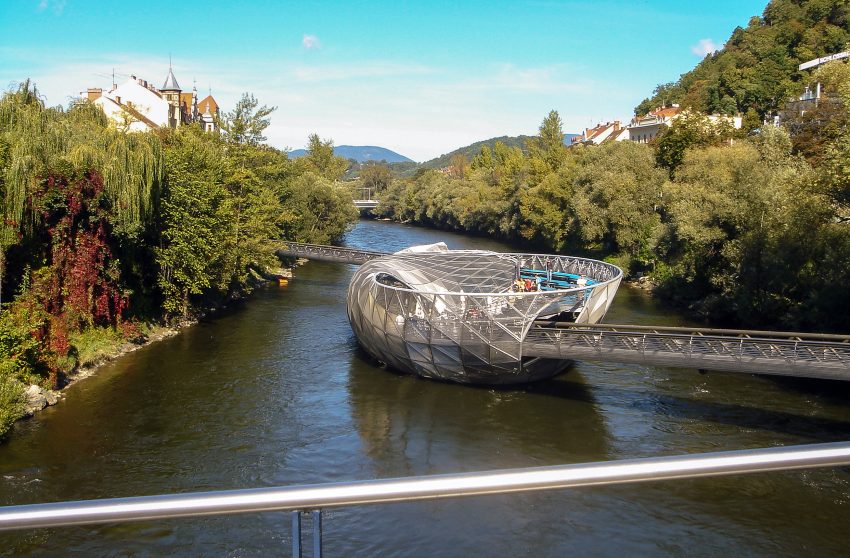
Murinsel is a product of the same cultural moment as Kunsthaus: it was created in connection with Graz as European Capital of Culture 2003, and it was designed by New York artist Vito Acconci, with Graz-born Robert Punkenhofer credited as the inspiration behind the project.
Structurally it’s an accessible artificial “island” in the Mur realised as a 47-metre reticular steel construction, with a curved form likened to a half-open shell. Graz Tourismus notes an amphitheatre-style open section with wave-like benches, and a café under a domed glass roof.
What to see is the whole hybrid: part bridge, part sculpture, part public room. The amphitheatre seating and the sense of being “in” the river (not just next to it) are the main experiences, with additional features for children like rope elements and a slide mentioned by Graz Tourismus.
Location: Lendkai 19, 8020 Graz, Austria | Hours: Tuesday – Sunday: 10:00–20:00. Closed on Monday. | Price: Free. | Website
13. Uhrturm
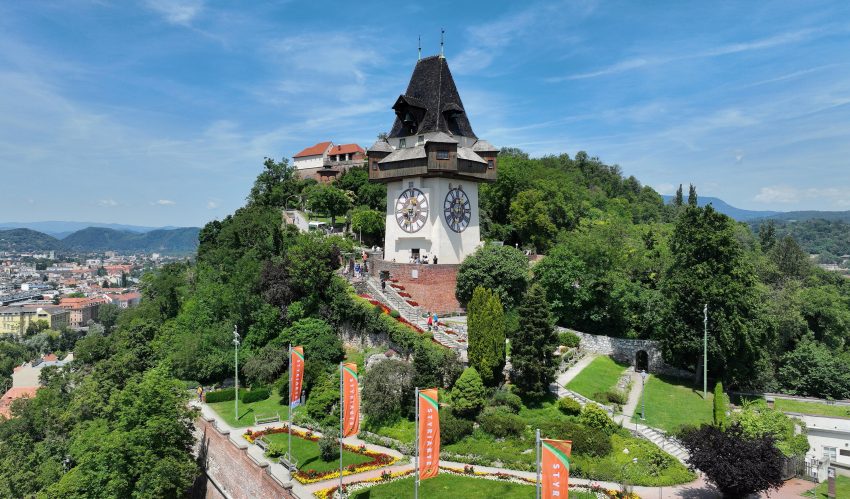
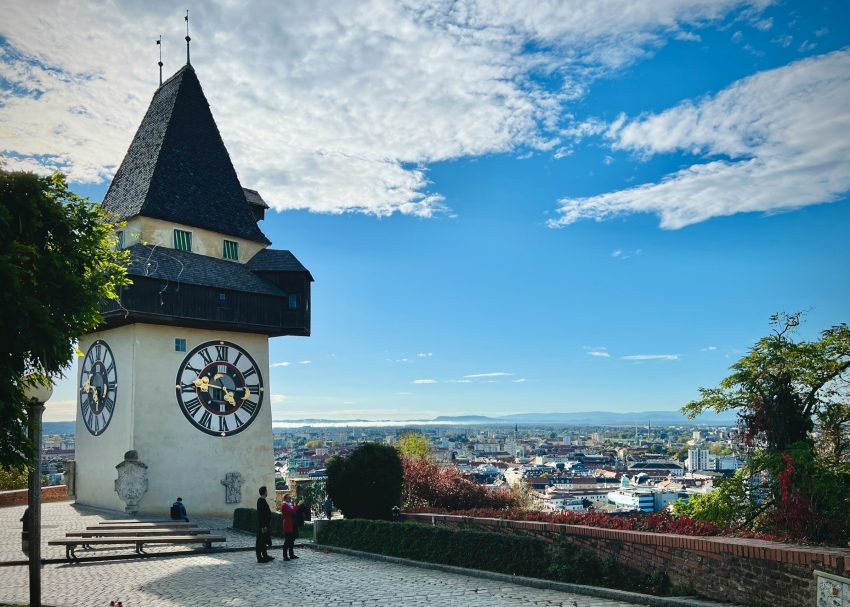
The Uhrturm is a medieval defensive site turned into the city’s emblem. Graz Tourismus notes a tower on this spot is first mentioned in the 13th century, and that during mid-16th-century fortress reconstruction it acquired the form that defines it today, with a characteristic wooden gallery used as a fire station.
Its quirkiest historical detail is the clock itself: the “swapped” hands. The explanation given is that the hour hand was originally the only long hand visible from a distance, and the minute hand was added later—creating the counterintuitive look people often mistake for a fault.
What to see is straightforward: the tower’s silhouette up close, the clock faces, and the view over the rooftops that makes it clear why visibility mattered to both fire watch and city symbolism.
Location: Am Schlossberg, 8010 Graz, Austria | Hours: 24 Hours. | Price: Free. | Website
14. Schlossberg
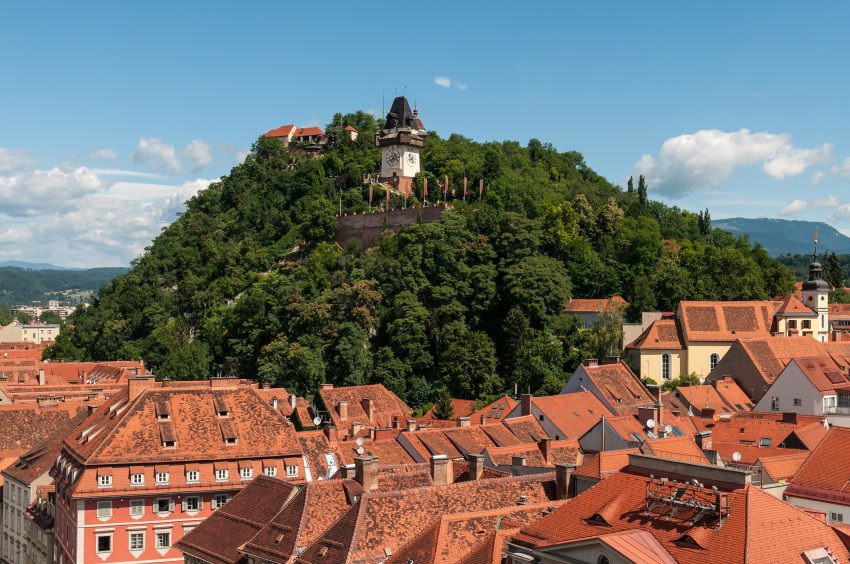
Schlossberg is a former fortress hill that has been repurposed into Graz’s most dramatic urban park. Graz Tourismus describes the mid-16th-century expansion of the fortress and city walls under Northern Italian architects (including Domenico dell’Aglio), and the later moment when Napoleon demanded demolition after 1809—while local payments helped save the Clock Tower and Bell Tower.
Its modern history is equally important to what you see today. The fortress hill was transformed into a romantic park in the 19th century, and the hill’s interior contains an extensive tunnel system built during the Second World War as air-raid shelters, parts of which remain in use as passages and access routes.
What to see is a mix of remnants and viewpoints: the preserved towers, engineered features like the deep “Turkish well” and cistern noted by Graz Tourismus, plus the layered infrastructure that makes the hill feel like a small city in itself—paths, terraces, and historic defensive spaces now serving as public leisure ground.
Location: Am Schlossberg, 8010 Graz, Austria | Hours: 24 Hours. | Price: Free. | Website

Moira & Andy
Hey! We're Moira & Andy. From hiking the Camino to trips around Europe in Bert our campervan — we've been traveling together since retirement in 2020!
This website uses affiliate links which earn a small commission at no additional cost to you.
Walking Tour Summary
Distance: 3.5 km
Sites: 14