Torre Guelfa, Pisa
Tower in Pisa
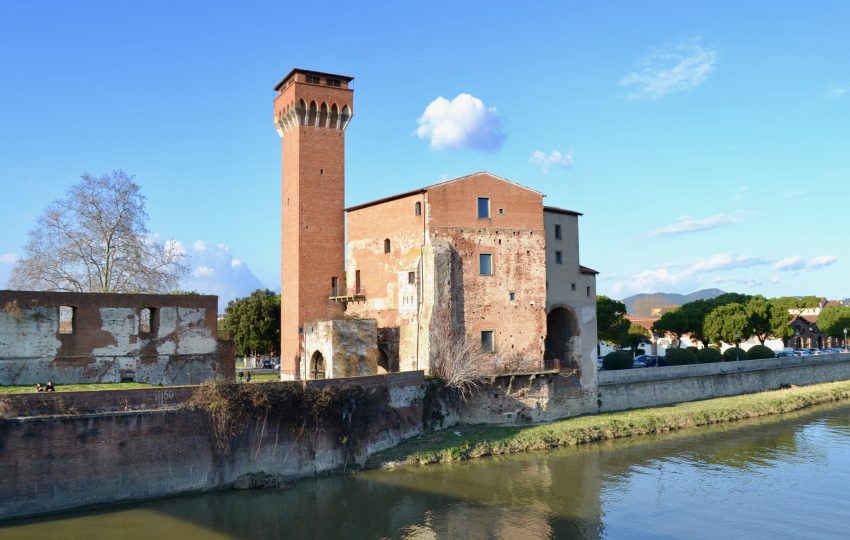
Rising above the Arno in the historic Cittadella Vecchia, the Torre Guelfa (Guelph Tower) is a striking reminder that Pisa's story is about far more than just its famous Leaning Tower. This tall brick tower, first built in the 15th century and rebuilt after wartime destruction, marks the site where the Pisan Republic once built and launched its ships, guarding the river and the approaches to the sea. Today, climbing the tower rewards you with wide open views over the city's rooftops, the gentle arc of the nearby hills and the green expanse of the San Rossore pine forest, making it one of the top sights in Pisa for travellers who enjoy mixing history with big skies and landscapes.
The wider Cittadella area, once known as Tersana, was crowded with medieval shipyards, ramps and workshops that kept Pisa's naval power afloat. Later, in 1394, Iacopo d'Appiano turned the former arsenal into the fortified Cittadella Vecchia to guard against political rivals, and under Florentine rule the complex was reshaped yet again, with the Torre Guelfa built as a powerful symbol standing opposite the now vanished Ghibelline Tower. Walking here today, you can still see traces of that layered past in the surviving brick arches along the Arno and the reconstructed tower itself, which is now open to visitors and a great place to visit on a walking tour of Pisa that ventures beyond the most obvious monuments.
Table of Contents
History and Significance of the Torre Guelfa
In the early 13th century, this stretch of riverfront was known as Tersana, and it functioned as Pisa’s busy maritime workshop. Here you would have found shipyards, storage sheds, slipways for launching vessels and even a small church dedicated to Saints Barbara and Reparata, all clustered within reach of the river. This was the industrial engine behind Pisa’s sea power, where crews prepared for voyages and ships were maintained between campaigns. Over time, as threats from rival factions increased, it became clear that the area needed to be defended as well as productive.
That change came in 1394 when Iacopo d'Appiano, newly in control of Pisa and wary of the pro Gambacorti faction, converted the arsenal into a fortified stronghold. Defensive towers and walls were added, transforming the open working yards into the Cittadella Vecchia, or Old Citadel. Later, during the 15th century under Florentine domination, the complex was reshaped again and the Torre Guelfa was erected, standing in deliberate contrast to the now lost Ghibelline Tower. The very name “Guelf” evokes the long history of rival political factions in medieval Italy, placing this riverfront tower inside a wider network of Tuscan power struggles.
The Second World War left deep scars on this part of Pisa. In 1944 heavy bombing devastated the Cittadella area, seriously damaging the tower and much of the surrounding fabric. For years the site stood as a broken fragment on the riverfront until, in 1956, the Torre Guelfa was rebuilt to match its original appearance. More recent restoration by the municipality has stabilised the structure and opened it to visitors, turning what was once a symbol of military might into a peaceful vantage point over the city and its natural surroundings. Today, the tower embodies several layers of meaning at once: medieval shipyard, fortified citadel, war ruin and, finally, scenic lookout and historical landmark.
Things to See and Do in the Torre Guelfa
Begin your visit with a walk through the Cittadella Vecchia, paying attention to the brick arches and fragments of wall that run along the river. These elements are echoes of the medieval arsenal and later fortifications, and they help you imagine the days when ships were built here and slid directly into the Arno. The setting, with the river curving gently past and the city’s rooftops in the distance, already feels different from the busier central streets.
Once you reach the Torre Guelfa itself, climb up through the interior to the rooftop terrace. The ascent is part of the experience, as narrow stairs and thick walls remind you that this was designed as a defensive lookout, not a decorative tower. From the top, you get a broad panorama of Pisa, framed on one side by the soft line of the nearby mountains and on the other by the deep green of the San Rossore park's pine forest. On a clear day, you can pick out church towers, bridges across the Arno and the dense grid of streets that define the historic centre.
Take a little time at the summit simply to stand and enjoy the breeze and the sounds of the city below. The views here are excellent for photography, especially at golden hour when the light warms the brickwork and the river. After descending, it is worth following the Lungarni for a while, perhaps looping back towards the older parts of the city where you can connect this military and industrial landscape to the churches, palaces and museums you may already have visited.
How to Get to the Torre Guelfa
If you are arriving by air, you will land at Pisa International Airport Galileo Galilei; from there, a short taxi ride or local bus will bring you into the city centre, and you can then continue by bus or on foot along the Lungarni to reach the Cittadella Vecchia and the Torre Guelfa. For the best deals and a seamless booking experience, check out these flights to Pisa on Booking.com.
Travellers arriving by train should head to Pisa Centrale, the main station; from there, you can walk towards the river and follow the Arno upstream to the Cittadella area, or use a local bus or taxi to shorten the journey before finishing with a pleasant riverside stroll to the tower. Use Omnio to easily compare schedules, book train tickets, and find the best prices all in one place for a hassle-free journey across Italy.
If you are travelling by car, follow signs into Pisa from the main regional roads, then park in one of the public car parks near but outside the restricted traffic zone and walk to the Lungarni; from there it is a short walk upstream along the river to the Cittadella Vecchia and the Torre Guelfa. If you are looking to rent a car in Italy I recommend having a look at Discover Cars, first, as they compare prices and review multiple car rental agencies for you.
Practical Tips on Visiting the Torre Guelfa
- Suggested tips: Combine your visit with a riverside walk along the Lungarni and, if time allows, a stop at the nearby Museum of the Ancient Ships to get a fuller picture of Pisa's maritime past.
- Best time to visit: Late afternoon or early evening offers beautiful light for views from the top, especially around sunset when the river and rooftops glow.
- Entrance fee:
- Opening hours:
- Official website:
- How long to spend: Allow around 45 minutes to explore the Cittadella area and climb the tower, longer if you plan to linger on the terrace for photos and views.
- Accessibility: Access to the top involves climbing internal stairs and is not suitable for visitors with significant mobility issues; the area around the base is generally accessible for enjoying river views and the exterior.
- Facilities: Facilities on site are limited, so plan restroom and refreshment stops before or after your visit in nearby cafés or bars along the Lungarni.
- Photography tip: Bring a wide-angle lens or be prepared to use panorama mode to capture both the tower and the sweep of the Arno; sunset shots from the top are especially rewarding.
- Guided tours: If you find a local guided tour including the Cittadella Vecchia, it can add valuable context about the shipyards, fortifications and wartime damage.
- Nearby food options: Head back along the river towards the centre for plenty of trattorias, wine bars and cafés where you can relax after your climb.
Where to Stay close to the Torre Guelfa
For easy access to the Torre Guelfa and the Lungarni, it makes sense to base yourself near the river or the western side of the historic centre. A practical and comfortable choice is Hotel Bologna Pisa, which is within walking distance of both the Arno and many of the main sights. If you prefer to stay closer to the Leaning Tower but still want to reach the Cittadella Vecchia on foot, Grand Hotel Duomo offers a central location near Piazza dei Miracoli with straightforward routes down to the river. Travellers arriving by train might opt for NH Pisa, directly opposite Pisa Centrale, from which it is easy to explore the city's riverfront, towers and historic squares.
Is the Torre Guelfa Worth Visiting
The Torre Guelfa is definitely worth visiting if you are interested in seeing a different face of Pisa beyond the classic postcard views. It ties together several key strands of the city's story: medieval shipbuilding, later fortification under shifting rulers, wartime destruction and, finally, thoughtful restoration for public enjoyment. Climbing the tower gives you one of the best open panoramas in Pisa, with an unusual angle over the river, the city and the surrounding landscape, while a walk through the Cittadella Vecchia adds atmosphere and context. For many visitors, this is the moment when Pisa feels like a real, layered city again rather than just a backdrop for the Leaning Tower.
What Other Travellers Say...

Torre Guelfa in Pisa's historic centre is a medieval tower that once formed part of the city's defensive walls and now serves as an exhibition space and viewpoint; visitors describe climbing external steps or accessing it via a connected exhibition to enjoy panoramic views over the river, the city and even sights toward the Leaning Tower, noting it can be quiet and free to enter, though some have reported inconsistent opening information and mixed experiences with staff.


FAQs for Visiting Torre Guelfa
Nearby Attractions to the Torre Guelfa
- Museum of the Ancient Ships: Located in the former arsenals nearby, this museum displays ancient vessels and artefacts that tell the story of Pisa's maritime heritage.
- Lungarni of Pisa: The river embankments along the Arno, perfect for a scenic stroll linking the Cittadella with bridges and central streets.
- Piazza dei Miracoli: Pisa's famous square with the Leaning Tower, cathedral, baptistery and Camposanto, reachable on foot or by a short bus ride.
- National Museum of San Matteo: An important museum of medieval sculpture, painting and manuscripts housed in a former convent near the river.
- Piazza dei Cavalieri: A historic square dominated by Palazzo dei Cavalieri and the Church of Santo Stefano, offering a different perspective on Pisa's civic and academic history.
The Torre Guelfa appears in our Complete Guide to Visiting Pisa!

Moira & Andy
Hey! We're Moira & Andy. From hiking the Camino to trips around Europe in Bert our campervan — we've been traveling together since retirement in 2020!
This website uses affiliate links which may earn a commission at no additional cost to you!
Nearby Attractions
- Museum of the Ancient Ships (0.2) km
Historic Building and Museum - Lungarni of Pisa (0.4) km
- Santa Maria della Spina (0.5) km
Church - Murale Tuttomondo (0.7) km
Historic Site - Corso Italia (0.8) km
Street - Piazza Vittorio Emanuele II (0.8) km
Square - Palazzo Blu (0.8) km
Gallery and Palace - Orto Botanico dell’Università di Pisa (0.8) km
Gardens - Logge di Banchi (0.9) km
Historic Building - Santo Stefano dei Cavalieri (1.0) km
Church