Tomb of Turpio, Lyon
Roman Site in Lyon
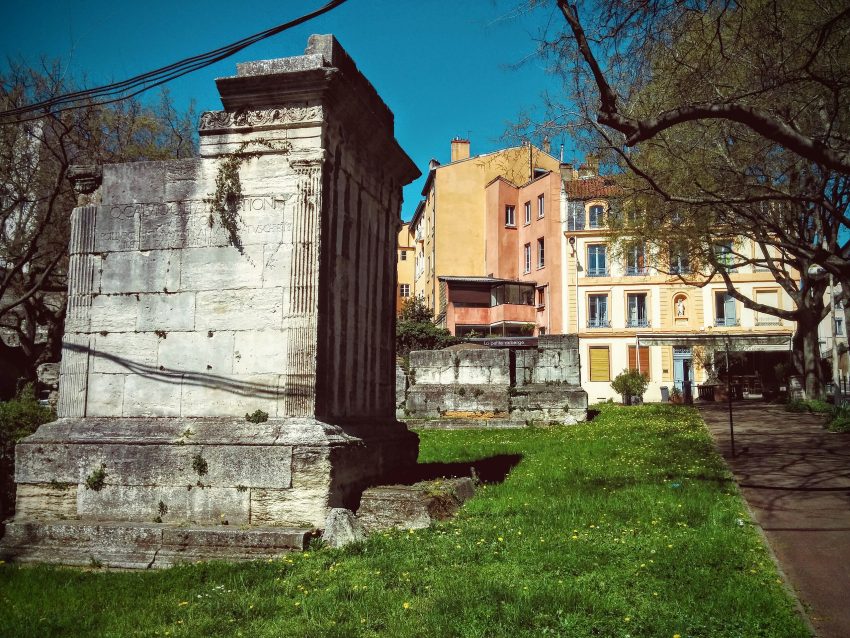
The Tomb of Turpio is one of the must-see places in Lyon if you're fascinated by its Roman past and enjoy visiting sites that most tourists overlook. Set in the Saint-Just district on the slopes of Fourvière Hill, this imposing funerary monument once stood along the Aquitaine Way, the Roman road that connected Lugdunum with the western provinces. Today it rises from Place Eugène-Wernert as a powerful stone reminder that the hilltops around Lyon were once lined not only with theatres and temples, but also with necropolises for the city's dead.
Discovered during clearance work in 1885, the Tomb of Turpio was part of a group of ten monuments associated with the Trion necropolis. Several of these tombs were dismantled and carefully reassembled in their current location, but the mausoleum of Turpio is the best preserved. With its square base, fluted corner pilasters crowned with Ionic capitals, and traces of an elegant frieze, it's easy to imagine the lighter superstructure that once rose above, perhaps sheltering a statue of the deceased. Often visited on Roman walking tours of Lyon that explore the Roman remains on Fourvière, it's a quiet, atmospheric stop that rewards a closer look.
Table of Contents
- History and Significance of the Tomb of Turpio
- Things to See and Do at the Tomb of Turpio
- How to Get to the Tomb of Turpio
- Practical Tips on Visiting the Tomb of Turpio
- Where to Stay close to the Tomb of Turpio
- Is the Tomb of Turpio Worth Visiting?
- FAQs for Visiting Tomb of Turpio
- Nearby Attractions to the Tomb of Turpio
History and Significance of the Tomb of Turpio
In Roman times, burial grounds were placed outside city limits along the main roads, and Lugdunum was no exception. The Trion necropolis developed along the Aquitaine Way, which connected the city to the provinces of Aquitaine and Boulogne. When clearance work in the Saint-Just district cut into this ancient landscape in 1885, workers uncovered a cluster of ten tombs-testimony to a once-impressive funerary avenue. Recognising their importance, archaeologists documented the monuments and relocated five of the larger ones, including Turpio’s, to nearby Place Eugène-Wernert to save them from destruction.
The Tomb of Turpio stands out among this group for both its preservation and its craftsmanship. Built in the early 1st century AD from “Pierre du Midi,” a soft limestone widely used in Lyon at the time, it reflects the city's early imperial prosperity. The nearly four-metre-square base rises to a preserved height of 5.8 metres, with fluted corner pilasters capped by Ionic capitals and fragments of frieze and cornice hinting at the monument's original refinement. Comparisons with similar tombs in places like Beaucaire and Glanum suggest that above this solid base, a lighter architectural crown-perhaps a small colonnade and statue-completed the design.
Beyond its aesthetic appeal, the Tomb of Turpio is significant because it ties together several strands of Lyon's Roman story. It sits at the intersection of major road networks, urban planning, and funerary customs, illustrating how status and memory were expressed in stone. The shift from “Pierre du Midi” to “Pierre de Seyssel” in later centuries also tells us about changing building practices in the region. Together with the nearby reconstructed mausoleums of Julius Severianus, Quintus Valerius, and Satrius, it offers a rare, tangible link to the families who lived-and died-in the shadow of ancient Lugdunum.
Things to See and Do at the Tomb of Turpio
Your visit begins in Place Eugène-Wernert, a small, quiet square in Saint-Just that feels pleasantly removed from the busier streets below. The Tomb of Turpio dominates one side of the space, its blocky, time-worn mass contrasting with the surrounding residential buildings. Start by walking slowly around the base, paying attention to the fluted pilasters at each corner and the Ionic capitals that crown them. Though weathered, these details still speak of skilled stone carving and a desire to project dignity and status long after death.
On one face, you can still make out fragments of the decorative frieze and cornice, which would once have wrapped around the entire monument. Try to imagine how much more elaborate the structure would have looked when new: bright limestone, crisp carvings, and a lighter superstructure rising above, perhaps framing a statue of Turpio himself. Informational panels, if present, may help fill in some of the gaps, but much of the enjoyment comes from simply observing how the monument has aged and survived.
Don’t forget to look at the nearby mausoleums reassembled alongside Turpio’s. The triple mausoleum of Julius Severianus, Quintus Valerius, and a tomb attributed to Julia, along with the mausoleum of Satrius, help put the site into context. Together, they hint at how the Trion necropolis may have looked when these tombs lined the Roman road, each one making a statement about the family it commemorated. From the square, it’s a short walk to other Roman and early Christian sites on the hill, making this spot one of the best places to see in the Tomb of Turpio’s immediate surroundings if you’re building a full Roman-themed itinerary.
How to Get to the Tomb of Turpio
Most visitors arriving from abroad will land at Lyon-Saint Exupéry Airport (LYS), which has regular connections across Europe and beyond. From the airport, the Rhônexpress tram runs into central Lyon, where you can transfer to the metro and then to buses or the funicular up to the Saint-Just and Fourvière area, from which it's a short walk to Place Eugène-Wernert and the Tomb of Turpio. For the best deals and a seamless booking experience, check out these flights to Lyon on Booking.com.
If you're travelling by train, Lyon Part-Dieu and Lyon Perrache are the main gateways. From Part-Dieu, use the metro and funicular from Vieux Lyon - Cathédrale Saint-Jean, or take buses towards Saint-Just; from Perrache, you can either catch a bus that climbs the hill or ride the metro to Vieux Lyon and connect to the funicular before continuing on foot to the square. You can use SNCF Connect to check schedules, compare routes, and purchase tickets for National (SNCF ) and regional trains (TER). For a more streamlined experience, we recommend using Omio, which allows you to easily compare prices, schedules, and book tickets for both National and Regional travel across all of Europe, all in one place.
Arriving by car, follow signs towards Fourvière or the western hills of Lyon, then look for local directions to the Saint-Just district. Street parking can be limited on the slopes, so you may find it easier to park lower down near Vieux Lyon or in a nearby car park and walk or take public transport up to Place Eugène-Wernert and the Tomb of Turpio. If you are looking to rent a car in France I recommend having a look at Discover Cars, first, as they compare prices and review multiple car rental agencies for you.
Practical Tips on Visiting the Tomb of Turpio
- Suggested tips: Bring a short note or map of the surrounding Roman sites so you can easily link the Tomb of Turpio with other nearby remains on the hill.
- Best time to visit: Early morning or late afternoon offers softer light on the stone and a quieter, more contemplative atmosphere in the square.
- Entrance fee:
- Opening hours:
- Official website: [display https://lugdunum.grandlyon.com]
- How long to spend: Allow 15-30 minutes to explore the Tomb of Turpio and the neighbouring mausoleums, plus extra time if you're combining the visit with other nearby Roman sites.
- Accessibility: The square is on a hillside and some approaches are via sloping streets or steps; surfaces are mostly paved, but visitors with reduced mobility should plan their route carefully.
- Facilities: There are no facilities at the monument itself; cafés, bakeries, and toilets can be found in the Saint-Just neighbourhood or down in Vieux Lyon.
- Photography tip: Step back to capture the full height and square base, then move in closer to highlight the pilasters and capitals; side light emphasises the relief of the frieze and stone texture.
- Guided tours: Some guided walks and Roman-themed tours include the Trion necropolis area and Place Eugène-Wernert, providing historical context you won't get from the stones alone.
- Nearby food options: Head towards Saint-Just's local cafés or down to Vieux Lyon for a wider choice of bouchons and restaurants once you've finished exploring the tombs.
Where to Stay close to the Tomb of Turpio
For easy access to the Tomb of Turpio and the wider Fourvière hillside, Villa Florentine is a refined option with beautiful views over Lyon. From here, you can reach Saint-Just and Place Eugène-Wernert on foot or via a short ride, and still be within strolling distance of Vieux Lyon below.
If you prefer to base yourself in the old town and ride up the hill as needed, Cour des Loges Lyon, a Radisson Collection Hotel sits in the heart of Vieux Lyon’s Renaissance streets. From the hotel, it’s easy to catch the funicular or climb up to Saint-Just, then return in the evening to atmospheric lanes filled with shops and bouchons.
For a slightly more relaxed and local feel near the Saône, Collège Hôtel is another appealing choice. You'll be well placed to explore both banks of the river, head up to Fourvière and Saint-Just for Roman sites like the Tomb of Turpio, and then come back down for riverside walks and dinners in the old town.
Is the Tomb of Turpio Worth Visiting?
The Tomb of Turpio is definitely worth visiting if you're interested in Roman history, funerary monuments, or quieter corners of Lyon that still tell big stories. It may not be as visually dramatic as the theatres on Fourvière, but its solid base, carved details, and context within the Trion necropolis make it a compelling stop. Combined with nearby Roman sites and the hillside views, it adds depth and nuance to your understanding of ancient Lugdunum and offers a calm, thoughtful pause in the middle of a busy sightseeing day.
What Other Travellers Say...

Tombeau de Turpio at 1 Montée de Choulans is a small, well-preserved Roman/Gallo‑Roman mausoleum in Lyon’s 5th arrondissement that visitors say can be easy to miss from the street; reviewers note its impressive stonework and consider it the best preserved of several mausoleums in the area, with a brief historical explanation on site and a convenient stop before seeing nearby St Irenaeus or the former Basilica of St Just.


FAQs for Visiting Tomb of Turpio
Nearby Attractions to the Tomb of Turpio
- Parc des Hauteurs - A network of paths and terraces linking viewpoints and historic sites along the ridge of Fourvière, ideal for a scenic walk before or after visiting the tombs.
- Ancient Theatre of Fourvière - The grand Roman theatre on the hill, once seating thousands and still used today for performances and festivals.
- Odeon of Lyon - A smaller, more intimate Roman performance space beside the theatre, designed for music and literary events.
- Gallo-Roman Museum of Lyon-Fourvière - A hillside museum with artefacts, models, and exhibits that explain the wider context of Lugdunum's Roman past.
- Basilica of Notre-Dame de Fourvière - Lyon's iconic hilltop basilica, offering richly decorated interiors and sweeping views over the city.
The Tomb of Turpio appears in our Complete Guide to Visiting Lyon!

Moira & Andy
Hey! We're Moira & Andy. From hiking the Camino to trips around Europe in Bert our campervan — we've been traveling together since retirement in 2020!
This website uses affiliate links which may earn a commission at no additional cost to you!
Nearby Attractions
- Ancient Baths of Lyon (0.4) km
Roman Site - Odeon of Lyon (0.5) km
Roman Site - Ancient Theatre of Fourvière (0.6) km
Roman Site - Gallo-Roman Museum of Lyon-Fourvière (0.6) km
Museum - Basilica of Notre-Dame de Fourvière (0.9) km
Basilica - Abbaye Saint-Martin d’Ainay (0.9) km
Abbey - Parc des Hauteurs (0.9) km
Park - Funiculaire de Lyon (1.0) km
Cable Car - Cathédrale Saint-Jean (1.0) km
Cathedral - Metallic Tower of Fourvière (1.1) km
Tower