San Francesco di Paola, Naples
Church in Naples
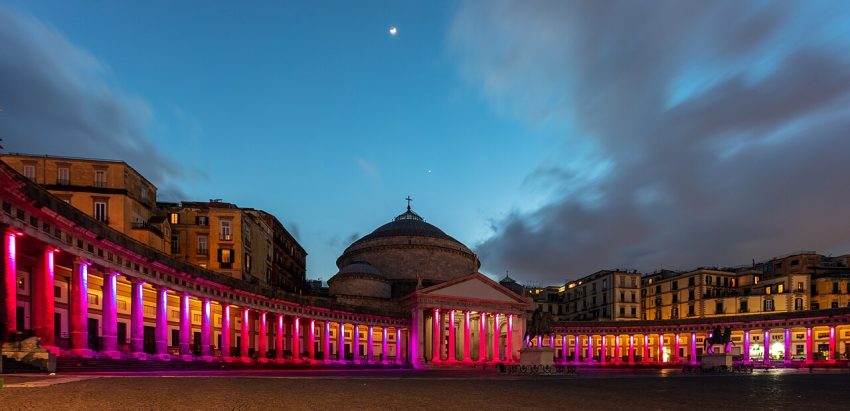
San Francesco di Paola dominates the western side of Piazza del Plebiscito with its wide portico, curved colonnades, and soaring dome, making it one of the must-see places in Naples for architecture lovers. Originally conceived by King Joachim Murat as a monument to Napoleon, the project changed direction after the emperor's fall. When the Bourbon Ferdinand I returned to power, he completed the building in 1816 as a church dedicated to Saint Francis of Paola, a friar who had lived in a monastery on this very site in the 16th century.
The church's design takes direct inspiration from the Pantheon in Rome, translated into a Neapolitan key. A grand portico, designed by Leopoldo Laperuta, leads into the circular main body by Swiss architect Pietro Bianchi, topped by a dome rising to 53 metres. Step inside and you find a bright, symmetrical interior lined with chapels, statues of saints and Fathers of the Church, and altarpieces that reflect different artistic currents of the 18th and 19th centuries. Together with the Royal Palace on the opposite side of the square, San Francesco di Paola is a highlight of any walking tour of Naples, anchoring the city's monumental heart.
Table of Contents
- History and Significance of the San Francesco di Paola
- Things to See and Do in the San Francesco di Paola
- How to Get to the San Francesco di Paola
- Practical Tips on Visiting the San Francesco di Paola
- Where to Stay close to the San Francesco di Paola
- Is the San Francesco di Paola Worth Visiting?
- FAQs for Visiting San Francesco di Paola
- Nearby Attractions to the San Francesco di Paola
History and Significance of the San Francesco di Paola
The story of San Francesco di Paola begins with imperial ambition. In the early 19th century, Joachim Murat, Napoleon's brother-in-law and King of Naples, planned a vast square in front of the Royal Palace as a tribute to the emperor. The site, close to the bay and the seat of power, was ideal for a bold architectural statement that would align Naples with the modern, imperial vision spreading from Paris across Europe. The colonnaded layout and central building were meant to celebrate Napoleonic rule in stone.
History, however, had other ideas. After Napoleon’s defeat and exile, the Bourbon Ferdinand I was restored to the throne and took over Murat’s unfinished project. Rather than scrapping it entirely, he recast its meaning by dedicating the new church to Saint Francis of Paola, a humble friar who had once lived in a monastery on this spot. Completed in 1816, the church blended political symbolism with religious devotion, turning what was meant to be an imperial monument into a shrine that linked Bourbon legitimacy to local piety and tradition.
San Francesco di Paola thus became a powerful emblem of a changing era. Its classical lines and Pantheon-inspired design speak to the neoclassical taste of the time, while its dedication and location on Piazza del Plebiscito connect it to key episodes in Italian history, including the 1860 plebiscite that brought Naples into the unified Kingdom of Italy. Today, it stands not only as an active place of worship, but also as a visual anchor for one of Italy's most memorable urban spaces.
Things to See and Do in the San Francesco di Paola
As you approach from Piazza del Plebiscito, pause to take in the building's façade. The broad portico, supported by six frontal columns and two Ionic pillars at the sides, frames the entrance and sets up the Pantheon-like effect of temple-front plus dome. The curved colonnades stretching out to either side help embrace the square, turning the church into a backdrop for public ceremonies, concerts, and everyday gatherings.
Inside, the circular plan and coffered dome create an immediate sense of symmetry and verticality. The light that filters down into the rotunda highlights the ring of chapels around the perimeter, each enriched with sculptures and paintings. Among the statues, you can spot San Giovanni Crisostomo by Gennaro Calì, Sant’Ambrogio by Tito Angelini, St Luke by Antonio Calì, St Matthew by Carlo Finelli, St John the Evangelist by Pietro Tenerani, St Mark by Giuseppe de Fabris, Sant’Agostino by Tommaso Arnaud, and Sant’Attanasio by Angelo Solani.
The chapels house a series of altarpieces that reward slow exploration. On the right-hand side, look for works such as San Nicola da Tolentino and St Francis of Paola Receives a Stem of Charity from an Angel by Nicola Carta, the Final Communion of San Ferdinando di Castiglia by Pietro Benvenuti, Transit di St Joseph by Camillo Gerra, and depictions of the Immaculate Conception and the Death of Sant’Andrea Avellino by Tommaso de Vivo. At the main altar, an earlier 1641 artwork by Anselmo Cangiano-brought here in 1835 from the church of Santi Apostoli-adds depth to the church’s artistic timeline. In the apse, Vincenzo Camuccini’s St Francis of Paola Resuscitates a Dead Man provides a dramatic focal point, while the sacristy preserves further works, including an Immaculate Conception by Gaspare Landi and a Circumcision of Jesus by Antonio Campi.
How to Get to the San Francesco di Paola
San Francesco di Paola is located on the western side of Piazza del Plebiscito, in the monumental centre of Naples, within easy walking distance of the seafront, the Royal Palace, and Galleria Umberto I. If you are flying into Naples International Airport (Capodichino), taxis, rideshares, and shuttle buses connect you with the city centre in about 20-30 minutes; from there, it is a pleasant walk through central streets to reach Piazza del Plebiscito and the church. For the best deals and a seamless booking experience, check out these flights to Naples on Booking.com.
Travellers arriving by train will come into Napoli Centrale at Piazza Garibaldi, the city's main rail hub. From the station, you can ride the metro or buses toward the historic and monumental districts and then walk the last stretch to the square, or follow a longer walking route that leads through the centre toward the bay and the piazza. Use Omnio to easily compare schedules, book train tickets, and find the best prices all in one place for a hassle-free journey across Italy.
If you are travelling by car, it is usually best to park in a garage near the waterfront, via Toledo, or Piazza Municipio, as the streets around Piazza del Plebiscito are heavily restricted to traffic and not ideal for driving. Once you have parked, you can reach the square and the church on foot within a few minutes, enjoying the open space and monumental architecture along the way. If you are looking to rent a car in Italy I recommend having a look at Discover Cars, first, as they compare prices and review multiple car rental agencies for you.
Practical Tips on Visiting the San Francesco di Paola
- Suggested tips: Dress modestly, as this is an active church, and take a moment to enjoy both the exterior colonnades and the interior dome to appreciate the full Pantheon-inspired design.
- Best time to visit: Late morning or late afternoon often offer softer light in the piazza and quieter moments inside the church between major services or events.
- Entrance fee: Free
- Opening hours: Monday to Saturday: 6:45 am to 12 pm and 4:30 pm to 7:30 pm. Sundays: 8 am to 12 pm.
- How long to spend: Allow 30-45 minutes to explore the interior calmly and then step back into the square for wider views and photos.
- Accessibility: The main entrance is reached via steps, and the interior has relatively level flooring; visitors with reduced mobility should check on-site for the most accessible approach.
- Facilities: There are no large visitor facilities inside, but you will find cafés, restaurants, and shops around Piazza del Plebiscito and nearby streets.
- Photography tip: Capture the church’s portico and colonnades from across the square, then move closer for upward shots of the dome and interior symmetry; be discreet and respectful during services.
- Guided tours: Many city walking tours include San Francesco di Paola as part of a Piazza del Plebiscito stop, giving helpful context on Murat, the Bourbons, and the church's symbolic role.
- Nearby food options: Streets leading from Piazza del Plebiscito toward via Toledo and the seafront are packed with cafés, gelaterie, and restaurants ideal for a post-visit break.
Where to Stay close to the San Francesco di Paola
Staying near San Francesco di Paola and Piazza del Plebiscito puts you right in the monumental heart of Naples, within easy reach of the Royal Palace, Galleria Umberto I, and the seafront. A comfortable, centrally located option is Grand Hotel Oriente, which offers modern rooms and quick access to both the square and via Toledo. If you would like to combine sea views with a short stroll to San Francesco di Paola, Hotel Royal Continental along the Lungomare gives you a scenic walk to the piazza via the waterfront. For a boutique stay in the historic centre but still within walking distance of the church, Santa Chiara Boutique Hotel places you along Spaccanapoli, making it easy to move between the old streets and the monumental square.
Is the San Francesco di Paola Worth Visiting?
San Francesco di Paola is definitely worth visiting, especially if you are already heading to Piazza del Plebiscito to see the Royal Palace and the city's grandest open space. The church offers a striking blend of neoclassical architecture and rich interior decoration, with its Pantheon-inspired dome, sweeping colonnades, and carefully curated sculptures and paintings. It also embodies a key chapter in Naples' political story, from Napoleonic ambitions to Bourbon restoration and later Italian unification. For travellers who enjoy connecting architecture, history, and atmosphere, it is a highlight of any walking tour of Naples and a serene counterpart to the lively streets that surround it.
What Other Travellers Say...

Sanctuary of Saint Francis of Paola sits over a gorge above Paola with a terrace offering magnificent views of the Tyrrhenian Sea; visitors praise its well‑kept grounds, peaceful atmosphere and striking exterior facade, note the simple interior and an adjacent modern chapel used for services, warn of some steep stairs and low openings and that drones aren’t allowed, and mention displays of finely carved nativity scenes at Christmas and Easter plus nearby parking and easy access to the beach.


FAQs for Visiting San Francesco di Paola
Nearby Attractions to the San Francesco di Paola
- Piazza del Plebiscito: Naples' main monumental square, framed by the Royal Palace and San Francesco di Paola, and a hub for events and concerts.
- Royal Palace of Naples (Palazzo Reale): The former Bourbon residence with richly decorated rooms and a long façade facing the square.
- Teatro di San Carlo: One of Europe's oldest and most prestigious opera houses, located just behind the Royal Palace.
- Galleria Umberto I: A 19th-century glass-roofed shopping gallery nearby, mixing elegant architecture with cafés and shops.
- Castel Nuovo (Maschio Angioino): A medieval fortress by the port, a short walk away and a key landmark on Naples' waterfront.
The San Francesco di Paola appears in our Complete Guide to Visiting Naples!

Moira & Andy
Hey! We're Moira & Andy. From hiking the Camino to trips around Europe in Bert our campervan — we've been traveling together since retirement in 2020!
This website uses affiliate links which may earn a commission at no additional cost to you!
Planning Your Visit
Monday to Saturday: 6:45 am to 12 pm and 4:30 pm to 7:30 pm. Sundays: 8 am to 12 pm.
Free
Nearby Attractions
- Piazza del Plebiscito (0.1) km
Square - Bourbon Tunnel (0.1) km
Historic Site - Royal Palace of Naples (0.2) km
Palace - Napoli Sotterranea (0.3) km
Historic Site - Teatro di San Carlo (0.3) km
Theatre - Galleria Umberto I (0.4) km
Shopping Centre - Castel Nuovo (0.6) km
Castle - Fontana del Gigante (0.7) km
Fountain - Castel Ovo (0.8) km
Castle - San Martino Monastery (1.1) km
Monastery and Museum