Porte de Mars, Reims
Historic Site in Reims
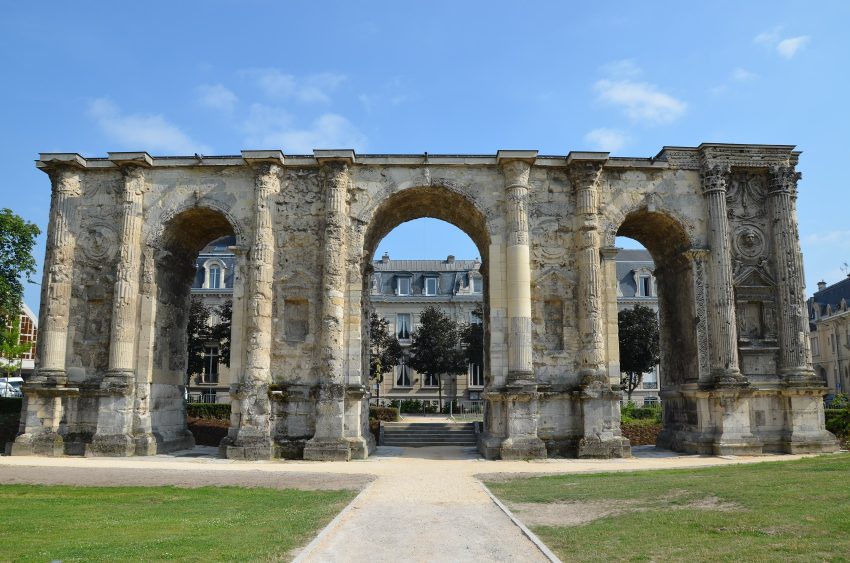
Porte de Mars is the kind of sight that resets your sense of Reims. After Gothic towers and coronation stories, you suddenly find yourself face-to-face with a colossal Roman arch-an unmistakable reminder that Reims was already an important city long before medieval France took shape. Standing near the edge of the centre, it feels both monumental and strangely approachable, because you can walk right up to it and read its details at close range.
It's one of the best places to see in Reims if you want to connect the city to its deeper Roman identity as Durocortorum, and it's a highlight of any walking tour of Reims because it adds a completely different time period to your day without requiring a museum ticket or a long detour.
Table of Contents
- History and Significance of the Porte de Mars
- Things to See and Do in the Porte de Mars
- Practical Tips on Visiting the Porte de Mars
- Where to Stay close to the Porte de Mars
- Add a Is the Porte de Mars Worth Visiting?
- FAQs for Visiting Porte de Mars
- For Different Travelers
- Nearby Attractions to the Porte de Mars
History and Significance of the Porte de Mars
Porte de Mars is a Roman triumphal arch dating to the early 3rd century AD and is historically associated with the Gallo-Roman city of Durocortorum, the ancestor of modern Reims. It once formed part of a broader system of city gates, and it is the only one of those gates that still survives, which makes it a rare, tangible fragment of Roman urban planning in the city.
Its name is traditionally linked to a nearby temple dedicated to Mars, and the arch's very presence speaks to the civic confidence of Roman Reims. Triumph arches were not merely decorative; they were statements of status, imperial order, and the city's connection to the wider Roman world. In Reims, this arch became part of later defensive and urban structures, showing how one monument can be continuously repurposed as the city's needs change.
Over the centuries the arch was incorporated into medieval fortifications and later urban fabric, sometimes partially obscured, sometimes protected by sheer accident. The fact that it was rediscovered and fully revealed only after later demolition of walls tells you something important about Reims: the city is layered, and many of its most compelling stories come from what survived beneath later centuries rather than what remained continuously visible.
Things to See and Do in the Porte de Mars
Start by walking around the arch rather than only viewing it front-on. The scale is easiest to appreciate when you let it fill your peripheral vision and then step back to see how the three openings align. From there, move closer and treat the surface like a carved narrative rather than a single façade.
Look up into the ceilings of the passageways, where much of the carving work is concentrated. The reliefs include mythological scenes and figures that can feel surprisingly lively: a mix of legend, symbolism, and glimpses of everyday labour. Even if you don’t identify every character, you can still enjoy the Roman habit of filling monumental architecture with storytelling detail.
Then take a moment to place the arch within the city's geography. Porte de Mars makes most sense when you think of it as a threshold: a gate that once organised movement in and out of Roman Reims. If you're visiting other history-heavy stops like Musée Saint-Remi, this becomes a perfect “open-air” counterpart-one is objects in a museum, the other is the city's ancient stone still standing in public space.
Practical Tips on Visiting the Porte de Mars
- Suggested tips: Visit early or late in the day for better light on the carvings, then pair it with a walk toward the historic centre for a smooth, story-driven route.
- Best time to visit: Morning for quieter surroundings, or golden-hour late afternoon for the most flattering light on the reliefs.
- Entrance fee: Free.
- Opening hours: Open-air monument with unrestricted viewing; access may vary if areas are fenced for maintenance.
- How long to spend: 20-40 minutes, longer if you enjoy studying carvings and walking a full loop around the arch.
- Accessibility: Generally accessible from surrounding paths, though paving and kerbs can vary in an open public-space setting.
- Facilities: No on-site facilities; plan cafés and toilets in central Reims nearby.
- Photography tip: Try angled shots from the corners to capture depth, then one close-up upward shot inside a passageway to show the carved ceiling.
- Guided tours: A guided walk is useful if you want the relief scenes decoded and tied back to Roman Durocortorum.
- Nearby food options: Head back toward the centre for cafés and lunch streets once you’ve finished the arch visit.
Where to Stay close to the Porte de Mars
For a city break that includes both Roman and Gothic Reims, a central base keeps everything walkable and flexible. Best Western Premier Hôtel de la Paix is a comfortable choice close to the main walking streets and a convenient midpoint for reaching Porte de Mars and the cathedral quarter. Holiday Inn Reims - Centre is a practical option that makes it easy to move between the arch, central cafés, and museum stops. If you want to be right by the cathedral area for early starts and evening strolls, La Caserne Chanzy Hotel & Spa, Autograph Collection keeps you anchored in the heart of the historic centre.
Add a Is the Porte de Mars Worth Visiting?
Yes, especially because it delivers something Reims’ medieval sights cannot: a direct, outdoor encounter with the city’s Roman roots. It’s quick to visit, visually dramatic, and surprisingly rewarding if you give it a few extra minutes to study the reliefs rather than treating it as a simple photo stop.
It's also worth it as a connective experience. Once you've seen Porte de Mars, museums and churches in Reims start to feel part of a longer continuum, and the city's identity as Durocortorum becomes more than a name-it becomes a real place you can stand inside.
FAQs for Visiting Porte de Mars
What Other Travellers Say...

Porte de Mars in Reims is the remains of an expansive Roman triumphal arch set in a small, flower-planted park near the city centre and transport links; visitors praise its well-preserved stonework and intricate carvings, note it's easy to access and photogenic, and mention nearby seating, hammocks and a café-style spot for relaxing or quick workouts, making it a pleasant stop for history lovers, photographers or anyone wanting a quiet moment in a leafy urban setting.


For Different Travelers
Families with Kids
This is a very family-friendly stop because it’s outdoors, free, and visually big in a way that children immediately understand. The best approach is to make it a short, active visit: walk through the arches, look up at the ceilings, and pick a few carvings to “spot” together without trying to interpret everything.
Pair it with a treat stop afterward in central Reims. It's an easy way to balance history with downtime, and it won't drain energy the way long indoor museums sometimes do.
Couples & Romantic Getaways
For couples, Porte de Mars is a lovely contrast to the cathedral district. It's less crowded, more open-air, and it gives your Reims visit a sense of depth-Roman, medieval, modern-without feeling like you're following the standard script.
Visit in late afternoon when the light is softer, then stroll back toward the centre for Champagne or dinner. It makes for a simple, elegant mini-itinerary that feels distinctly Reims.
Budget Travelers
Porte de Mars is ideal for budget travellers because it's free and genuinely memorable. Use it as one of your key history stops alongside free church interiors, then choose one paid experience-like a palace visit or a cellar tour-based on your priorities.
Because it’s close to the centre, it also costs nothing in transport, which helps keep the day efficient.
Nearby Attractions to the Porte de Mars
- Place de la République: A central square area that can be used as a stepping stone between the arch and the city centre.
- Reims Cathedral: The city's essential Gothic landmark and coronation church, packed with sculpture and stained glass.
- Palais du Tau: The archbishops' palace next to the cathedral, tied to coronation lodging and ceremony culture.
- Musée Saint-Remi: A museum in the former royal abbey that explores Reims from Roman times to the Renaissance.
- Basilique Saint-Remi: A UNESCO basilica with a serene Romanesque nave and the tomb of Saint Rémi.
The Porte de Mars appears in our Complete Guide to Visiting Reims!

Moira & Andy
Hey! We're Moira & Andy. From hiking the Camino to trips around Europe in Bert our campervan — we've been traveling together since retirement in 2020!
This website uses affiliate links which may earn a commission at no additional cost to you!
Planning Your Visit
Open-air monument with unrestricted viewing; access may vary if areas are fenced for maintenance.
Free.
Nearby Attractions
- Musée de la Reddition (0.3) km
Museum - Musée Hôtel Le Vergeur (0.5) km
Museum - Reims Cryptoporticus (0.5) km
Roman Site - La Maison Mumm (0.6) km
Historic Building - Place Royale (0.7) km
Palace - Chapelle Foujita (0.7) km
Church - Joan of Arc Statue (0.8) km
Statue - Reims Cathedral (0.8) km
Cathedral - Musée des Beaux-Arts (0.8) km
Gallery - Palais du Tau (0.9) km
Palace


