Manasija Monastery, Belgrade
Monastery near Belgrade
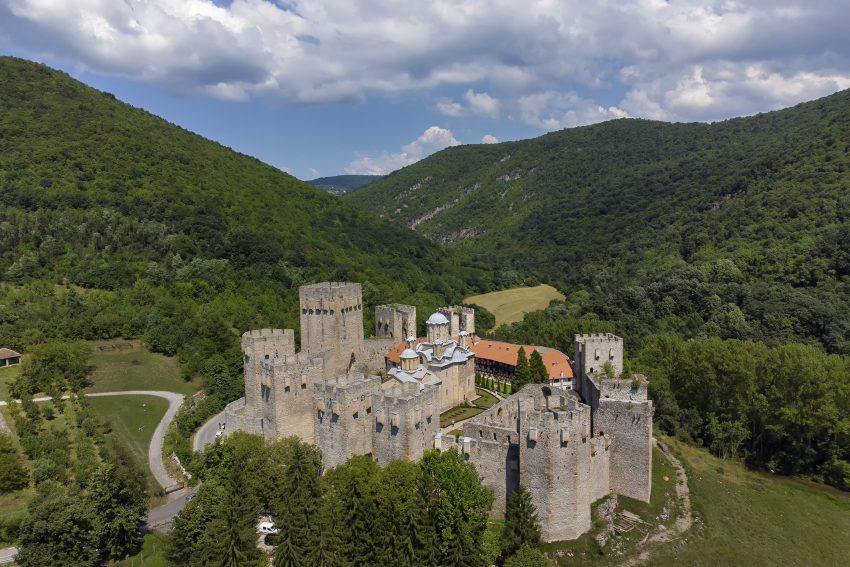
Manasija Monastery is one of the most impressive religious and historical sights in Serbia, set in the Resava gorge near Despotovac and wrapped in mighty stone walls that make it feel more like a fortress than a typical monastery. Founded by Despot Stefan Lazarević in the early 15th century, it is both a living Orthodox monastery and one of the defining monuments of medieval Serbian culture, so it works equally well as a spiritual stop, an architectural highlight, or a major point on a wider eastern Serbia road trip.
For travelers exploring this part of the country, Manasija is one of the best places to visit because it offers much more than a quick photo stop. You get defensive towers, a serene church interior, important frescoes, and a strong sense of place, whether you arrive on a dedicated day trip or include it as part of a walking or driving route through Despotovac, Resava Cave, and the surrounding countryside.
Table of Contents
- History and Significance of the Manasija Monastery
- Things to See and Do in the Manasija Monastery
- How to Get to the Manasija Monastery
- Practical Tips on Visiting the Manasija Monastery
- Where to Stay Close to the Manasija Monastery
- Is the Manasija Monastery Worth Visiting?
- For Different Travelers
- FAQs for Visiting Manasija Monastery
- Nearby Attractions to the Manasija Monastery
History and Significance of the Manasija Monastery
Manasija Monastery was built as the endowment of Despot Stefan Lazarević, with construction running from about 1406 or 1407 to 1418. It emerged in the difficult period after the Battle of Kosovo and was conceived not only as a monastery but as a strongly defended complex, which explains the monumental walls and towers that still set it apart from many other monastic sites in the Balkans.
Its importance goes well beyond architecture. Manasija became one of the great cultural centers of the Serbian Despotate, closely associated with the Resava School, a major center for copying, translating, and preserving manuscripts. That intellectual role, combined with the artistic quality of its surviving frescoes and the unusual sophistication of its fortifications, is a large part of why the monastery is regarded as one of the high points of late medieval Serbian culture.
The site is also closely tied to Stefan Lazarević himself, who was buried here after his death in 1427. UNESCO’s World Heritage Centre notes the monastery’s exceptional artistic and architectural value, especially the blend of sacral design, military engineering, and fresco painting, which together make Manasija a rare and unusually complete medieval ensemble.
Things to See and Do in the Manasija Monastery
The first thing most visitors notice is the dramatic fortified enclosure. The towers and ramparts give the monastery a defensive profile that feels almost castle-like, and this is one of the main reasons Manasija stands out even among Serbia’s many beautiful monasteries. Walking through the grounds, the contrast between the heavy outer walls and the calm inner courtyard is part of the experience.
Inside the church, the surviving frescoes are the real highlight. Only part of the original painted decoration remains, but what survives is widely regarded as artistically outstanding, with figures and scenes that still carry an extraordinary sense of refinement. Even if you are not normally drawn to religious art, this is one of those places where the atmosphere and craftsmanship tend to slow people down.
It is also worth taking a little time simply to absorb the setting. The monastery lies in attractive countryside near Despotovac, and many travelers sensibly combine it with Resava Cave or other eastern Serbia stops to create a fuller day out. If you like places that combine history, scenery, and a bit of quiet, Manasija is especially rewarding.
How to Get to the Manasija Monastery
Manasija Monastery is near Despotovac in eastern Serbia, roughly 135 km south-east of Belgrade, so most international visitors reach it as a day trip or overnight stop from the capital. The nearest major airport for most travelers is Belgrade Nikola Tesla Airport, from where continuing by road is the simplest option. For the best deals and a seamless booking experience, check out these flights to Belgrade on Booking.com.
There is no especially straightforward direct train journey to the monastery itself, which is why most visitors do not rely on rail for the final approach. A more realistic public transport plan is to use intercity bus connections toward Despotovac and then continue locally by taxi or arranged transfer, while train travel is usually better suited to broader Serbia itineraries than to the final access to Manasija. Train schedules and bookings can be found on Omio.
By car, this is an easy and sensible historic-site excursion if you want flexibility, especially because the wider area has several worthwhile stops that pair well together. Driving also gives you the clearest route for combining Manasija Monastery with Resava Cave and nearby nature spots in a single day.
Practical Tips on Visiting the Manasija Monastery
- Entrance fee: Free.
- Opening hours: Daily: 09:00–18:00.
- Official website:
- Best time to visit: Spring and early autumn are especially pleasant, with milder temperatures and a calmer atmosphere around the monastery grounds.
- How long to spend: Around 1-2 hours is enough for most visitors, though longer works well if you like architecture, frescoes, and slow-paced cultural stops.
- Accessibility: The grounds are manageable for many visitors, but as with many historic monastic sites, some surfaces can be uneven and access may not be fully step-free throughout.
- Facilities: Expect basic visitor facilities rather than a large museum-style setup, so it is best to arrive prepared and treat it as an active religious site.
Where to Stay Close to the Manasija Monastery
For a culture-heavy itinerary, it makes most sense to base yourself in or near Despotovac so you stay close to Manasija, Resava Cave, and the other major eastern Serbia sights without wasting time on long transfers.
Despotovac is the practical base here because it keeps you near the monastery and the wider Resava area, and it suits travelers who want to explore at a relaxed pace rather than rush in from Belgrade. A sensible option is Hotel Resava, which is convenient for local sightseeing and works well if you want a straightforward base close to the main attractions. For a quieter countryside stay with easier access to the wider region, Motel Kruna is often considered by road-trippers exploring beyond just the monastery.
If your main focus is nature as much as heritage, staying in the broader Despotovac or Resava area is more rewarding than a purely urban base, since it lets you combine the monastery with caves, viewpoints, and waterfalls without backtracking. Another practical nearby option is Hotel Petrus, which is a little farther away but can work well for travelers arriving by road and linking this stop with other central Serbia destinations.
Is the Manasija Monastery Worth Visiting?
Yes, definitely. Manasija Monastery is one of the strongest single historical sights in Serbia because it feels distinctive, visually memorable, and culturally important all at once, with fortress walls, a beautiful church, and real medieval weight rather than a more generic religious stop.
The honest pivot is that travelers who are not interested in churches, frescoes, or medieval heritage may find it quieter and more contemplative than exciting. If your trip is focused almost entirely on nightlife, urban energy, or fast-paced sightseeing, it may work better as part of a wider eastern Serbia day out rather than as the main reason for the journey.
What Other Travellers Say...

Reviewers describe a beautifully preserved medieval monastery/fortress with a serene, spiritual atmosphere, impressive history, and notable features like frescoes and strong surrounding walls. Visitors appreciate the cleanliness, welcoming feel, easy access from the freeway, and practical amenities such as free entry and ample on-site parking, with optional paid access to climb the walls. Several suggest visiting on weekdays or in mild weather to avoid crowds, and note nearby attractions and a well-regarded souvenir shop.


For Different Travelers
Families with Kids
Families with kids will often find Manasija easier than many museum visits because the fortress-like exterior gives the site immediate visual appeal. The towers, walls, and enclosed grounds help younger visitors engage with the setting, especially if you frame it as a medieval stronghold rather than only a monastery.
That said, it still works best for families who enjoy calm cultural stops rather than highly interactive attractions. Pairing it with somewhere more active nearby, such as a cave or nature stop, usually makes the day more balanced.
Couples & Romantic Getaways
For couples, Manasija works well as a quiet and atmospheric stop with a very photogenic setting. The combination of stone walls, forested surroundings, and the peaceful monastery courtyard gives it a reflective feel that suits slower travel.
It is especially good for couples building a scenic day through eastern Serbia rather than staying only in Belgrade. Add a countryside lunch and one or two nearby sights, and it becomes part of a very appealing day trip.
Budget Travelers
Budget travelers will appreciate that Manasija is generally free to enter and does not require a complicated or expensive visit. If you are already exploring Serbia by bus or car, it is one of the better-value cultural stops in the country.
The main budget issue is transport rather than admission. The easiest way to keep costs sensible is to combine it with other nearby attractions on the same day, rather than making a special trip only for the monastery.
History Buffs
History buffs should put Manasija high on their Serbia list. This is not just a beautiful monastery but a major late medieval foundation linked directly to Despot Stefan Lazarević, the Resava School, and one of the most distinctive fortified religious complexes in the region.
It is the kind of place where the details matter, from the defensive logic of the walls to the surviving frescoes and burial associations. Even compared with other important Serbian monasteries, Manasija has an unusually strong combination of political, artistic, and architectural significance.
FAQs for Visiting Manasija Monastery
Getting There
Tickets & Entry
Visiting Experience
Tours, Context & Itineraries
Photography
Accessibility & Facilities
Food & Breaks Nearby
Safety & Timing
Nearby Attractions to the Manasija Monastery
- Resava Cave: One of the region’s best-known natural sights, this cave pairs very naturally with a monastery visit for a balanced half-day or full-day outing.
- Veliki Buk Waterfall: A scenic waterfall stop that adds fresh air and landscape to a heritage-focused itinerary.
- Despotovac: The nearest town is the practical base for food, accommodation, and organizing the wider visit.
- Krupaj Spring: A beautiful natural spring in eastern Serbia that suits travelers who want another peaceful stop in the same broader region.
- Just Out Festival grounds: If you are visiting at the right time of year, the monastery’s surroundings can take on a very different feel during the annual medieval-themed festival.
The Manasija Monastery appears in our Complete Guide to Visiting Belgrade!

Moira & Andy
Hey! We're Moira & Andy. From hiking the Camino to trips around Europe in Bert our campervan — we've been traveling together since retirement in 2020!
This website uses affiliate links which may earn a commission at no additional cost to you!
Planning Your Visit
Daily: 09:00-18:00.
Free.
Nearby Attractions
- Golubac Fortress (64.4) km
- Beli Dvor (109.4) km
Historic Building, Historic Site and Palace - Cathedral of Saint Sava (111) km
Cathedral, Church and Religious Building - House of Flowers (111.1) km
Mausoleum, Memorial and Museum - Museum of Yugoslavia (111.2) km
Historic Site, Mausoleum and Museum - Nikola Tesla Museum (111.4) km
Museum - Tašmajdan Park (111.7) km
Area and Park - St. Mark's Church (111.9) km
Church, Historic Building and Religious Building - Skupština (112.2) km
Attraction, Historic Building and Notable Building - Old Palace (112.3) km
Historic Building, Historic Site and Palace