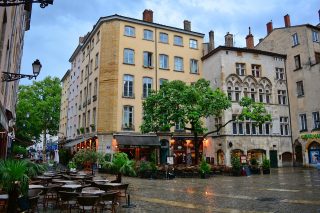
Longue Traboule, Lyon
Historic Building in Lyon

Traboules are one of the top attractions in Lyon if you love the feeling of stepping behind a door and suddenly finding yourself in another world. These hidden passageways slip through buildings and courtyards, linking one street to another in ways that don't appear on a simple city map. Originally created as practical shortcuts-especially for silk workers carrying heavy bolts of fabric-they also offered shelter from bad weather and a discreet way to move around the city. Today, most visitors encounter traboules in Vieux Lyon, Croix-Rousse, and parts of the Presqu'île, where they still hide behind ordinary-looking doors and gateways.
Among the most famous is the Longue Traboule in Vieux Lyon, running from 54 Rue Saint-Jean to 27 Rue du Bœuf via four buildings and five courtyards. As you walk its length, stone arches, spiral staircases, and quiet inner courtyards unfold one after another, creating the sense of a secret spine running through the old town. It's a great place to visit on a walking tour of Lyon, especially if you enjoy peeling back layers of history that most people walk straight past.
Table of Contents
- History and Significance of the Traboules of Lyon
- Things to See and Do in the Traboules of Lyon
- How to Get to the Traboules of Lyon
- Practical Tips on Visiting the Traboules of Lyon
- Where to Stay close to the Traboules of Lyon
- Is the Traboules of Lyon Worth Visiting?
- FAQs for Visiting Traboules of Lyon
- Nearby Attractions to the Traboules of Lyon
History and Significance of the Traboules of Lyon
The origins of Lyon's traboules stretch back at least to the Renaissance, and some passages may be even older. In Vieux Lyon, they provided a sheltered way for residents to reach the river, warehouses, and workshops without being exposed to wind and rain in the narrow streets. On the slopes of Croix-Rousse, they became particularly important for the canuts, the silk workers whose livelihoods depended on moving delicate silk and heavy rolls of cloth quickly across the hill. Rather than spending time navigating steep streets, they cut through the heart of blocks, saving time and effort.
Architecturally, traboules are a fascinating blend of practicality and beauty. Many are lined with arches, galleries, and staircases that reveal the internal organisation of Renaissance townhouses. Some open into light-filled courtyards framed by loggias and stone balustrades, while others remain dim and tunnel-like, with only glimpses of sky overhead. Because they sit somewhere between public and private space, they also tell a story about how neighbours, merchants, and families once shared access and responsibilities within a dense urban fabric.
The Longue Traboule is a perfect example of this layered history. Its length and succession of courtyards show how multiple properties were stitched together by a single pedestrian route. In modern times, traboules gained new symbolic importance during the Second World War, when the Resistance used them as discreet routes through the city. Today, many are listed or protected, and the city works with residents to keep a selection open to the public. Walking these passages has become one of the things to do in Lyon that connects everyday exploration with the city's deeper past.
Things to See and Do in the Traboules of Lyon
Start in Vieux Lyon, where several traboules are signposted with small plaques near their entrances. The Longue Traboule between Rue Saint-Jean and Rue du Bœuf is a classic choice: step through the first doorway and follow the passage as it threads through courtyards and stairwells, watching how the light changes and how the architecture shifts from one building to the next. Each courtyard has its own character, from plain stone walls to more decorative facades with mullioned windows and galleries.
In Croix-Rousse, the traboules feel different again. Here, many passages are taller and more vertical, reflecting the hill’s steep slopes and the silk workshops they once served. As you move through them, look up to see the tall, narrow windows of former weaving studios, or down to notice worn stone steps shaped by centuries of foot traffic. Some traboules in this district also open onto viewpoints or small landings that offer glimpses over rooftops and down towards the city.
You can explore traboules on your own using printed maps or local signs, or join a guided tour that explains their social, economic, and wartime roles in more detail. Guided visits are particularly helpful for finding less obvious entrances and understanding which passages are currently accessible. This spot is one of the best places to see in Lyon not as a single monument, but as a network of experiences-each doorway leading you into a slightly different corner of the city's soul.
How to Get to the Traboules of Lyon
Most visitors arrive via Lyon-Saint Exupéry Airport (LYS), which connects the city to many European and international destinations. From the airport, take the Rhônexpress tram into central Lyon, then transfer to the metro to reach Vieux Lyon - Cathédrale Saint-Jean or Croix-Rousse, both excellent starting points for exploring traboules. For the best deals and a seamless booking experience, check out these flights to Lyon on Booking.com.
If you're travelling by train, Lyon Part-Dieu and Lyon Perrache are the main stations. From Part-Dieu, use the metro to reach Vieux Lyon - Cathédrale Saint-Jean for the old town traboules or Croix-Rousse station for the hilltop passages; from Perrache, tram and metro links will bring you quickly to the same areas, from which you can continue on foot. You can use SNCF Connect to check schedules, compare routes, and purchase tickets for National (SNCF ) and regional trains (TER). For a more streamlined experience, we recommend using Omio, which allows you to easily compare prices, schedules, and book tickets for both National and Regional travel across all of Europe, all in one place.
For those arriving by car, it's usually easiest to park on the Presqu'île or in underground car parks near the Saône and Rhône, then explore Vieux Lyon and Croix-Rousse on foot or by metro and funicular. If you are looking to rent a car in France I recommend having a look at Discover Cars, first, as they compare prices and review multiple car rental agencies for you. The narrow, historic streets and frequent pedestrian zones make walking the most enjoyable and practical way to access traboule entrances.
Practical Tips on Visiting the Traboules of Lyon
- Suggested tips: Respect that many traboules run through residential buildings-keep noise low, avoid lingering outside private doors, and follow any posted rules.
- Best time to visit: Mornings or late afternoons on weekdays tend to be quieter, making it easier to enjoy the atmosphere and take photos without crowds.
- Entrance fee: Free for publicly accessible traboules; paid guided-tours are available for deeper insight and access to selected passages.
- Opening hours: Some public traboules are open during daytime hours only; specific times can vary, and certain doors may be locked outside core hours, usually from 7:00 AM to 7:00 PM is ok.
- How long to spend: Allow 1-2 hours to explore a handful of traboules in Vieux Lyon or Croix-Rousse, or half a day if you're combining both districts with a guided tour.
- Accessibility: Many passages include steps, uneven cobbles, and occasional steep sections, so they may be challenging for visitors with reduced mobility or pushchairs.
- Facilities: Traboules themselves have no facilities; cafés, shops, and toilets are available nearby in Vieux Lyon, Croix-Rousse, and on the Presqu'île.
- Photography tip: Be discreet when taking photos, especially in residential courtyards-focus on architectural details like arches, staircases, and galleries rather than windows or people.
- Guided tours: Official walking-tours are a great way to learn the history and ensure you're using passages that are open and approved for public access.
- Nearby food options: In both Vieux Lyon and Croix-Rousse you'll find plenty of bouchons, bakeries, and cafés where you can refuel between traboule-hunting sessions.
Where to Stay close to the Traboules of Lyon
If you want to be right among the traboules of Vieux Lyon, Cour des Loges Lyon, a Radisson Collection Hotel is an atmospheric choice set in Renaissance buildings threaded with courtyards and passageways of their own, just steps from some of the most famous traboules.
For easy access to both Vieux Lyon and Croix-Rousse, Collège Hôtel near the Saône offers a quirky, central base. From here, you can walk into the old town or take public transport up to Croix-Rousse to explore traboules in both districts without long transfers.
If you prefer staying on the Presqu’île while remaining within walking distance of many traboule entrances, Hôtel des Artistes places you by the river, with quick access to bridges leading into Vieux Lyon and metro links up to Croix-Rousse.
Is the Traboules of Lyon Worth Visiting?
The traboules of Lyon are absolutely worth visiting if you're at all interested in how a city really works beneath the surface. Rather than a single monument, they offer a network of experiences: glimpses of Renaissance courtyards, steep staircases once used by silk workers, and quiet inner worlds hidden behind ordinary doors. Walking even a few of these passages adds a unique, atmospheric dimension to your trip and helps you understand why they remain a highlight of any walking tour of Lyon.
What Other Travellers Say...

Traboule et Cour des Voraces at 9 Pl. Colbert in Lyon is a tucked-away 19th-century passage notable for its striking six‑storey staircase, popular with photographers and street‑art visible throughout; visitors note a compact green space at the north entrance, an elevator to reach the top if you prefer not to climb, and a sense of hidden history—residents once used the passage for discreet movement and there are no on-site information panels, so it's best visited if you're interested in architecture, photography, or local wartime lore.


FAQs for Visiting Traboules of Lyon
Nearby Attractions to the Traboules of Lyon
- Vieux Lyon - The city's Renaissance old town, packed with narrow lanes, historic facades, and plenty of traboule entrances to discover.
- Miniature and Cinema Museum - A fascinating collection of film props and hyper-realistic miniatures housed in the Maison des Avocats in Vieux Lyon.
- Basilica of Notre-Dame de Fourvière - The hilltop basilica overlooking the city, easily combined with traboule explorations via the funicular from Vieux Lyon.
- Mur des Canuts - A vast trompe-l'œil mural in Croix-Rousse celebrating the district's silk-working heritage and everyday life.
- Saône River Quays - Scenic riverfront paths at the foot of Vieux Lyon and Croix-Rousse, perfect for a relaxed stroll between traboule-hunting sessions.
The Longue Traboule appears in our Complete Guide to Visiting Lyon!

Moira & Andy
Hey! We're Moira & Andy. From hiking the Camino to trips around Europe in Bert our campervan — we've been traveling together since retirement in 2020!
This website uses affiliate links which may earn a commission at no additional cost to you!
Planning Your Visit
Some public traboules are open during daytime hours only; specific times can vary, and certain doors may be locked outside core hours, usually from 7:00 AM to 7:00 PM is ok.
Free for publicly accessible traboules; paid guided tours are available for deeper insight and access to selected passages.
Nearby Attractions
- Miniature and Cinema Museum (0.0) km
Museum - Place de la Basoche (0.0) km
Square - Cour d’Appel (0.1) km
Historic Building - Maison du Chamarier (0.1) km
Historic Building - La Tour Rose (The Pink Tower) (0.1) km
Historic Building and Tower - Vieux Lyon (0.1) km
Area - Cathédrale Saint-Jean (0.1) km
Cathedral - Musée Gadagne (0.2) km
Museum - Saône River (0.2) km
River - Funiculaire de Lyon (0.2) km
Cable Car