Great Synagogue, Budapest
Synagogue in Budapest
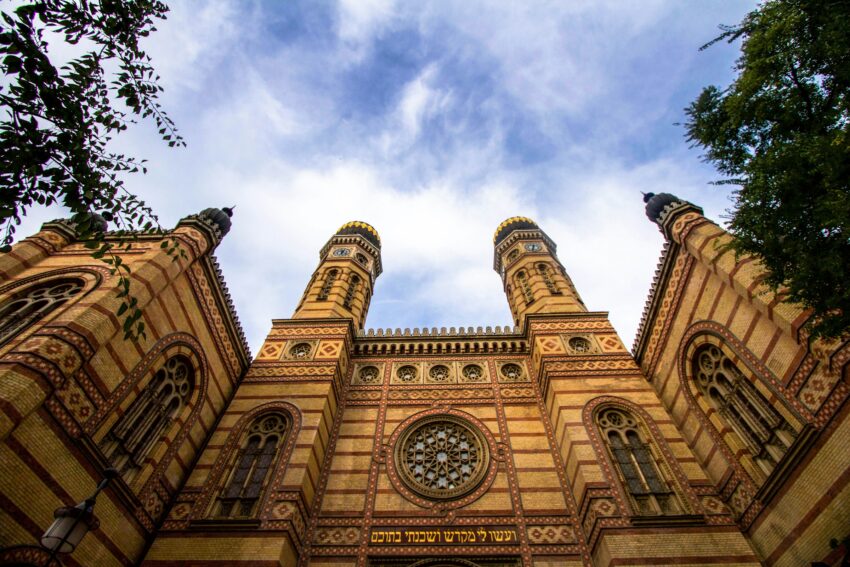
Budapest's Great Synagogue (often called the Dohány Street Synagogue) rises in the heart of Pest's Jewish Quarter, a few minutes' walk from the city's busiest boulevards yet emotionally worlds apart. Built in the 1850s for the Neolog Jewish community, it is among the largest synagogues on earth, and its striped brickwork, twin octagonal towers, and onion domes make it one of the most recognizable silhouettes in the city.
It's a place many visitors fold into a walking tour of the Jewish Quarter or a “best places to see” day in central Budapest, but the experience is more than architectural sightseeing. The synagogue sits within a larger complex that includes the Jewish Museum, the Heroes' Temple, a graveyard, and Holocaust memorials, and the surrounding streets still carry the weight of the ghetto boundary that ran here during World War II.
History and Significance of the Great Synagogue
Construction began in the mid-19th century, when Budapest’s Neolog community wanted a monumental synagogue that reflected both Jewish tradition and a modern, city-facing identity. The result was a richly detailed Moorish Revival design by Viennese architect Ludwig Forster, a style choice that reads immediately from the street in the patterned brickwork and the domed towers.
The site's meaning deepened dramatically during World War II, when Dohány Street marked the edge of the Budapest Ghetto. The complex today is inseparable from that history: remembrance is built into the visit through the memorial garden and the burial ground, where victims of the Holocaust are laid to rest alongside non-Jews who risked their lives to save others.
After wartime damage and decades of neglect under communist rule, the synagogue underwent a major restoration in the 1990s that returned its exterior and interior to the grandeur visitors see now. That restoration is part of why the building feels so striking today: it is simultaneously a living place of worship and a carefully preserved record of a community’s endurance.
Things to See and Do in the Great Synagogue
Start outside and take a moment to read the building before you go in. The twin towers and onion domes are the headline, but the façade’s Moorish Revival detailing rewards a slower look, especially if you approach from the Jewish Quarter streets where the synagogue suddenly fills your view.
Inside, the scale is what most people remember first: a soaring nave (nearly 40 feet high) with layered Gothic, Romantic, and Byzantine influences. Seating follows traditional practice, with men on the ground floor and women in the upper galleries, and the overall capacity reaches roughly 3,000 worshippers. The organ is another defining feature, with a newer instrument replacing the original 19th-century organ.
Don’t treat the synagogue as a single-room stop. The Jewish Museum and archives add essential context through objects and exhibits that connect everyday religious life to Budapest’s broader Jewish story. The memorial areas and graveyard are quieter, slower spaces where many visitors end up spending more time than expected, reading names and pausing in reflection.
How to Get to the Great Synagogue
Budapest is served by Budapest Ferenc Liszt International Airport (BUD), with most visitors reaching the city center by airport shuttle, taxi, or public transit connections. For the best deals and a seamless booking experience, check out these flights to Budapest on Booking.com.
If you’re arriving by rail, Budapest’s major stations (including Keleti, Nyugati, and Déli) connect to international and domestic routes, and from there it’s easy to continue by metro, tram, or taxi into the Jewish Quarter area. Train schedules and bookings can be found on Omio.
Within Budapest, the synagogue is in central Pest on Dohány utca, close to Astoria and Deák Ferenc tér, so it's straightforward to reach by metro and then finish on foot. If you're driving, expect city-center traffic and limited parking; using a garage and walking the last stretch is usually less stressful.
Practical Tips on Visiting the Great Synagogue
- Official website: https://www.greatsynagogue.hu/
- Entrance fee: Adults: 14500 HUF; Students: 12000 HUF.
- Opening hours: (Seasonal) Sunday – Thursday: 10:00–16:00 (January 7 – February 28); 10:00–18:00 (March 1 – April 30); 10:00–20:00 (May 1 – September 30); 10:00–18:00 (October 1 – October 31); 10:00–16:00 (November 2 – December 31). (Seasonal) Friday: 10:00–16:00 (March 1 – October 31); 10:00–14:00 (November 2 – December 31). Saturday: Closed.
- Best time to visit: Go early on a weekday for a calmer interior and more breathing room in the museum and memorial areas; avoid Saturdays, when it is typically closed.
- How long to spend: Plan 1.5-2.5 hours for the synagogue plus museum and memorial spaces, longer if you like to read exhibits carefully.
- Accessibility: Step-free access is available to key areas, but some older sections and galleries may involve stairs; ask staff on arrival about the easiest route.
- Facilities: Expect security screening at entry; coverings are usually available if you need help meeting the modest dress code.
Where to Stay Close to the Great Synagogue
Staying in District VII (Erzsébetváros) or the edge of District V puts you within an easy walk of the Great Synagogue and makes it simple to return at a quieter hour after seeing the busier parts of the center. Look for a hotel or apartment on a side street off Károly körút or near Deák Ferenc tér if you want strong transit connections without being directly on the loudest nightlife blocks.
What Other Travellers Say...
Ornate domes top this lavish Moorish-style synagogue, with a museum, cemetery & Holocaust memorial.





FAQs for Visiting the Great Synagogue
The Great Synagogue appears in our Complete Guide to Visiting Budapest!

Moira & Andy
Hey! We're Moira & Andy. From hiking the Camino to trips around Europe in Bert our campervan — we've been traveling together since retirement in 2020!
This website uses affiliate links which may earn a commission at no additional cost to you!
Planning Your Visit
(Seasonal) Sunday - Thursday: 10:00-16:00 (January 7 - February 28); 10:00-18:00 (March 1 - April 30); 10:00-20:00 (May 1 - September 30); 10:00-18:00 (October 1 - October 31); 10:00-16:00 (November 2 - December 31).
(Seasonal) Friday: 10:00-16:00 (March 1 - October 31); 10:00-14:00 (November 2 - December 31).
Saturday: Closed.
Adults: 14500 HUF; Students: 12000 HUF.
Nearby Attractions
- Kazinczy Street (0.3) km
Area - Gozsdu Courtyard (0.4) km
Courtyard - Vaci Street (0.6) km
Activity - St. Stephen's Basilica (0.8) km
Basilica, Church and Tower - Central Market Hall (0.9) km
Market - Chain Bridge (1.1) km
Abbey - Castle Bazaar (1.3) km
Gardens - Gellert Hill (1.4) km
Hill - Gellert Spa Bath (1.4) km
Abbey and Spa - Shoes on the Danube Bank (1.5) km
Memorial