Chain Bridge, Budapest
Abbey in Budapest
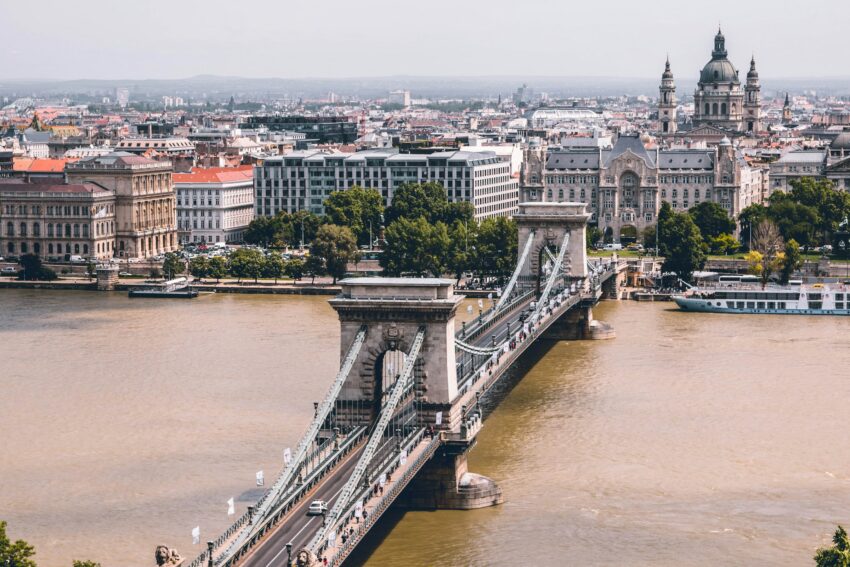
The Chain Bridge, or Széchenyi Lánchíd, is the most famous crossing over the Danube in Budapest and one of the clearest symbols of how Buda and Pest became a single city in the imagination of travelers. It links Széchenyi István tér on the Pest side with Clark Ádám tér at the foot of Castle Hill, so even a simple walk across it feels like moving between two of Budapest's most important historic settings.
What makes it so memorable is not just the bridge itself, but the setting around it. From the pavements you get one of the city's classic panoramas, with the Danube below, Buda Castle rising behind one end, and the grand buildings of central Pest stretching out behind the other. After its major renovation, it is once again a central part of the everyday city as well as a must-do stop for visitors.
Table of Contents
History and Significance of the Chain Bridge
The Chain Bridge was the first permanent bridge across the Danube in Hungary, and that alone explains much of its importance. Opened in 1849 and associated with the reform era vision of Count István Széchenyi, it represented modern engineering, stronger national connections, and a practical answer to the old problem of getting reliably between Buda and Pest in all seasons. It was designed by William Tierney Clark and built under the supervision of Adam Clark, whose name still marks the square on the Buda side.
Its symbolism deepened in the twentieth century. The bridge was destroyed during the Second World War, then rebuilt and reopened in 1949, giving it a second life as a monument to resilience as well as progress. That layered history is part of why locals and visitors treat it as more than infrastructure: it is a landmark that carries the story of Budapest itself.
The recent renovation added another chapter. Today the bridge remains a defining piece of the central Danube panorama. Even if you have seen it in photographs before arriving, it still has the rare quality of feeling both monumental and completely woven into daily life.
Things to See and Do in the Chain Bridge
The simplest pleasure here is to walk the full length of the bridge and stop midway for the river views. From the centre span you can look north toward the Parliament, south toward the riverfront embankments, and back toward the elegant urban set-pieces at each end. Early morning is calmer, while dusk and evening bring out the atmosphere that makes this one of Budapest’s classic photo spots.
Do not rush past the stone lions at either end, because they are among the bridge’s best-known details and help give the crossing its ceremonial feel. On the Buda side, the bridge flows naturally into Clark Ádám tér and the lower station of the funicular, while on the Pest side it opens onto one of the most distinguished squares in the city near the Academy of Sciences and the Gresham Palace.
This is also one of those places that works best when combined with a short riverside walk. You can pair it with the Danube Promenade on the Pest side, the climb or funicular ride up toward Buda Castle, or a longer central Budapest stroll that includes St. Stephen's Basilica and the riverfront. The bridge itself does not take long to “see,” but it rewards lingering because the experience is really about the views, the movement, and the sense of place.
How to Get to the Chain Bridge
Reaching the Chain Bridge is easy once you are in central Budapest, but it is worth knowing the best approach depending on where you are starting. From Budapest Ferenc Liszt International Airport, the 100E Airport Express runs directly to Deák Ferenc tér, one of the main transport hubs in the city centre, from where the bridge is a manageable walk or short onward connection. For the best deals and a seamless booking experience, check out these flights to Budapest on Booking.com.
If you are arriving by train, the simplest plan is usually to continue by metro, tram, or bus into the centre and approach either Széchenyi István tér on the Pest side or Clark Ádám tér on the Buda side. The bridge is especially easy to include once you are already exploring the inner districts, and many visitors reach it naturally during a day spent between the Basilica, the Danube Promenade, and Castle Hill. Train schedules and bookings can be found on Omio.
By bus or tram, central riverside connections on the Pest side are particularly useful, while on the Buda side the bridge sits beside the lower station of the Buda Castle Funicular. If you are driving, the more practical choice is usually to park in a nearby garage and explore the area on foot, since this is one of the busiest and most sight-dense parts of Budapest.
Practical Tips on Visiting the Chain Bridge
- Entrance fee: Free.
- Opening hours: 24 Hours.
- Best time to visit: Early morning is best for a quieter walk and cleaner photos, while sunset and after dark are ideal for atmosphere and city lights.
- How long to spend: Give it 15 to 30 minutes for a simple crossing, or around an hour if you want to combine it with riverside viewpoints and the Buda side.
- Accessibility: The bridge is straightforward for a standard city walk, but the wider experience around it can involve cobbles, slopes, and hillier approaches on the Buda side.
- Facilities: There are no attraction-style visitor facilities on the bridge itself, but cafés, hotels, public transport links, and city-centre services are close by on both ends.
Where to Stay Close to the Chain Bridge
For a culture-heavy itinerary, the best base is the central Danube area around the bridge itself, where you can walk easily between the river, the historic centre, and major sights on both the Buda and Pest sides.
Staying near the Chain Bridge works particularly well if you want Budapest to feel immediately cinematic from the moment you step outside. On the Pest side, Four Seasons Hotel Gresham Palace Budapest places you right beside the bridge in one of the city’s most polished heritage settings, which suits travelers who want classic views and a very central address. InterContinental Budapest is another strong choice nearby, especially if you want an easy riverside base with excellent access to promenades, transport, and the heart of Pest.
On the Buda side, Hotel Clark Budapest is hard to beat if your priority is atmosphere, bridge views, and immediate access to Castle Hill. This side feels slightly quieter and more intimate at night, while still keeping you within a short walk of the city's biggest landmarks.
Is the Chain Bridge Worth Visiting?
Yes, absolutely. Even though it is “just” a bridge, it is one of those places where Budapest instantly makes sense: the river, the skyline, the relationship between Buda and Pest, and the city's layers of history all come together in a single short walk.
The honest pivot is that travelers who dislike urban walking stops without a ticketed interior or a long checklist of exhibits may find it more of a brief scenic pause than a destination in its own right. But for almost everyone else, especially first-time visitors, it is one of the most satisfying and representative places in the city to experience for yourself.
What Other Travellers Say...
Reviewers consistently describe the Széchenyi Chain Bridge as an iconic, beautiful landmark with excellent views over the Danube and across both Buda and Pest, especially when walking across it. The bridge's historic character and details like the stone lions are frequently highlighted, and many note that nighttime illumination creates a particularly memorable atmosphere for sightseeing and photos. Its central location also makes it a convenient starting point for exploring nearby attractions such as Buda Castle and river cruises. No notable negatives are mentioned in these reviews.





For Different Travelers
Families with Kids
For families, the Chain Bridge is an easy win because it gives children a big landmark, river views, boats below, and the novelty of walking between two sides of a capital city in just a few minutes. It works best as a short scenic stop rather than a long standalone visit, especially when paired with the funicular, Castle Hill, or a riverside stroll with snack breaks built in.
If you are visiting with younger children, go earlier in the day when the pavements feel calmer and you can pause more easily for photos. Families with strollers can manage the bridge itself, but the wider area on the Buda side can become less convenient once you head uphill.
Couples & Romantic Getaways
For couples, this is one of Budapest's most dependable romantic walks. The bridge looks wonderful by day, but it really comes into its own around sunset and after dark, when the river, Castle Hill, and central Pest begin to glow and the city feels almost stage-set.
It also works beautifully as a connector between date-night stops rather than a destination you over-plan. A slow crossing before dinner, a riverside drink, or a walk toward the illuminated castle side can turn a very simple route into one of the most memorable parts of an evening in Budapest.
Budget Travelers
For budget travelers, the Chain Bridge is ideal because it delivers one of Budapest's classic experiences without an entry charge. You can fold it into a self-guided day that includes the Danube Promenade, central squares, church exteriors, viewpoints, and the Castle District approaches without spending much beyond transport and food.
It is also a strong choice when time is short. If you want the feeling of having seen a truly iconic Budapest landmark without committing to a museum visit or advance booking, this is one of the easiest and most rewarding places to add to your route.
History Buffs
History buffs will get more from the Chain Bridge than casual visitors because nearly every element of it points to a larger Budapest story: reform-era ambition, nineteenth-century engineering, wartime destruction, and postwar reconstruction. It is one of those landmarks where knowing the background genuinely changes the experience of standing there.
It also rewards close attention to context. Looking from one end to the other, and then outward to the surrounding squares, castle slopes, and riverbanks, helps you understand why this crossing became so central to Budapest’s symbolic geography as well as its practical growth.
FAQs for Visiting Chain Bridge
Getting There
Tickets & Entry
Visiting Experience
Photography
Accessibility & Facilities
Food & Breaks Nearby
Safety & Timing
The Chain Bridge appears in our Complete Guide to Visiting Budapest!

Moira & Andy
Hey! We're Moira & Andy. From hiking the Camino to trips around Europe in Bert our campervan — we've been traveling together since retirement in 2020!
This website uses affiliate links which may earn a commission at no additional cost to you!
Planning Your Visit
24 Hours.
Free.
Nearby Attractions
- Shoes on the Danube Bank (0.5) km
Memorial - St. Stephen's Basilica (0.5) km
Basilica, Church and Tower - Castle Bazaar (0.6) km
Gardens - Castle Hill (0.6) km
Archive - Hungarian Parliament Building (0.7) km
Attraction, Historic Building and Notable Building - Buda Castle (0.7) km
Castle - Vaci Street (0.9) km
Activity - Fisherman's Bastion (0.9) km
Archive - Gozsdu Courtyard (0.9) km
Courtyard - Matthias Church (1) km
Church