Glenfinnan Viaduct, Lochaber and Fort William
Aqueduct near Lochaber and Fort William
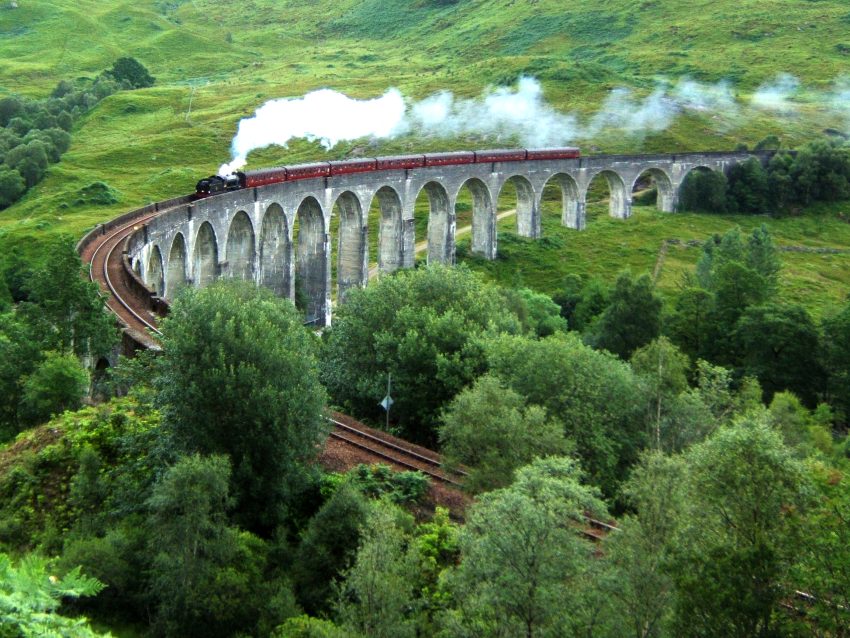
Glenfinnan Viaduct in Lochaber and Fort William, Scotland, is a railway bridge on the West Highland Line, set above the glen near Glenfinnan village. It draws visitors for its sweeping curve, the views over the valley, and the sight of trains crossing the span.
The viaduct is a working piece of transport infrastructure as well as a viewpoint, so the experience is as much about timing and place as the structure itself. People usually come for a short stop, a walk to the viewpoints, or to watch a train pass through the landscape. It suits railway enthusiasts, photographers, and anyone spending a day around Glenfinnan who wants a clear, practical reason to pause and look around.
Table of Contents
History and Significance of Glenfinnan Monument
By 1815, the Jacobite cause was no longer a real political threat to the Hanoverian monarchy, but it still lived strongly in memory, song, and local loyalty. Alexander MacDonald of Glenaladale, from a minor branch of Clan Donald, chose to mark that memory by building a monument at Glenfinnan, where Prince Charles Edward Stuart had first called the clans to arms in 1745. The result was the Glenfinnan Monument: a tall, circular tower in rubble masonry, with a Tudor Gothic doorway, narrow slit windows, and a spiral stair leading to a viewing platform.
The site itself is sacred ground in Jacobite lore. On Monday 19 August 1745, a small boat brought Bonnie Prince Charlie ashore at the north end of Loch Shiel. In the early afternoon, he raised his red-and-white silk standard, reputedly sewn by the women of nearby Dalilea, in the presence of the “Seven Men of Moidart”-four Irishmen, two Scots and one Englishman. Soon they were joined by MacDonald clans (Clanranald, Morar, Keppoch) and the Camerons of Lochiel. This was the beginning of a campaign that would see the Prince enter Edinburgh, defeat Sir John Cope at Prestonpans, push as far as Derby, and then retreat, ending in disaster at Culloden in April 1746 and his eventual escape to France with help from supporters such as Flora MacDonald.
The monument’s later additions deepen its symbolism. In 1835, sculptor John Greenshields’ statue of an anonymous Highlander was placed atop the tower, originally described at commission as representing Charles Edward Stuart. The perimeter wall, now octagonal and faceted, carries cast-iron panels in Gaelic, Latin and English, along with a marble plaque honouring the clansmen who died in the Jacobite cause and Alexander MacDonald himself, who died in the year of completion. Within the enclosure, emblematic clan plants evoke the badges that would once have been worn in bonnets, while the white cockade recalls the simple knotted ribbon that became a powerful symbol of Jacobite allegiance.
Things to See and Do in Glenfinnan Monument
The first impression of Glenfinnan Monument is from ground level: walk out onto the lochside meadow and take in the full view of the tower framed by Loch Shiel and the surrounding hills. From here, it is easy to picture longboats landing, standards raised, and clans assembling under their banners. The stonework and proportions of the tower stand out against the wide sky and water, making this one of the most photogenic corners of the West Highlands.
Inside the perimeter wall, you step into a small, enclosed space that feels almost like an open-air chapel. Benches run around the edges, and the emblematic clan plants add a living layer to the memorial. Take time to read the cast-iron panels in Gaelic, Latin and English, and the marble plaque that commemorates the Jacobite dead and Alexander MacDonald. These inscriptions quietly remind you that the monument is not just about one romantic prince, but about the men who followed him and the families who remembered them.
If you are able-bodied and comfortable with confined spaces, you can climb the interior spiral staircase to the top of the tower. The steps are narrow, uneven stone, arranged in a tight spiral, and the platform is accessed through a small hatch, so this climb is not suitable for visitors with mobility issues, poor balance, or claustrophobia. For those who do make the ascent, the reward is a superb 360-degree panorama: Loch Shiel stretching westward, the Lochaber hills and the Glenfinnan Viaduct to the east, the pine-clad slopes of Ardgour to the south, and St Finnan's Church and the Glenfinnan Hotel to the north. Up close, the Highlander statue-with full dress and tartan now encrusted in yellow, brown, green and orange crustose lichens-feels both heroic and strangely vulnerable, a solitary figure guarding the loch.
Finally, visit the National Trust for Scotland Visitor Centre, where an exhibition and audio programme tell the story of Prince Charles Edward Stuart’s campaign from Glenfinnan to Derby and back to Culloden. Displays explore the events of the 1745 Rising, the lives of those who joined it, and the aftermath that saw Highland dress and tartan later outlawed because of their association with rebellion. The centre also houses a gift shop and café, making it a comfortable place to round out your visit with a deeper understanding of the monument and its wider context.
How to Get to Glenfinnan Monument
Glenfinnan Monument stands at the head of Loch Shiel in the West Highlands of Scotland, on the A830 “Road to the Isles” between Fort William and Mallaig. It is straightforward to reach but feels pleasantly remote once you arrive.
The nearest major airports are Inverness and Glasgow. From either city you can hire a car or take onward public transport via Fort William before continuing to Glenfinnan, with journey times varying depending on connections. For the best deals and a seamless booking experience, check out these flights to Lochaber and Fort William on Booking.com.
For train travellers, Glenfinnan has its own station on the famous West Highland Line between Fort William and Mallaig. Regular ScotRail services run from Glasgow Queen Street to Fort William and on toward Mallaig, passing over the Glenfinnan Viaduct before stopping at the village. From Glenfinnan station, it is a short walk down to the monument and visitor centre, making the train one of the most scenic and convenient ways to arrive.Train schedules and bookings can be found on Omio.
If you are driving, follow the A82 to Fort William and then the A830 west toward Mallaig. Glenfinnan is clearly signposted, and there is a National Trust for Scotland car park close to the visitor centre, from which a short path leads to the monument and lochside viewpoint.
Practical Tips on Visiting Glenfinnan Monument
- Suggested tips: Bring a waterproof and warm layers, even in summer-Highland weather can change quickly, and the lochside can feel exposed in wind and rain.
- Best time to visit: Late spring to early autumn offers the best combination of longer daylight, clearer views and visitor centre opening hours; early morning or late afternoon can be quieter and especially atmospheric.
- Entrance fee: Monument: Adult £5, Chile £3, Car Park: £3.5 Views of Viaduct: Free!
- Opening hours: Glenfinnan Visitor Centre and Monument View Carpark 2 Jan–3 Apr, daily, 10.00–16.00 Current period4 Apr–4 Nov, daily, 10.00–17.00 5 Nov–23 Dec, daily, 10.00–16.00 24–26 Dec, closed 27 Dec–30 Dec, daily, 10.00–16.00 31 Dec–1 Jan 2023, closed
- Official website: https://www.nts.org.uk/visit/places/glenfinnan-monument/planning-your-visit
- How long to spend: Allow 1.5-2 hours to explore the visitor centre, walk out to the monument, and (if you choose) climb the tower; longer if you also visit the viaduct viewpoint or St Finnan’s Church.
- Accessibility: The approach to the lochside monument is on paths that may be uneven or muddy in places; the tower climb involves a steep, narrow spiral stair and is unsuitable for visitors with limited mobility, balance issues, or claustrophobia.
- Facilities: The Visitor Centre provides restrooms, a café, a gift shop and interpretive displays; additional food and accommodation options can be found in Glenfinnan village and in nearby Fort William.
- Photography tip: For classic shots, frame the monument against Loch Shiel with the hills receding into the distance; in softer light after rain or at sunset, reflections on the water and mist in the glen can make the scene especially evocative.
- Guided tours: Check at the Visitor Centre for any ranger talks or short guided introductions to the monument and Jacobite history; some wider Highland tours also include Glenfinnan as a key stop.
- Nearby food options: A café at the Visitor Centre and local hotels or inns in Glenfinnan offer light meals and drinks; Fort William, a short drive away, has a wider choice of pubs, cafés and restaurants.
Where to Stay close to Glenfinnan Monument
Staying near Glenfinnan Monument lets you enjoy the peace of Loch Shiel after day-trippers have gone and gives you the chance to see the monument in different lights and weather. For a classic Highland stay almost on the loch shore, Glenfinnan House Hotel offers traditional rooms, open fires and views toward the monument itself. Just along the road, The Prince’s House Hotel provides a welcoming base close to both the monument and Glenfinnan station, ideal if you are travelling by train. If you prefer to base yourself in a larger town with more services while still being within easy driving distance, Moorings Hotel near Fort William sits by the Caledonian Canal and works well for combining Glenfinnan with other West Highland sights.
Is Glenfinnan Monument Worth Visiting?
Glenfinnan Monument is absolutely worth visiting, especially if you are interested in Scotland's Jacobite history or simply love dramatic Highland scenery. Few places bring together such a precise historical moment and such a powerful landscape: the exact spot where Bonnie Prince Charlie raised his standard, marked by a solitary tower and Highlander statue, looking out over a long, still loch. Add in the visitor centre's thoughtful interpretation, the option to climb the tower, and the nearby views of the Glenfinnan Viaduct, and it becomes a deeply memorable stop rather than just a quick photo opportunity.
What Other Travellers Say...
Glenfinnan Viaduct View Cafe sits at the start of the popular walking route to views of the Loch-side monument and the famous viaduct; visitors praise the scenic, well-marked hike up to a hillside viewpoint and managed paths underneath the viaduct, note that it can get very busy around the steam train crossings, and recommend arriving early, wearing good shoes and allowing time for parking and the short incline to the lookout — the site also offers parking, a cafe, toilets and a gift shop.





FAQs for Visiting Glenfinnan Monument
The Glenfinnan Viaduct appears in our Complete Guide to Visiting Lochaber and Fort William!

Moira & Andy
Hey! We're Moira & Andy. From hiking the Camino to trips around Europe in Bert our campervan — we've been traveling together since retirement in 2020!
This website uses affiliate links which may earn a commission at no additional cost to you!
Planning Your Visit
Glenfinnan Visitor Centre and Monument View Carpark
2 Jan-3 Apr, daily, 10.00-16.00
Current period4 Apr-4 Nov, daily, 10.00-17.00
5 Nov-23 Dec, daily, 10.00-16.00
24-26 Dec, closed
27 Dec-30 Dec, daily, 10.00-16.00
31 Dec-1 Jan 2023, closed
Monument: Adult £5, Chile £3, Car Park: £3.5 Views of Viaduct: Free!
Nearby Attractions
- Glenfinnan Monument (0.2) km
Monument, Viewing Point and Visitor Centre - Armadale Castle & Gardens (35.8) km
Castle, Gardens and Museum - Knock Castle (36.5) km
Castle - Dunscaith Castle (44.1) km
Castle - Eilean Donan Castle (45.1) km
Castle - Tobermory Lighthouse (46.3) km
Lighthouse - Tobermory (47.6) km
Town - Tobermory Distillery (47.6) km
Distillery - Caisteal Maol (47.9) km
Castle - Duart Castle (48) km
Castle