Funiculaire de Lyon
Cable Car in Lyon
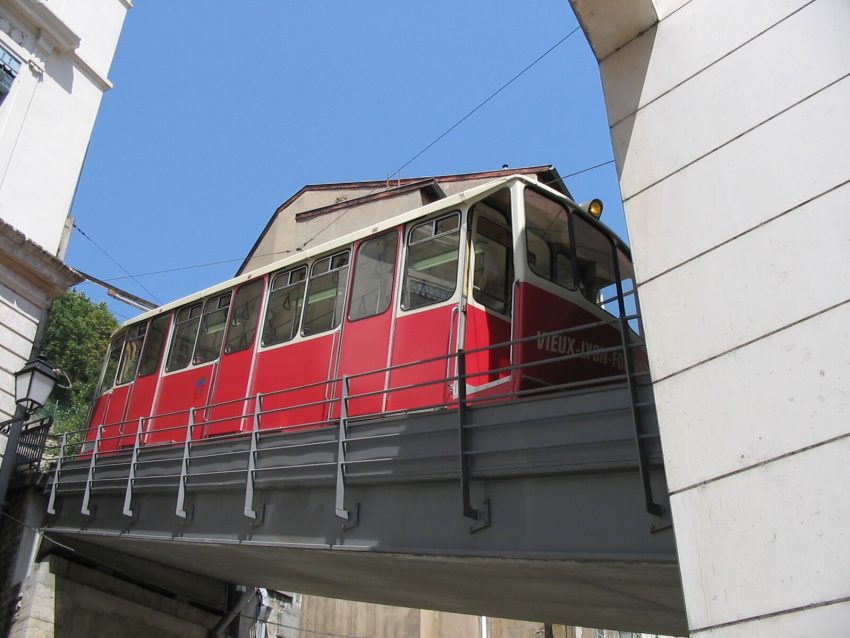
The Funiculaire de Lyon is one of the things to do in Lyon that combines everyday practicality with a dash of old-world charm. Climbing steep Fourvière Hill from Vieux Lyon, it saves your legs while giving you a short, atmospheric ride through the rock toward some of the city's most famous viewpoints and ruins. Originally opened in 1862 and now fully integrated into the TCL public transport network, it's an easy hop with a regular metro ticket rather than a separate tourist attraction.
Two lines run today. Funiculaire F1 links Vieux Lyon directly to Fourvière, delivering you right by the Basilica of Notre-Dame de Fourvière and the entrances to Parc des Hauteurs. Funiculaire F2 climbs from the same lower station up to Saint-Just, close to the Ancient Theatre of Fourvière and the Gallo-Roman Museum. Together they turn what would be a sweaty uphill slog into a three-minute ride, often visited on walking-tours of Lyon as a handy and nostalgic way to reach the hilltop.
Table of Contents
- History and Significance of the Funiculaire de Lyon
- Things to See and Do in the Funiculaire de Lyon
- How to Get to the Funiculaire de Lyon
- Practical Tips on Visiting the Funiculaire de Lyon
- Where to Stay close to the Funiculaire de Lyon
- Is the Funiculaire de Lyon Worth Visiting?
- FAQs for Visiting Funiculaire de Lyon
- Nearby Attractions to the Funiculaire de Lyon
History and Significance of the Funiculaire de Lyon
When the first funicular line opened in 1862, Lyon was expanding rapidly and Fourvière Hill posed a real challenge for everyday movement between the lower city and the heights. The solution was innovative for its time: a cable-hauled railway climbing a steep gradient, carrying passengers in carriages that remained level while the track rose sharply. Over the years, additional lines were added, and for a time Lyon had one of Europe's densest funicular networks.
As technology and urban needs evolved, some of the original lines were closed or replaced, but two survived and were modernised rather than abandoned. Today's F1 and F2 lines retain the spirit of the originals while using updated systems and rolling stock that meet modern safety and comfort standards. Stepping into the compact carriages at Vieux Lyon, you're joining a tradition of hillside travel that stretches back more than a century and a half.
The funiculars are more than just transport: they’re woven into the city’s identity. Locals use them as part of daily commutes or quick shortcuts to the basilica and Saint-Just, while visitors experience them as a small, memorable piece of Lyon’s character. The fact that you can ride one of the world’s oldest active funicular systems with the same ticket you use on the metro makes it feel like a living piece of heritage rather than a museum piece on rails.
Things to See and Do in the Funiculaire de Lyon
The experience begins at the shared lower station, Vieux Lyon - Cathédrale Saint-Jean, where you'll find clear signage for F1 (Fourvière) and F2 (Saint-Just). Once you've validated your ticket, step into the sloping car and notice how the interior is tiered to stay comfortable on the steep gradient. As the funicular sets off, the carriage glides into the tunnel and you feel the quick, smooth climb that makes you grateful you're not tackling the hill on foot.
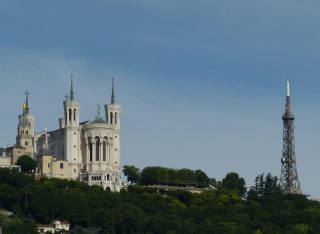
On the F1 line, you'll emerge at Fourvière, only a short walk from the Basilica of Notre-Dame de Fourvière, one of the top attractions in Lyon, and the viewpoints that look out across the city's rooftops towards the Alps on clear days. From here, you can step straight into Parc des Hauteurs and follow hilltop paths and footbridges, or loop back down to Vieux Lyon on foot via staircases and viewpoints.
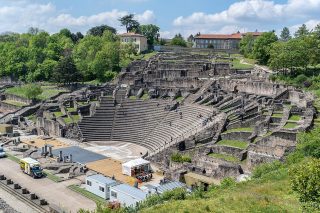
The F2 line takes you to Saint-Just, closer to the Ancient Theatre of Fourvière and the Gallo-Roman Museum. This makes it ideal if you're planning a day focused on Lyon's Roman heritage. You can ride up, explore the theatres and museum, then walk across to Fourvière and either walk or ride back down on F1, turning the funiculars into part of a simple circular route linking several major sights.
How to Get to the Funiculaire de Lyon
If you're arriving from abroad, you'll most likely land at Lyon-Saint Exupéry Airport (LYS), which has good connections across Europe and beyond. From the airport, take the Rhônexpress tram into the city, then transfer to the metro network to reach the Presqu'île and Vieux Lyon, where the funicular station is located. For the best deals and a seamless booking experience, check out these flights to Lyon on Booking.com.
From within France or neighbouring countries, trains bring you into Lyon Part-Dieu or Lyon Perrache. From Part-Dieu, hop on the metro (Line B then D) to Vieux Lyon - Cathédrale Saint-Jean; from Perrache, buses or trams plus a short walk or a quick metro connection will get you to the same station. Once you're there, the funicular lines F1 and F2 depart from platforms connected directly to the metro area, so transfers are simple. You can use SNCF Connect to check schedules, compare routes, and purchase tickets for National (SNCF ) and regional trains (TER). For a more streamlined experience, we recommend using Omio, which allows you to easily compare prices, schedules, and book tickets for both National and Regional travel across all of Europe, all in one place.
If you're arriving by car, follow signs to central Lyon and look for parking around the Presqu'île or near Vieux Lyon; underground car parks close to the old town make it easy to leave the car and explore on foot. From there, it's a short walk over the Saône or through the tunnel to Vieux Lyon - Cathédrale Saint-Jean, where you can ride the funiculars instead of driving up Fourvière's narrow, winding streets. If you are looking to rent a car in France I recommend having a look at Discover Cars, first, as they compare prices and review multiple car rental agencies for you.
Practical Tips on Visiting the Funiculaire de Lyon
- Suggested tips: Treat the funicular as both transport and mini-attraction-plan your ride at the start or end of a visit to Fourvière so you can enjoy the change in height and perspective without rushing.
- Best time to visit: Mornings and late afternoons are usually less busy than peak midday or post-mass times at the basilica; evenings can be atmospheric if you’re heading up to see the city lights.
- Entrance fee: Standard TCL public transport ticket: €2.10 (valid for 1 hour on all modes of transport, including metro, tram, and bus)
- Opening hours: Daily, from around 5:00 AM to midnight (same as Lyon’s metro system); Trains run every 5–10 minutes
- Official website: https://www.tcl.fr
- How long to spend: The ride itself lasts just a few minutes; allow extra time for queues at busy periods and for exploring Fourvière or the Roman sites once you arrive.
- Accessibility: Stations and trains are designed to be accessible, but the steep surroundings at the top stations may still involve slopes and steps; plan your routes accordingly if you have reduced mobility.
- Facilities: Toilets, ticket machines and information screens are available at Vieux Lyon; cafés, viewpoints and additional services are found at the hilltop sites rather than at the funicular stations themselves.
- Photography tip: Grab a quick shot from the platform showing the sloping carriage and track, then focus your serious photography on the panoramas at Fourvière and the Roman theatres once you arrive.
- Guided tours: Some city tours include a funicular ride as part of the itinerary, using it as a link between Vieux Lyon, Fourvière and the Roman ruins while guides share historical background.
- Nearby food options: Before or after your ride, you'll find plenty of bouchons and cafés in Vieux Lyon, plus a few spots around Fourvière and the Roman theatre area with fantastic views.
Where to Stay close to the Funiculaire de Lyon
To be right at the foot of Fourvière and steps from the funicular station, Cour des Loges Lyon, a Radisson Collection Hotel is a characterful option in the heart of Vieux Lyon. From its Renaissance courtyards, you can stroll to Vieux Lyon - Cathédrale Saint-Jean in minutes and be on the funicular up to the basilica or Roman sites in no time.
If you’d like views over the city as well as easy access to the funicular, Villa Florentine sits on the slopes of Fourvière itself. You can walk down to the funicular or basilica, then ride up or down as part of your route, enjoying both hillside tranquillity and quick connections to the old town.
For a base that balances Fourvière access with riverside charm, Collège Hôtel near the Saône is a great choice. It's a short walk across to Vieux Lyon and the funicular station, while also putting you within easy reach of Presqu'île squares and evening riverside strolls.
Is the Funiculaire de Lyon Worth Visiting?
The Funiculaire de Lyon is absolutely worth using, even if you're fit enough to tackle the hill on foot. It turns a steep climb into a short, atmospheric ride that links some of the city's most important sights-Vieux Lyon, the Basilica of Notre-Dame de Fourvière, Parc des Hauteurs, and the Roman theatres-without breaking your stride. As part of one of the must-see places in Lyon, Fourvière Hill, it adds a small but memorable layer of history and charm to your day, all for the price of a regular metro ticket.
What Other Travellers Say...

Funiculaire de Lyon provides a practical, included-in-the-city-transport way to reach the hilltop attractions of Fourvière and Cathédrale Saint-Jean-Baptiste; visitors describe it as a charming, unique ride that can be busy at peak times, mostly running through a tunnel so the main appeal is the experience and the views once you reach the top, and there's a free restroom at the base.


FAQs for Visiting Funiculaire de Lyon
Nearby Attractions to the Funiculaire de Lyon
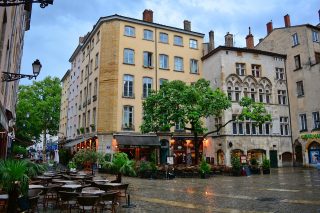
- Vieux Lyon - The Renaissance old town at the base of the hill, filled with traboules, bouchons and cobbled streets just steps from the funicular station.
- Basilica of Notre-Dame de Fourvière - Hilltop basilica with richly decorated interiors and some of Lyon's best panoramic views, reached via F1.
- Parc des Hauteurs - Elevated park and walkway system linking Fourvière to the Roman theatres and Loyasse cemetery, ideal for scenic strolls.
- Ancient Theatre of Fourvière - Major Roman theatre still used for performances, easily accessed from the Saint-Just side of the hill.
- Gallo-Roman Museum of Lyon-Fourvière - Museum built into the hillside near the theatres, showcasing artefacts and stories from Roman Lugdunum.
The Funiculaire de Lyon appears in our Complete Guide to Visiting Lyon!

Moira & Andy
Hey! We're Moira & Andy. From hiking the Camino to trips around Europe in Bert our campervan — we've been traveling together since retirement in 2020!
This website uses affiliate links which may earn a commission at no additional cost to you!
Planning Your Visit
Daily, from around 5:00 AM to midnight (same as Lyon’s metro system); Trains run every 5-10 minutes
Standard TCL public transport ticket: €2.10 (valid for 1 hour on all modes of transport, including metro, tram, and bus)
Nearby Attractions
- Cathédrale Saint-Jean (0.1) km
Cathedral - Maison du Chamarier (0.2) km
Historic Building - Place de la Basoche (0.2) km
Square - Miniature and Cinema Museum (0.2) km
Museum - Longue Traboule (0.2) km
Historic Building - Cour d’Appel (0.3) km
Historic Building - Saône River (0.3) km
River - La Tour Rose (The Pink Tower) (0.3) km
Historic Building and Tower - Parc des Hauteurs (0.3) km
Park - Vieux Lyon (0.4) km
Area