Basilica of Notre-Dame de Fourvière, Lyon
Basilica in Lyon
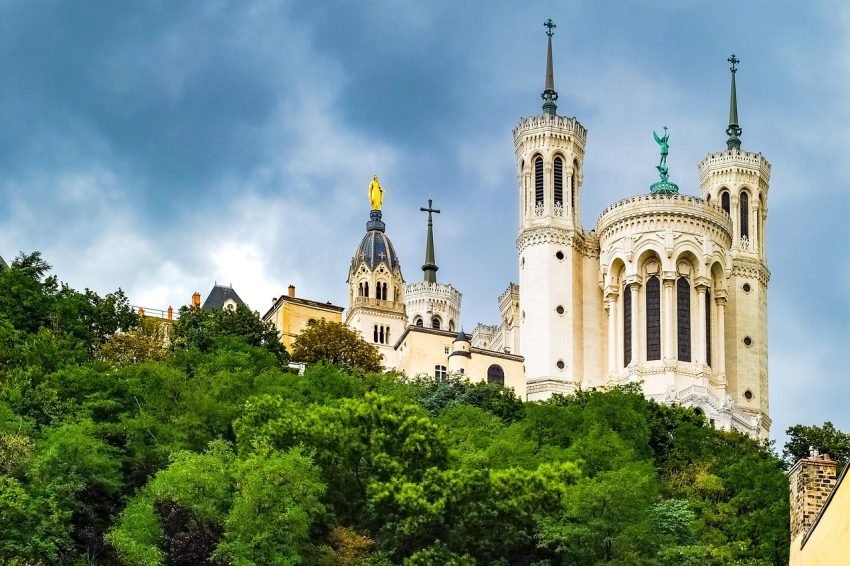
Perched high on Fourvière hill and visible from almost everywhere in the city, the Basilica of Notre-Dame de Fourvière is one of the top sights in Lyon and the building that defines its skyline. The exterior may look relatively sober from a distance, but up close you start to notice the blend of Romanesque and Byzantine influences: squat towers, ornate stonework, and a strong, fortress-like silhouette that makes the basilica feel both protective and welcoming. Step inside and the contrast is striking-gilded ceilings, intricate mosaics, and luminous stained glass create an interior that shimmers with colour and detail.
Outside, the terrace wraps around the hilltop, offering one of the best viewpoints in the city. On a clear day you can see the rooftops of Vieux Lyon, the orderly grid of the Presqu'île, the Rhône and Saône rivers, and, if you're lucky, even the Alps on the horizon. Inside, the main sanctuary is richly decorated yet surprisingly peaceful, while the lower basilica (crypt) has a more subdued, contemplative feel. Whether you ride the funicular up from Vieux Lyon or walk through the gardens and stairways, visiting Fourvière is a highlight of any walking tour of Lyon and a moment when the city's layout suddenly makes sense from above.
Table of Contents
- History and Significance of the Basilica of Notre-Dame de Fourvière
- Things to See and Do in the Basilica of Notre-Dame de Fourvière
- How to Get to the Basilica of Notre-Dame de Fourvière
- Practical Tips on Visiting the Basilica of Notre-Dame de Fourvière
- Where to Stay close to the Basilica of Notre-Dame de Fourvière
- Is the Basilica of Notre-Dame de Fourvière Worth Visiting?
- FAQs for Visiting Basilica of Notre-Dame de Fourvière
- Nearby Attractions to the Basilica of Notre-Dame de Fourvière
History and Significance of the Basilica of Notre-Dame de Fourvière
The Basilica of Notre-Dame de Fourvière was built in the late 19th century, between 1872 and 1884, on a hill that has been spiritually important for Lyon for centuries. Long before the basilica, this ridge was home to ancient Roman buildings and, later, to a chapel dedicated to the Virgin Mary. In times of crisis-plagues, wars, political upheaval-the people of Lyon repeatedly turned to Mary for protection, and vows were made to honour her if the city was spared. Fourvière is the concrete expression of that devotion: a monumental thank-you, watching over the city from above.
Architect Pierre Bossan's design combines Romanesque and Byzantine elements rather than following a more typical Gothic revival trend. The result is distinctive-almost fortress-like on the outside, yet lavishly ornamented within. The upper church is dedicated to Mary, with walls and ceilings covered in mosaics that celebrate her role in Lyon's history and in Catholic tradition, while the lower church is devoted to a variety of Marian devotions from around the world. This double structure symbolically links the universal church with the specific history and faith of Lyon.
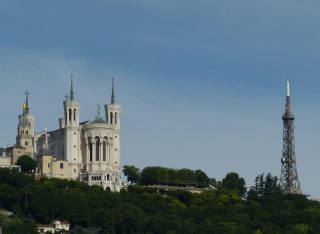
Over time, the basilica has become not just a religious symbol but an emblem of the city itself. Its silhouette, alongside the metallic Fourvière tower and the older buildings on the hill, forms the backdrop to many of Lyon's classic views. The basilica plays a major role during the Fête des Lumières each December, when the city is illuminated with installations and processions in honour of the Virgin Mary. Fourvière's presence-visible from Place Bellecour, Vieux Lyon, and far beyond-reminds locals and visitors alike of the deep links between the city's topography, history, and spiritual identity.
Things to See and Do in the Basilica of Notre-Dame de Fourvière
Most visits begin on the esplanade in front of the basilica, where the view alone is worth the climb. Take a few minutes to orient yourself: trace the curve of the Saône, pick out the bridges and main squares, and see how Vieux Lyon nestles at the foot of the hill while the Presqu'île stretches between the rivers. This is an ideal spot for photos, but it's also a good place to simply stand and appreciate how the city fits together, from Roman ruins on the hill to contemporary districts on the plains.
Inside the upper church, your eyes will likely go straight to the lavish mosaics that cover the walls and ceilings. These scenes, rich with gold and saturated colour, depict episodes from the life of the Virgin Mary and moments from Lyon’s own religious history. Look up to admire the starry ceilings, then scan the stained glass windows and sculpted details around the choir and side chapels. Despite the visual richness, the space retains a sense of calm, especially if you visit outside the busiest hours.
Don't skip the lower basilica (crypt), which has a very different character. Descend the stairs and you'll find a quieter, more intimate space dedicated to various Marian devotions from around the world. The cooler light, lower ceilings, and quieter atmosphere invite slower reflection. Depending on the season, you might also find exhibitions, guided visits, or the chance to climb the towers or explore the rooftop (usually as part of special tours), which adds another perspective on the architecture and the panorama. When you're done, you can stroll around the hill to the nearby Roman theatres or follow paths through the gardens back down towards Vieux Lyon.
How to Get to the Basilica of Notre-Dame de Fourvière
Most international visitors arrive in Lyon via Lyon-Saint Exupéry Airport (LYS), which offers frequent connections to cities across Europe and some long-haul destinations. For the best deals and a seamless booking experience, check out these flights to Lyon on Booking.com. From the airport, the Rhônexpress tram will take you to Lyon Part-Dieu station, where you can connect to the metro and then continue to Vieux Lyon as your base for reaching Fourvière.
From within Lyon, the easiest public transport route is to take metro Line D to Vieux Lyon - Cathédrale Saint-Jean, then switch to one of the funicular lines (F1 or F2, depending on service) that climb directly up to the Fourvière station just next to the basilica.You can use SNCF Connect to check schedules, compare routes, and purchase tickets for National (SNCF ) and regional trains (TER). For a more streamlined experience, we recommend using Omio, which allows you to easily compare prices, schedules, and book tickets for both National and Regional travel across all of Europe, all in one place. The ride is short but memorable, and it saves you a steep walk, especially in hot weather. You can also choose to walk up via staircases and paths from Vieux Lyon or from the Roman theatres, which takes a bit longer but offers lovely viewpoints and a stronger sense of the hill’s height.
If you’re driving, you can reach the Fourvière hill by following signs from the city centre and using the nearby car parks, though narrow roads and limited spaces can make this a bit challenging, especially during busy periods.If you are looking to rent a car in France I recommend having a look at Discover Cars, first, as they compare prices and review multiple car rental agencies for you. Many visitors find it easier to park on the Presqu'île or in Vieux Lyon and then use the funicular or walk up. Either way, once you're on the hilltop, the basilica, viewpoints, and nearby Roman sites are all within easy walking distance.
Practical Tips on Visiting the Basilica of Notre-Dame de Fourvière
- Suggested tips: If you can, go up by funicular and come down on foot through the gardens or via the Roman theatres to enjoy both the views and the changing atmosphere of the hill.
- Best time to visit: Early morning offers quieter interiors, while late afternoon and early evening are ideal for views and golden light over the city; after dark, the basilica itself becomes a luminous landmark.
- Entrance fee: Free
- Opening hours: Basilica Opening Hours: Monday to Saturday: 7:00 AM to 8:00 PM Sunday: 7:00 AM to 12:30 PM (afternoons reserved for services) Sanctuary Gates: Open daily from 7:00 AM to 11:00 PM
- Official website: https://www.fourviere.org/en/
- How long to spend: Allow 1-2 hours to explore the upper church, lower basilica, and terrace at a relaxed pace; longer if you’re joining a guided tour or combining the visit with the Roman theatres.
- Accessibility: The funicular makes access easier for visitors with reduced mobility, and the esplanade is relatively level; inside, there may be some steps and uneven surfaces, especially when moving between the upper church and the crypt.
- Facilities: You'll find toilets, a small shop, and sometimes a café or refreshment options near the site; additional cafés and services are available downhill in Vieux Lyon.
- Photography tip: For city panoramas, use the terrace and side viewpoints rather than just the front steps; inside, respect any rules on photography and focus on details of mosaics and stained glass rather than using flash.
- Guided tours: Consider joining a guided visit to learn more about the basilica's iconography, history, and architecture-some tours also include rooftop or tower access for even better views.
- Nearby food options: Vieux Lyon at the foot of the hill is packed with bouchons, cafés, and ice cream shops, making it easy to pair your visit with a leisurely meal or a post-visit treat.
Where to Stay close to the Basilica of Notre-Dame de Fourvière
For a truly special stay right on the slopes of the hill, Villa Florentine offers terraces with panoramic views over Vieux Lyon and the Presqu'île. From here, you can walk up to the basilica in just a few minutes or drop down into the old town for dinner, enjoying the best of both viewpoints and atmosphere.
If you prefer to base yourself in the heart of Vieux Lyon while staying close to the funicular, Cour des Loges Lyon, a Radisson Collection Hotel combines Renaissance architecture with modern comfort. You're only a short walk from the Vieux Lyon funicular station, making trips up to Fourvière quick and easy, and you can wander back through winding lanes in the evening.
Another appealing option near the Saône is Collège Hôtel, a playful, school-themed hotel within walking distance of both Vieux Lyon and the riverside. From here, you can stroll to the funicular or take a scenic route on foot up towards the basilica, then return to a lively but slightly quieter corner of the old city at night.
Is the Basilica of Notre-Dame de Fourvière Worth Visiting?
The Basilica of Notre-Dame de Fourvière is unquestionably worth visiting, even if you only have a short time in Lyon. The combination of panoramic views, striking architecture, and richly decorated interiors gives it a “wow” factor that's hard to match, while the crypt and surrounding gardens offer quieter spaces for reflection. Because it's so closely tied to Lyon's identity-visible from almost every key square and featured prominently in the city's festivals-seeing Fourvière in person helps you understand the whole city better. It's one of those places you remember as much for how it made you feel as for what you saw.
What Other Travellers Say...

Basilica of Notre Dame of Fourvière sits atop a hill in Lyon, its 19th‑century structure marked by four octagonal towers; visitors praise the ornate interior with gold‑leaf mosaics and a peaceful, powerful atmosphere and note that services are still held and a religious art museum is on site. The summit offers sweeping panoramic views of the city that many say are best at sunset or by night, reachable on foot, by funicular or tram, and reviewers recommend allowing time to linger, bringing water for the climb, and combining the visit with the nearby archaeological site and Roman theatre.


FAQs for Visiting Basilica of Notre-Dame de Fourvière
Nearby Attractions to the Basilica of Notre-Dame de Fourvière
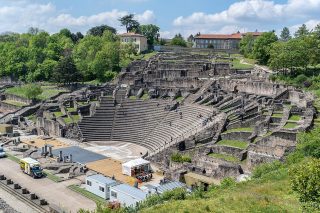
- Roman Theatres of Fourvière - Ancient theatres and archaeological remains just a short walk from the basilica, with a museum and summer performances.
- Vieux Lyon - The Renaissance old town at the foot of the hill, full of traboules, courtyards, and traditional bouchons.
- Cathédrale Saint-Jean - Gothic cathedral with a famous astronomical clock, anchoring the main square of Vieux Lyon.
- Colline de Fourvière Gardens - Green spaces and walking paths on the hill, ideal for strolling between viewpoints and down towards the river.
- Place Bellecour - Lyon's vast central square on the Presqu'île, easily visible from the basilica terrace and reachable by funicular and metro.
The Basilica of Notre-Dame de Fourvière appears in our Complete Guide to Visiting Lyon!

Moira & Andy
Hey! We're Moira & Andy. From hiking the Camino to trips around Europe in Bert our campervan — we've been traveling together since retirement in 2020!
This website uses affiliate links which may earn a commission at no additional cost to you!
Planning Your Visit
Basilica Opening Hours:
Monday to Saturday: 7:00 AM to 8:00 PM
Sunday: 7:00 AM to 12:30 PM (afternoons reserved for services)
Sanctuary Gates:
Open daily from 7:00 AM to 11:00 PM
Free
Nearby Attractions
- Parc des Hauteurs (0.1) km
Park - Metallic Tower of Fourvière (0.2) km
Tower - Gallo-Roman Museum of Lyon-Fourvière (0.3) km
Museum - La Tour Rose (The Pink Tower) (0.3) km
Historic Building and Tower - Place de la Basoche (0.3) km
Square - Longue Traboule (0.4) km
Historic Building - Ancient Theatre of Fourvière (0.4) km
Roman Site - Cathédrale Saint-Jean (0.4) km
Cathedral - Miniature and Cinema Museum (0.4) km
Museum - Maison du Chamarier (0.4) km
Historic Building