Arbor Low, Bakewell
Historic Site in Bakewell
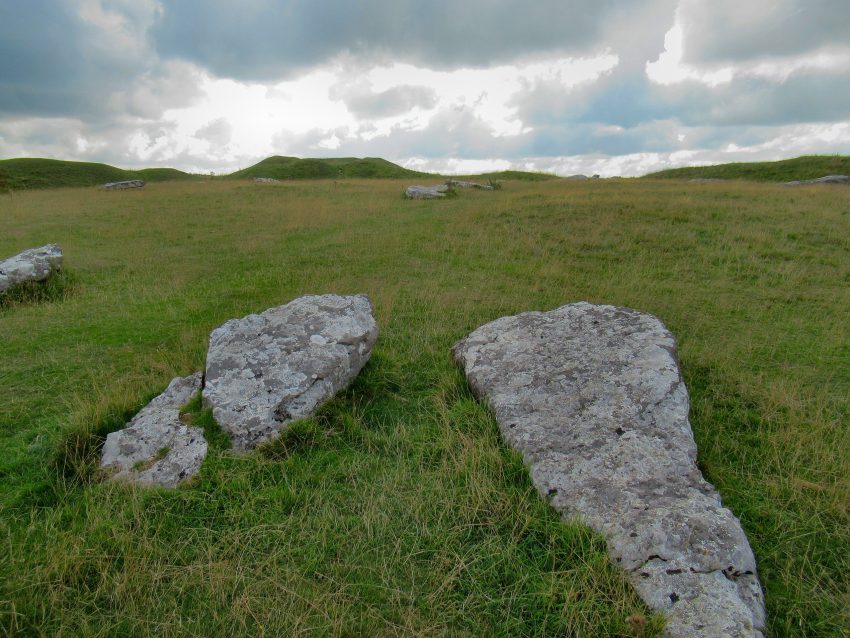
Arbor Low is one of the top attractions in Monyash for travellers fascinated by ancient landscapes and prehistoric mysteries. Often called the Peak District Stonehenge, this impressive henge-and-stone-circle complex stands on a windswept limestone plateau, offering both archaeological intrigue and sweeping countryside views. Its earthworks, limestone blocks, and Bronze Age barrows create an atmospheric site that feels unchanged for millennia.
Walking up to Arbor Low, you immediately sense its scale. The great outer bank curves around a wide circular ditch, while inside, an arrangement of large weathered limestone stones lies scattered in a rough circle. Though the stones are now recumbent, their size and presence make it clear that this was once a place of deep ritual significance. Nearby, the Bronze Age mound of Gib Hill rises from the landscape, adding another layer to this extraordinary prehistoric complex.
History and Significance of Arbor Low
Arbor Low was constructed around 2500 BC during the Neolithic period, a time marked by the building of monumental structures across the British Isles. The henge itself measures roughly 259 x 246 feet, defined by an outer bank and a substantial inner ditch up to 6 feet deep and 30 feet wide. Within this enclosure, 46 large stones and 13 smaller ones form a circle, with a central “cove” believed to be the focus of ceremonial practices.
Archaeologists are unsure whether the stones originally stood upright. They may have been toppled in the medieval Christian era, laid flat intentionally by the Neolithic builders, or brought down by natural processes. Excavations within the cove uncovered a skeleton, though it is thought to be a later addition and not part of the original Neolithic design.
The site continued to evolve during the Bronze Age. A large round barrow was constructed by reusing earth from the henge bank, and excavations in 1845 revealed a cist containing a cremation burial, pottery vessels, and a bone pin. Across the landscape, chambered tombs and smaller burial cairns suggest that Arbor Low was only one feature in a much wider ceremonial network.
Nearby Gib Hill, a Bronze Age barrow constructed atop an older Stone Age mound, may once have been linked to Arbor Low via an earthen bank. The two monuments share a visual relationship that hints at their combined ritual importance in prehistoric society.
Things to See and Do in Arbor Low
A visit to Arbor Low is all about atmosphere and imagination. Start by walking the perimeter bank to appreciate the monument's impressive size and the engineering skills required to construct it. From the top of the bank, the surrounding Peak District landscape stretches out in all directions, often accompanied by the sound of wind passing over the open hills.
Inside the henge, take time to explore the limestone stones. Many reach lengths of up to 13 feet, their weathered surfaces catching the light and inviting close inspection. The central cove is a fascinating focal point and makes a striking photographic subject against the sky.
A short walk leads to Gib Hill, where you can stand atop the Bronze Age mound and take in panoramic views. The relationship between Gib Hill and Arbor Low becomes clear from here, helping you imagine the prehistoric landscape as it might once have been.
How to Get There
Arbor Low is located near Monyash in the central Peak District and is best reached by car. A small parking area is available along the track leading to the farm from which the footpath to the site begins.
Public transport is limited in this rural area, though hikers can reach the monument via longer walking routes from surrounding villages and trails.
Practical Tips on Visiting Arbor Low
- Best time to visit Arbor Low: Late afternoon or early evening for dramatic light and fewer visitors.
- Entrance fee in Euros: A small donation is often requested as the site is accessed via private land (around 1-2 EUR).
- Opening hours: Open year-round during daylight hours.
- Official website: Information available through local Peak District heritage resources.
- How long to spend: 45 minutes to 1.5 hours, depending on whether you visit Gib Hill as well.
- Accessibility: The path crosses uneven farmland and may be muddy; not suitable for all mobility levels.
- Facilities: None on-site; nearest amenities are in Monyash or Bakewell.
- Photography tip: Capture the stone circle from the edge of the ditch for a sense of scale.
- Guided tours: Occasionally offered by local archaeological groups on special heritage days.
- Nearby food options: Pubs and cafés in Monyash and nearby Bakewell.
Where to Stay close to Arbor Low
For a comfortable base near the monument, The Rutland Arms Hotel offers historic charm in the nearby town of Bakewell. Travellers seeking a countryside retreat might prefer The Peacock at Rowsley, ideal for exploring the central Peak District. Another welcoming option is East Lodge Country House Hotel, known for its scenic surroundings.
Is Arbor Low Worth Visiting?
Yes. Arbor Low is one of the most atmospheric and significant prehistoric sites in northern England. Its henge, stone circle, nearby barrows, and remote setting create a powerful impression, making it a rewarding stop for history lovers, photographers, and anyone who enjoys exploring ancient landscapes.
What Other Travellers Say...

Arbor Low Stone Circle and Gib Hill Barrow is a well-preserved prehistoric monument on a limestone plateau near Monyash, featuring an egg-shaped circle of large limestone blocks with a central cluster of smaller stones and surrounded by an earth bank and ditch; visitors reach it via a short, easy walk from a small car park on a private farm where an honesty box requests a £1 donation, the farm track can be uneven and muddy so sturdy footwear and caution for low vehicles are advised, and the site offers wide, far-reaching views and a sense of walking where ancestors once did.


FAQs for Visiting
Nearby Attractions to Arbor Low
- Gib Hill: A Bronze Age burial mound with panoramic views and ties to Arbor Low’s ceremonial landscape.
- Monyash Village: A charming Peak District village with walking routes and a traditional pub.
- Bakewell Town Centre: Known for its markets, cafés, and historic charm.
- Lathkill Dale: A beautiful limestone valley ideal for walking and wildlife spotting.
- Haddon Hall: A superb medieval manor house set in stunning grounds not far from Bakewell.
The Arbor Low appears in our Complete Guide to Visiting Bakewell!

Moira & Andy
Hey! We're Moira & Andy. From hiking the Camino to trips around Europe in Bert our campervan — we've been traveling together since retirement in 2020!
This website uses affiliate links which may earn a commission at no additional cost to you!
Planning Your Visit
Open any reasonable time during daylight hours.
Access through private land, for which the owner issues £1 charge per person.
Nearby Attractions
- Magpie Mine, Sheldon (4.8) km
Historic Site - All Saints' Church (7.4) km
Church - Old House Museum (7.4) km
Historic Building and Museum - Bakewell Bridge (7.8) km
Bridge - Thornbridge Hall Gardens (7.9) km
Historic Building - Haddon Hall (7.9) km
Historic Building - Monsal Trail (8.3) km
Walk - Thor’s Cave (10.6) km
Cave - Ilam Park (11.5) km
Historic Building and Park - Chatsworth House (11.9) km
Historic Building