Self-Guided Walking Tour of Bratislava
This website uses affiliate links which earn a small commission at no additional cost to you.
Bratislava is a compact Danube capital where old-town streets, Habsburg history, café culture, and castle views are all close together. Its most recognisable landmark is Bratislava Castle, which rises above the Danube and has long been a symbol of the city; Visit Bratislava describes it as a site with royal history, museum exhibitions, a Baroque garden, and wide views from above the river.
For visitors, Bratislava works well as a short city break because the main sights are easy to cover on foot. The Old Town, Michael’s Gate, Main Square, St Martin’s Cathedral, the Blue Church, the riverside, and the castle can be combined without needing a complicated itinerary. It is smaller and quieter than Vienna or Prague, but that is part of its appeal: it offers Central European architecture, history, food, and river scenery in a more manageable setting.
Table of Contents
- How to get to Bratislava
- A Short History of Bratislava
- Where to Stay in Bratislava
- Your Self-Guided Walking Tour of Bratislava
- Slovak Radio Building
- Grassalkovich Palace
- Bratislava Castle
- St. Martin's Cathedral
- New Bridge and UFO Observation Deck
- Palace of Erdody
- Johann Pálffy Palace
- Palace of Zichy
- Leopold de Pauli’s Palace
- Napoleon's Army Soldier Statue
- Hlavne Namestie
- Old Town Hall
- Bratislava City Museum
- Schone Naci Statue
- Cumil Statue
- Hviezdoslav Square
- Old Slovak National Theater
- Blue Church
- Primate's Palace
- Michael's Tower and Street
- Obchodna Street
How to get to Bratislava
By Air: Most visitors fly into Bratislava Airport (BTS) or Vienna International Airport (VIE). Bratislava Airport is close to town and is linked by local buses and taxis, while Vienna Airport typically has more flight options and frequent direct coach transfers into Bratislava. If you're coming from elsewhere in Slovakia or Central Europe, it's often quickest to connect via Vienna and roll straight into the centre. For the best deals and a seamless booking experience, check out these flights to Bratislava on Booking.com.
By Train: Bratislava is well connected by rail, especially from Vienna, Budapest, Prague, and other regional hubs. Most services arrive at Bratislava hlavná stanica (Main Station) or Bratislava-Petržalka, and from either you can reach the Old Town quickly by public transport or taxi. Trains are a good option if you want a low-stress arrival and plan to keep your time in the city mostly car-free. Train schedules and bookings can be found on Omio.
By Car: Driving into Bratislava is straightforward, but the historic centre is best treated as a “park once, then walk” destination. If you’re road-tripping, choose a hotel with parking or use a secure car park and then do the rest on foot and by public transport. The Old Town streets can be tight and traffic rules (and parking enforcement) are not forgiving, so it pays to plan parking before you arrive.
How to get around the city: For this itinerary, walking does the heavy lifting. When you do want a break, Bratislava’s trams and buses are useful for quick hops (for example, between the station area, the riverfront, and neighbourhoods just beyond the Old Town). Taxis and ride-hailing apps can be convenient late at night or with luggage, but inside the centre you’ll usually beat traffic simply by walking.
A Short History of Bratislava
Bratislava Before Medieval Power
Long before the postcard views, Bratislava’s position on major routes made it valuable, contested, and continually reshaped. Early settlement and trade laid the groundwork for a place that would later develop fortifications and elevated lookouts, the logic of which still makes sense when you’re standing at viewpoints around the castle hill and looking across the river.
Medieval Bratislava and the Rise of the Old Town
As Bratislava grew in medieval importance, it developed the compact street plan you’ll enjoy on foot today: narrow lanes, defensible gates, and a central core where civic and religious buildings signalled authority. St. Martin’s Cathedral became one of the defining silhouettes of the city, and the Old Town’s key squares evolved as commercial and social stages where daily life, ceremony, and power all overlapped.
Bratislava Under Habsburg Influence
Bratislava’s architecture and civic confidence were deeply shaped by centuries of Habsburg-era prestige and administration. Grander façades, palaces, and institutions left the Old Town with a more “capital-like” feel than its size suggests. Places such as the Primate’s Palace and the elegant urban squares reflect this period’s taste for representative buildings that projected stability, wealth, and cultural ambition.
Bratislava in the 20th Century: Borders, Identity, and Modern Layers
The 20th century brought rapid political change, shifting identities, and a new visual language in parts of the city. You can see the contrast between historic core and modern statement pieces when you reach structures like the SNP Bridge (Most SNP) with its UFO observation deck: a bold reimagining of the skyline that sparks strong opinions, but also tells a clear story about modernisation and the city’s evolving relationship with the Danube.
Bratislava Today: Heritage Restored, City Reimagined
Today’s Bratislava leans into its walkability and restored heritage while keeping its playful edge. Landmarks such as Bratislava Castle dominate the “big picture,” but the city’s personality often comes through in details at street level: statues like Čumil, lively café culture, and small museums and historic interiors that make the past feel close rather than distant. The best way to feel how history shaped the city is exactly this: walking between layers and noticing how each era left something behind.
Where to Stay in Bratislava
To make the most of visiting Bratislava and this walking tour then you consider stay overnight at the centre. The Old Town is the easiest base because you can start early, finish late, and slip back to your room whenever you want a reset between castle viewpoints, museums, and dinner plans. For a classic, walk-everywhere stay right on a major square, consider Radisson Blu Carlton Hotel, Bratislava or, for a boutique feel close to the historic lanes, Marrol's Boutique Hotel.
If you like being on the edge of the Old Town with easy access to parks, elegant boulevards, and a slightly calmer feel at night, the area around Hodžovo námestie and the Presidential Palace works well. It’s still a short walk into the historic core, but you’re not right in the busiest pedestrian flow. Good picks here include Crowne Plaza Bratislava and LOFT Hotel Bratislava.
For a riverside base near the Danube promenade and bridge connections (great if you like early-morning walks and views), staying close to the riverfront can be a strong choice while still keeping the Old Town within easy reach on foot. A convenient option in this zone is Park Inn by Radisson Danube Bratislava. If you’re aiming for value while remaining central and practical for the castle/Old Town loop, ibis Bratislava Centrum is well placed for walking without paying a premium for the most touristy streets.
Your Self-Guided Walking Tour of Bratislava
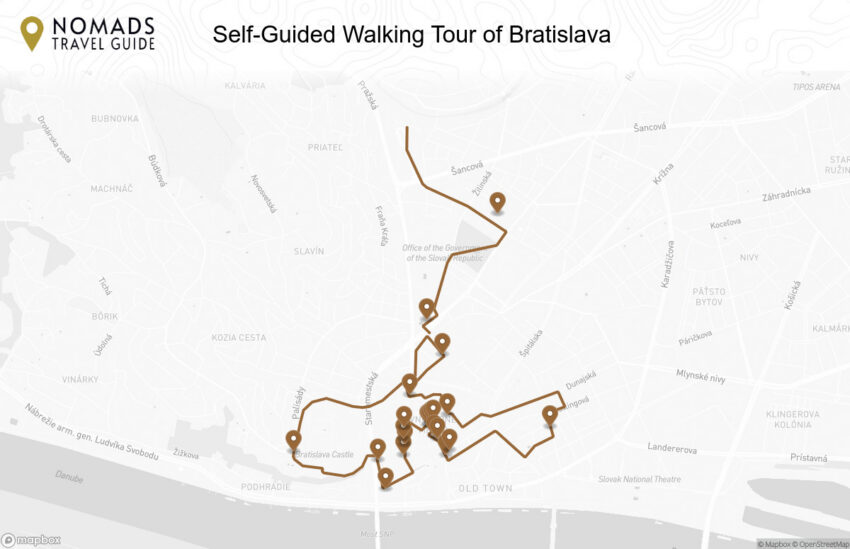
Discover Bratislava on foot with our walking tour map guiding you between each stop as you explore its Old Town lanes, landmark squares, and castle viewpoints above the Danube. As this is a self guided walking tour, you are free to skip places, swap the order, and take coffee stops whenever you want-use the map as your structure, then let the city set the pace.
1. Slovak Radio Building
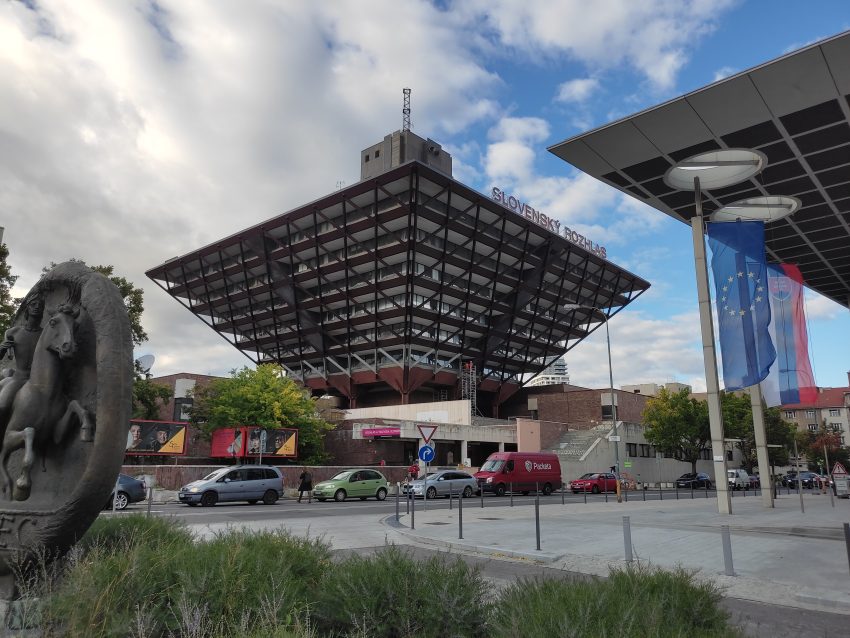
The Slovak Radio Building in Bratislava is the city’s famous “inverted pyramid,” a late-socialist-era landmark whose construction began in 1967 and was completed in 1983. It was designed by architects Štefan Svetko, Štefan Ďurkovič, and Barnabáš Kissling, and it later became a headquarters for Slovakia’s public broadcasting (regular broadcasting from the building is commonly dated to March 1985).
Its form is the point: a large steel structure shaped like an upside-down pyramid, with a second inner pyramid housing technical broadcast spaces and studios. Beyond the architecture, it’s also a performance venue, with a large concert hall (just over 520 seats in most descriptions) and a substantial concert organ.
What to see is mainly the exterior massing and the engineering silhouette, which is easiest to appreciate from slightly back from the façade so you can read the full inverted geometry. If you want an “inside” experience, the concert hall is the most meaningful public-facing space, so checking what’s on there is typically the best way to see more than the building’s shell.
Location: 1, Mýtna 2826, 811 07 Bratislava-Staré Mesto, Slovakia | Hours: Check official website. | Price: Free (exterior); prices vary by event. | Website


2. Grassalkovich Palace
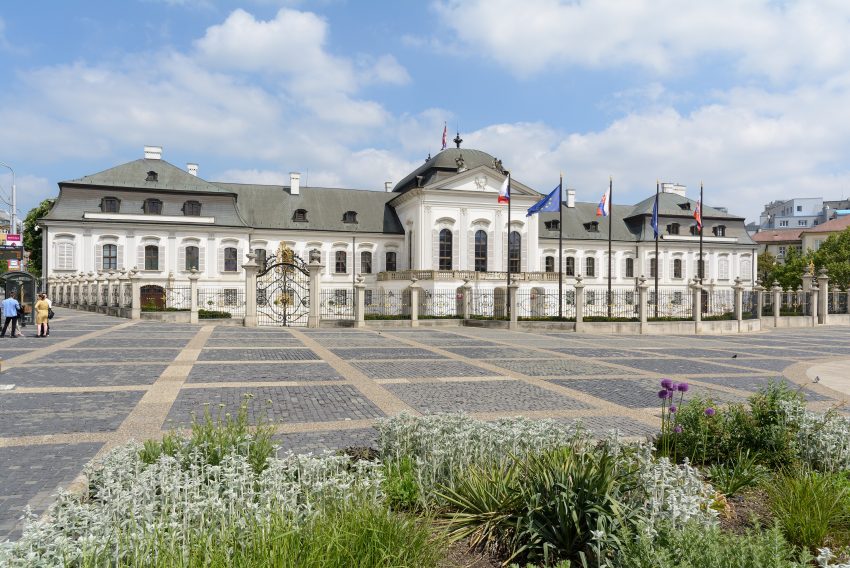
Grassalkovich Palace, often called the Presidential Palace, is a Rococo summer palace completed in 1760 for Count Antal (Anton) Grassalkovich, a prominent Hungarian noble closely connected to Empress Maria Theresa. Over the 20th century it cycled through very different roles (including wartime and communist-era uses), before major restoration in the early 1990s and its formal adoption as the Slovak president’s residence on 30 September 1996.
Because it is the working seat of the President of the Slovak Republic, the palace itself is typically viewed from the outside rather than visited like a standard museum interior. The real “what to see” is therefore architectural: the ceremonial frontage on Hodžovo Square, the symmetry of the main block, and the sense of an 18th-century aristocratic residence repurposed for modern state functions.
The gardens behind the palace are the easiest public payoff: a formal, French-style layout that functions as a city-centre park. For a concrete detail, Visit Bratislava lists the Grassalkovich Garden opening hours as daily, Monday–Sunday, 08:00–21:00 (though hours can vary seasonally, so treat signage on the day as authoritative).
Location: Hodžovo námestie 2978/1, 811 06 Bratislava-Staré Mesto, Slovakia | Hours: (Seasonal) March: 10:00–19:00; April – May: 08:00–20:00; June – September: 08:00–21:00. | Price: Free. | Website
3. Bratislava Castle
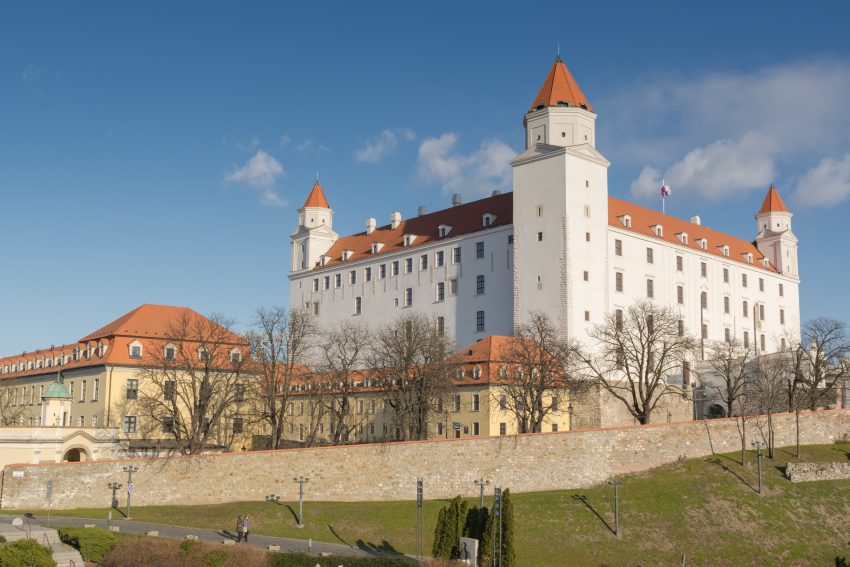
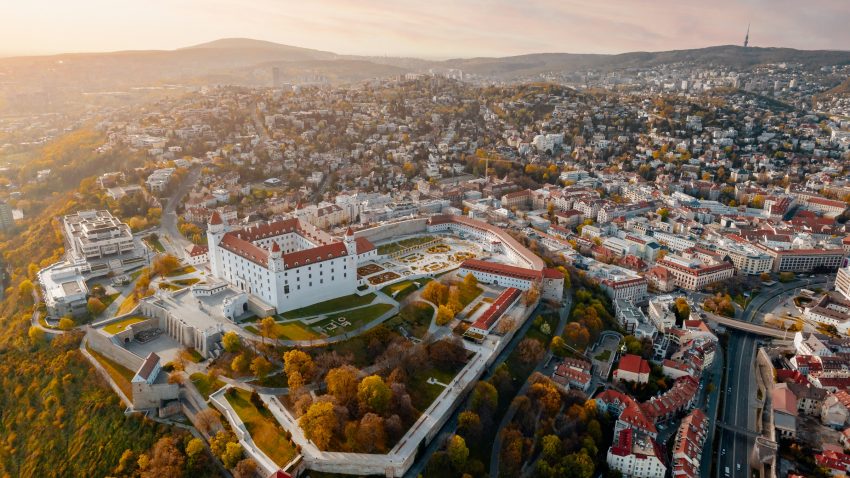
Bratislava Castle sits high above the Danube and has been a dominant feature of the city for centuries. The site developed from early medieval fortifications into the large, four-towered complex you see today, shaped by long periods under the Kingdom of Hungary and the Habsburg era. A major fire in 1811 left it in ruins for generations before large-scale restoration in the mid-20th century. Today, the castle is closely tied to Slovak state history, including major constitutional milestones signed on-site in the late 20th century. Much of the interior is used for Slovak National Museum exhibitions, so it’s both a landmark and a working cultural venue. Even if you only visit the courtyards, you get a strong sense of how the building was designed to project power over the city below. What to see is split between views and museum spaces. The terraces and castle grounds are the classic draw: you can look out over the old town, the river, and across toward Austria on a clear day. Inside, the museum areas and representative halls give you the “state castle” feel rather than a purely medieval ruin experience.
Location: 811 06 Bratislava-Old Town, Slovakia | Hours: Monday: 10:00–18:00. Tuesday: Closed. Wednesday: 10:00–18:00. Thursday: 10:00–18:00. Friday: 10:00–18:00. Saturday: 10:00–18:00. Sunday: 10:00–18:00. | Price: Adults: €14; Students/Children: €7; Seniors (65–69): €8; Seniors 70+ & children under 6: free. | Website
4. St. Martin's Cathedral
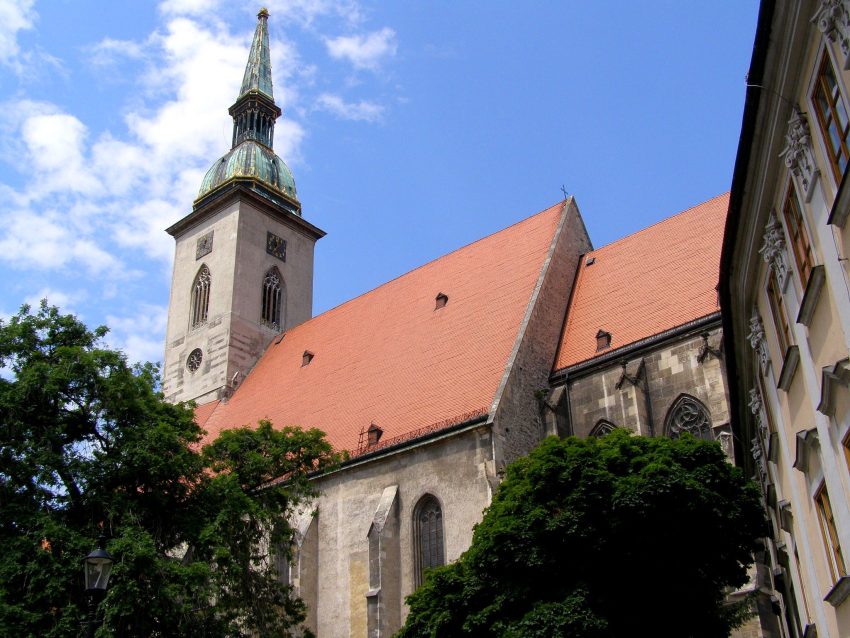
St. Martin’s Cathedral is one of Bratislava’s oldest major churches and is most famous as the coronation church of the Kingdom of Hungary. Between 1563 and 1830, Hungarian kings (and related royal figures) were crowned here, which is why the cathedral holds such a central place in the city’s story. Its tower also formed part of the city’s fortifications, physically tying it to Bratislava’s defensive past. The building’s Gothic character is part of the appeal: it feels austere, vertical, and historic in a way that contrasts with the lighter Baroque streets nearby. The coronation connection is still signposted on the skyline by a large replica crown placed atop the tower, an intentional reminder of the site’s political-religious role. When you’re there, focus on the exterior tower details first, then step inside for the sense of scale and ceremony. The surrounding area also tells a story: modern infrastructure projects reshaped the neighbourhood, and you can still find memorial references to what once stood nearby. It’s a stop that rewards slow looking rather than rushing through.
Location: Rudnayovo námestie 1, 811 01 Bratislava-Staré Mesto, Slovakia | Hours: Monday – Friday: 09:00–11:30 & 13:00–18:00. Saturday: 09:00–11:30. Sunday: 13:45–16:30. | Price: Free; donations appreciated. | Website
5. New Bridge and UFO Observation Deck
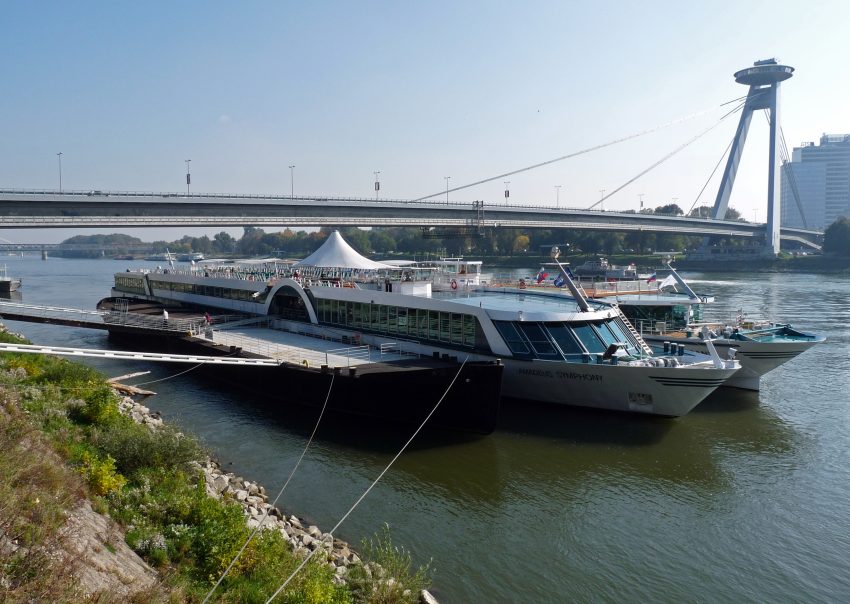
Most SNP (often still called the “New Bridge”) was built during the late 1960s–early 1970s and opened on 26 August 1972. It’s a distinctive cable-stayed bridge over the Danube and is noted internationally for its unusual engineering profile. The “UFO” form at the top of the pylon became one of Bratislava’s most recognisable modern icons. The UFO structure houses an observation deck (and a restaurant), reached by lifts inside the pylon. The whole concept reflects a very 20th-century confidence in infrastructure doubling as a civic symbol—transport below, spectacle above. Whatever you think of the aesthetics, it’s an unmistakable part of Bratislava’s post-war urban identity. What to see is, straightforwardly, the panorama. From the deck you can take in the Danube, the old town, and key landmarks like the castle and cathedral from a completely different angle than you get at street level. If you time it well, the changing light over the river is the highlight, not the structure itself.
Location: Most SNP, 851 01 Bratislava, Slovakia | Hours: Monday – Sunday: 10:00–23:00. | Price: Check official website. | Website
6. Palace of Erdody
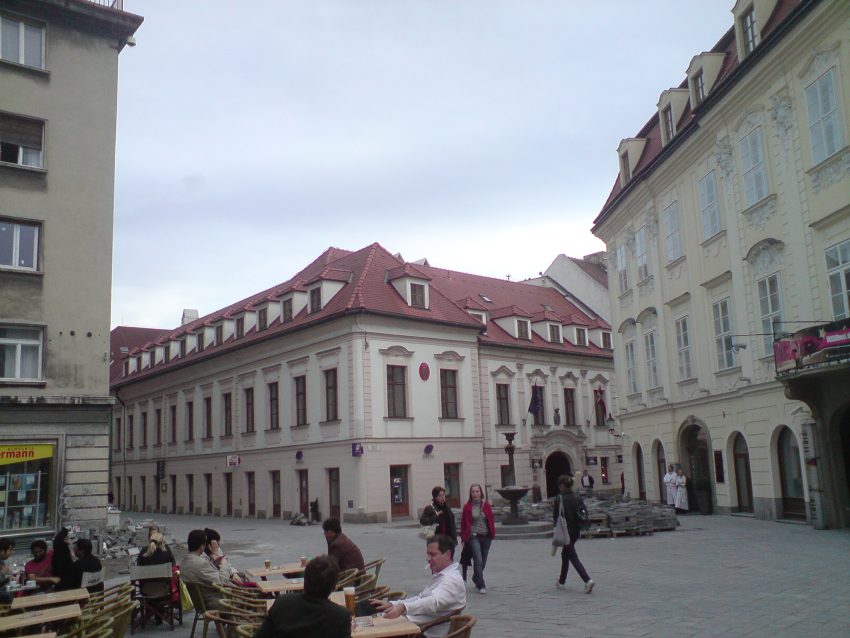
Erdődy Palace was built in 1770, associated with Count Juraj (George) Leopold Erdődy, a figure connected to the Hungarian Royal Chamber, and designed by builder/architect Matej (Mathew) Walch according to several accounts. Its origins sit firmly in Bratislava’s late-18th-century wave of aristocratic urban palaces, when noble families established prestigious city residences in the old town. The palace’s history is tied to the social world of the period—elite residences, salons, and the broader cultural life that clustered around Ventúrska Street and nearby lanes. Some sources emphasise later associations with artists and composers in the general milieu of these old-town palaces, but the most reliable “history” is the palace’s 18th-century construction and noble ownership context. What to see today is primarily the building as part of the old town’s architectural fabric: façade, scale, and its placement among neighbouring palaces. It’s best appreciated by comparing it with nearby aristocratic houses—spotting how each expresses status through portals, courtyards, and street presence. Even if you don’t go inside, it enriches your sense of Bratislava as a city of layered elite streetscapes.
Location: Ventúrska 269/1, 811 01 Bratislava-Staré Mesto, Slovakia | Hours: 24 Hours. | Price: Free.
7. Johann Pálffy Palace
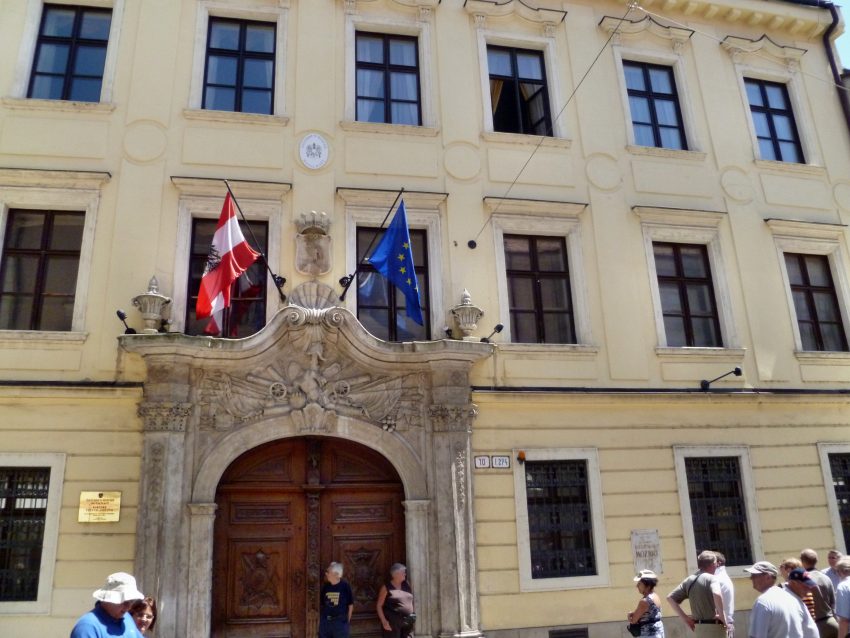
Johann Pálffy Palace is part of the cluster of historic aristocratic buildings in Bratislava’s Old Town, tied to the influential Pálffy family. Sources commonly describe it as a Baroque-era palace on Ventúrska Street, reflecting the period when noble families invested heavily in prestigious urban residences. Because multiple “Pálffy Palace” sites exist in central Bratislava, it’s worth treating the name as a family label rather than a single building identity. What remains consistent is the broader history: the Pálffys were major aristocratic patrons in the region, and their palaces signal Bratislava’s role as a significant Hungarian/imperial city. What to see is the Baroque street presence—especially portals and façade details—and how it fits into Ventúrska Street’s “palace corridor” feel. If the building hosts exhibitions or cultural programming, that modern use is itself part of the story: old aristocratic spaces adapted for public culture. Even as an exterior stop, it’s a strong example of old-town noble architecture.
Location: Panská 19, 811 01 Bratislava, Slovakia | Hours: Monday: Closed. Tuesday – Sunday: 11:00–18:00. | Price: Adults: €8 (Mirbach Palace or Pálffy Palace); €10 (Mirbach Palace & Pálffy Palace); Under 18: free. | Website
8. Palace of Zichy
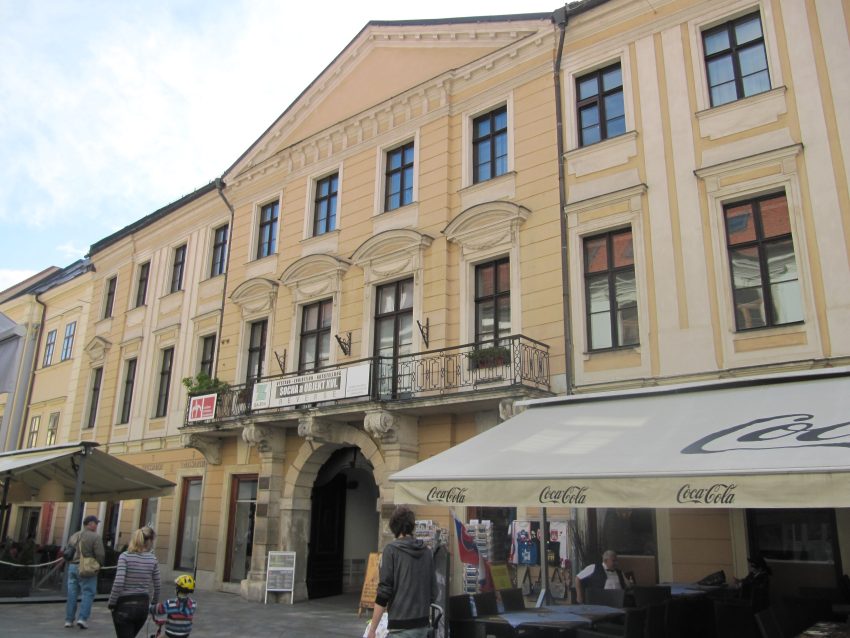
Zichy Palace was built in the late 18th century, commonly dated to roughly 1770–1780 (or completion around the mid-1770s), for Count František (Franz) Zichy. It’s a classic example of Bratislava’s late-18th-century palace-building boom, when older medieval plots were consolidated into grander residences. The building is also linked to later cultural history, including documented musical connections in the early 19th century through the Zichy household. Architecturally, sources describe a strict, classicist façade paired with interior layers that can trace back to earlier (including Gothic) structures. That “old inside / new outside” tension is typical in a city where rebuilding often meant wrapping prestige architecture around older cores rather than starting from scratch. What to see includes the façade and courtyard atmosphere, and—when accessible—the interior spaces used for ceremonies or events. If you’re interested in Bratislava’s cultural life beyond monuments, this is a good example of how palaces have been repurposed as civic-cultural venues. It’s less about a single famous room and more about the building’s continuing role in the old town.
Location: 9, Ventúrska 265, 811 01 Bratislava-Staré Mesto, Slovakia | Hours: Tuesday – Sunday: 15:00–19:00. Closed on Monday. | Price: Free. | Website
9. Leopold de Pauli’s Palace
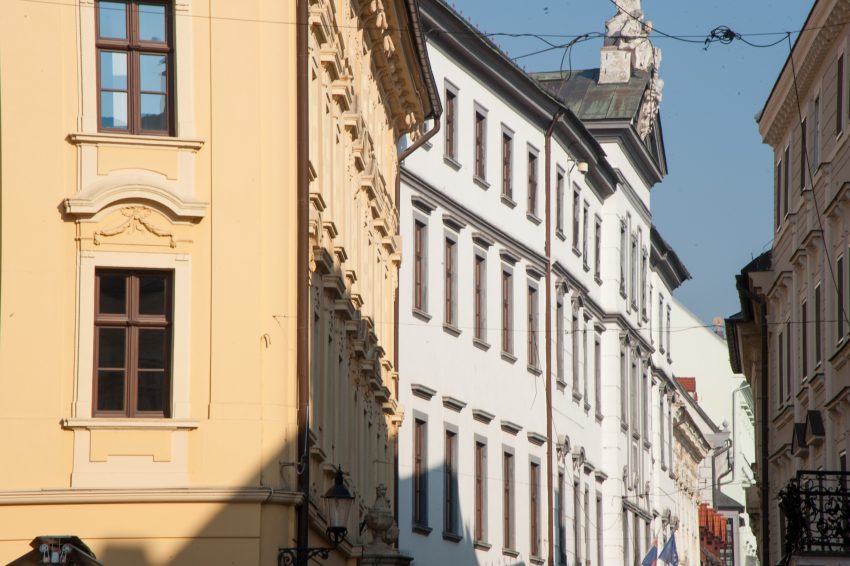
Leopold de Pauli’s Palace is described as being built for Leopold de Pauli in 1775–1776, tied to his role as an administrator of imperial property, and it sits within the same late-18th-century aristocratic building wave as several nearby palaces. It’s another reminder that Bratislava’s old town streets were once a dense network of elite residences and administrative power, not just picturesque lanes. Because naming and attribution can vary across sources (and similar family names recur in the area), the safest historical takeaway is the documented late-18th-century origin and its association with imperial administration. In other words: it’s a palace that reflects governance and social hierarchy as much as domestic life. What to see is the exterior and how it reads in the street: portals, proportions, and the quiet confidence of late-18th-century classicising taste. If you’re exploring Ventúrska Street and its surroundings, it works best as part of a “palace sequence,” where you compare stylistic signals of status from building to building. It’s an architecture-first stop rather than a heavily interpreted museum site.
Location: Ventúrska 263/11, 811 01 Bratislava-Staré Mesto, Slovakia | Hours: Monday: 12:00–21:00. Tuesday – Friday: 09:00–21:00. Saturday: 10:00–18:00. Closed on Sunday. | Price: Free. | Website
10. Napoleon's Army Soldier Statue
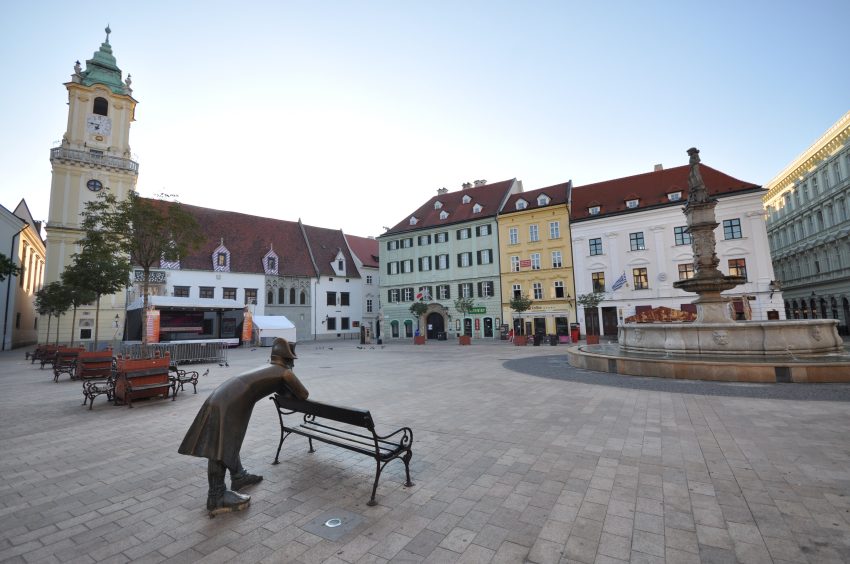
The Napoleonic soldier statue is part of Bratislava’s late-20th-century wave of quirky old-town sculptures. It commemorates occasions when Napoleon’s army entered the city, turning a complex historical era into an approachable street-level reference point. The figure is associated with sculptor Juraj Melis and is commonly discussed alongside other playful statues installed in the old town. What matters historically is the reminder that Bratislava (Pressburg) sat in the path of major European power struggles. The statue doesn’t try to be a full history lesson; instead, it signals that the Napoleonic period left an imprint on the city’s memory, and it invites curiosity rather than reverence. What to see is the setting and the gesture: it’s designed to be photographed and noticed during a casual stroll, not approached like a museum piece. If you’re interested in context, treat it as a prompt—spot it, then connect the idea of “Napoleonic Bratislava” with nearby civic spaces like the Main Square and Primate’s Palace, where European history feels more formally documented.
Location: Hlavné námestie 358/7, 811 01 Bratislava-Staré Mesto, Slovakia | Hours: 24 Hours. | Price: Free.
11. Hlavne Namestie
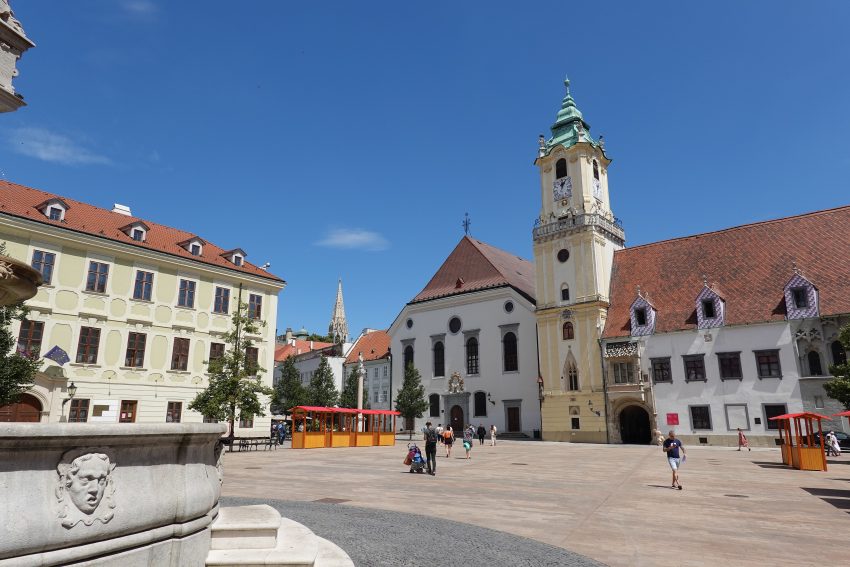
Hlavné námestie (Main Square) is the old town’s central civic space, shaped by centuries of city life and framed by key historic buildings. The square’s identity is tightly linked to the Old Town Hall complex and the layers of medieval-to-modern architecture around it. Historically, this is where public announcements, markets, and civic ceremonies would have played out in front of the town’s governing institutions. A major historic feature is the Roland (Maximilian) Fountain, commissioned in 1572 under King Maximilian II to provide a public water supply. It’s one of the square’s defining symbols, and its long history of rebuilds and restorations reflects how the city has maintained continuity while repeatedly updating the fabric of the old town. What to see here is less about a single “must-enter” interior and more about the ensemble. Take in the town hall façades, the fountain, and the way the square opens and compresses into surrounding lanes. It’s also an easy place to spot some of Bratislava’s playful public sculptures nearby, which add a modern layer to an older setting.
Location: Hlavné námestie, 811 01 Bratislava-Staré Mesto, Slovakia | Hours: 24 Hours. | Price: Free.
12. Old Town Hall
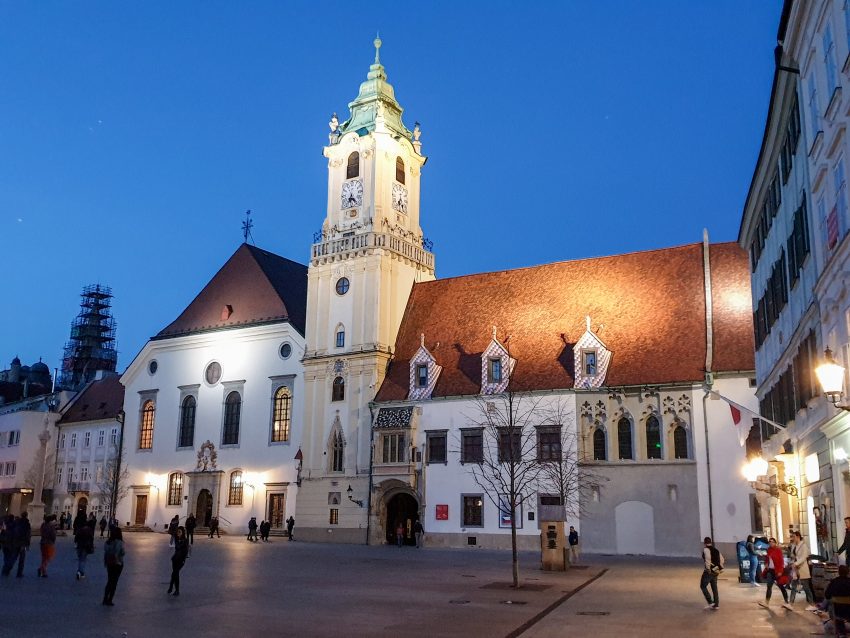
Bratislava’s Old Town Hall is a complex of buildings that grew over centuries, with origins reaching into the medieval period and significant development from the 14th century onward. It became the city’s administrative heart by connecting multiple townhouses and has been rebuilt and reshaped in different styles as the city evolved. This layered construction is part of what makes it feel like a living archive of Bratislava’s civic life. It also matters because it houses the Bratislava City Museum, founded in 1868 and regarded as the oldest continuously operating museum in Slovakia. That pairing—old government centre turned historical museum—fits the building’s identity perfectly. You’re effectively walking through spaces designed for authority, judgment, and public administration, now repurposed to interpret the city. What to see includes the courtyard atmosphere, the architectural mash-up of Gothic and later additions, and (when open) the museum exhibitions. Many visitors prioritise the tower for views over the historic core, because it gives you a “map-like” read of the streets and squares below. It’s one of the best places in the old town to connect history with orientation.
Location: Hlavné námestie 501/1, 811 01 Bratislava-Staré Mesto, Slovakia | Hours: Tuesday – Sunday: 10:00–18:00. Closed on Monday. | Price: Adults: from €5; Reduced: from €1.30. | Website
13. Bratislava City Museum
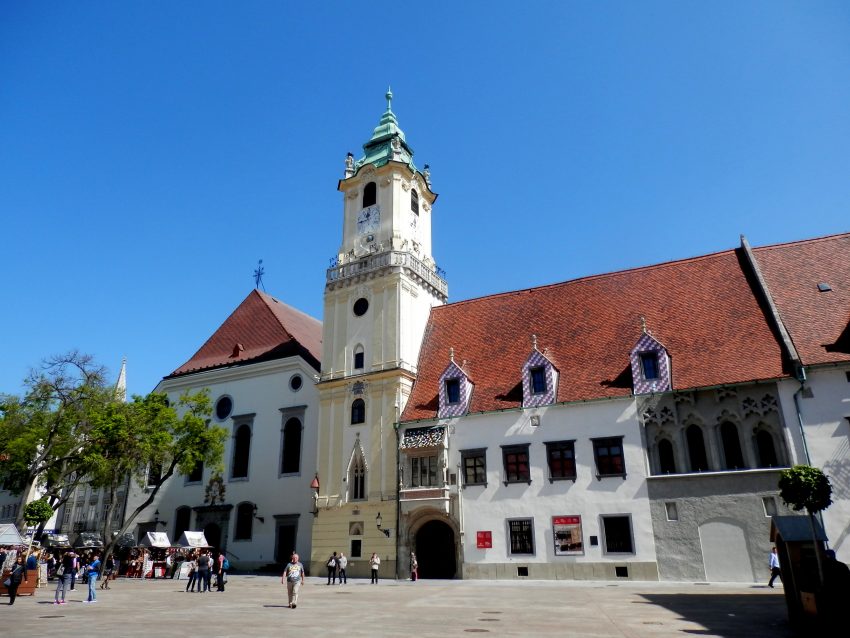
Bratislava City Museum was founded in 1868 and is described as the oldest continuously operating museum in Slovakia. Its headquarters are based in the Old Town Hall complex, which immediately anchors the museum’s identity in the city’s civic and administrative past. The museum’s purpose is broad: documenting Bratislava’s history from early periods into the 20th century. The significance is twofold: the institution’s age (established in the 19th century, when urban identity and public museums were being formalised across Europe) and its location inside one of Bratislava’s most important historic buildings. That combination means the building itself is part of the collection experience, not just a container for exhibits. What to see will depend on current exhibitions, but the core appeal is “Bratislava through time” in a setting that still feels authentically municipal. If you have limited time, prioritise displays most directly tied to the old town and any sections that interpret how the city’s role changed under different states and empires. The museum is a good choice when you want narrative context, not just individual landmarks.
Location: 1, Radničná 577, 811 01 Bratislava-Staré Mesto, Slovakia | Hours: Monday: Closed. Tuesday – Sunday: 10:00–18:00. | Price: Adults: €8; Concessions: €4; Family (2+3): €18; Family (1+2): €10; School group: €2 per person; Old Town Hall Tower: €4. | Website
14. Schone Naci Statue
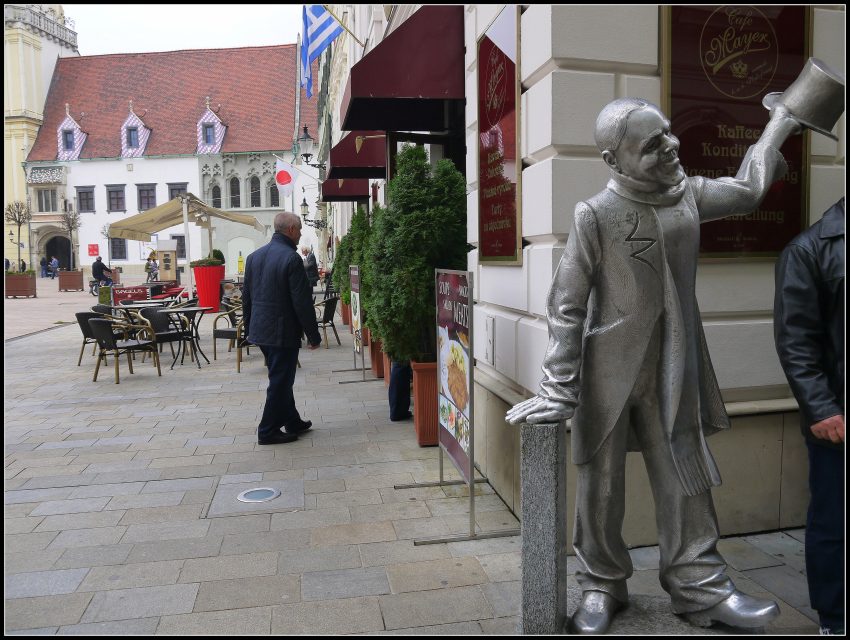
Schöner Náci refers to Ignác Lamár, a well-known Bratislava character remembered as part of the city’s early-20th-century street and café culture. The statue draws on that local memory, turning a real person’s presence into a small public monument. It’s a reminder that “heritage” can be social and everyday, not only royal or ecclesiastical. The sculpture itself belongs to the modern period of old-town revitalisation, when Bratislava installed playful statues to humanise public space and create points of interest beyond the major monuments. That context matters: this isn’t an old statue preserved from the past, but a contemporary decision about which stories deserve visibility. What to see is the detail and the interaction it invites: people treat it as a friendly landmark rather than a solemn memorial. If you want the “why,” read it as a portrait of the city’s pre-war urban personality—polite rituals, promenades, and public sociability—compressed into a single figure you encounter at street level.
Location: Rybárska brána 217/1, 811 01 Bratislava-Staré Mesto, Slovakia | Hours: 24 Hours. | Price: Free.
15. Cumil Statue
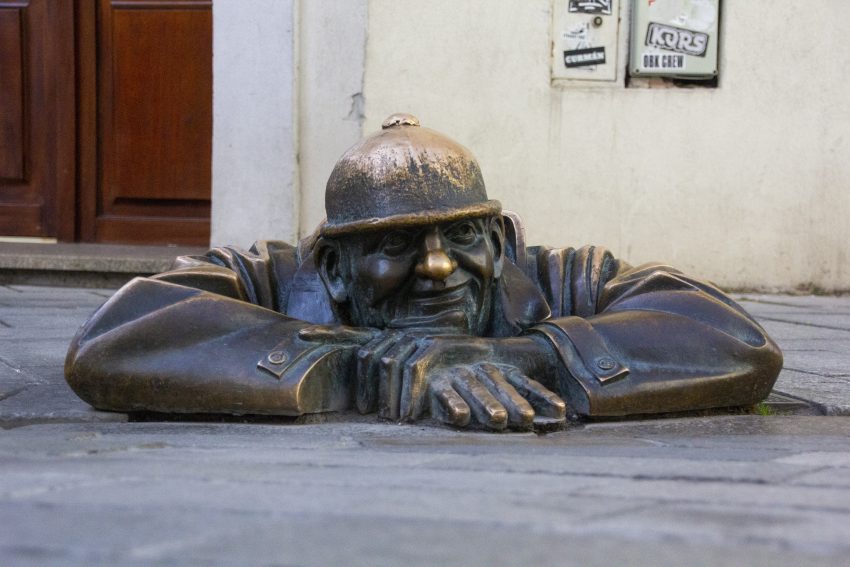
Čumil is a bronze statue installed on 26 July 1997, created by artist Viktor Hulík, and it quickly became one of Bratislava’s most recognisable small attractions. It was placed during a celebration linked to the renewal of the pedestrian zone in the city centre, so it’s tied directly to how the old town was reshaped after the communist period. The figure peeks from a manhole, playing with the idea of the city as something with hidden layers. Historically, it doesn’t represent medieval Bratislava; it represents Bratislava’s modern reinvention—adding humour and street-level charm to public space. The fact that it’s sometimes misidentified abroad actually underscores how quickly a local in-joke can become a generic “tourist symbol” once it’s photographed enough. What to see is the setting and the sculptural punchline: it works best when you notice it “in the flow” of old-town streets rather than treating it as a destination. It’s also useful as a marker that you’re in the most walkable central area, close to major squares and civic buildings. Small, yes—but culturally very Bratislava.
Location: Panská 251/1, 811 01 Bratislava-Staré Mesto, Slovakia | Hours: 24 Hours. | Price: Free.
16. Hviezdoslav Square
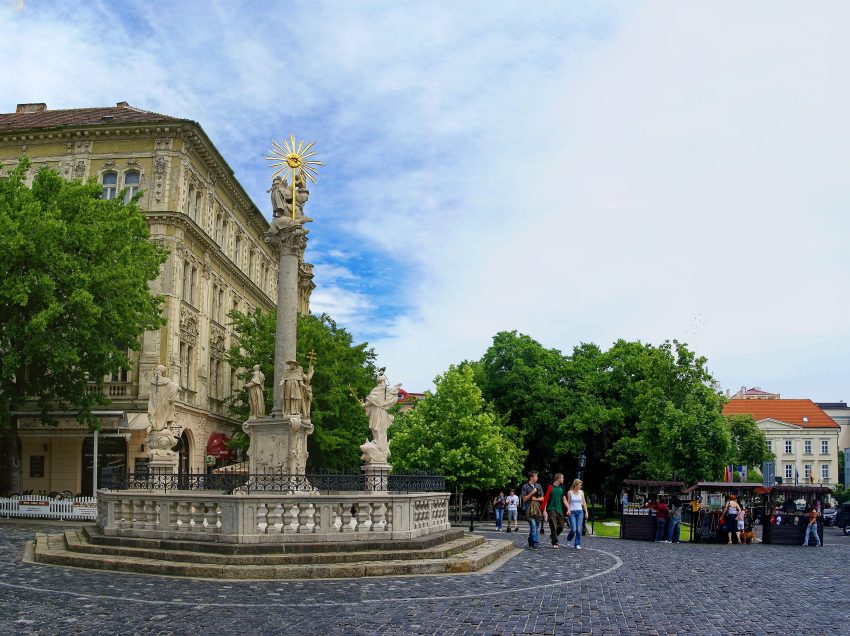
Hviezdoslav Square is a major pedestrian square in Bratislava’s Old Town, named after poet Pavol Országh Hviezdoslav. Historically, the area had medieval houses and later became a prominent promenade zone, with large-scale reconstruction at the end of the 20th century reshaping its layout and feel. It connects the river-bridge area toward the historic theatre end of the old town. The square is also a reminder that Bratislava’s “public spaces” have been repeatedly reinterpreted—noble residences, hotels, civic gatherings, and modern event programming have all left layers here. It’s the kind of place where the buildings along the edges are as important as the open space itself. What to see includes the promenade atmosphere, fountains, and the architectural frontage along the square. It’s also closely linked to the historic Slovak National Theatre building at the eastern end, so it works well as a place to pause and take in the city’s 19th-century civic ambition. Even without a plan, it naturally funnels you into photogenic old-town streets.
Location: 811 02 Bratislava-Old Town, Slovakia | Hours: 24 Hours. | Price: Free.
17. Old Slovak National Theater
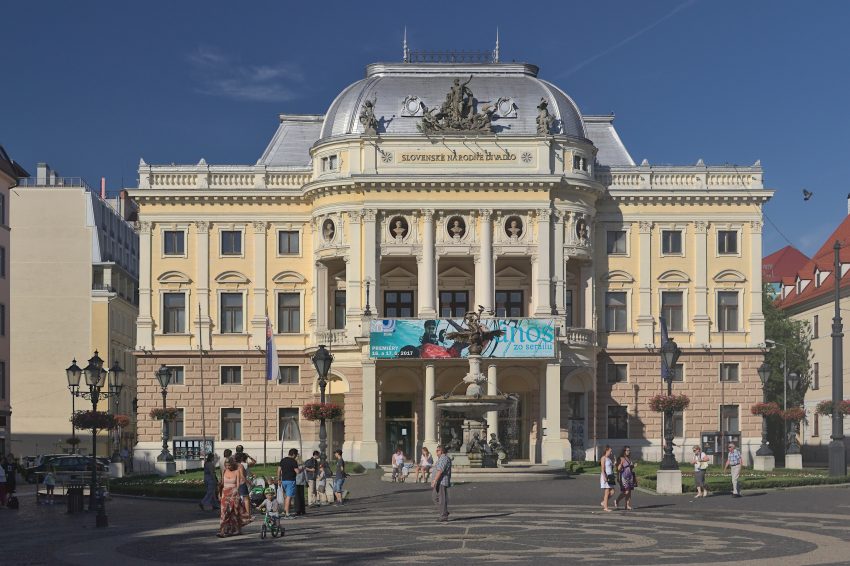
The historic building of the Slovak National Theatre on Hviezdoslav Square opened in 1886 and was designed by the Viennese theatre-architecture specialists Ferdinand Fellner and Hermann Helmer. Built originally as the City Theatre in the Austro-Hungarian period, it represents a 19th-century civic ambition: culture as a statement of modern urban identity. Its presence at the end of a major promenade square is very deliberate. Historically, the building predates the founding of the Slovak National Theatre institution (which came later), so it has hosted changing cultural and political contexts over time. That layered identity—imperial-era city theatre later absorbed into a national cultural framework—is part of what makes it compelling even from the outside. What to see includes the Neo-Renaissance exterior details and the way the theatre anchors the square’s formal geometry. If you can access the interior during performances or open times, the historic theatre layout and decorative spaces are a key part of the experience. Even when you’re only viewing it from the square, it’s one of the clearest “1880s Bratislava” statements in the city centre.
Location: Gorkého 2, 811 01 Bratislava, Slovakia | Hours: Check official website. | Price: Prices vary by show. | Website
18. Blue Church
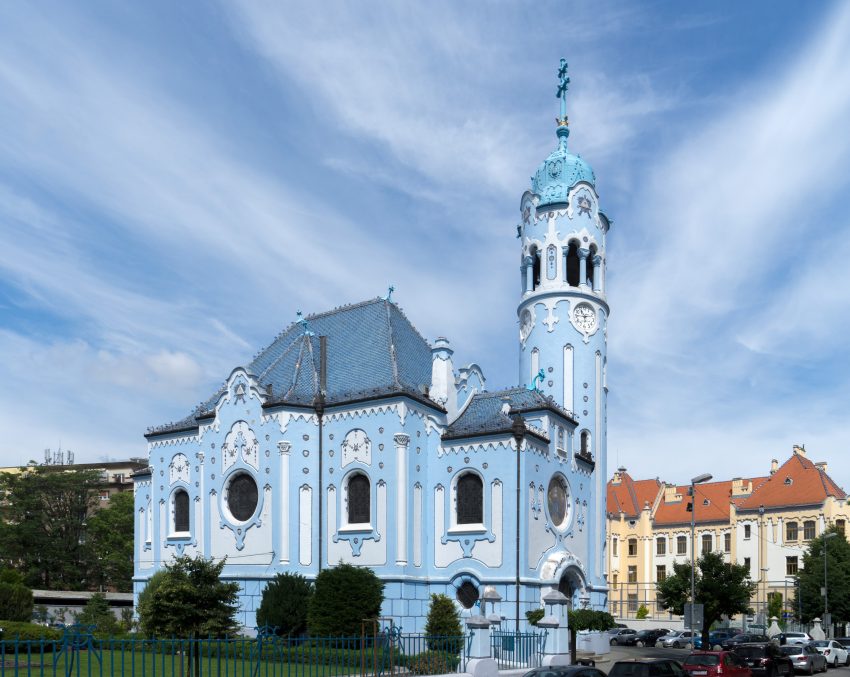
The Blue Church, officially the Church of St. Elizabeth, is one of Bratislava’s best-known early 20th-century buildings. It was designed by architect Ödön Lechner in the Hungarian Secession (Art Nouveau) style and built in the period 1908–1913, with consecration associated with that same early-20th-century phase. Its distinctive colour scheme is not a gimmick—it’s central to the building’s identity and detailing. Historically, it was connected to the nearby school complex and functioned as a school chapel, which helps explain its location and scale compared with older city-centre churches. The church’s popularity today comes from how cohesive the design is: façade, roof, mosaics, and decorative elements all reinforce the same aesthetic language. What to see is the exterior first: the blue-glazed roof, rounded forms, and Art Nouveau ornament reward close inspection. Inside, the atmosphere is typically calmer and more intimate than the city’s larger Gothic or Baroque churches, so it’s worth stepping in if open. It’s a short visit, but visually memorable.
Location: Bezručova 2, 811 09 Bratislava, Slovakia | Hours: Monday – Wednesday: 06:30–07:30. Thursday – Friday: 17:30–19:00. Saturday: 06:30–07:30. Sunday: 07:30–11:00 & 17:30–19:00. | Price: Free. | Website
19. Primate's Palace
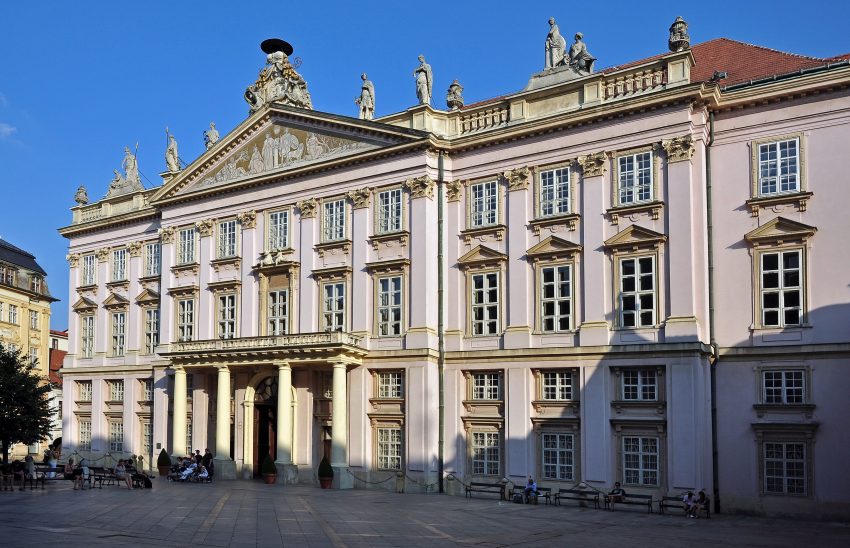
Primate’s Palace is a neoclassical landmark built from 1778 to 1781 for Archbishop József Batthyány, the Primate of the Kingdom of Hungary. Its most famous historical moment came in 1805, when the Hall of Mirrors hosted the signing of the Peace of Pressburg after the Battle of Austerlitz. Today it functions as the seat of Bratislava’s mayor, which keeps it in active civic use rather than as a static monument. The palace’s significance is partly architectural—clean neoclassical lines, a formal urban presence—and partly political, because it’s tied to European power politics at a moment when Napoleon’s wars reshaped the continent. Knowing that context changes how you read the interiors: it’s not just “pretty rooms,” it’s a stage for diplomacy. What to see centres on the ceremonial rooms, especially the Hall of Mirrors, if access is available. The surrounding square and façades are also part of the experience, because the palace was designed to communicate status within the old town’s tight street network. It’s one of the most “state history” sites in central Bratislava.
Location: Primaciálne námestie 2, 811 01 Bratislava, Slovakia | Hours: Wednesday: 10:00–17:00. Thursday: 12:00–17:00. Saturday: 10:00–17:00. Sunday: 10:00–17:00. Closed on Monday, Tuesday, Friday. | Price: €3. | Website
20. Michael's Tower and Street
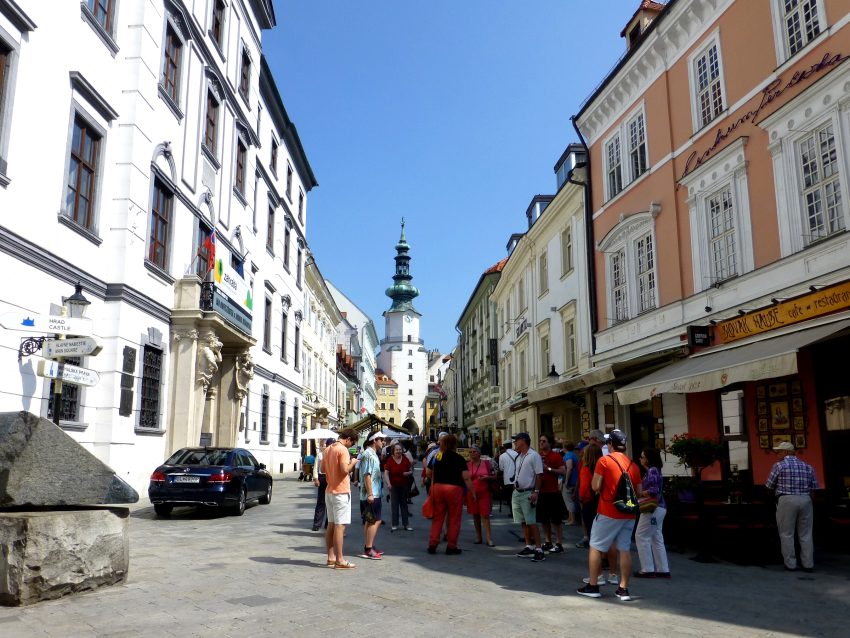
Michael’s Gate is the only preserved gate from Bratislava’s medieval fortifications and ranks among the city’s oldest surviving structures. Built around 1300 and later reshaped through Baroque reconstruction in the 18th century, it carries the marks of both medieval defence and later urban pride. The tower houses an Exhibition of Weapons linked to the Bratislava City Museum, reinforcing its historic “guarded threshold” role. The gate’s symbolism is straightforward: for centuries, this was one of the controlled points of entry through the city walls. That physical fact gives the surrounding street its character, because movement still funnels through a space designed for surveillance and control—only now it’s shoppers, visitors, and locals flowing through instead of guarded traffic. What to see includes the tower itself, the statue of St. Michael and the dragon on top, and the views from the upper levels when accessible. Michalská Street leading to the gate is also part of the experience, because it sets up the approach and makes the tower feel like a landmark you “arrive” at. It’s one of the most readable pieces of medieval Bratislava in daily use.
Location: Michalská 22, 811 01 Bratislava, Slovakia | Hours: Monday: 10:00–18:00. Tuesday: Closed. Wednesday: 10:00–18:00. Thursday: 10:00–18:00. Friday: 10:00–18:00. Saturday: 10:00–18:00. Sunday: 10:00–18:00. | Price: General admission: €6; Reduced (children 6–15, students, seniors): €4; Family ticket: €14 (2+3/2+2/2+1) or €8 (1+2/1+1); Children under 6: free. | Website
21. Obchodna Street
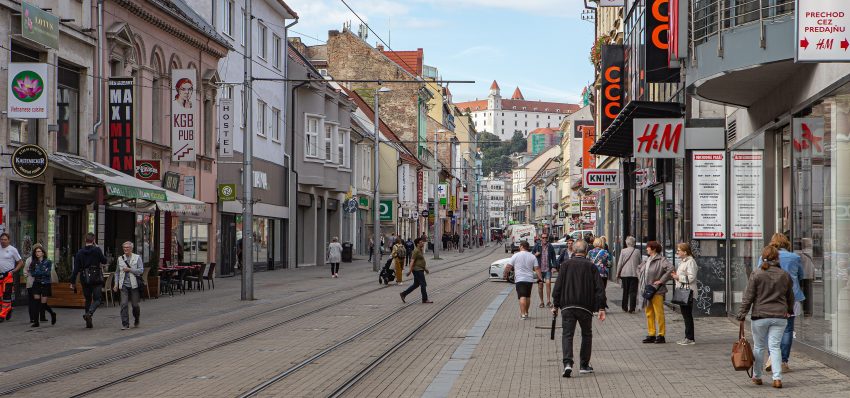
Obchodná ulica has long functioned as a commercial artery, historically serving as a market road connecting areas outside the medieval core toward the city’s gates. Over time, it shifted from a more peripheral route—associated in parts with vineyards and taverns—into a busier urban street as Bratislava expanded beyond its fortifications. Its story is essentially the story of a city growing outward and turning movement corridors into retail streets. In the modern period, the street’s commercial character became even more pronounced, and it remains known for shopping and everyday city life. The appeal is not “monumental architecture” so much as the lived-in rhythm of a working central street: storefronts, cross-streets, and constant foot traffic. What to see (and do) is largely experiential: walk the length of the street, watch how it changes block by block, and notice how it links the old town’s historic landmarks with more contemporary retail zones. It’s also useful as a connective route if you’re moving between major old-town points without staying exclusively on the postcard-pretty lanes.
Location: Obchodná, 811 06 Bratislava-Staré Mesto, Slovakia | Hours: 24 Hours. | Price: Free.

Moira & Andy
Hey! We're Moira & Andy. From hiking the Camino to trips around Europe in Bert our campervan — we've been traveling together since retirement in 2020!
This website uses affiliate links which earn a small commission at no additional cost to you.
Walking Tour Summary
Distance: 5.5 km
Sites: 21
Walking Tour Map