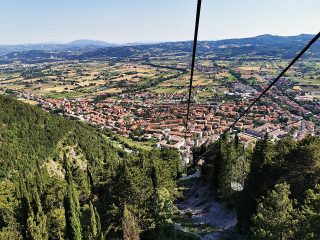
Fontana Maggiore, Perugia
Fountain in Perugia
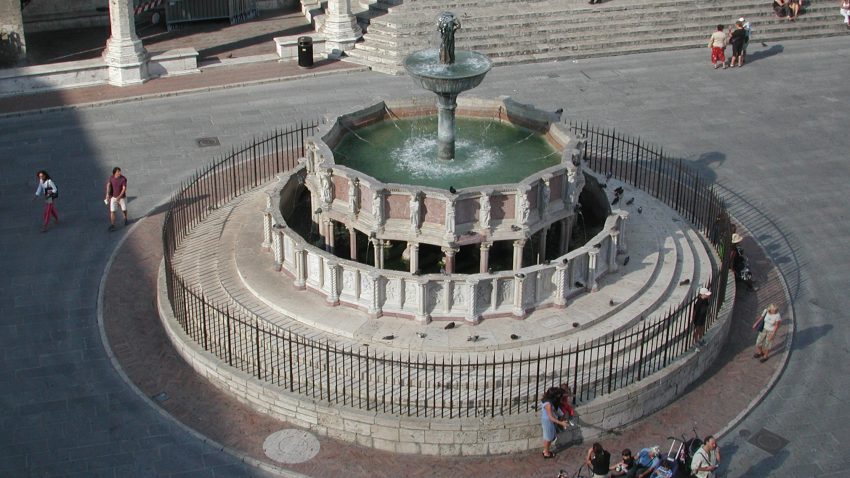
At the heart of Perugia's main square, the Great Fountain is far more than a pretty backdrop for photos. It is the visible celebration of a 13th century engineering triumph, when Boninsegna Veneziano used a forced pressure duct to bring water from Monte Pacciano up to the city's acropolis without any pumps. In a hilltop city where water was life, this feat was extraordinary, and in 1275 fra Bevignate da Cingoli was entrusted with creating a fountain grand enough to mark the achievement. Today, its tiered basins, sculpted panels and ever-moving water still tell the story of a city that mastered its landscape.
Standing before the fountain, you are surrounded by stone that speaks in symbols. The lower basin's zodiac signs echo medieval fascination with the heavens, while the upper ring of saints, mythical and biblical figures ties Perugia to both sacred tradition and the landscape around it, represented by personifications like Augusta Perugia and Domina Iacus of Lake Trasimeno. Topped by a bronze cup with nymphs spouting water, the Great Fountain is a highlight of any walking tour of Perugia and a perfect place to pause between church visits, museum stops and café breaks.
Table of Contents
- History and Significance of the Great Fountain of Perugia
- Things to See and Do in the Great Fountain of Perugia
- How to Get to the Great Fountain of Perugia
- Practical Tips on Visiting the Great Fountain of Perugia
- Where to Stay close to the Great Fountain of Perugia
- Is the Great Fountain of Perugia Worth Visiting?
- FAQs for Visiting Great Fountain of Perugia
- Nearby Attractions to the Great Fountain of Perugia
History and Significance of the Great Fountain of Perugia
The story of the Great Fountain begins with a problem: how to bring reliable water to Perugia's hilltop acropolis. Boninsegna Veneziano, a master of hydraulics, solved this by creating a forced pressure duct from the springs of Monte Pacciano. By carefully exploiting differences in elevation and pressure, he was able to make water appear to run “uphill” to the city, without any mechanical pumps. In the 13th century this was cutting edge engineering, signalling Perugia's technical prowess and ensuring a secure supply of fresh water for its inhabitants.
To commemorate this achievement, the city commissioned a monumental fountain for the main square. In 1275, the Cistercian friar Bevignate da Cingoli was tasked with designing and building what would become the Great Fountain. Stone was quarried in Assisi, preassembled in a workshop to ensure accuracy, then transported to the piazza and installed in sections. This careful prefabrication process helped guarantee the stability and tight fit needed for a complex hydraulic structure long before modern construction methods.
The resulting fountain, with its two concentric polygonal marble basins and bronze crowning element, quickly became the symbol of Perugia’s civic pride. Its iconography blends religious, mythological and local themes: saints and biblical figures share space with personified rivers and the city itself, linking Perugia’s earthly fortunes to both divine protection and the natural resources that sustained it. The inscription around the lowest frame invites everyone who passes to stop and look more closely, promising “wonderful things” to those who pay attention - a message that still feels apt for visitors today.
Things to See and Do in the Great Fountain of Perugia
Begin at the lower basin, which is encircled by 25 mirrored panels, each divided into two tiles. These tiles depict the signs of the Zodiac and related imagery, reflecting the medieval preoccupation with astrology, the cycles of time and the relationship between heaven and earth. Take your time walking around the circumference and try to spot your own sign; it is a simple way to connect personally with a design that is more than seven centuries old.
Next, shift your attention to the upper basin, where 24 statues represent a blend of saints, mythological characters and biblical figures. Among them you will find Augusta Perugia, the personification of the city, holding a cornucopia that symbolises abundance and the provision of wheat. Domina Iacus, the nymph of Lake Trasimeno, appears with fish, representing the bounty of the surrounding waters and reminding viewers of the broader landscape that feeds the city. Saints Peter, Paul and John the Baptist add a strong Christian dimension, underlining the square's role as a meeting point between civic and religious life.
Look up to the bronze cup at the top, where a group of nymphs spout water back into the basins below, completing the cycle begun at the distant springs of Monte Pacciano. This vertical layering of imagery - zodiac at the base, saints and personifications above, nymphs on top - mirrors the medieval worldview, moving from earthly time to celestial and divine realms. Finally, seek out the Italian inscription on the lowest frame inviting passersby to admire the fountain's bubbling water and promising that closer inspection reveals wonders. Reading it and then stepping in for a detailed look is a simple ritual that helps you appreciate why this fountain remains one of the best places to visit in Perugia for understanding the city's self-image.
How to Get to the Great Fountain of Perugia
The Great Fountain stands in Piazza IV Novembre, the main square at the historic core of Perugia, so reaching it is straightforward once you are in the city. Perugia is served by its own airport, Perugia San Francesco d'Assisi - Umbria International Airport, and can also be accessed via larger airports such as Rome or Florence, followed by onward travel by train, coach or hire car into the city. For the best deals and a seamless booking experience, check out these flights to Perugia on Booking.com. From the airport or bus terminals, local buses, the minimetrò and taxis will bring you up to the hilltop centre; from there, follow signs towards Piazza IV Novembre and the cathedral.
If you travel by train, Perugia's main station (Perugia Fontivegge) connects with regional and intercity services across central Italy. Use Omnio to easily compare schedules, book train tickets, and find the best prices all in one place for a hassle-free journey across Italy. From the station, you can take the minimetrò or a city bus to the historic centre, then stroll along Corso Vannucci or nearby streets until they open out into Piazza IV Novembre, where the Great Fountain occupies pride of place. Taxis offer a convenient alternative if you are carrying luggage or visiting with limited mobility.
Arriving by car, it is best to park in one of the car parks located below or just outside the historic centre, since much of the old town operates as a restricted-traffic zone. If you are looking to rent a car in Italy I recommend having a look at Discover Cars, first, as they compare prices and review multiple car rental agencies for you. From the car parks, escalators, lifts and well-marked pedestrian routes lead up into the centre; once there, simply follow the flow of people and signage towards the cathedral and main square, where the fountain is impossible to miss.
Practical Tips on Visiting the Great Fountain of Perugia
- Suggested tips: Start or end your day at the fountain, using it as a meeting point and orientation landmark as you explore the historic streets radiating from Piazza IV Novembre.
- Best time to visit: Early morning for quiet contemplation and softer light on the carvings, or late afternoon and evening when the square is livelier and the fountain becomes a social backdrop.
- Entrance fee: Free – the Great Fountain is an open-air monument in a public square.
- Opening hours: Accessible at all hours; illumination in the evening depends on local lighting schedules.
- How long to spend: Allow 20-30 minutes to walk around the fountain, study the panels and statues, and take photos; longer if you are combining it with visits to the cathedral and Palazzo dei Priori.
- Accessibility: The piazza around the fountain is largely level and pedestrian, making it accessible for most visitors, though some approaches from side streets are sloped or paved with uneven stone.
- Facilities: Cafés, bars, restaurants, shops and ATMs are plentiful around the square and in the nearby streets, along with tourist information points.
- Photography tip: Walk a full circle around the fountain to capture both close-up details of the zodiac tiles and wider shots with the cathedral and Palazzo dei Priori in the background; evening light often brings out the texture of the stone.
- Guided tours: Many guided walking tours of Perugia include the Great Fountain as a central stop, explaining its hydraulic origins and symbolic program in the context of the surrounding buildings.
- Nearby food options: Use the square as your base for sampling Umbrian cuisine in surrounding trattorias, cafés and gelaterias, perfect for a break between sightseeing stops.
Where to Stay close to the Great Fountain of Perugia
Staying near Piazza IV Novembre and the Great Fountain puts you right at the heart of Perugia's historic centre. For an elegant base with sweeping views over the valley and an easy walk to the square, Sina Brufani offers classic rooms and a refined atmosphere along the main ridge of the old town. If you prefer something more intimate tucked into medieval streets just a few minutes from the fountain, Hotel Priori Secret Garden combines historic character with cosy, contemporary touches. A friendly, budget-conscious option within walking distance of Piazza IV Novembre is Albergo Morlacchi, ideal if you want to spend long days exploring and use your hotel as a simple, central base.
Is the Great Fountain of Perugia Worth Visiting?
The Great Fountain of Perugia is absolutely worth visiting and will almost certainly be one of the landmarks you remember most from the city. It condenses Perugia's identity into a single object: an ambitious hydraulic project turned into an artwork that weaves together astrology, saints, local rivers and civic pride. Because it stands in the main square, you will naturally pass it several times, but taking a dedicated moment to walk around the basins, read the inscription and pick out individual figures makes the history behind the water come alive. Whether you are here for festivals, churches or simply to wander medieval streets, the fountain is a compelling focal point for your time in Perugia.
What Other Travellers Say...

The Fontana Maggiore sits in Piazza IV Novembre in Perugia and is a 13th-century fountain known for its ornate carvings; visitors say it's striking and best enjoyed from the surrounding steps, where you can soak up the lively square after climbing the hill. The lower tier features numerous bas‑relief scenes showing people working or praying, offering a vivid glimpse into past daily life, and the fountain is conveniently located between the Umbria Gallery and the Duomo with many nearby bars, cafés and restaurants—though some visitors wished for more on-site information about its history.


FAQs for Visiting Great Fountain of Perugia
Nearby Attractions to the Great Fountain of Perugia
- Cathedral of San Lorenzo: The city's main cathedral, standing directly on Piazza IV Novembre beside the fountain, with a long history dating back to the 9th century.
- Palazzo dei Priori: Medieval Town Hall overlooking the square, home to important civic spaces and cultural institutions.
- Piazza IV Novembre: The main square itself, built over the Roman forum and hosting major events, festivals and everyday gatherings.
- Rocca Paolina: Impressive underground fortress remains and vaulted streets a short walk away, revealing Perugia's turbulent past.
- Etruscan Well (Pozzo Etrusco): Ancient stone well hidden in the old town, showcasing the engineering skills that sustained Perugia long before the medieval aqueduct.
The Fontana Maggiore appears in our Complete Guide to Visiting Perugia!

Moira & Andy
Hey! We're Moira & Andy. From hiking the Camino to trips around Europe in Bert our campervan — we've been traveling together since retirement in 2020!
This website uses affiliate links which may earn a commission at no additional cost to you!
Planning Your Visit
Accessible at all hours; illumination in the evening depends on local lighting schedules.
Free - the Great Fountain is an open-air monument in a public square.
Nearby Attractions
- Piazza IV Novembre (0.0) km
Square - Underground Perugia (0.0) km
Historic Site - Palazzo dei Priori (0.0) km
Town Hall - Cathedral of San Lorenzo (0.1) km
Cathedral - Nobile Collegio della Mercanzia (0.1) km
Historic Building and Museum - National Gallery of Umbria (0.1) km
Gallery - Etruscan Well (0.1) km
Historic Site - Corso Vannucci (0.1) km
Street - Nobile Collegio del Cambio (0.1) km
Museum - Palazzo del Capitano del Popolo (0.1) km
Palace