Catacombs of San Gennaro, Naples
Historic Site in Naples
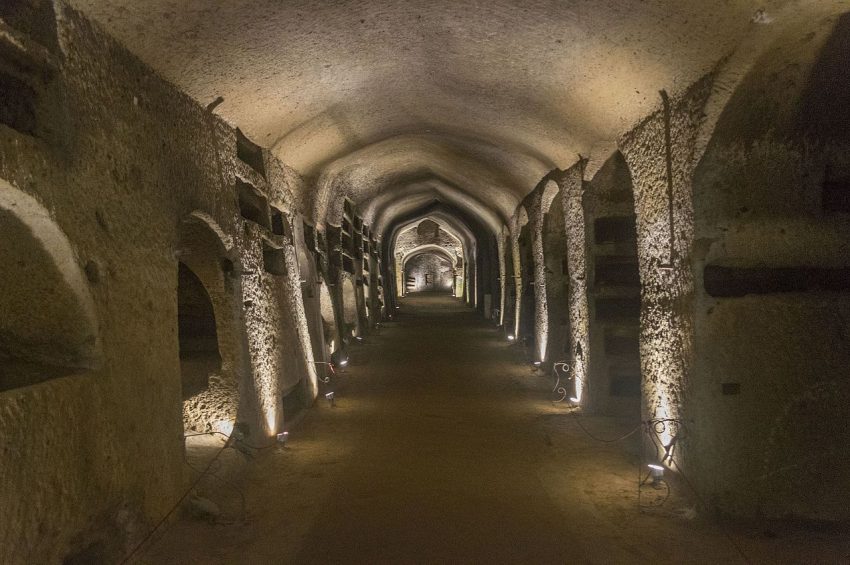
Carved into the soft volcanic tuff on the northern slopes of Naples, the Catacombs of San Gennaro reveal a hidden city of the dead beneath the lively streets of Rione Sanità. Spread over two levels-San Gennaro Superiore and San Gennaro Inferiore-this vast paleo-Christian complex once formed part of three cemeteries dedicated to Saints Gaudiosus, Severus, and Januarius, with the latter giving the site its name. Walking through the broad corridors, passing loculi, arcosoli, and ancient sarcophagi, you experience a powerful mix of archaeology, art, and faith that makes this one of the must-see places in Naples for anyone curious about its earliest Christian roots.
The oldest sections, dating to the 3rd-4th centuries, may have begun as pre-Christian burials before becoming a key Christian cemetery after the entombment of Bishop Agrippinus. Over the centuries, the catacombs grew to welcome Neapolitan bishops, saints, and ordinary believers, and became a centre of worship complete with altars and basilica-style spaces carved directly into the rock. Despite looting between the 13th and 18th centuries, wartime use as a refuge, and decades of neglect, modern restorations and guided tours now make the Catacombs of San Gennaro a haunting, atmospheric stop often visited on walking tours of Naples, where you can literally step down into the city's layered past.
Table of Contents
- History and Significance of the Catacombs of San Gennaro
- Things to See and Do in the Catacombs of San Gennaro
- How to Get to the Catacombs of San Gennaro
- Practical Tips on Visiting the Catacombs of San Gennaro
- Where to Stay close to the Catacombs of San Gennaro
- Is the Catacombs of San Gennaro Worth Visiting?
- FAQs for Visiting the Catacombs of San Gennaro
- Nearby Attractions to the Catacombs of San Gennaro
History and Significance of the Catacombs of San Gennaro
The story of the Catacombs of San Gennaro begins in the early centuries of Christianity, when communities around Naples started burying their dead in the easily worked tuff along the slopes leading up to what is now Capodimonte. Originally, this area comprised three distinct burial grounds linked to Saints Gaudiosus, Severus, and Januarius (San Gennaro), with the oldest parts of the site dating to the 3rd-4th centuries. It may have begun as a pre-Christian cemetery, but the burial of Bishop Agrippinus transformed it into a Christian focal point, attracting more burials and devotional activity.
Over time, the catacombs expanded and absorbed neighbouring burial areas, evolving into a large, interconnected necropolis. By the 5th century, the complex was consecrated to Saint Januarius, Naples’ patron saint, whose remains were placed here before later being transferred to the Cathedral in the 9th century. As more bishops and prominent figures were laid to rest in its galleries, the catacombs became a key religious centre for the early Neapolitan church, with basilica-style spaces such as the 4th-century Basilica of Agrippinus carved directly into the rock for liturgical use.
From the 13th to the 18th century, the catacombs suffered repeated looting, with sarcophagi, relics, and decorative elements removed or damaged. During World War II, the underground passages once again sheltered local residents from bombing raids, adding another chapter to their long history of refuge and resilience. After the war, restoration work slowly began, leading to the reopening of the site in 1969 and modern archaeological campaigns starting in 1971. Today, the Catacombs of San Gennaro stand as one of the most important early Christian sites in southern Italy, blending religious significance, urban history, and underground architecture.
Things to See and Do in the Catacombs of San Gennaro
A guided visit typically begins in San Gennaro Superiore, the upper level with its broad corridors and regular layout. Here, you see lines of loculi-simple rectangular niches cut into the walls-as well as arcosoli, arched recesses that served as family tombs and often received more elaborate decoration. Some arcosoli preserve faded frescoes or traces of colour that hint at the beliefs and hopes of the people buried here. The generous height of the corridors, unusual for catacombs, makes the underground space feel more like a vaulted basilica than a cramped tunnel.
Descending to San Gennaro Inferiore, you move deeper into the earlier, more atmospheric parts of the complex. In these older sections, you encounter different burial types, including ground pits, sarcophagi carved from tuff, and burials reusing fragments of older tombs. The variety of tombs-from simple loculi for ordinary believers to more ornate arcosoli and sarcophagi-speaks to the social diversity of the community over several centuries. The play of light and shadow along the walls, combined with fresco fragments, carved niches, and occasional inscriptions, gives a strong sense of continuity between past and present.
One of the spiritual and architectural highlights is the Basilica of Agrippinus, a 4th-century underground basilica space with altars and ritual areas carved directly from the rock. Here, you can appreciate how the catacombs were not just a place of burial but also a centre of worship and commemoration. Throughout the visit, guides explain the evolution of burial practices, the role of bishops and saints, and the impact of looting and restoration. Together, these elements make the Catacombs of San Gennaro one of the best places to visit in Naples for experiencing early Christian history in a vivid, three-dimensional way.
How to Get to the Catacombs of San Gennaro
The Catacombs of San Gennaro are located beneath the Rione Sanità district, on the northern slope of Naples between the historic centre and the Capodimonte hill. If you arrive by air at Naples International Airport (Capodichino), you can reach the area by taxi or rideshare in a short journey, or by taking a bus into the city centre and then continuing by local transport or on foot to Rione Sanità. For the best deals and a seamless booking experience, check out these flights to Naples on Booking.com.
Travellers arriving by train will come into Napoli Centrale at Piazza Garibaldi. From there, you can use buses or the metro to get closer to Rione Sanità, then walk up through the neighbourhood to the catacombs’ signed entrance, often near the Basilica dell’Incoronata Madre del Buon Consiglio and other local landmarks. Use Omnio to easily compare schedules, book train tickets, and find the best prices all in one place for a hassle-free journey across Italy. The walk from the historic centre is also possible for those comfortable with some uphill sections and urban navigation.
If you are travelling by car, follow signs toward Capodimonte and Rione Sanità and look for parking in nearby streets or garages, bearing in mind that the historic neighbourhood has narrow roads and limited spaces; many visitors prefer to park further out and walk or use public transport for the final stretch. If you are looking to rent a car in Italy I recommend having a look at Discover Cars, first, as they compare prices and review multiple car rental agencies for you. Once on foot in the district, clear signposts and local maps usually guide you to the catacombs’ entrance and ticket office.
Practical Tips on Visiting the Catacombs of San Gennaro
- Suggested tips: Wear comfortable shoes and a light layer-temperatures underground stay cool and the floors can be uneven or slightly damp.
- Best time to visit: Late morning or mid-afternoon on weekdays tends to be quieter; book ahead at weekends or in peak season.
- Entrance fee: Adults: €13.00
- Opening hours: From Mondays to Sundays from 10 am to 5 pm (Last admission 5 pm); Closed on Wednesdays
- Official website: https://catacombedinapoli.it/
- How long to spend: Allow about 1-1.5 hours for a guided tour, plus extra time to explore Rione Sanità or nearby sites afterward.
- Accessibility: Access involves stairs, slopes, and uneven ground; the site may not be suitable for visitors with significant mobility issues or severe claustrophobia.
- Facilities: Basic facilities, such as ticket office and restrooms, are available near the entrance; cafés and small shops can be found in the surrounding neighbourhood.
- Photography tip: Light is low, so focus on mood rather than detail-capture long perspectives of the corridors and subtle frescoes where permitted, and avoid flash when asked.
- Guided tours: Visits are generally guided for safety and interpretation; tours explain burial types, history, and iconography in an accessible way.
- Nearby food options: Rione Sanità offers traditional bakeries, bars, and trattorias where you can try local dishes and street food after your underground visit.
Where to Stay close to the Catacombs of San Gennaro
Staying near the Catacombs of San Gennaro suits travellers who want to explore both Rione Sanità and the Capodimonte area while still being reasonably close to the historic centre. For a comfortable base with good access downhill to the centro storico and uphill to Capodimonte, Culture Hotel Villa Capodimonte offers hillside views and a quiet setting. If you prefer to stay in the heart of the old town and reach the catacombs by bus, taxi, or a longer walk, Hotel Piazza Bellini & Apartments places you near museums and nightlife. Another appealing option within the historic fabric but with easy connections toward Rione Sanità is Decumani Hotel De Charme, set in a historic palazzo ideal for exploring Naples both above and below ground.
Is the Catacombs of San Gennaro Worth Visiting?
The Catacombs of San Gennaro are unquestionably worth visiting if you want to understand Naples beyond its surface-level chaos and baroque splendour. Here, in quiet tuff-carved corridors, you see how early Christian communities honoured their dead, how bishops and saints became focal points of devotion, and how burial practices evolved over centuries. The combination of spacious passageways, diverse tomb types, fresco fragments, and basilica spaces makes the site both moving and intellectually fascinating. Coupled with its dramatic setting beneath Rione Sanità and its links to Capodimonte and the wider Christian history of Naples, it stands out as one of the top attractions in Naples for travellers interested in archaeology, faith, and the deep layers of urban history.
What Other Travellers Say...

Catacombs of San Gennaro, on Via Capodimonte 13 in Naples, offers guided tours of an underground Christian cemetery dating from the 2nd–4th centuries; visitors praise knowledgeable English-speaking guides, find the subterranean passages atmospheric and worth seeing for their dark history, note limited or no photography is allowed, and report mixed impressions about visible remains—some saw skeletons while others found mostly empty niches—but most recommend the tour and also mention the adjoining church as worthwhile to visit.


FAQs for Visiting the Catacombs of San Gennaro
Nearby Attractions to the Catacombs of San Gennaro
- Catacombs of San Gaudioso: Another early Christian burial complex in Rione Sanità, offering a complementary perspective on Naples’ underground history.
- Basilica dell’Incoronata Madre del Buon Consiglio: A striking church near the catacombs, often combined with a visit to the site.
- Rione Sanità: A vibrant historic neighbourhood filled with markets, street art, and local life, sitting between the catacombs and the city centre.
- Museo di Capodimonte: A major art museum and former royal palace set in a large park above the catacombs on the Capodimonte hill.
- National Archaeological Museum of Naples (MANN): One of the world's leading archaeological museums, located downhill toward the historic centre and easily reachable by public transport or taxi.
The Catacombs of San Gennaro appears in our Complete Guide to Visiting Naples!

Moira & Andy
Hey! We're Moira & Andy. From hiking the Camino to trips around Europe in Bert our campervan — we've been traveling together since retirement in 2020!
This website uses affiliate links which may earn a commission at no additional cost to you!
Planning Your Visit
From Mondays to Sundays from 10 am to 5 pm (Last admission 5 pm); Closed on Wednesdays
Adults: €13.00
Nearby Attractions
- Museo di Capodimonte (0.4) km
Museum - National Archeological Museum (1.3) km
Museum - Naples Cathedral (1.7) km
Cathedral - Chiesa delle Cape di Morte (1.8) km
Church - Piazza Dante (1.8) km
Square - San Lorenzo Maggiore (1.8) km
Church - Cappella Sansevero (1.9) km
Church - Santa Chiara (2.0) km
Abbey - Castel Sant’Elmo (2.4) km
Castle - San Martino Monastery (2.5) km
Monastery and Museum