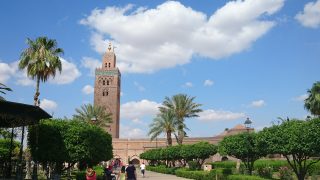
Almoravid Koubba, Marrakesh
Historic Building in Marrakesh
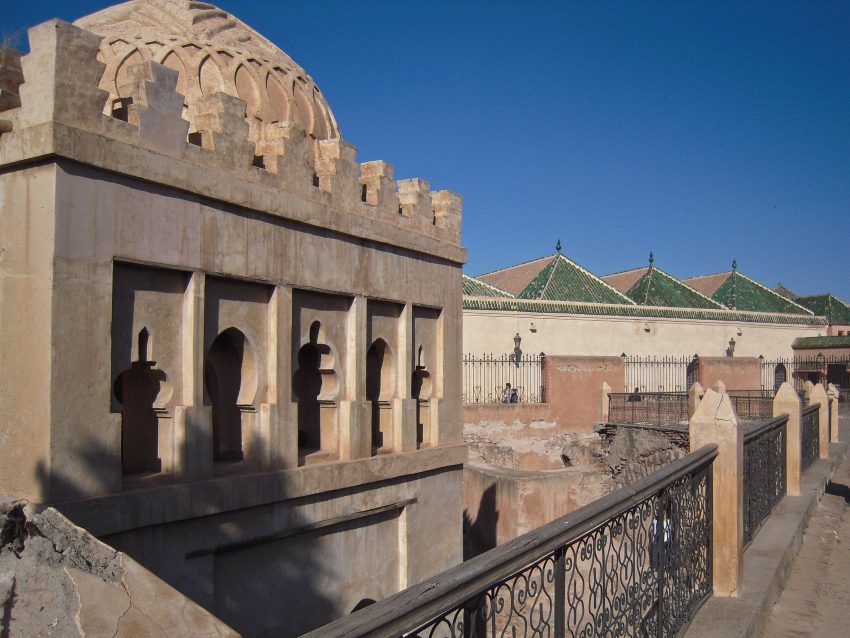
The Almoravid Koubba in Marrakesh, Morocco, is a small historic attraction in the medina, tucked just behind the Museum of Marrakech and close to Ben Youssef Mosque. This 12th-century pavilion is one of the few surviving Almoravid monuments in the city, and visitors reach it by descending below present street level into an excavated space.
What stands out here is the compact scale: a water basin sits beneath a carved dome with floral patterns, calligraphy, and early muqarnas details. The visit is short, but it gives a clear sense of Marrakesh’s earliest Islamic architecture. It is best suited to travellers with an interest in history, architecture, and sites that can be explored without a long stop.
History and Significance of the Almoravid Qubba
The Almoravid Qubba was commissioned during the reign of Ali ibn Yusuf, the ruler who turned Marrakech from a frontier settlement into a true imperial capital. At that time, the nearby Ben Youssef Mosque was the main mosque of the city; the Qubba likely formed part of its ensemble, serving as a dedicated pavilion where worshippers performed ritual washing before prayer. This type of freestanding ablutions facility, known as a mida’a, appears again in later mosques in Marrakech, but the Qubba is the earliest surviving example and the only intact monument left from the Almoravid period in the city.
Over the centuries, the original Ben Youssef Mosque was entirely rebuilt, and the urban fabric around it shifted. The Qubba survived but gradually vanished from view as other structures were built over and around it, and as the ground level rose by seven to eight metres. It was renovated in the 16th century, then eventually covered by an outbuilding attached to the mosque. Its existence disappeared from popular memory until the mid-20th century, when French scholars studying the medina uncovered it during excavation work. Recognised immediately as a major find, it was carefully cleared, documented by figures such as Henri Terrasse and Jacques Meunié, and preserved as a standalone historic monument.
Today, the Almoravid Qubba is significant far beyond its small footprint. Architecturally, it showcases a sophisticated blend of influences: the carved cupola recalls Umayyad domes in al-Andalus, while the miniature muqarnas cupolas in the corners are among the earliest known examples of this honeycomb-like technique in Morocco. Symbolically, some scholars suggest that combining Umayyad and Abbasid motifs was a deliberate statement by the Almoravids, aligning themselves with the great caliphates of the Islamic world. Culturally, the inscription in cursive Maghrebi script, now badly damaged but once reading lines such as “I was created for science and prayer,” underlines the close link between knowledge, devotion, and water in the religious life of the early city.
Things to See and Do in the Almoravid Qubba
Your visit begins above street level, near the Museum of Marrakech, where a simple entrance and a modern ticket office give little hint of what lies below. A flight of stairs leads you down into the excavated space, where the Qubba reveals its full 12-metre height and rectangular plan. Standing beside the basin, you can imagine how water once flowed here, with worshippers washing before crossing to the Ben Youssef Mosque for prayer. The sunken setting, carved dome overhead, and quiet air make the space feel almost like a time capsule.
Take time to study the decoration in detail. The dome’s interior is packed with sculpted motifs: acanthus leaves curling around palm fronds and pine cones, palmette or seashell shapes radiating from arches, and panels of Arabic calligraphy that once recorded the building’s foundation and patron. In the corners, small subsidiary cupolas filled with muqarnas create a transition from the square base to the rounded forms above. Looking up, you can see why the Qubba is often compared to the domes of the Great Mosque of Córdoba and the Bab al-Mardum Mosque in Toledo, yet it retains a distinctly Maghrebi flavour.
Because the site is compact, it pairs well with nearby attractions. From the Qubba, you are only steps away from the Museum of Marrakech, with its chandelier-filled courtyard, and a short walk from the Ben Youssef Madrasa, where Saadian-era stucco and zellij cover a larger, later religious college. Together, these three sites make a powerful mini-route through Marrakech's architectural history, tracing a line from the Almoravids through the city's later dynasties. After your visit, wandering the surrounding streets, it is fascinating to think that most of this tiny Almoravid jewel lay buried for centuries beneath your feet.
How to Get to the Almoravid Qubba
To reach the Almoravid Qubba you will first travel to Marrakech, a city that is easy to access from both within Morocco and abroad. Most international visitors arrive via Marrakech Menara Airport, which has regular flights from major European hubs and other Moroccan cities and lies only a short drive from the medina. For the best deals and a seamless booking experience, check out these flights to Marrakesh on Booking.com. From the airport, taxis or pre-arranged transfers can bring you towards the old city, where you can be dropped near points like Jemaa el-Fnaa or the Koutoubia area before walking into the medina's northern quarters.
If you are coming from another Moroccan city, trains run to Marrakech from Casablanca, Rabat, Tangier, and beyond, arriving at the main railway station in the modern Gueliz district.Train schedules and bookings can be found on Omio. From there, a petit taxi will take you to one of the northern entrances to the medina; from those drop-off points, you can follow signs or a map towards the Ben Youssef Madrasa and Museum of Marrakech, with the Qubba located just beside them. Long-distance buses use various stations outside the centre; taxis from those points follow similar routes to deliver you to the northern medina.
Drivers will follow the ring roads and main avenues to reach car parks on the edge of the medina, especially around the northern and eastern walls. Once parked, it is a pedestrian experience: you enter the old city on foot and navigate the narrow streets towards the Ben Youssef area. The Almoravid Qubba is signed near the Museum of Marrakech, around 40 metres south of the Ben Youssef Mosque, so it is straightforward to find once you’re in the right neighbourhood.
Practical Tips on Visiting the Almoravid Qubba
- Suggested tips: Bring a small torch or use your phone’s light if you like examining fine detail; some corners can be dim depending on the time of day.
- Best time to visit: Late morning or early afternoon offer good light for seeing the carvings and tend to be quieter than peak tour-group times.
- Entrance fee: Expect a small fee of just a few euros, often combined with or similar to the Museum of Marrakech ticket prices.
- Opening hours: Typically open daily during standard museum hours, roughly from late morning to late afternoon; check locally for current times.
- How long to spend: Around 20-40 minutes is usually enough to explore the Qubba fully, especially if you combine the visit with the nearby museum and madrasa.
- Accessibility: Access is via a staircase down to the excavated level, which can be steep and uneven; this makes the site challenging for visitors with reduced mobility.
- Facilities: Facilities on site are minimal; any restrooms or cafés you use will usually be in or near the Museum of Marrakech or in the surrounding streets.
- Photography tip: A wide-angle lens or phone camera setting helps capture the full dome from within the tight interior space; try different angles from near the basin and from the corners.
- Guided tours: Many architectural or history-focused walking tours include the Qubba, which can greatly enhance your understanding of its place in Almoravid Marrakech.
- Nearby food options: After your visit, head towards the main streets between Ben Youssef and Jemaa el-Fnaa, where cafés and small restaurants offer tagines, snacks, and tea.
Where to Stay close to the Almoravid Qubba
Staying near the Almoravid Qubba places you in the historic heart of Marrakech, with the Ben Youssef Madrasa, Museum of Marrakech, and the northern souks all within a few minutes' walk. A comfortable and well-known option nearby is Riad Karmela, which offers traditional rooms and a calm courtyard just a short stroll from the Ben Youssef area. For a more intimate, design-focused stay, Riad Camilia combines contemporary touches with historic architecture and gives easy access to both the Qubba and the main souks. Travellers looking for a stylish base with rooftop views might choose Riad Chorfa, where you can step straight out into the medina lanes and reach the Qubba in just a few minutes on foot.
Is the Almoravid Qubba Worth Visiting?
If you are at all interested in architecture, history, or the deeper story of Marrakech, the Almoravid Qubba is absolutely worth a stop. It may be small, but it offers a rare, tangible link to the city's 12th-century origins and showcases a level of craftsmanship that rivals far larger monuments. Combined with the nearby museum and Ben Youssef Madrasa, it helps connect the dots between different eras of Moroccan design, turning a simple detour into a rich historical journey and making this modest pavilion one of the best places to visit in Marrakech for lovers of Islamic art.
What Other Travellers Say...
Almoravid Koubba, at 75 Derb Souk Cheria in Marrakech, is a 12th‑century domed building and the last remaining example of Almoravid architecture; visitors praise its beauty and historical significance and note a water reservoir/irrigation feature, while others warn the interior can be small, that upkeep and displays may be limited, and that entry fees have led some to view it from outside rather than pay.





FAQs for Visiting Almoravid Qubba
The Almoravid Koubba appears in our Complete Guide to Visiting Marrakesh!

Moira & Andy
Hey! We're Moira & Andy. From hiking the Camino to trips around Europe in Bert our campervan — we've been traveling together since retirement in 2020!
This website uses affiliate links which may earn a commission at no additional cost to you!
Planning Your Visit
Typically open daily during standard museum hours, roughly from late morning to late afternoon; check locally for current times.
Expect a small fee of just a few euros, often combined with or similar to the Museum of Marrakech ticket prices.
Nearby Attractions
- Marrakech Museum (0.1) km
Museum - Ben Youssef Madrasa (0.1) km
Madrasa - Le Jardin Secret (0.2) km
Gardens and Historic Building - Dar el Bacha (0.5) km
Historic Building and Museum - Souks of Marrakesh (0.5) km
Market - Jemaa el-Fnaa (0.6) km
Market and Square - Dar Si Said (1) km
Historic Building and Museum - Tiskiwin Museum (1.1) km
Museum - Kasbah Mosque (1.1) km
Mosque - Koutoubia Mosque (1.1) km
Mosque