Self-Guided Walking Tour of Zaragoza (2026)
This website uses affiliate links which earn a small commission at no additional cost to you.
Zaragoza is one of Spain's most underrated city-break destinations: big enough to feel lively, compact enough to explore comfortably on foot, and layered with history from Roman Caesaraugusta through Moorish rule and Aragon's golden age. A self-guided walk is the easiest way to connect the dots between its grand riverfront landmarks, intimate old-town lanes, and the everyday rhythm of local markets, cafés, and plazas.
This route is designed to be flexible, so you can treat it as a steady loop or break it into two shorter strolls with a long lunch in between. You'll move between the headline sights and the small details that make Zaragoza memorable: tiled courtyards, Mudéjar brickwork, hidden chapels, and viewpoints where the Ebro frames the skyline. If you're deciding what to prioritise, this is a practical way to cover the best things to see in Zaragoza without feeling rushed.
Expect an easy, mostly flat walk with plenty of natural pause points for photos, coffee, and tapas. Mornings are ideal for the major monuments before the city warms up, while late afternoon is perfect for the riverfront and a slow finish in the tapas streets. Wear comfortable shoes for a few cobbled sections, keep a little time in reserve for church interiors and museums, and let Zaragoza’s compact centre do the rest.
Table of Contents
- How to Get to Zaragoza
- A Short History of Zaragoza
- Roman Zaragoza: Caesaraugusta and the foundations of the city
- Islamic Zaragoza: Saraqusta and a frontier capital
- Medieval Zaragoza: Aragón’s power and the rise of La Seo
- Renaissance Zaragoza: commerce, institutions, and La Lonja
- Early modern Zaragoza: the river crossing and an urban skyline
- 17th–18th century Zaragoza: Plaza del Pilar and the Basilica’s transformation
- 18th–19th century Zaragoza: Goya’s era and the city’s cultural identity
- 19th–20th century Zaragoza: modern streets, markets, and everyday urban life
- Contemporary Zaragoza: living traditions in El Tubo and the historic centre
- Where to Stay in Zaragoza
- Your Self-Guided Walking Tour of Zaragoza
How to Get to Zaragoza
By Air: Zaragoza Airport (ZAZ) is a small, efficient airport around 10-15 km west of the city centre. It has a limited but useful spread of domestic and some international routes, so many travellers also consider flying into Madrid or Barcelona and continuing overland. From ZAZ, the simplest option is usually a taxi or rideshare into town; there are also public transport connections, but they can be less frequent depending on the day and season, so check timetables before you commit. If you arrive via Madrid or Barcelona airports, you can often connect straight onto fast rail services to Zaragoza for a smoother end-to-end journey. For the best deals and a seamless booking experience, check out these flights to Zaragoza on Booking.com.
By Train: Zaragoza-Delicias is the main station and it's well set up for visitors, with fast AVE services linking Zaragoza with Madrid and Barcelona in roughly 1.5-2 hours, plus other long-distance and regional trains across Aragón and neighbouring regions. The station sits a little outside the historic core, but it's easy to reach the centre by taxi, city bus, or a straightforward walk if you're travelling light. Booking ahead is wise around weekends, holidays, and major events, especially for the best fares and preferred departure times. Train schedules and bookings can be found on Omio.
By Car: Driving is practical if you want to combine Zaragoza with smaller towns, wineries, or natural areas in Aragón, and the city is well connected by major highways (notably routes linking Madrid and Barcelona). Expect straightforward motorway driving, but plan around urban traffic at peak hours and be strategic about parking-central street parking can be limited and time-restricted, so underground car parks are often the easiest choice if you're staying in the old town. If you're only visiting for a day, consider parking on the edge of the centre and walking in to avoid congestion. If you are looking to rent a car in Spain I recommend having a look at Discover Cars, first, as they compare prices and review multiple car rental agencies for you.
By Bus: Long-distance coaches can be good value and cover routes that aren't as convenient by rail, including connections from smaller cities and towns across Spain. Services typically arrive at Zaragoza's Estación Central de Autobuses (integrated with or adjacent to Zaragoza-Delicias), which makes onward transfers simple. Journey times are usually longer than the AVE on the Madrid/Barcelona corridors, but buses can be a sensible option if schedules align better or you're travelling on a tighter budget.
A Short History of Zaragoza
Roman Zaragoza: Caesaraugusta and the foundations of the city
Zaragoza's recorded urban story begins in the Roman era as Caesaraugusta, a planned colony with the typical Roman grid, public buildings, and defensive works. Fragments of the Roman Walls of Zaragoza still hint at the scale and ambition of this early city, which thrived on administration, trade, and engineering. Even when later centuries rebuilt, expanded, and reoriented the streets, the Roman footprint continued to shape how the historic centre developed.
Islamic Zaragoza: Saraqusta and a frontier capital
During the medieval Islamic period, Saraqusta became a significant political and cultural centre on a shifting frontier, with scholarship, craftsmanship, and urban life concentrated around fortified precincts and busy commercial streets. Later Christian rebuilding often sits on top of this layer, but the legacy remains in the city’s long tradition of decorative craft and the ease with which different artistic languages blend. This layered continuity is one reason Zaragoza’s cathedral complex feels like an architectural palimpsest rather than a single-style monument.
Medieval Zaragoza: Aragón’s power and the rise of La Seo
After Zaragoza was incorporated into the Christian kingdom of Aragón, the city grew into a major ecclesiastical and civic centre. The Cathedral of the Savior of Zaragoza (La Seo) became one of the most important statements of status and authority, expanded and embellished over centuries as tastes and fortunes changed. Its fabric captures Zaragoza's hallmark mix of influences, where medieval structure, later chapels, and rich decorative programs reflect both piety and politics.
Renaissance Zaragoza: commerce, institutions, and La Lonja
By the Renaissance, Zaragoza’s prosperity was expressed not only in religious building but in civic architecture tied to trade and governance. La Lonja (The Old Exchange) embodies this moment: an impressive merchant hall that signals confidence, connectivity, and the city’s role as a marketplace of goods and ideas. The surrounding streets and plazas developed into a stage set for public life, where commerce and ceremony reinforced each other.
Early modern Zaragoza: the river crossing and an urban skyline
As the city consolidated its importance, infrastructure and monumental public spaces took on greater meaning. Puente de Piedra (Stone Bridge) became more than a practical crossing: it was a symbolic gateway associated with movement, commerce, and the daily flow between neighbourhoods. Over time, Zaragoza’s skyline also became increasingly defined by major religious building campaigns, culminating in one of Spain’s most recognisable monumental ensembles.
17th-18th century Zaragoza: Plaza del Pilar and the Basilica’s transformation
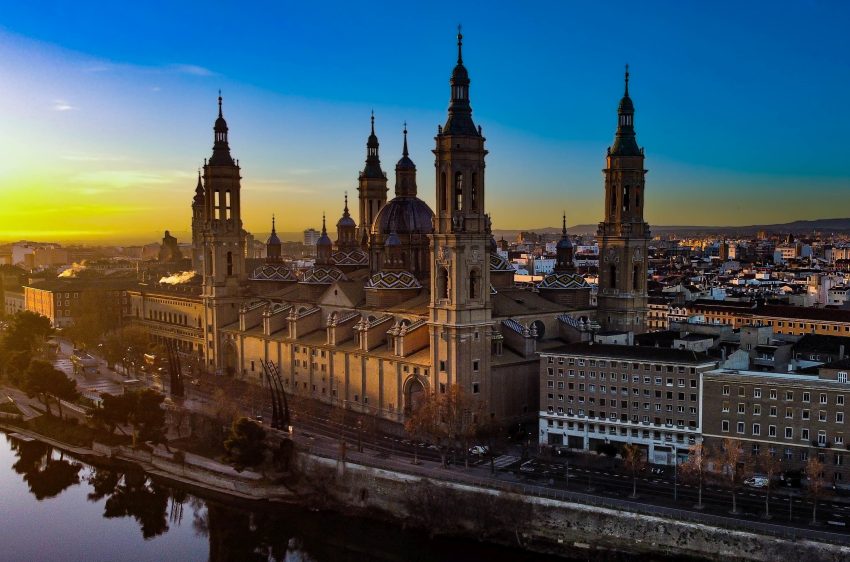
The Cathedral-Basilica of Our Lady of the Pillar rose into its present prominence as devotion, patronage, and Baroque spectacle reshaped the heart of the city. Plaza del Pilar evolved into Zaragoza’s grand civic-religious theatre, sized for gatherings, processions, and the rhythm of public life. For a modern visitor, the Torre Del Pilar Mirador (Column Tower Lookout) is a useful way to read this history visually, turning the basilica, the square, and the surrounding old city into a coherent narrative you can see at a glance.
18th-19th century Zaragoza: Goya’s era and the city’s cultural identity
Zaragoza’s cultural identity is inseparable from the orbit of Francisco de Goya, whose life and artistic legacy helped define how the region is remembered. The Goya Museum – Ibercaja Collection anchors that story in the city, connecting local context with broader currents in Spanish art and modernity. This period also sharpened Zaragoza’s civic confidence, expressed through institutions, public culture, and a sense of itself as more than a provincial centre.
19th-20th century Zaragoza: modern streets, markets, and everyday urban life
As Zaragoza modernised, the city balanced preservation with expansion, and daily life increasingly centred on new commercial routines alongside historic monuments. Calle Alfonso I (Alfonso I Street) became one of the key connectors through the centre, a processional-feeling street where architecture, shopping, and sightlines bind together the city's most emblematic spaces. Zaragoza Central Market reflects the same modern urban pulse in a different register: a place where food culture and local habits carry history forward in the most practical way.
Contemporary Zaragoza: living traditions in El Tubo and the historic centre
Today, Zaragoza’s history feels most alive where people gather, eat, and move through the old streets rather than only inside monuments. El Tubo (“The Tube” Area) captures that continuity: tight lanes, social energy, and a food-and-conversation culture that turns heritage into something lived rather than displayed. The result is a city where Roman stones, cathedral façades, merchant halls, and tapas streets all sit in the same frame, and the past remains visible because it’s still in use.
Where to Stay in Zaragoza
To make the most of visiting Zaragoza and this walking tour then you consider stay overnight at the centre. The most convenient base is the historic core around Plaza del Pilar, La Seo, and the lanes leading into El Tubo, because you can start early at the major landmarks, pop back to your room between stops, and finish with tapas without needing transport. Good options right in this zone include Hotel Pilar Plaza, Catalonia El Pilar, Hotel Sauce, and Hotel Alfonso.
If you want a slightly more “city-break” feel with wider avenues, shopping, and easy access to restaurants while still being walkable to the old town, base yourself around Plaza Aragón, Plaza España, and Paseo de la Independencia. This area is ideal if you like a polished central hotel, strong transport links, and a straightforward walk into the historic centre for the tour loop. Consider NH Collection Gran Hotel de Zaragoza, Hotel Palafox, Hotel Goya, and Vincci Zaragoza Zentro.
If you're arriving on a tight schedule or you're prioritising smooth connections over being in the thick of the old-town lanes, the Zaragoza-Delicias station and the Expo/Ebro west side can be a practical base. You'll typically trade a bit of atmosphere for convenience, bigger rooms, and quick access to buses/taxis into the centre for the walking tour start. Solid picks here include Eurostars Zaragoza, Exe Plaza Delicias, Hotel Hiberus, and iStay by NH Zaragoza Sport Hotel.
For a quieter stay with a more local, residential feel (and good tram/bus links back into the centre), look at the Universidad/Romareda/Aragonia side of town. It's a good choice if you prefer calmer evenings, you're combining Zaragoza with day trips, or you want a comfortable base that's still straightforward for reaching the tour route each morning. Options to consider include Hotel Reina Petronila, ILUNION Romareda, Hotel Zaragoza Royal, and Hotel Gran Vía.
Your Self-Guided Walking Tour of Zaragoza
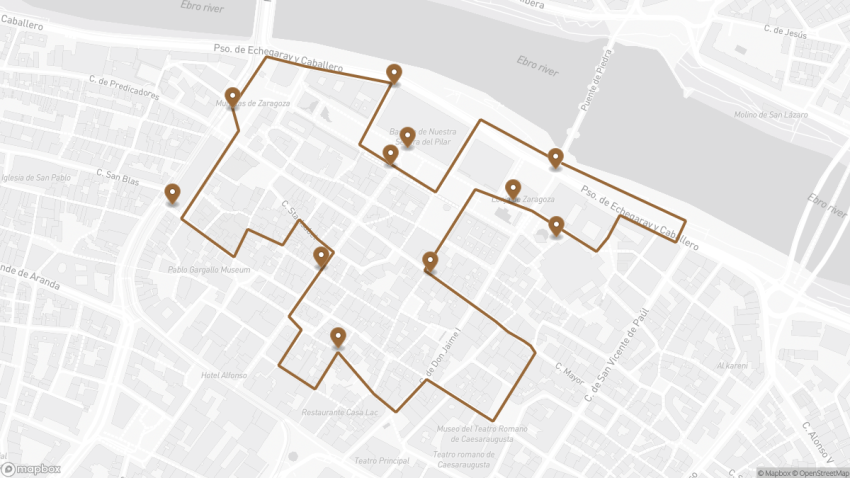
Discover Zaragoza on foot with our walking tour map, guiding you between each stop as you explore the city's landmark squares, historic streets, and riverside viewpoints. Because it's a self-guided route, you can skip any stops that don't interest you, linger where you like, and add coffee breaks whenever the mood (or a great terrace) strikes.
1. Puente de Piedra

Puente de Piedra is Zaragoza’s classic crossing of the Ebro, long associated with the city’s medieval growth and its role as a strategic river town between the Christian kingdoms of the north and the Islamic south. While there were earlier crossings, the bridge that became “the” stone bridge took shape in the Middle Ages and was repeatedly repaired after floods, which were a constant threat on the Ebro. Its long lifespan has made it part of the city’s everyday identity in a way newer bridges rarely manage.
What most people notice first is the sense of arrival it gives you: the skyline of the city’s great churches rises ahead, and the riverbanks open up into broad views in both directions. The bridge is also where Zaragoza feels most “river-city,” with the Ebro wide enough to read as a landscape rather than a canal.
Look for the sculptural details and the rhythm of the arches, then linger for views toward the Basilica del Pilar and the towers beyond. At either end you can usually find good viewpoints along the river paths, and at golden hour the stone and water reflect warm light that makes even quick photos look composed. It’s also a useful spot for orienting yourself: once you’ve seen the skyline from here, the city’s main landmarks are easy to place.
Location: Puente de Piedra, Zaragoza, Spain | Hours: 24 Hours. | Price: Free. | Website
2. Cathedral of the Savior of Zaragoza

The Cathedral of the Savior, commonly known as La Seo, is one of Zaragoza’s most historically layered buildings, shaped by successive religious and political eras. The site itself tells the story: Roman Zaragoza, later the Islamic city, and then the Christian reconquest all left marks, with the cathedral evolving over centuries rather than being built in a single burst. That long timeline is exactly what makes it compelling, because you’re effectively reading the city’s history in stone, brick, and ornament.
Architecturally it’s famous for its mixture of styles, especially the Mudéjar work that blends Islamic craftsmanship with Christian patronage. You’ll see transitions from Romanesque and Gothic structures into richly patterned brickwork, and later additions that reflect Renaissance and Baroque tastes. The result is not a “pure” cathedral in one style, but a confident patchwork that feels distinctly Aragonese.
Inside, pay attention to the choir stalls, chapels, and the play of light across different architectural phases. The exterior walls and decorative panels are also a highlight, especially where intricate Mudéjar patterns appear like textile designs translated into brick. If you visit more than one major church in Zaragoza, La Seo is the one that rewards slow looking, because the details keep changing as you move.
Location: Pl. de la Seo, 4, Casco Antiguo, 50001 Zaragoza, Spain | Hours: Monday – Saturday: 10:00–14:30 & 16:00–20:00. Sunday: 10:00–12:00 & 16:00–20:00. | Price: Adults: €10; Seniors (65+) & disabled visitors: €9; Youth (13–18) & university students up to 25: €7; Under 12: free. | Website

3. La Lonja

La Lonja is Zaragoza’s great Renaissance civic building, created in the 16th century when the city was thriving as a commercial hub in the Crown of Aragon. Built as an exchange where merchants could meet and formalize deals, it represents a moment when trade, law, and urban prestige were tightly linked. Its very existence is a statement: Zaragoza wasn’t just a religious or administrative center, it was a city that expected to do business at scale.
The exterior is restrained and elegant, with symmetry and proportion that signal Renaissance ideals, but the building’s real impact comes from understanding its original function. Imagine it as a place of negotiation and reputation, where credit and trust mattered as much as coin. That mercantile heritage gives the building a different feel from palaces or churches nearby.
Inside, the main hall is the focus, often used today for exhibitions, which suits the building’s open, public character. Look up at the ceiling structure and the way the space is designed to feel orderly and dignified, rather than decorative for decoration’s sake. Even when there’s no exhibition on, it’s worth stepping in to appreciate how a commercial building was given monumental status in Zaragoza’s golden age.
Location: Pl. de Ntra. Sra. del Pilar, s/n, Casco Antiguo, 50003 Zaragoza, Spain | Hours: Tuesday – Saturday: 10:00–14:00 & 17:00–21:00. Sunday: 10:00–14:30. Closed on Monday. | Price: Free. | Website
4. Goya Museum - Ibercaja Collection

The Goya Museum is one of the best places to understand Francisco de Goya in the city and region that shaped him. While Goya is often associated with Madrid and the Spanish court, his roots in Aragon are essential to his story, and Zaragoza is a natural place to track that early context. The museum’s collection is structured to situate him within Spanish art before and after his time, making it more than a single-artist shrine.
The experience typically balances works by Goya with pieces by earlier artists and contemporaries, so you can see what he inherited and what he broke away from. That matters with Goya, because he shifts from courtly polish to a more unsettling modern sensibility over his career, and it helps to see the broader artistic ecosystem around him.
When you visit, focus on how his figures convey psychology: gestures, faces, and the way he uses contrast to sharpen mood. If you’re not an art specialist, it’s still approachable because the themes are human and often blunt—power, superstition, violence, celebration, vanity. Allow time for the prints if they’re on display, since they’re where his voice can feel most direct and least diplomatic.
Location: C. de Espoz y Mina, 23, Casco Antiguo, 50003 Zaragoza, Spain | Hours: Monday: Closed. Tuesday – Saturday: 10:00–14:00 & 16:00–20:00. Sunday: 10:00–14:00. | Price: Adults: €4; Concessions: €2; Under 16: free. | Website
5. Calle Alfonso I

Calle Alfonso I is one of Zaragoza’s main historic arteries, linking key civic and religious spaces and acting as a stage for the city’s daily life. It follows the logic of older Zaragoza: streets that connect marketplaces, major squares, and institutional buildings, gradually formalized into a prominent commercial corridor. Over time it became the place where Zaragoza “shows itself,” with shopfronts, façades, and constant movement.
Its appeal is partly architectural and partly atmospheric. Buildings along the street reflect different periods, and as you walk you’ll notice how the city’s grandeur is expressed in balconies, stonework, and the shifting scale of intersections. It’s also a street that amplifies the sense of Zaragoza as a living city rather than an outdoor museum—locals are here to work, shop, meet, and pass through.
To make the most of it, look up as much as you look ahead: the upper stories and details often carry the most character. Pause at side streets that open into smaller plazas or reveal unexpected church towers. If you time it well, the street can feel theatrical during late afternoon and early evening, when the light catches façades and the city’s rhythm speeds up.
Location: C. de Alfonso I, Casco Antiguo, 50003 Zaragoza, Spain | Hours: 24 Hours. | Price: Free.
6. Plaza del Pilar

Plaza del Pilar is Zaragoza’s symbolic heart, a vast open space framed by some of the city’s most important landmarks. The scale is deliberate: this is a plaza designed for big civic moments—religious festivals, public gatherings, celebrations, and the everyday flow of people moving between the old city’s major sites. Few places in Zaragoza give you such an immediate sense of the city’s identity and pride.
Historically, the plaza’s importance is inseparable from the devotional significance of the Basilica del Pilar and Zaragoza’s long role as a major center of Marian worship. The open space around it allows the buildings to read as monuments, not just structures, and it also makes the plaza a kind of urban living room where the city meets itself.
When you’re there, take time to absorb the skyline: domes, towers, and long façades all read clearly because of the open expanse. Look for public art and fountains that add texture to the space, and notice how the plaza changes mood depending on time of day. Early morning feels almost ceremonial; evening is livelier, with the buildings illuminated and the square used for strolling and lingering.
Location: Pl. de Ntra. Sra. del Pilar, Casco Antiguo, 50003 Zaragoza, Spain | Hours: 24 Hours. | Price: Free.
7. Cathedral-Basilica of Our Lady of the Pillar

The Basilica del Pilar is Zaragoza’s most famous church and one of Spain’s great pilgrimage sites, tied to a tradition that places Marian devotion at the origins of local Christianity. Over centuries, the basilica grew in stature and architectural ambition, culminating in the grand Baroque-scale building that dominates the plaza today. It’s not just a church; it’s a statement of faith, regional identity, and artistic patronage.
Architecturally, it’s defined by its multiple domes and towers and by the way its bulk anchors the cityscape. The interior is designed to handle crowds and ceremony while still offering spaces for quiet devotion. Its artworks, including paintings associated with Goya, connect Zaragoza’s religious life with the broader story of Spanish art.
Inside, seek out the central devotional focus and observe how people interact with it—this is a living sacred place, not only a sightseeing stop. Spend time looking up at the domes and decorative programs, and note the way light and gilding create a sense of grandeur without feeling cold. If you’re interested in art, the works linked to Goya are a key reason this basilica belongs on any Zaragoza itinerary.
Location: Plaza del Pilar, s/n, Casco Antiguo, 50003 Zaragoza, Spain | Hours: Monday – Friday: 07:30–13:30 & 16:30–20:15. Saturday: 07:30–11:45 & 16:30–20:30. Sunday: 07:30–13:30 & 16:30–21:30. | Price: Free; tower and museum tickets cost extra. | Website
8. Torre Del Pilar Mirador

The Torre Del Pilar Mirador offers one of the best panoramic perspectives in Zaragoza, because it places you above the city’s historic core with the Ebro and surrounding neighborhoods stretching outward. Viewing points like this are modern additions in spirit even when attached to older monumental structures: they translate heritage into a visual experience people can grasp instantly. In a city with big architecture and broad horizons, height makes the urban layout legible.
From above, you can understand how Zaragoza sits on the river and how the old center relates to later expansions. Domes and towers become navigational markers, and the grid and street patterns start to show their logic. It’s also a good way to appreciate the sheer scale of the Basilica del Pilar itself, which can feel even more monumental when you see how it dominates the plaza and the riverfront.
When you visit, take your time identifying landmarks: the Ebro crossings, major church roofs, and the long lines of key streets. Light conditions matter—clear days give you distance, while late afternoon brings warmer tones that make the city feel softer. If you’re choosing one elevated view in Zaragoza, this lookout is the most iconic because it pairs the panorama with the city’s signature monument.
Location: Pl. de Ntra. Sra. del Pilar, Casco Antiguo, 50003 Zaragoza, Spain | Hours: Monday – Thursday: 10:30–14:30 & 16:00–20:00. Friday – Sunday: 10:00–20:00. | Price: General: €6; Youth (13–18, student/university up to 25): €4; Seniors (65+ or disability 33%+): €5; Residents: €5; Groups (20+): €4; Under 12 (with an adult) & disability 50%+: free. | Website
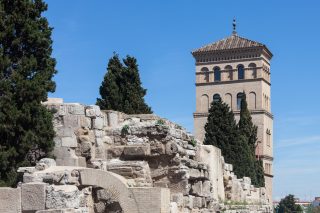
9. Roman Walls of Zaragoza
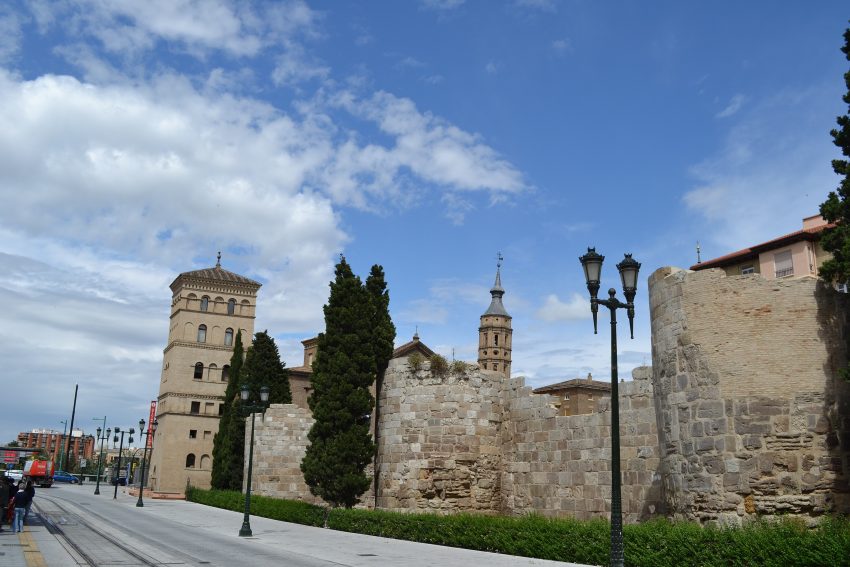
Zaragoza’s Roman walls are a direct link to Caesaraugusta, the Roman city that underlies much of modern Zaragoza’s street plan and identity. Built for defense and prestige, Roman walls weren’t only military structures; they were also signals of civic status, marking the boundary of an important settlement. The surviving fragments remind you that Zaragoza’s story starts far earlier than its medieval churches and palaces.
Over centuries, segments were dismantled, incorporated into later buildings, or simply lost as the city expanded. What remains tends to be partial, but that’s typical for Roman urban defenses in living cities. The value is in the material reality: large stone blocks, the thickness of the structure, and the sense of a perimeter that once defined daily life.
When you visit, look for how the walls integrate with the surrounding modern fabric—this contrast is part of the experience. Interpretive panels, if present, help reconstruct what you’re seeing, but even without them you can read the engineering confidence in the surviving masonry. Pairing the walls with other Roman-era traces in Zaragoza makes the ancient city feel less abstract and more tangible.
Location: Plaza César Augusto, 3, Casco Antiguo, 50003 Zaragoza, Spain | Hours: Monday: Open 24 hours Tuesday: Open 24 hours Wednesday: Open 24 hours Thursday: Open 24 hours Friday: Open 24 hours Saturday: Open 24 hours Sunday: Open 24 hours | Website
10. Zaragoza Central Market

Zaragoza Central Market is a showcase of the city’s food culture and a fine example of market architecture that blends practicality with civic pride. Markets like this grew in importance as cities modernized food supply, sanitation, and urban commerce, turning everyday shopping into a structured public institution. The building’s design reflects that era’s fascination with iron, glass, and airy interiors that signal cleanliness and order.
Beyond architecture, the market is about what Zaragoza eats and how it shops. You’ll find strong regional signatures—Aragonese produce, cured meats, cheeses, seafood counters that reflect Spain’s national distribution networks, and seasonal fruit that tells you what time of year you’re visiting. It’s a place where local routines are visible and where the city feels most grounded.
Go with an appetite and a bit of curiosity: walk the aisles first, then decide what to sample or buy. Look for specialty stalls and ask about regional items if you’re unfamiliar with them. The market is also useful for understanding Spanish food culture in practice—quality ingredients, social exchange at the counter, and a pace that’s lively without being chaotic.
Location: Av. de César Augusto, 110, Casco Antiguo, 50003 Zaragoza, Spain | Hours: Monday – Friday: 09:00–14:00 & 17:30–20:00. Saturday: 09:00–14:30. Closed on Sunday. | Price: Free. | Website
11. El Tubo

El Tubo is Zaragoza’s best-known old-town nightlife and tapas area, shaped by narrow streets that historically encouraged density, sociability, and a certain sense of contained energy. Districts like this often grow organically: small bars, close quarters, and a reputation that spreads until the neighborhood becomes a destination in itself. Over time, El Tubo has become part of Zaragoza’s cultural brand, associated with casual eating, late hours, and a lively street scene.
Its character comes from the concentration of venues and the way the streets funnel people together. Even if you’re not focused on food, the area is worth seeing for atmosphere: voices bouncing off stone walls, the rhythm of people moving between doorways, and the feeling of a neighborhood that functions as an evening ritual for locals.
To experience it well, keep your expectations realistic: the point is variety and energy, not a single “best” spot. Wander slowly, peek at menus, and choose places that look busy with locals rather than only visitors. If you’re sensitive to noise or crowds, earlier evening is calmer; later, it becomes louder and more packed, which is exactly what many people come for.
Location: C. de la Libertad, 12, Casco Antiguo, 50003 Zaragoza, Spain | Hours: 24 Hours. | Price: Free. | Website

Moira & Andy
Hey! We're Moira & Andy. From hiking the Camino to trips around Europe in Bert our campervan — we've been traveling together since retirement in 2020!
This website uses affiliate links which earn a small commission at no additional cost to you.
Walking Tour Summary
Distance: 3 km
Sites: 11
Walking Tour Map