Self-Guided Walking Tour of Seville (2026)

This website uses affiliate links which earn a small commission at no additional cost to you.
Seville is a city made for walking: grand plazas, orange-tree-lined lanes, and neighbourhoods where every turn feels like a postcard. This self-guided walking tour of Seville is designed to help you stitch the highlights together into one satisfying route, without the pressure of a fixed schedule or a group pace. It's an easy way to get your bearings while still leaving room for detours, tapas stops, and lingering in the shade when the sun climbs.
Along the way you'll move between elegant historic districts and lively local streets, passing layers of Seville's Roman, Islamic, and Christian heritage. Expect a mix of headline landmarks and atmospheric in-betweens-the kinds of places that make Seville feel intimate, not just impressive. If you're trying to narrow down the best things to see in Seville, this walk gives you a clear structure while keeping things flexible.
Because it’s self-guided, you can start whenever suits you, pause for churros or a quiet courtyard, and skip anything that doesn’t match your interests. Whether you want architecture, history, photo spots, or simply the feeling of wandering with purpose, this route delivers a strong first impression and a deeper sense of how the city fits together.
Table of Contents
- How to Get to Seville
- A Short History of Seville
- Seville in Antiquity and the Roman Era
- Seville in the Early Middle Ages and the Islamic Golden Age
- Seville after the Christian Conquest and the Rise of a Royal City
- Seville in the Age of Empire and Atlantic Wealth
- Seville in the Baroque City and Aristocratic Seville
- Seville in the 19th Century to Early 20th Century Modernisation
- Seville in 1929 and the City’s Grand International Moment
- Seville from Late 20th Century to Today: Culture, Reinvention, and New Icons
- Where to Stay in Seville
- Your Self-Guided Walking Tour of Seville
- Plaza de Espana
- Real Fabrica de Tabacos
- Real Alcazar de Sevilla
- General Archive of the Indies
- Seville Cathedral & Giralda Tower
- Museo del Baile Flamenco
- Casa de Pilatos
- Palacio de las Duenas
- Setas de Sevilla
- Palacio de Lebrija
- Calle Sierpes
- Plaza de Toros de Sevilla
- Torre del Oro
- Royal Shipyards of Seville
- Torre de la Plata
- Palacio de San Telmo
How to Get to Seville
By Air: Seville is served by Seville Airport (SVQ), with direct flights from many major European cities and frequent domestic connections via Madrid and Barcelona. The airport sits to the northeast of the city, and the easiest onward options are an airport bus into the centre, a taxi, or a pre-booked transfer if you are arriving late or with lots of luggage. If you are connecting through Madrid, allow extra time for terminals and security, as the domestic-to-international flow can be slower at peak periods. For the best deals and a seamless booking experience, check out these flights to Seville on Booking.com.
By Train: Seville is one of Spain's best-connected rail cities, with high-speed AVE services linking it to Madrid in around 2.5 hours and onward connections to Córdoba, Zaragoza, and Barcelona (often direct on certain services, or with an easy change). Most trains arrive at Sevilla Santa Justa, the main station, which is well placed for reaching the centre by taxi, local bus, or a straightforward walk depending on where you are staying. Booking ahead is usually worthwhile for better fares, especially around weekends, festivals, and school holidays. Train schedules and bookings can be found on Omio.
By Car: Driving to Seville can make sense if you are building a wider Andalusia itinerary, but it is less convenient for the city centre itself due to restricted access streets, limited parking, and traffic around peak times. Approach roads are generally good, with motorway links from Málaga, Cádiz, and Córdoba, but once you arrive it is best to park in a secured garage or a hotel car park and explore on foot. If you plan to keep the car overnight, confirm parking arrangements in advance and pay attention to low-emission or access-controlled zones. If you are looking to rent a car in Spain I recommend having a look at Discover Cars, first, as they compare prices and review multiple car rental agencies for you.
By Bus: Long-distance buses are often the cheapest option from other Andalusian cities and can be practical if trains are sold out or timings do not suit. Services typically arrive at Estación de Autobuses Plaza de Armas (central and walkable for many areas) or Estación de Autobuses Prado de San Sebastián (handy for the historic centre and tram/metro links). Journey times are usually longer than the train, but buses can be a solid option for routes with fewer rail services.
A Short History of Seville
Seville in Antiquity and the Roman Era
Seville's earliest urban identity took shape long before the medieval skyline that defines it today. Under Roman rule the city developed into a prosperous centre with trade, administration, and a durable street pattern that still influences the older quarters. Even as later periods rebuilt and repurposed the city, the idea of Seville as a place of commerce and civic life endured, setting the foundations for its later role as one of the Iberian Peninsula's most important cities.
Seville in the Early Middle Ages and the Islamic Golden Age
From the early medieval centuries onward, Seville became a major cultural and economic hub under Islamic governance, with advances in architecture, craft, irrigation, and scholarship shaping daily life and the built environment. The roots of Seville's most celebrated monument, the Real Alcázar de Sevilla, lie in this period: a palace complex that began as a fortified seat of power and evolved into a refined courtly residence. The city's later cathedral bell tower, the Giralda, also carries the legacy of Islamic Seville in its form and construction logic, even as it was transformed to suit a different religious and political world.
Seville after the Christian Conquest and the Rise of a Royal City
The Christian reconquest brought a profound reordering of institutions and sacred space, and Seville's prestige grew as it became a key royal and ecclesiastical centre. The Seville Cathedral and Giralda Tower embody this shift: the cathedral's scale and ambition signal authority and wealth, while the tower's layered history reflects continuity through change. The Real Alcázar de Sevilla also took on new life as a royal palace, where successive monarchs expanded and embellished the complex, creating a uniquely blended architectural language that remains one of Seville's defining signatures.
Seville in the Age of Empire and Atlantic Wealth
Seville reached a peak of international influence during Spain's imperial expansion, when Atlantic trade poured money, people, and ideas into the city. This era helped shape a city of grand religious institutions, aristocratic households, and intense street-level commerce. The Torre del Oro, built originally as part of the city's defensive riverfront system, gained enduring symbolic power as Seville's maritime fortunes rose and fell. While the imperial boom brought prosperity, it also exposed Seville to volatility-plagues, shifting trade patterns, and political pressures that later tempered its dominance.
Seville in the Baroque City and Aristocratic Seville
As Seville moved into the early modern centuries, religious art, processions, and noble patronage left an unmistakable imprint. Much of the city's domestic grandeur is expressed in its courtyard mansions and palatial residences, where architecture became a statement of lineage and cultural sophistication. Casa de Pilatos is a prime example of this world: an elegant fusion of artistic influences expressed through patios, tilework, and sculptural detail. Palacio de las Dueñas likewise reflects Seville's aristocratic social fabric, tied to noble families whose estates, collections, and private chapels were part of the city's cultural ecosystem.
Seville in the 19th Century to Early 20th Century Modernisation
The modern era brought new educational, civic, and infrastructural ambitions, as Seville adapted to changing politics and industry. One of the most striking symbols of this transformation is the Universidad de Sevilla, housed in a monumental complex that speaks to institutional power and the city's evolving identity as a centre of learning. Streets and shopping corridors also became social stages for the emerging middle class; Calle Sierpes, in particular, developed a reputation as a lively artery of commerce and conversation, linking the rhythms of everyday life to Seville's wider urban story.
Seville in 1929 and the City’s Grand International Moment
A defining turning point in Seville's modern image came with the Ibero-American Exposition of 1929, which reshaped public spaces and left behind some of the city's most recognisable landmark architecture. Plaza de España stands at the heart of that legacy, designed as a monumental showcase of craftsmanship, regional identity, and national confidence. Its sweeping scale and theatrical layout helped set the tone for how Seville would present itself to the world thereafter-romantic, artistic, and unmistakably ceremonial.
Seville from Late 20th Century to Today: Culture, Reinvention, and New Icons
In recent decades, Seville has balanced heritage with contemporary reinvention, strengthening its cultural identity while adding modern landmarks and museums that speak to living tradition. Flamenco, long woven into the city's social and artistic life, has been given dedicated interpretive space at the Museo del Baile Flamenco, where performance culture is treated as history, technique, and identity-not simply entertainment. Seville has also embraced bold contemporary urban design with Setas de Sevilla, a modern icon that reimagines a central public space while offering a new way to experience the city's rooftops and layers of history from above.
Where to Stay in Seville
To make the most of visiting Seville and this walking tour then you consider stay overnight at the centre. The Historic Centre (Centro) is the most convenient base for walking between the main sights, with an easy mix of landmark access, evening atmosphere, and plenty of places to eat between stops. If you want to be close to the cathedral area and classic postcard streets, look at Hotel Casa 1800 Sevilla and Hotel Amadeus Sevilla, both ideal for being on foot early and returning easily for a break. For a slightly more contemporary, boutique feel while still being central, Legado Alcázar Hotel also works well for this route.
If you prefer a more local, neighbourhood vibe that is still walkable to the historic core, Triana is a strong option, especially if you like lively evenings and traditional tapas bars after the tour. Staying here typically means a short walk over the river to rejoin the main walking route, and it can feel a little calmer at night than the busiest central lanes. Good choices include Monte Triana and Zenit Sevilla, both well placed for crossing into the centre while keeping you close to Triana’s restaurants and riverside strolls.
For something stylish, slightly quieter, and still practical for walking, base yourself around Alameda de Hércules and the northern edge of the old town. This area suits travellers who want cafés, bars, and a more contemporary Seville feel, while remaining within a straightforward walk of key stops like Calle Sierpes and the central squares. Consider Hotel Fernando III if you want a classic, comfortable option with strong amenities, or Hotel América Sevilla if you want to be positioned near major shopping streets and have quick access back into the heart of the route.
Your Self-Guided Walking Tour of Seville
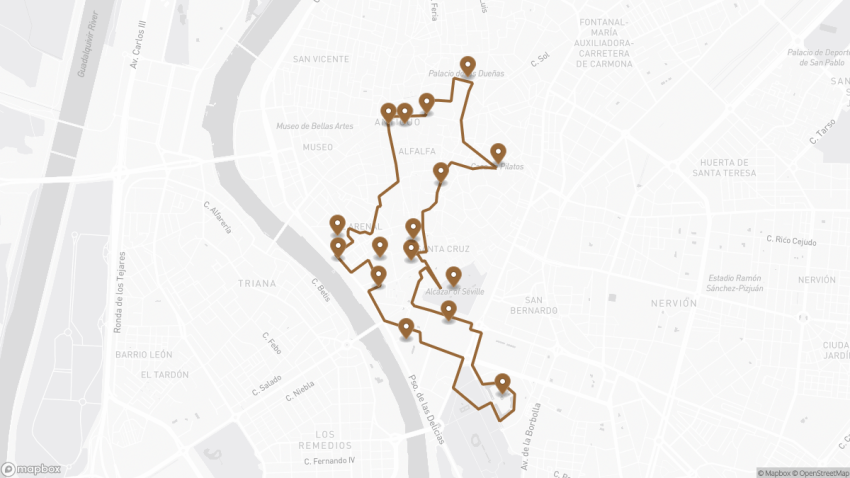
Discover Seville on foot with our walking tour map, guiding you from stop to stop as you explore the city's landmark sights, atmospheric streets, and unforgettable plazas at your own pace. Because it's a self-guided walking tour, you can linger where you want, skip anything that doesn't interest you, and build in as many coffee or tapas breaks as you like along the way.
1. Plaza de Espana
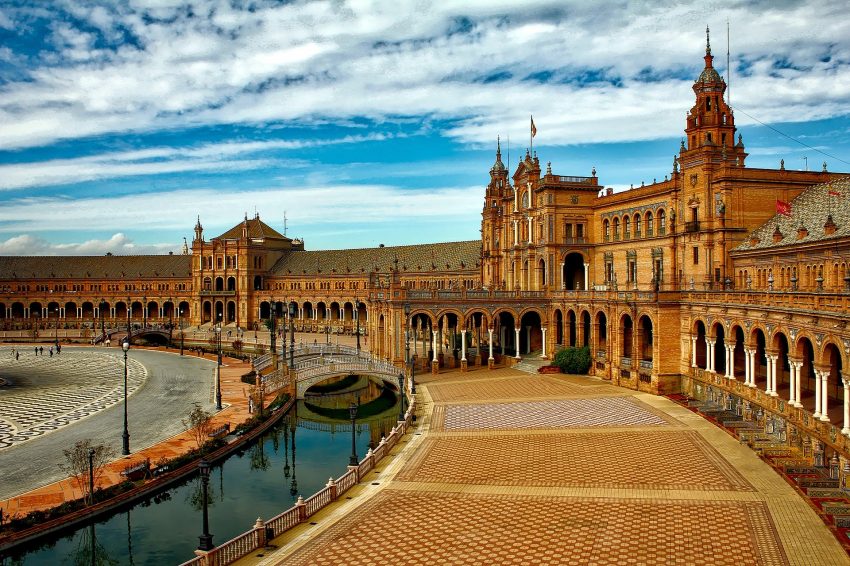
Built for the 1929 Ibero-American Exposition, Plaza de Espana is one of Seville’s most ambitious 20th-century civic projects, designed to showcase Spain’s regional diversity and its links with the wider Spanish-speaking world. Its architecture blends Renaissance Revival with Andalusian Mudéjar touches, and the overall layout is deliberately theatrical: a vast semi-circular palace embracing a grand square, as if Spain itself is presenting an open “stage” to visitors.
What makes it memorable is the craft detail at human scale. Along the curved façade you’ll find a series of ceramic-tiled alcoves (one for each province), with painted maps, historical scenes, and benches that invite you to stop and scan the iconography. The brickwork, glazed tiles, and wrought-iron bridges over the canal are as much the attraction as the monumentality.
Spend time walking the full arc rather than treating it as a photo stop. Cross the bridges for different angles, look up at the towers and layered façades, then linger by the canal where rowing boats often circulate. If you want quieter moments, arrive early; later in the day it becomes lively with street musicians and a steady rhythm of visitors.
Location: Plaza de España, s/n. 41013 Seville | Hours: 24 Hour | Price: Free | Website

2. Real Fabrica de Tabacos

The University of Seville’s most famous setting is the former Royal Tobacco Factory, a vast 18th-century industrial complex that once ranked among Europe’s largest manufacturing buildings. Its history sits at the intersection of empire, commerce, and social life: tobacco from the Americas fueled a major local economy, and the factory’s workforce—especially the cigarreras—became an enduring part of Seville’s cultural identity.
Architecturally, it is closer to a fortified palace than a typical campus. You’ll notice its monumental scale, thick walls, and a surrounding moat-like channel, all of which speak to the value of what was produced here and the need for control and security. The courtyards and long interior corridors retain the sense of an ordered, state-run machine, even though the building’s purpose has completely shifted.
When visiting, focus on the exterior presence and the sequence of courtyards if access is available. Look for the grand gateways, the rhythmic stone-and-brick detailing, and the way the building asserts itself within the city. Even without a full interior tour, the sheer footprint and industrial-palatial character make it a key stop for understanding Seville beyond medieval and Baroque monuments.
Location: Royal Tobacco Factory, Calle San Fernando, 4 41004 Sevilla Spain | Hours: Monday – Friday: 08:00–21:00. Saturday: 08:00–14:00. Closed on Sunday. | Price: Free (Part of the interior of the university is free to visit) | Website
3. Real Alcazar de Sevilla

The Real Alcazar is a living palatial complex with roots that reach back to early Islamic fortifications, later transformed under Christian rule into one of Europe’s most important examples of Mudéjar architecture. Successive monarchs expanded it over centuries, so what you see today is a layered statement of power: Islamic spatial concepts and decorative traditions adapted to Christian royal ceremony, with later Gothic, Renaissance, and Baroque additions woven in.
Historically, its significance is not just age but continuity. The Alcazar remained a seat of authority, shaping court life and projecting legitimacy through architecture, gardens, and ritualized movement from public to private spaces. That mix of political function and artistic ambition is why the interiors feel less like a single building and more like an evolving royal “world.”
On-site, prioritize the Mudéjar palaces: intricate stucco, carved wood ceilings, glazed tilework, and patterned arches that reward slow looking. Then give the gardens real time—shaded paths, water channels, pavilions, and botanical variety create a different rhythm from the rooms, and the transitions between sunlight and shadow are part of the experience. If you can, revisit a courtyard after touring: the second look often reveals details you missed when you were moving quickly.
Location: Patio de Banderas, s/n 41004 Sevilla Spain | Hours: (Summer) Monday – Sunday: 09:30–19:00. (Winter) Monday – Sunday: 09:30–17:00. Closed on 1 January, 6 January, Good Friday, 25 December. | Price: €15.50 (general); €8.00 (reduced); optional Upper Royal Quarters add-on €5.50. | Website
4. General Archive of the Indies

General Archive of the Indies is one of the most consequential archives in Europe for understanding the Spanish Empire, because it consolidates vast quantities of administrative records relating to Spain’s overseas territories. The building itself was created in the late 16th century as the Casa Lonja de Mercaderes, a purpose-built merchants’ exchange designed to pull commercial activity away from the cathedral precinct and formalize Seville’s role as a regulated hub of Atlantic trade. Its later conversion into an archive in the late 18th century reflects a different imperial priority: organizing, preserving, and controlling knowledge of empire through documentation.
Historically, the archive matters less as a “museum of objects” and more as a power-house of paper. The collections include correspondence, maps, legal proceedings, shipping and trade records, and reports that track how Spain governed, exploited, evangelized, and negotiated across the Americas and beyond. For historians and researchers, it’s foundational; for visitors, it’s a way to see how empire ran on bureaucracy, information flows, and standardized record-keeping, not just ships and battles.
What to see on-site: start with the architecture—its severe, Renaissance classicism, symmetry, and monumental stairways fit the building’s original civic-commercial function and later institutional gravitas. Then look for any rotating exhibitions (often featuring maps, manuscripts, and thematic displays) that translate the archive’s scale into something viewable in a short visit. Finally, take time in the main halls and reading-room areas (where accessible) to appreciate the atmosphere of an active archive; pairing this stop with the nearby cathedral and Alcazar helps you connect religious authority, royal power, and imperial administration within a few minutes’ walk.
Location: Edificio de la Lonja Avenida de la Constitución, 3 41071 Seville | Hours: Tuesday – Saturday: 09:30–17:00; Sunday & Public Holidays: 10:00–14:00. Closed on Monday. | Price: Free | Website
5. Seville Cathedral & Giralda Tower
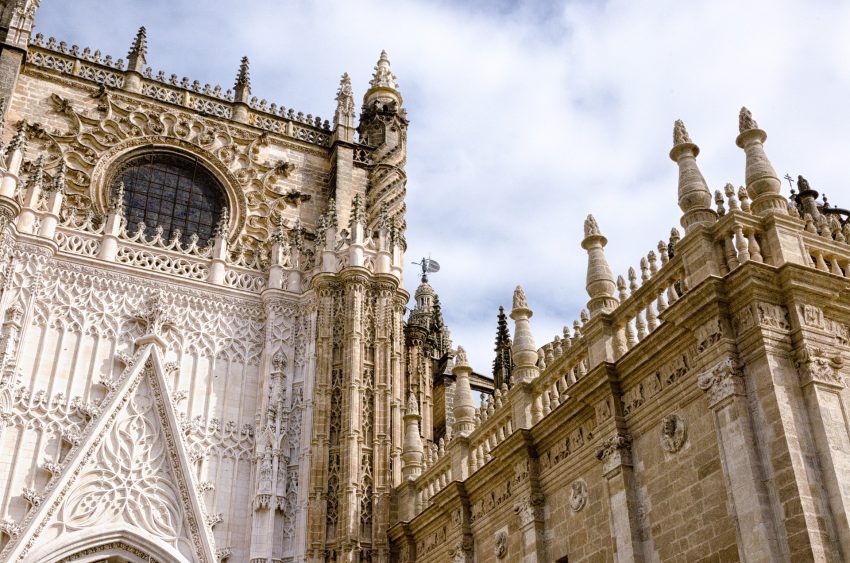
Seville Cathedral was built in the 15th and early 16th centuries on the site of the city’s main mosque, expressing Seville’s confidence at a moment when wealth, trade, and religious authority were tightly interlinked. The result is a vast Gothic interior designed to overwhelm: not subtle, but deliberately monumental, turning scale into a form of spiritual persuasion.
The Giralda began as the mosque’s minaret under Almohad rule, later adapted as a bell tower after the Christian conquest. That layered identity—Islamic engineering and proportions with later Christian additions—makes it one of Seville’s most emblematic monuments, a visible reminder of the city’s deep cultural stratigraphy rather than a single “pure” style.
Inside the cathedral, look for the main altarpiece (a major focus of devotional art), the choir area, and the way light filters through high stained glass into side chapels. Then climb the Giralda: the ascent is via ramps rather than stairs, originally designed for practical access, and the views at the top help you map Seville’s historic core—an excellent payoff after absorbing the cathedral’s interior scale.
Location: Av. de la Constitución, s/n 41004 Sevilla Spain | Hours: Monday – Saturday: 11:00–18:00. Sunday: 14:30–19:00. | Price: €13 online / €14 ticket office (general admission; includes the Cathedral, Giralda, and Church of El Salvador). | Website
6. Museo del Baile Flamenco

This museum is a modern interpretive space devoted to flamenco as a living Andalusian art form—music, song, and dance shaped by centuries of cultural exchange. Rather than focusing only on “romance” or stereotype, it frames flamenco as an evolving tradition with roots in local communities, performance venues, and social history.
The value here is context. Exhibits typically unpack the elements of flamenco—compás (rhythm), palos (styles), guitar technique, vocal expression, and the dancer’s vocabulary—so that a later live performance feels more legible. It’s useful if you want to move beyond “it’s passionate” into understanding how the structure and improvisation actually work.
What to see: engage with the audiovisual material and any demonstrations or shows offered on-site, because flamenco is best understood through sound and movement rather than static display. Pay attention to costume detail, footwear, and the relationship between dancer and musician—those practicalities explain a lot about the art’s intensity. If you plan to see a performance elsewhere, this is an efficient primer that can materially improve what you notice.
Location: Museo del Baile Flamenco, Calle Manuel Rojas Marcos, 3 41004 Sevilla, Spain | Hours: Daily: 11:00–18:45. First Monday of the month: 14:30–18:45. | Price: Museum Only: €6 Museum + Show: €29 (Combo ticket) Show Only: €25 | Website
7. Casa de Pilatos
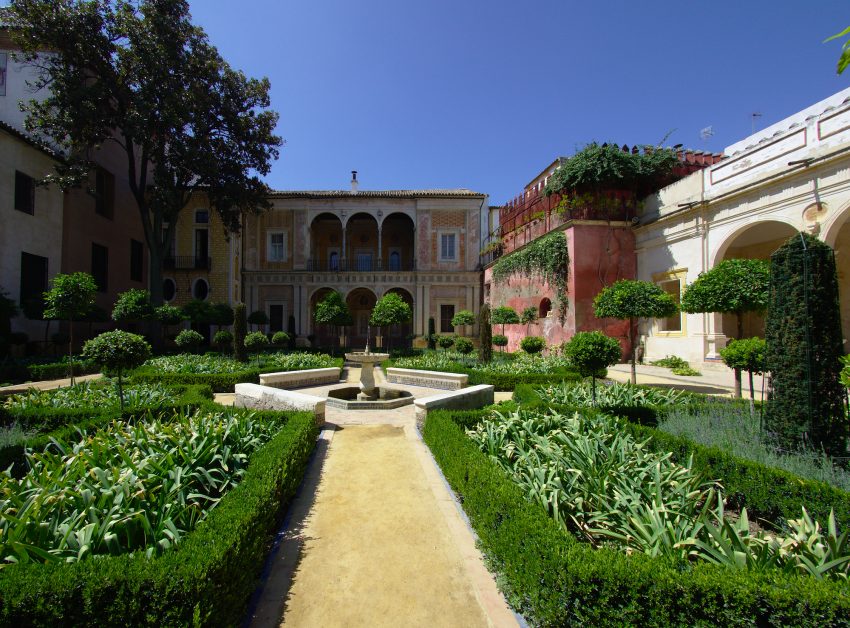
Casa de Pilatos is a 16th-century aristocratic residence that captures Seville’s Renaissance-era fascination with classical forms, while remaining deeply Andalusian in its courtyards, tilework, and spatial flow. It became a template for later noble houses: part palace, part urban retreat, organized around patios that balance display and privacy.
Historically, it is also a story of collecting and taste. The house reflects the ambitions of a powerful family and the broader currents of the time: Italian Renaissance influence arriving through travel and patronage, blended with local Mudéjar craft traditions that continued to flourish. That fusion is precisely what makes the building feel “Sevillian” rather than imported.
On a visit, look closely at the main courtyard and staircases, where the interplay of marble, azulejos, and carved detailing is most concentrated. Notice how light is managed—bright open patios feeding into cooler, shaded rooms—then explore secondary spaces that reveal the house’s scale beyond its headline views. It’s a site for slow observation: the decorative density can be missed if you treat it as a quick walkthrough.
Location: Plaza de Pilatos,1, 41003 Sevilla, Spain | Hours: Daily: 09:00–18:00. 25 December: 09:00–14:00; 1 January: 10:00–18:00; 6 January: 09:00–14:00. | Price: €12 (ground floor); €18 (ground floor + upper floor guided visit). | Website
8. Palacio de las Duenas
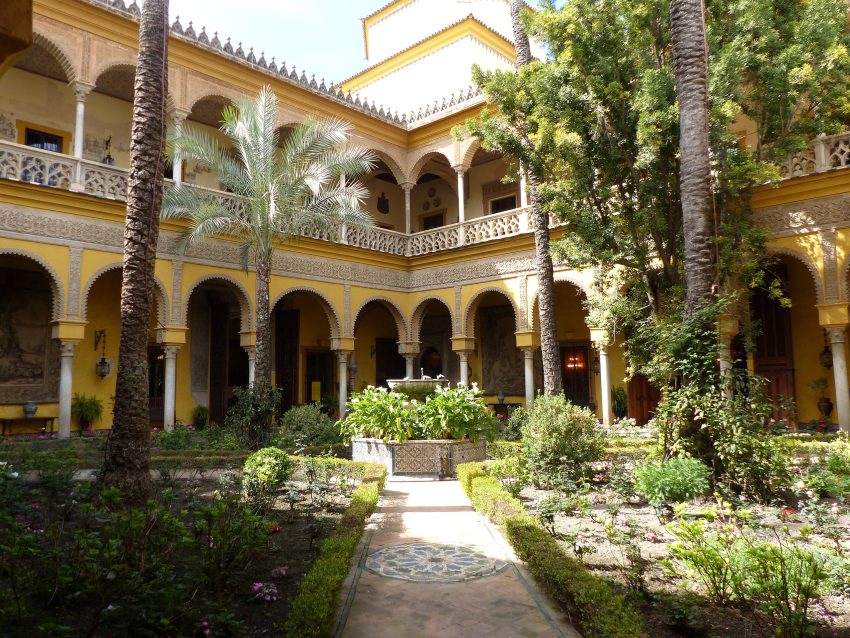
Palacio de las Duenas is a noble palace associated with Seville’s upper social world, notable for its blend of domestic intimacy and aristocratic presentation. Over centuries it has been adapted and embellished, so it reads as a composite of styles and periods, with patios, gardens, and halls arranged to support both everyday life and ceremonial occasions.
Its historical interest lies in that lived continuity: not a sealed museum-piece, but a residence that reflects how elite households evolved in Seville. The architecture and decoration demonstrate how Andalusian palatial life often pivoted around open-air courtyards and garden spaces, using plants, fountains, and shade as functional design rather than mere ornament.
What to see: focus on the patios and the transition zones—archways, galleries, and garden edges—where the building’s character is most apparent. Interiors provide context through decorative arts and family history, but the atmosphere is often strongest outdoors, where the arrangement of courtyards and greenery conveys how the palace “worked.” If you’re visiting multiple grand sites, this one is a good counterpoint because it feels more residential than monumental.
Location: Palacio de las Dueñas en sevilla, Calle Dueñas, 5, Seville, Spain | Hours: (Summer) April – September: Daily: 10:00–19:00. (Winter) October – March: Daily: 10:00–18:00. Closed on 01 January, 06 January, 25 December, 30 December & 31 December. On 05 January & 24 December: 10:00–15:00. | Price: €14 (general); €10 (reduced); €0 (children under 6). | Website
9. Setas de Sevilla

Setas de Sevilla is a contemporary landmark built in the early 21st century, created as a bold intervention in a historic urban fabric. Its significance is less about ancient history and more about how modern Seville negotiates public space: replacing an underused area with a structure that combines viewpoint, plaza life, and cultural programming.
The design is intentionally dramatic—an elevated, sculptural canopy that redefines the skyline and creates shade below. Whether you see it as harmonious or disruptive, it has become a reference point for present-day Seville, and it often sparks useful questions about conservation, modern architecture, and what a “historic city” is allowed to become.
What to see: go up for the panoramic walkway, especially near sunset when the city’s roofscape and church towers sharpen into view. At ground level, pay attention to how the space functions as a meeting point—street life, markets, and movement patterns tell you as much as the structure itself. If you have limited time, prioritize the viewpoint; it’s one of the quickest ways to orient yourself over Seville’s center.
Location: Plaza de la Encarnación, 41003 Seville, Andalucía, Spain | Hours: Daily: 09:30–00:30 (last entry 23:45). | Price: €15 (general ticket for the rooftop viewing platform; concessions may be available). | Website
10. Palacio de Lebrija
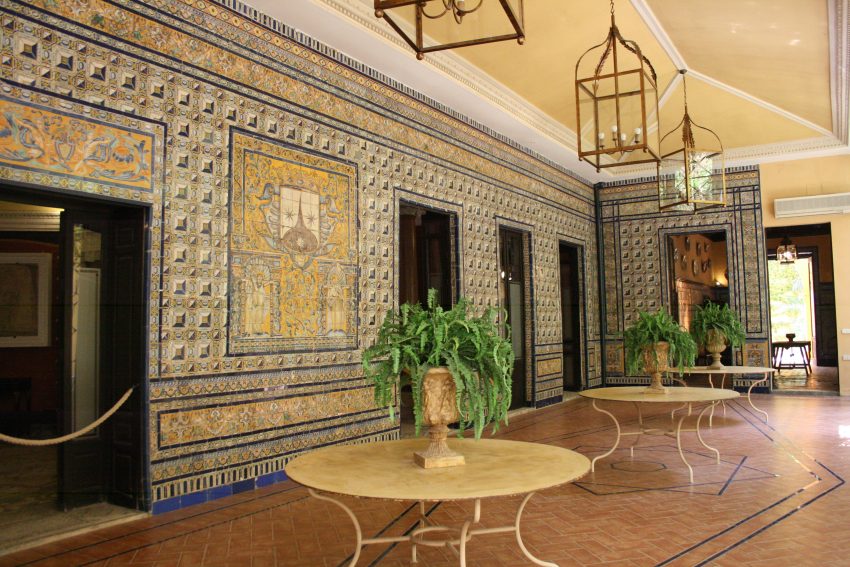
Palacio de Lebrija is an early-20th-century aristocratic townhouse that became famous because its owner, the Countess of Lebrija, turned it into a showcase for archaeological collecting at a time when Seville’s elite were actively assembling private “museums” at home. The building itself includes older elements typical of Sevillian domestic architecture, but its identity today is defined by the way antiquities—especially Roman material—were incorporated into living spaces as symbols of education, prestige, and a curated connection to the classical past.
The real headline is the Roman mosaics, many of them installed as floors so you view them in the way they were intended to be seen: underfoot, integrated into a functional interior rather than isolated behind glass. That decision transforms the visit into something quite different from a conventional museum. The palace also reflects the layering that defines Seville: Andalusian patio planning and decorative traditions sit alongside classical fragments, portraits, and period furnishings, creating a coherent “collector’s house” rather than a single-style monument.
When you visit, focus first on the ground-floor rooms and patios where the mosaics and architectural fragments are most concentrated, and take time to read the imagery—mythological scenes, geometric patterns, and figurative panels—because the detail rewards slow looking. If an upper-floor visit is available, it adds context through salons and domestic spaces that show how the house functioned as a residence as well as a display setting. Watch for the transitions between courtyards, corridors, and rooms: the way the palace controls light and temperature is part of the experience, and it helps explain why the patio house remained such a durable model in Seville.
Location: Palacio de Lebrija, Calle Cuna, 8, 41004 Sevilla, Spain | Hours: (Winter) September – June: Daily: 10:00–18:00. (Summer) July – August: Daily: 10:00–15:00. | Price: €15; Children (6–12): €6; Groups (15+): €10. | Website
11. Calle Sierpes

Calle Sierpes is one of Seville’s classic central streets, shaped by centuries of commercial life and pedestrian movement. Historically, streets like this were the arteries of urban identity: shops, workshops, cafés, and informal public rituals playing out in a corridor that connects key civic and religious spaces.
Its appeal is not a single monument but an atmosphere of continuity. The street embodies how Seville’s center still works day-to-day—local shopping culture alongside visitor browsing—within a compact, walkable setting. That makes it useful for understanding the city’s rhythm between “sights” rather than treating travel as a sequence of isolated attractions.
What to see (and do): treat it as a slow walk rather than a quick passage. Notice storefront details, the changing architecture as you move along, and the ebb and flow at different times of day. It’s also a practical connector: use it to stitch together nearby highlights, and consider a pause in a café or pastry stop as part of the experience, because the street’s real character comes from how people inhabit it.
Location: C. Sierpes, Casco Antiguo, 41004 Sevilla, Spain | Hours: 24 Hours. | Price: Free.
12. Plaza de Toros de Sevilla

Museo Taurino de la Real Maestranza de Caballería sits within Seville’s most historically influential bullfighting institution, tied to the city’s elite cavalry brotherhood and its long tradition of public spectacle. The museum’s narrative follows how bullfighting developed from aristocratic horsemanship into a formalized arena culture, and how Seville helped codify style, ceremony, and social meaning around the corrida over the 18th–20th centuries.
A lot of the historical value is in the material culture: costumes, portraits, prints, and objects that document shifting aesthetics and professionalization. You’ll see how the “look” of bullfighting evolved—tailoring, embroidery, and color—alongside evidence of patronage and celebrity. Even if you’re not a fan of the sport, the museum works as a lens on Andalusian identity, class, and urban entertainment, showing how a local tradition became a national and international symbol.
What to see: prioritize the traje de luces displays (the craftsmanship is the point), the chronology of famous toreros through portraits and posters, and any sections that explain the ritual sequence of a bullfight (it helps you read the objects rather than treating them as décor). If your ticket includes it, pair the museum with the arena visit at the Plaza de Toros de la Real Maestranza de Caballería—standing in the ring and then returning to the exhibits makes the scale, choreography, and social theatre much easier to grasp.
Location: Plaza de toros de la Real Maestranza de Caballería de Sevilla Paseo de Cristóbal Colón, 12 41001 Sevilla Spain | Hours: Daily: 09:30–19:30. Bullfighting days: 09:30–15:00. | Price: €10 (general); €6 (seniors 65+ and pensioners, students 17–25, youth 12–16); €3.50 (children 7–11); free (children 0–6 accompanied). | Website
13. Torre del Oro
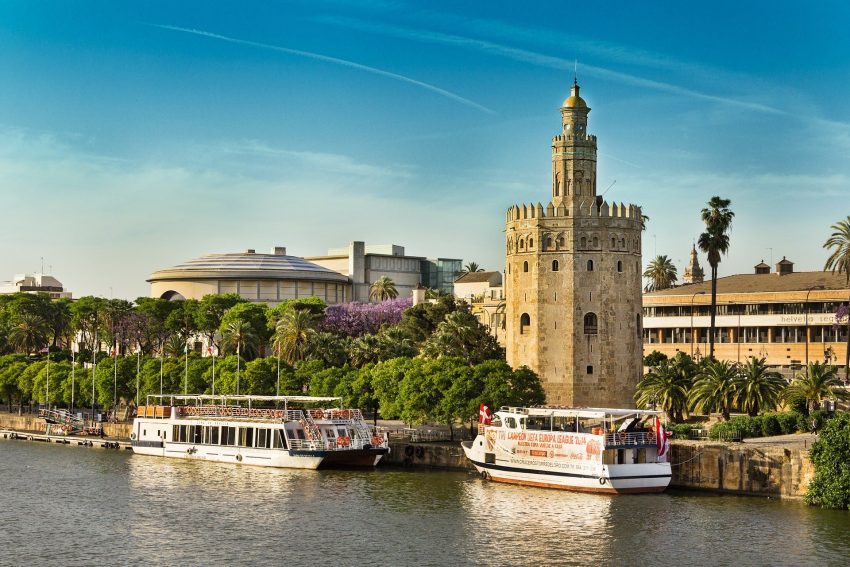
Torre del Oro dates to the early 13th century, built under Almohad rule as part of Seville’s river defenses. Positioned on the Guadalquivir, it worked with other fortifications and a heavy chain stretched across the water to control access and protect the city—an effective reminder that the river was both Seville’s lifeline and its vulnerability.
The tower’s name has inspired stories—some romantic, some speculative—often linking it to gold and treasure arriving from overseas. Whether or not those legends reflect reality, the site’s real historical weight is its strategic river role and its later afterlife as Seville’s maritime story expanded in the age of Atlantic exploration and trade.
What to see: the tower itself is compact, but the views and river context are the payoff. Walk the perimeter to appreciate its layered, dodecagonal form and its relationship to the embankment. If you go inside, treat it as a short visit that complements a longer riverside stroll—especially at sunset when the light gives the stone a warm, metallic tone that helps explain the tower’s evocative name.
Location: Paseo Cristobal Colón, s/n 41001 Sevilla. | Hours: Monday – Friday: 09:30–19:00. Saturday – Sunday & public holidays: 10:30–19:00. Closed on 1 January, 6 January, Good Friday, 1 May, 25 December. | Price: Free entry (voluntary contribution requested). | Website
14. Royal Shipyards of Seville
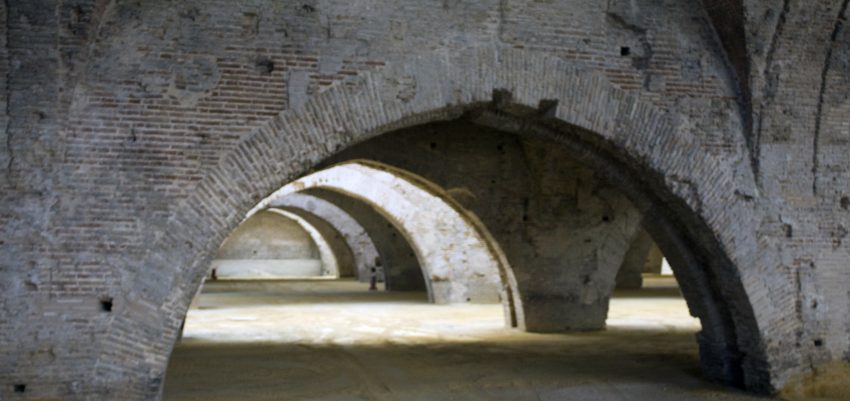
Royal Shipyards of Seville are a rare survival of Seville’s medieval-industrial infrastructure, founded in the 13th century after the Christian conquest of the city. Built close to the Guadalquivir, the shipyards were designed for speed and scale: a sequence of large vaulted naves where galleys and other vessels could be constructed, repaired, and provisioned. Their origin ties directly to royal military logistics, when control of sea and river routes underpinned power in Iberia and the western Mediterranean.
Over later centuries, as Seville’s economy pivoted toward Atlantic trade and imperial administration, the shipyards’ role shifted and their spaces were repeatedly adapted for other uses, including storage and state purposes. That long afterlife is part of their historical interest: they illustrate how strategic industrial architecture can be repurposed as technologies, trade patterns, and political priorities change. Even when shipbuilding declined, the site remained embedded in the city’s working waterfront ecosystem.
What to see today is primarily the architecture and the sense of volume. Look for the repeated Gothic-style vaults, the rhythm of pillars, and the way the naves create a “cathedral of work” effect that’s very different from Seville’s religious monuments. If areas are open or interpreted, pay attention to any exhibits or signage explaining how ships were assembled inside the vaulted bays and how close the complex once sat to the active river edge; walking the perimeter also helps you imagine the former relationship between workshop, water, and the city wall.
Location: Reales Atarazanas Calle Temprado, 1 41001 Sevilla Spain | Hours: The Reales Atarazanas de Sevilla are Seville’s vast medieval shipyards, built for royal galleys and later reused as warehouses and military workshops. This %%currentyear%% guide explains what you can still see today, how to find them, and how to plan around their limited public access. | Price: Free (during special open days; regular ticketing to be confirmed). | Website
15. Torre de la Plata

Torre de la Plata is a small but historically important remnant of Seville’s medieval defensive system, built in the 13th century under Almohad rule. It once formed part of the city’s riverside fortifications, linked by the wall line known as the coracha to the larger Torre del Oro, creating a controlled, protected approach along the Guadalquivir. In other words, it wasn’t conceived as a standalone landmark; it was a working component in a continuous military perimeter.
The tower’s octagonal plan is the key architectural feature to notice, a form that reads clearly even at street level and distinguishes it from Seville’s more famous monumental towers. Over time, as the walls disappeared and the city expanded, the Torre de la Plata lost its defensive purpose and became easy to overlook, which is why it feels like a “hidden” survival rather than a headline attraction. Restoration work in the late 20th century helped stabilize and re-present it as a protected historic element rather than an abandoned fragment.
What to see today is primarily the exterior: walk around it and take in the masonry, the octagonal geometry, and how it sits against the modern street pattern that replaced the old wall line. It works best as a short, intentional stop while moving between the cathedral area and the riverfront—more about imagining the former fortifications than ticking off an interior visit. If you pair it with Torre del Oro, you get a much clearer sense of how Seville’s river defenses were laid out and why the Guadalquivir mattered strategically as well as economically.
Location: Torre de la Plata, Calle Santander, Seville, Spain | Hours: Open 24 hours. | Price: Free. | Website
16. Palacio de San Telmo

Palacio de San Telmo began life in the late 17th century as a purpose-built institution rather than a noble residence: it was created as a nautical college to train navigators and seamen, which makes its origin inseparable from Seville’s maritime and imperial history. Its later transformations—from educational complex to grand palace associated with powerful patrons and administrations—explain why the building feels both institutional and ceremonially “state-like,” with architecture intended to project discipline, learning, and authority.
Architecturally, the palace is a standout of Sevillian Baroque, and its façade is the feature most visitors remember. The entrance portal is highly sculptural, a dense display of stonework that turns the act of arrival into a visual statement. Along the exterior you’ll also notice a sequence of decorative elements that reinforce the building’s prestige and civic importance, and the overall massing is monumental in a way that signals its public role more than domestic comfort.
What to see depends on access, because it often functions as an active seat of governance. If you can enter, prioritize the grand staircases, principal halls, and any formal courtyards—these spaces communicate how the palace evolved from training institution into a setting for representation and ceremony. Even if you only see it from outside, spend time with the main façade and portal, then step back to take in the building’s scale along the river-side axis; it’s an effective stop for understanding how Seville’s power shifted from mercantile infrastructure to institutional and administrative grandeur.
Location: San Telmo Palace, Calle Palos de la Frontera, 41004 Sevilla, Spain | Hours: Thursday: 10:00, 12:00, 16:00 & 18:00. Saturday: 11:00, 13:00, 16:00 & 18:00. Closed on Monday, Tuesday, Wednesday, Friday & Sunday. | Price: Free | Website

Moira & Andy
Hey! We're Moira & Andy. From hiking the Camino to trips around Europe in Bert our campervan — we've been traveling together since retirement in 2020!
This website uses affiliate links which earn a small commission at no additional cost to you.
Walking Tour Summary
Distance: 7.5 km
Sites: 16
Walking Tour Map