Self-Guided Walking Tour of Lecce (2026)

This website uses affiliate links which earn a small commission at no additional cost to you.
Lecce is made for walking: a compact historic center, richly decorated façades, and one beautiful viewpoint after another, all stitched together by pedestrian-friendly lanes. A self-guided route lets you move at your own pace, dip into churches and courtyards when they're open, and linger in the squares when the light is at its best. It's also the easiest way to catch the city's atmosphere, because the details that make Lecce special are often above eye level or tucked just off the main streets.
This tour is designed to link the best things to see in Lecce into a logical loop, so you're not backtracking or guessing what to visit next. Expect a mix of headline monuments, photogenic streets, and smaller stops that give you a break from the crowds. You can keep it brisk in a couple of hours, or turn it into a half-day with café stops and short interior visits.
If you start early, you'll get quieter streets and softer light on the stonework; if you go later, the city feels more animated and the golden colour of Lecce's buildings really stands out. Either way, comfortable shoes are essential because the joy of Lecce is in the slow, street-by-street discovery. Treat the route as a framework, and adjust the pace depending on how often you want to stop for photos, gelato, or a long look at the Baroque carving.
How to Get to Lecce
By Air: Lecce does not have its own commercial airport, so the usual approach is to fly into Brindisi Airport (the closest) or Bari Airport (with more route options), then continue overland to Lecce. From Brindisi you can typically reach Lecce fastest by train from Brindisi Centrale or by a pre-booked transfer/taxi; from Bari you have more frequent onward trains but a longer ground journey. If you are arriving late, check the last train times and have a backup (taxi or transfer) to avoid being stranded. For the best deals and a seamless booking experience, check out these flights to Lecce on Booking.com.
By Train: Lecce is one of the main rail hubs in Salento, with direct and frequent services to/from major cities in Apulia (including Bari), plus longer-distance services that connect onward to the rest of Italy via Bari. The main station is Lecce Centrale, which is walkable to the historic centre for many travellers, or a short local bus/taxi ride if you have luggage or your accommodation is outside the core. Booking ahead is most useful in peak season and for faster services; regional trains are generally flexible but can be busy at weekends. Use Omnio to easily compare schedules, book train tickets, and find the best prices all in one place for a hassle-free journey across Italy.
By Car: Driving to Lecce is straightforward if you are already in southern Italy, and it's most useful if you plan to explore the wider Salento coast and small towns. Expect limited access and scarce parking inside the central areas, so it's usually best to target a public car park at the edge of the centre and walk in. If you are coming from Bari or Brindisi, the fastest routes are typically via the main highways/arterial roads toward Salento, with the final approach taking you onto city streets that can slow down at peak times. If you are looking to rent a car in Italy I recommend having a look at Discover Cars, first, as they compare prices and review multiple car rental agencies for you.
By Bus: Long-distance coaches can be a good-value alternative, especially if flight schedules don't line up with trains or you're travelling late. Buses often connect Lecce with Bari and other regional cities, and some services run from Rome or Naples depending on season and operator; journey times are longer than the fastest trains but can be convenient if you want a direct one-seat ride.
A Short History of Lecce
Lecce in the Ancient Era (before the 3rd century BCE)
Lecce's earliest urban story is tied to the long arc of settlement in southern Italy, when local peoples developed fortified communities, agriculture, and coastal-to-inland trade. Over time, the settlement gained strategic value as networks expanded across the wider Mediterranean, drawing it into the orbit of larger powers and making it a place where cultural layers accumulated rather than being replaced cleanly.
Those early centuries left fewer obvious “street-level” traces than later periods, but they set the conditions for Lecce’s Roman transformation: a town that could be reorganised, monumentalised, and plugged into imperial systems of roads, taxation, and civic life.
Lecce in the Roman City Period (3rd century BCE-5th century CE)
Under Rome, Lecce developed the classic civic core you can still read in the modern streetscape. The most visible anchors are the entertainment buildings: the Anfiteatro Romano di Lecce and the Teatro Romano di Lecce, both physical reminders that public spectacle and civic identity were central to Roman urbanism.
That Roman imprint is strongly felt around Piazza Sant’Oronzo, where layers of later life grew up around the ancient core rather than erasing it. Even when the empire weakened, these large-scale structures shaped what came after: medieval and early modern building often had to negotiate, reuse, or build around the Roman fabric.
Lecce Through Late Antiquity and the Medieval Centuries (6th-15th centuries)
As authority shifted after Rome, Lecce moved through phases of instability and reorganisation typical of many Italian towns, with governance changing hands and defensive priorities rising. The Christianisation of public space became more pronounced, and ecclesiastical institutions increasingly acted as stabilising forces-administratively, socially, and architecturally.
This long medieval span also included the presence of minority communities and shifting tolerances. The Museo Ebraico di Lecce is a useful reference point for that layered religious and social history, pointing to periods when Jewish life was visible within the urban economy, and other periods when pressure, restrictions, or forced change narrowed that space.
Lecce in the Age of Fortification and City Gates (16th century)
The 16th century brought a more militarised urban logic, with stronger defences and more controlled access reflecting a broader era of insecurity and rivalry. The fortress that defines this phase is Castello Carlo V, a statement of authority as much as a practical defensive work, shaping movement and power within the city.
The monumental gates also belong to this defensive and ceremonial worldview. Porta Napoli and Porta San Biagio signal a city that managed entry, displayed status, and choreographed arrival-turning what could be purely functional infrastructure into civic theatre.
Lecce in the Baroque Zenith (17th century)
Lecce’s most recognisable architectural identity was forged in the 1600s, when religious orders, civic elites, and church institutions drove a building boom that prioritised dramatic façades, sculptural stonework, and showpiece interiors. The pairing of the Basilica di Santa Croce and the Palazzo dei Celestini captures this moment: an assertive blend of spirituality, power, and public display.
Baroque Lecce is also a story of competing commissions and distinctive stylistic voices. Churches such as Chiesa di San Matteo, Chiesa di Santa Chiara, and Basilica di San Giovanni Battista al Rosario reflect the Counter-Reformation impulse to inspire devotion through architecture that felt immersive, emotional, and unmistakably “present” in the street.
Lecce From the 18th Century to the Modern City (18th century-present)
After the peak Baroque phase, Lecce's evolution became less about creating a new signature style and more about adapting what already existed: reshaping spaces, managing growth, and integrating modern infrastructure while retaining the density and drama of the historic core. The Lecce Cathedral stands as the clearest symbol of continuity through these changes-an anchor of civic-religious identity as political frameworks and daily life modernised around it.
In the modern era, Lecce’s historic fabric has become both a lived environment and an asset that requires careful stewardship. What visitors experience today is the result of repeated reinvention: Roman public life, medieval resilience, early modern defence, and Baroque ambition, all preserved and reinterpreted as the city’s economy and cultural priorities shifted toward heritage, education, and tourism.
Where to Stay in Lecce
To make the most of visiting Lecce and this walking tour, then you consider stay overnight at the centre. The best base is the Centro Storico, because you can step out early for quieter streets, return easily for a rest between stops, and enjoy the historic core after day-trippers leave. For a characterful stay inside (or right on the edge of) the old town, look at Patria Palace Hotel, Risorgimento Resort, and La Fiermontina Urban Resort-all strong picks if you want atmosphere, walkability, and an easy start/finish point for the route.
If you prefer somewhere slightly calmer but still effectively “central,” staying near Porta Napoli / the northern edge of the old town is a smart compromise: you’re close enough to walk into the historic lanes in minutes, but you’ll often get better value and easier vehicle access for luggage. Options around this side that work well for walking-tour convenience include Grand Hotel Tiziano e dei Congressi, 8Piuhotel, and B&B Palazzo Bignami, which suit travellers who want quick access to the centre without being right in the busiest evening lanes.
For a more modern, shopping-and-dining neighbourhood with lots of choice and a straightforward walk into the old town, the area around Piazza Mazzini is a practical base. It’s good if you like wider streets, more contemporary cafés, and easier taxi pick-ups, while still being close enough to join the tour on foot. Consider Mercure Hotel President Lecce, Hotel Delle Palme, and Hilton Garden Inn Lecce for comfort, reliable facilities, and an easy walk or short taxi ride to the historic core.
If you’re arriving by train or planning day trips, staying near Lecce’s station can be convenient, but it’s best to choose somewhere that still keeps you within a manageable walk of the old town so the tour remains effortless. This area suits shorter stays, early departures, and travellers who want logistics to be simple, especially with luggage. Look at Hotel Cappello, Grand Hotel di Lecce, and Eos Hotel as workable options that balance transport convenience with walkability for your route.
Your Self-Guided Walking Tour of Lecce
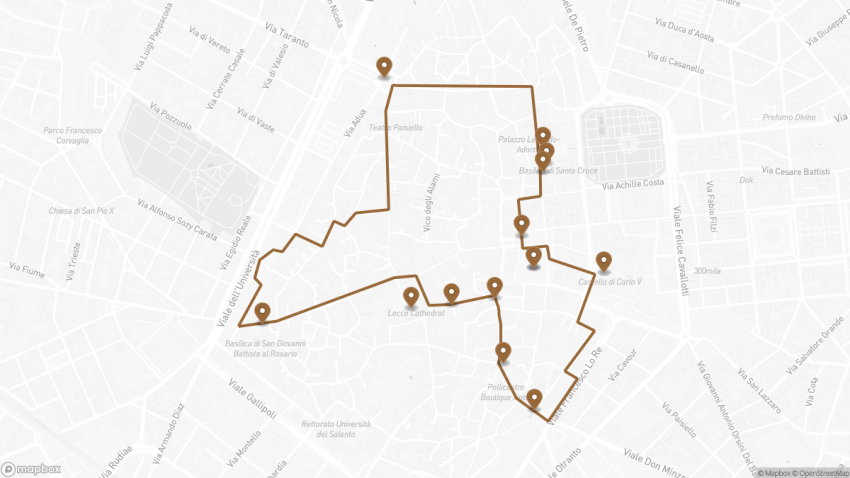
Explore Lecce on foot with our walking tour map, guiding you from stop to stop as you discover the city's highlights. Because it's self-guided, you can set your own pace, skip any places that don't interest you, and pause for coffee whenever you feel like it.
1. Castello Carlo V
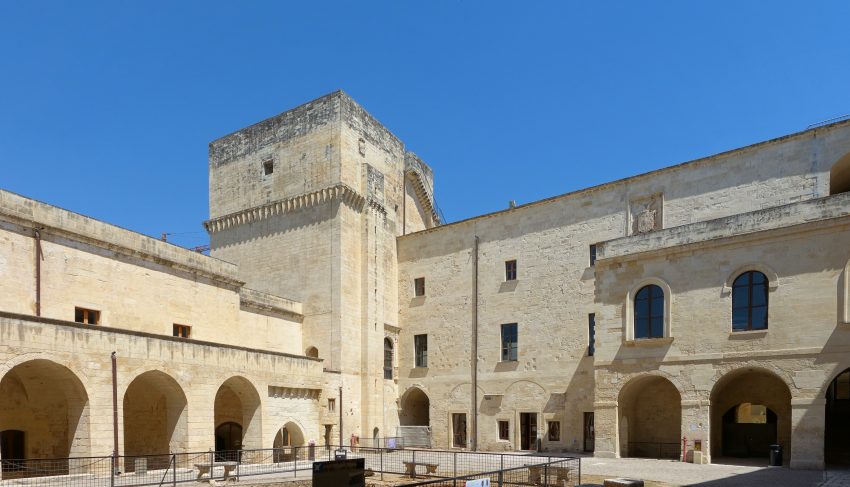
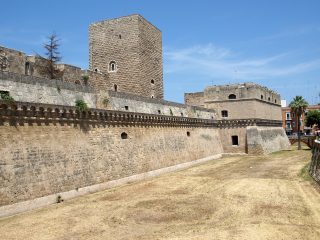
Castello Carlo V is Lecce’s statement of early-modern military architecture, built as artillery and geopolitical pressure forced cities to rethink medieval walls and towers. Associated with Charles V’s defensive programs in the 16th century, the castle embodies the transition from picturesque fortification to angular, bastioned geometry designed for cannon warfare.
Unlike a romantic hilltop castle, this is an urban fortress: thick walls, bastions, controlled access, and an emphasis on dominating approaches rather than providing palatial comfort. Over time, many such structures gained layered uses—administration, storage, detention—so the castle’s history is as much about civic control as it is about external defense.
When you visit, pay attention to the plan: corners, bastions, and how lines of fire would have worked. Inside, look for exhibition spaces and reused rooms that reveal later adaptations; outside, walk the perimeter to feel how the structure sits in the city grid and why it was placed exactly where it is.
Location: Castello Carlo V, Via XXV Luglio, Lecce, Province of Lecce, Italy

2. Porta San Biagio

Porta San Biagio is another of Lecce’s historic gates, associated with the city’s fortified perimeter and the controlled movement of people and goods into the urban core. Gates like this are practical infrastructure, but they are also symbols—announcing authority, identity, and the boundary between civic order and the outside world.
Compared to the city’s peak Baroque monuments, the gate’s appeal is its clarity: an urban marker that still does what it was built to do, even after walls and defensive functions receded. Its dedication to Saint Blaise ties it into Lecce’s devotional geography, where saints and routes often map onto older movement corridors.
When you’re there, treat it as a “hinge point” for understanding the city plan. Stand on both sides to feel the shift from broader approach roads to tighter historic streets, and look for remaining traces of how the gate once connected to walls, ditches, or controlled entry systems.
Location: Piazza D'Italia, 73100 Lecce LE, Italy | Hours: 24 Hours. | Price: Free.
3. Chiesa di San Matteo
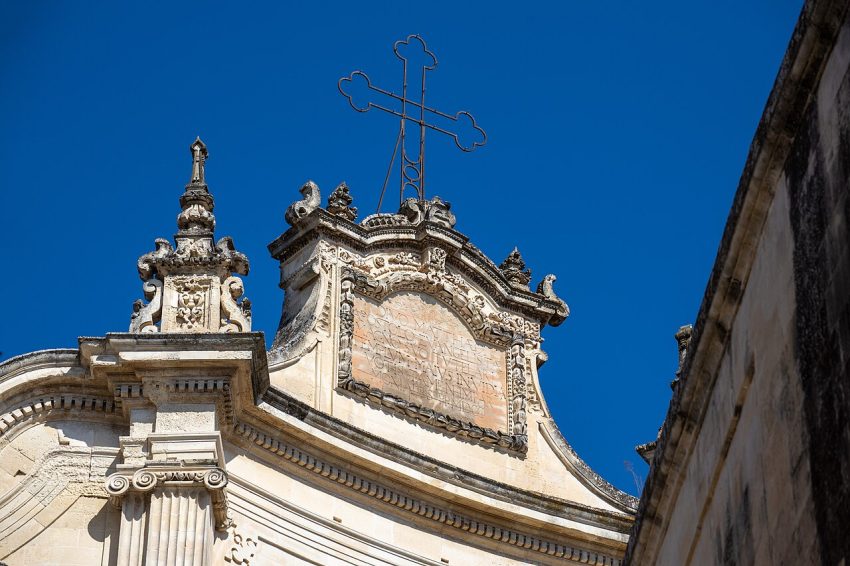
Chiesa di San Matteo is a concentrated dose of Baroque design, reflecting Lecce’s appetite for architectural drama in the 17th century. Churches here often served not only devotional functions but also as markers of patronage and artistic competition—stone-carvers and architects pushing the local style forward.
The façade is the key feature: it plays with concave and convex forms to create motion and tension, a spatial trick that makes the building feel animated as you approach. This kind of sculptural frontage is meant to engage you emotionally before you even step inside.
Inside, look for how the Baroque directs attention—toward the altar, through framed chapels, and via contrasts of light and shadow. Even a short visit is rewarding if you pause at the center and let your eyes move deliberately from architectural lines to carved details to the overall spatial “theater.”
Location: Chiesa di San Matteo, Via dei Perroni, Lecce, Province of Lecce, Italy
4. Chiesa di Santa Chiara

The Church of Saint Clare reflects Lecce’s 17th-century religious building boom, when new façades and richly staged interiors expressed both devotion and local artistic ambition. As with many churches tied to female religious orders, its history is also a social one—connected to education, charity, enclosure, and patronage networks in the city.
Architecturally, you’ll often notice a compact footprint and an interior designed for focused impact rather than sheer scale. Lecce’s Baroque tends to emphasize sculpted surfaces and spatial dynamism, and Santa Chiara typically rewards visitors who look closely rather than expecting vastness.
What to see is the interplay of geometry, ornament, and light. Pause in the nave and observe how the eye is directed; then move toward side elements and decorative programs that reveal the church’s identity and the city’s stone-carving culture.
Location: P.za Vittorio Emanuele II, 73100 Lecce LE, Italy | Hours: (Summer) April – September; Daily: 09:00–21:00. (Winter) October – March; Daily: 09:00–18:00. | Price: Adults: €11 (LeccEcclesiae single ticket for multiple sites); Reduced (12–17): €5; Family: €24. | Website
5. Teatro Romano di Lecce
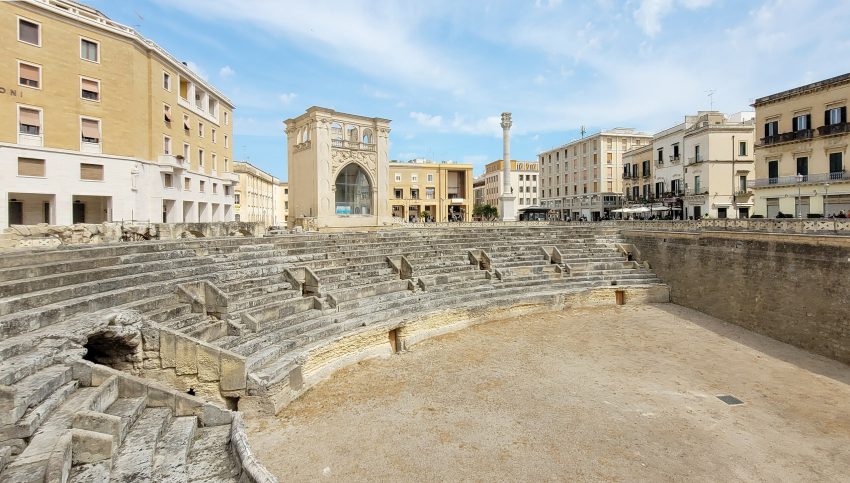
Lecce’s Roman Theatre is smaller and more intimate than the amphitheater, linked to staged drama, music, and civic performances rather than mass spectacles. It speaks to Lecce’s role as a Roman city with the cultural infrastructure expected of an urban center—places not just for commerce and administration, but for performance and public identity.
Because it sits within the dense fabric of the old town, the experience is almost surprising: you turn a corner and suddenly find stepped seating and stage remnants tucked behind later buildings. That embeddedness is historically honest—cities rarely preserve antiquity in isolation; they absorb it.
When you visit, focus on the layout: seating arc, stage area, and how performers would have faced the audience. Also notice the juxtaposition—Roman stone against later walls—because that contrast is essentially Lecce’s story in miniature: continuity through reuse.
Location: Roman Amphitheater, Piazza Sant'Oronzo, Lecce, Province of Lecce, Italy
6. Lecce Cathedral

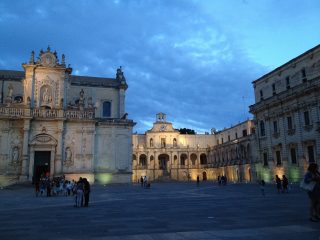
Lecce Cathedral is the centerpiece of the city’s ecclesiastical power, with roots in the medieval period and a major Baroque rebuilding that gave it the appearance most visitors recognize today. Cathedrals in southern Italy often reflect cycles of rebuilding after earthquakes, fires, or changing liturgical tastes, and Lecce’s cathedral complex expresses that long institutional timeline.
The setting matters as much as the church: the cathedral stands within a composed precinct, where the surrounding buildings and open space create a sense of ceremony and controlled grandeur. The architecture emphasizes vertical accents and strong façades, and the warm local stone ties the cathedral visually to the rest of the historic center.
On site, take time in the square first, then enter. Outside, walk the perimeter to see how the building presents different faces; inside, look for chapels and altars that showcase local craftsmanship, and pay attention to how the space uses light to guide attention toward the liturgical focus.
Location: P.za del Duomo, 1, 73100 Lecce LE, Italy
7. Basilica di San Giovanni Battista al Rosario

Location: Via Giuseppe Libertini, 5, 73100 Lecce LE, Italy | Hours: Check official website. | Price: Free; donations appreciated.
8. Porta Napoli

Porta Napoli is one of the most recognizable entrances into Lecce’s historic center, built in the era when the city reinforced its defenses under Spanish rule. The gate is commonly associated with the 16th-century refortification program connected to Emperor Charles V, and it functions as a statement piece: less a fortress element than a ceremonial threshold announcing Lecce’s status and prosperity.
Architecturally, it reads like a triumphal arch, with classical language that contrasts with the more exuberant Baroque you’ll see deeper in town. Look for the symmetry of the composition, the heraldic and dedicatory elements, and the way the gate frames the street beyond—this “framing” is part of the intended experience.
When you’re there, treat it as both a monument and a viewpoint marker. Walk around it rather than only passing through: the side angles clarify its massing, and the open space nearby makes it easy to appreciate proportions and decorative details without visual clutter.
Location: Piazzetta Arco di Trionfo, 73100 Lecce LE, Italy | Hours: 24 Hours. | Price: Free.
9. Palazzo dei Celestini

Palazzo dei Celestini originated as part of a major monastic complex associated with the Celestine order, then evolved into one of Lecce’s most prominent civic-looking façades. Its history reflects a broader pattern in southern Italian cities: religious institutions accumulated wealth and urban presence, and later many of these spaces shifted to administrative or representative functions.
The exterior is the main event. The façade is a showcase of Lecce’s local stonework traditions and the city’s confident 17th-century aesthetic—rhythmic windows, carved ornament, and an overall sense of controlled richness rather than pure excess.
On site, spend time scanning the façade from left to right as if reading it like a text: portals, window surrounds, and cornices are where the stone-carving virtuosity concentrates. Even if you don’t enter, the building rewards slow looking, especially in changing light when the stone picks up warm tones.
Location: Via Umberto I, 73100 Lecce LE, Italy | Hours: Monday – Friday: 10:00–12:00 & 16:00–17:30. Saturday: Closed. Sunday: Closed. | Price: Free. | Website
10. Basilica di Santa Croce
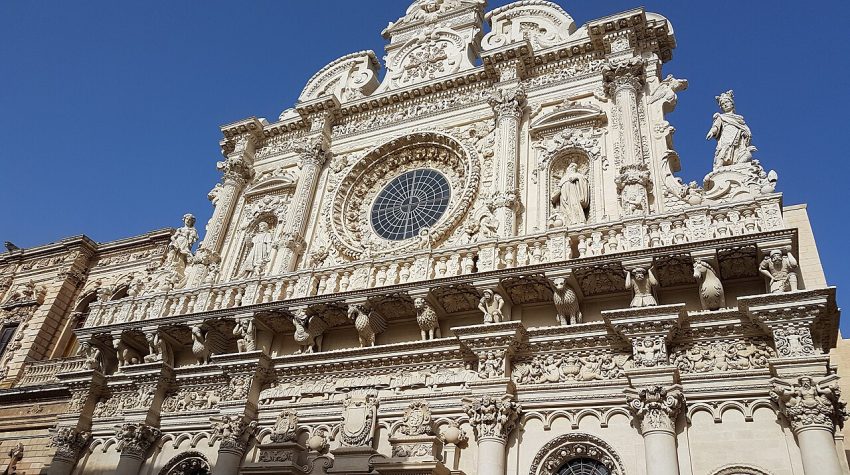
The Basilica di Santa Croce is the defining monument of Lecce Baroque, begun in the late Renaissance period and completed across the 17th century as tastes shifted toward theatrical, surface-rich architecture. It sits on the footprint of earlier religious structures and became a kind of civic-religious showpiece—an announcement of local craftsmanship and patronage power.
Its façade is among the most elaborate in Italy: densely carved stonework, layered columns and niches, and a strong central emphasis anchored by the great rose window. The decoration isn’t random; it’s staged to pull your eye upward and inward, balancing symmetry with a sense of movement and depth.
Inside, focus on how the interior “calms down” relative to the façade, then notice where ornament returns—altars, side chapels, and the handling of light. Outside, step back far enough to take in the full façade, then move closer to appreciate individual carvings that can disappear from a distance.
Location: Basilica di Santa Croce, Via Umberto I, Lecce, Italy
11. Museo Ebraico di Lecce
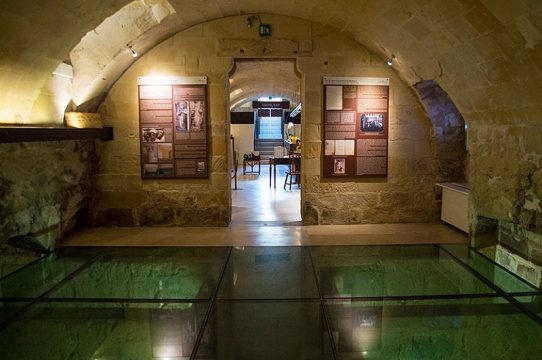
The Lecce Jewish Museum is tied to the story of the city’s medieval Jewish community, which was active in southern Italy’s commercial and cultural networks before expulsions and forced conversions reshaped the region’s demography. The museum’s setting is part of its meaning: it anchors memory in the fabric of the old town rather than treating it as an abstract chapter.
What you’re typically coming for is below street level: spaces associated with domestic and ritual life, often including elements interpreted as part of a mikveh (ritual bath) complex. The experience is intimate compared to Lecce’s grand churches—more about small-scale traces and reconstruction than monumental architecture.
When visiting, take time with interpretive material so the stones don’t feel mute. The value here is context: how a minority community fit into a port-linked economy, how neighborhoods worked, and how later urban layers preserved (and obscured) earlier footprints.
Location: Jewish Museum Lecce, Via Umberto I, Lecce, Province of Lecce, Italy | Hours: Monday – Saturday: 10.00 am – 8:30 pm Sunday: 10:30 am - 1:30 pm | Price: € 9,00 | Website
12. Piazza Sant'Oronzo
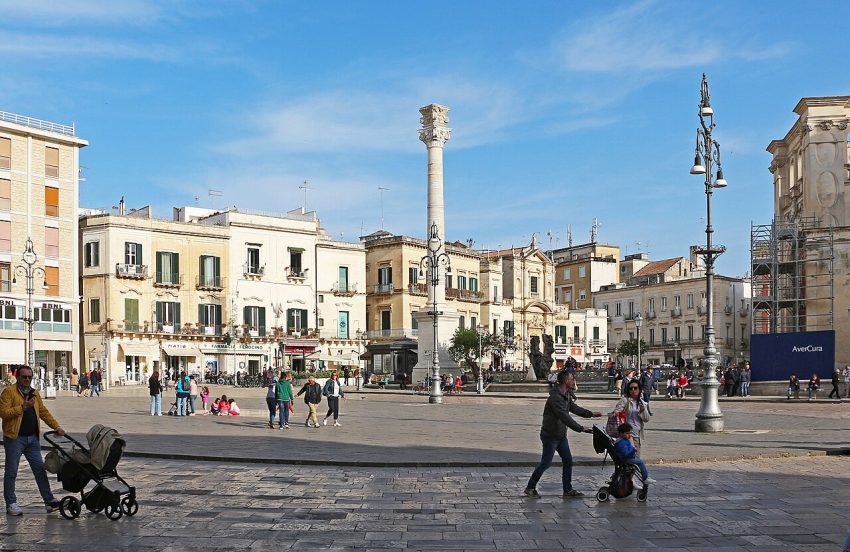
Piazza Sant’Oronzo is Lecce’s public living room, layered over centuries of urban change. The square’s identity ties to Saint Orontius, the city’s patron, but its deeper historical structure is Roman: Lecce’s ancient core still surfaces here in dramatic fragments.
The most striking “what to see” is the exposed portion of the Roman amphitheater embedded into the square’s edge, a reminder that today’s café culture sits on top of an entertainment district built for imperial crowds. Around the piazza, you also read later periods: civic buildings, commemorative elements, and the steady reshaping of public space for ceremony and daily life.
Spend time here at two speeds: fast for orientation, slow for details. Circle the amphitheater viewing areas, then look outward at how modern façades and older civic structures negotiate the square’s geometry. It’s also one of the best places to understand Lecce’s rhythm—morning errands, afternoon pauses, evening passeggiata.
Location: Piazza Sant'Oronzo, Lecce, Province of Lecce, Italy | Hours: Always accessible. | Price: Free
13. Anfiteatro Romano di Lecce
The Roman Amphitheater of Lecce dates to the imperial period, when Roman urban life revolved around mass spectacle—gladiatorial combats, animal hunts, and civic ceremonies staged for thousands. Its survival is partial because later Lecce built over it, which is precisely what makes it compelling: it’s an archaeological “cut” through the living city.
What you see today is a segment of seating and arena perimeter revealed by excavations, with the rest still hidden beneath later streets and buildings. That incompleteness helps you imagine the original scale, while the visible stonework shows the practical engineering of Roman entertainment architecture—tiers, access routes, and the shaping of crowd movement.
On site, use the surrounding piazza as your viewing platform: change angles to understand curvature and depth. If you can, visit at a quieter hour so you can read the structure without the square’s noise; then return later to see how modern Lecce coexists with the ancient footprint.
Location: Roman Amphitheater, Piazza Sant'Oronzo, Lecce, Province of Lecce, Italy
14. Teatro Romano di Lecce
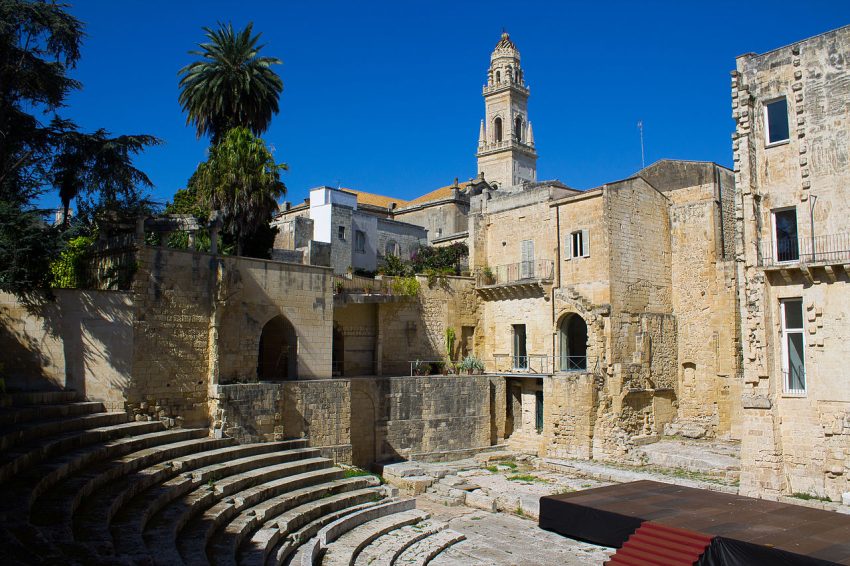
The Teatro Romano di Lecce is a compact but historically significant remnant of the Roman city, dating to the imperial period when towns across the region invested in permanent venues for drama, music, and civic performances. Its survival is the result of both chance and Lecce’s habit of building “over” earlier layers: for centuries the theater sat hidden within the dense medieval and early modern fabric, and only later excavations brought it back into view. That buried-and-revealed story is part of what makes the site useful for understanding Lecce’s long urban continuity rather than treating Roman remains as isolated ruins.
What you see today is the characteristic semicircular cavea (seating) arranged around the performance space, with the most legible elements being the stepped seating tiers and the outline of the stage area. Compared to the nearby amphitheater, which speaks to mass spectacle, the theater is about controlled sightlines and acoustics: a more intimate civic experience designed to focus attention on performers and scripted events. The setting—tucked behind later buildings—also emphasizes how Roman Lecce remains structurally embedded in the modern city plan, not separated from it.
When you visit, spend a minute mapping the geometry: stand where you can see the curve of the seating and imagine the full semicircle continuing beyond what is preserved. Look for how entrances and circulation would have moved audiences into their sections, and note the relationship between the seating and the stage footprint. Because the site is confined, small shifts in position change what you can “read,” so walk the perimeter slowly and use different angles to reconstruct the original scale and the theater’s role within the ancient city.
Location: teatro romano di Lecce, Via Del Teatro Romano, Lecce, Province of Lecce, Italy

Moira & Andy
Hey! We're Moira & Andy. From hiking the Camino to trips around Europe in Bert our campervan — we've been traveling together since retirement in 2020!
This website uses affiliate links which earn a small commission at no additional cost to you.
Walking Tour Summary
Distance: 3 km
Sites: 14
Walking Tour Map