Self-Guided Walking Tour of Alicante (2026)
This website uses affiliate links which earn a small commission at no additional cost to you.
Alicante is a city that rewards walking. It is compact enough to explore at a relaxed pace, but layered enough to feel like you are moving through distinct neighbourhoods every few minutes: palm-lined seafront, elegant 19th-century streets, lively market lanes, and the steep, whitewashed climbs of the old quarter. A self-guided route is ideal here because you can linger where the city feels most alive, pause for a coffee in a shaded plaza, and detour for viewpoints without worrying about schedules.
This walking tour is designed to stitch Alicante's highlights into a practical loop, with plenty of chances to stop for food, photos, and short breaks in the shade. You will pass through the historic heart, where churches and civic buildings sit alongside everyday local life, then work your way toward the areas that define Alicante's sense of place: the waterfront promenades, the castle hill, and the streets where the city's contemporary energy is most visible. If your goal is to cover the best things to see in Alicante in a single day, this approach keeps the route efficient while still feeling unhurried.
Along the way, you will get a strong mix of history and atmosphere: the story of a Mediterranean port shaped by trade and fortification, the view-driven drama of the castle setting, and the simple pleasures that make Alicante easy to enjoy-markets, terraces, and the rhythm of the sea always nearby. Consider starting early to beat the heat and crowds, then finishing later in the day when the light softens and the city shifts into its evening pace.
How to get to Alicante
By Air: Alicante-Elche Airport (ALC) is the main gateway, with extensive domestic and European connections and generally the fastest option if you are coming from outside Spain. From the airport, the easiest transfer is by airport bus to central Alicante (terminating near key downtown stops), or by taxi/ride-hailing if you want a direct door-to-door trip; if you are heading straight to the Old Town or the seafront, public transport usually gets you close enough to walk the final stretch. In peak summer, allow extra time for security queues and for road congestion on the approach to the city. For the best deals and a seamless booking experience, check out these flights to Alicante on Booking.com.
By Train: Alicante is well connected by Spain's rail network, including high-speed services on the Madrid-Alicante corridor and frequent regional trains linking other Valencian and Murcia destinations. Alicante-Terminal station sits close to the centre, so arriving by rail is convenient for a walking-based itinerary: you can typically reach the waterfront, central shopping streets, and many hotels in a short taxi ride or a manageable walk, depending on luggage. For the best fares, booking earlier is usually advantageous, especially around weekends and holiday periods. Train schedules and bookings can be found on Omio.
By Car: Driving to Alicante can be practical if you are combining the city with coastal towns or inland day trips, with major routes such as the AP-7/A-70 connecting you along the Mediterranean corridor. The main drawback is parking: the city centre and Old Town have limited on-street spaces and regulated zones, so a paid underground car park is often the simplest solution, particularly in summer. If your accommodation offers parking, confirm access details in advance, as some central streets have restrictions or tight approaches. If you are looking to rent a car in Spain I recommend having a look at Discover Cars, first, as they compare prices and review multiple car rental agencies for you.
By Bus: Long-distance buses can be a cost-effective alternative, with services linking Alicante to many Spanish cities and regional hubs. The main bus station is generally straightforward for onward local transport, and for budget-focused travellers it can be a sensible option if train times or prices do not suit your schedule. [bus]
Where to Stay in Alicante
To make the most of visiting Alicante and this walking tour, then you should consider staying overnight in the centre. If you want to be able to start early, dip in and out of the Old Town, and finish by the waterfront without relying on taxis, the most practical base is the seafront/Old Town edge around El Postiguet and the Explanada. From here you can walk straight into the historic lanes, reach the main promenades in minutes, and keep the route flexible for heat or crowds. Strong options in this zone include Meliá Alicante for a classic seafront base and Hotel Spa Porta Maris by Meliá for immediate access to the marina and promenades.
If you prefer a more “city-break” feel with shopping streets, cafés, and fast access to transport links, stay in the central Ensanche/Centro area around Avenida Alfonso X El Sabio and the Mercado district. This puts you close to the walkable core while giving you a broader spread of dining and evening atmosphere beyond the Old Town. Consider Eurostars Lucentum for a very central, practical location, and Hospes Amérigo if you want a more boutique-style stay close to key historic streets and the cathedral area.
If your priority is a slightly quieter base with easy access to the castle approach and still within comfortable walking distance of the centre, the area around the Castle of Santa Bárbara foothills and the northern edge of the centre can work well. It is typically calmer at night, but you can still walk into the heart of Alicante quickly, especially if you are comfortable with gentle gradients. A good option here is Hotel Maya Alicante, which is well placed for viewpoints and onward walking routes. If you are arriving by rail or want an easy drive-in/drive-out plan with simpler parking logistics, the station-side/Benalúa edge is often more straightforward; NH Alicante is a practical choice for that style of stay.
The History of Alicante
Ancient origins and the rise of a port city
Alicante’s story begins with its strategic position on the Mediterranean, where successive cultures used the natural harbour and the defensible hill of Benacantil to control trade and movement along the coast. Archaeological evidence around the mountain points to very early occupation, but the city’s enduring “icon” is Santa Bárbara Castle, whose origins are commonly dated to the 9th century during Muslim rule, when the hilltop was fortified to command the bay and the surrounding approaches.
Medieval Alicante and the Christian reconquest
In the medieval period, Alicante developed as a walled settlement shaped by the frontier politics of eastern Iberia. Santa Bárbara Castle changed hands in the 13th century and was later rebuilt and strengthened under successive rulers, reflecting both its military value and the city's growing importance as a coastal stronghold. In the Old Town, the medieval street pattern still frames small squares and lanes around the Square of the Most Holy Face, which sits beside the civic heart of the city near the Town Hall-an area where religious processions, local ceremonies, and everyday city life have overlapped for centuries.
Early modern faith and civic power
From the 14th to 16th centuries, Alicante's oldest active church, the Basilica of Santa María, rose in Valencian Gothic style on the site of the former mosque, anchoring the medieval core with a building that later gained prominent Baroque elements. In the 17th century, the Co-cathedral of Saint Nicholas of Bari was built over an earlier mosque between 1613 and 1662, designed by Agustín Bernardino, and its sober exterior and domed crossing remain one of the clearest architectural statements of early modern Alicante. This same era gradually formalised Alicante's urban identity as a port city with stronger institutions and a more monumental public realm.
An 18th-century city and a 20th-century makeover
In the 18th century, Alicante's civic centre took on the confident Baroque face you see today at Alicante Town Hall, an 18th-century building credited to architect Lorenzo Chápuli, with its principal façade and ceremonial interiors marking the city's administrative consolidation. The early 20th century then added a second layer of landmark architecture: Alicante's Central Market was designed in 1915 by Francisco Fajardo Guardiola and completed in the early 1920s under Juan Vidal Ramos, while Casa Carbonell-also by Juan Vidal Ramos, built in the 1920s for textile entrepreneur Enrique Carbonell-became a defining presence along the seafront promenade. Together they capture a period when Alicante's commercial confidence and urban growth were being expressed in stone, iron, and modernist detail.
The seafront city you walk today
Alicante’s modern identity is inseparable from its waterfront. The Explanada de España, running beside the port, evolved into a signature promenade and later took its present name in the 20th century, with major remodelling plans in the mid-century as the seafront became a larger civic stage for locals and visitors. Rambla Méndez Núñez acts as a key urban spine linking the port area toward the Central Market and marking the transition between the older fabric and the newer city, which is why it often feels like the “hinge” street when you explore on foot. The result is a city where the walkable highlights are not confined to one period: medieval lanes, early modern churches, Baroque civic grandeur, and early-20th-century statement buildings all sit within an easy stroll of the sea.
Your Self-Guided Walking Tour of Alicante
Discover Alicante on foot with a walking tour map that guides you between each stop as you explore its palm-lined seafront, castle viewpoints, historic quarters, and everyday local life. This route follows the city's layered story as a Mediterranean port shaped by trade, fortification, and long centuries of cultural change, moving from Old Town lanes and landmark squares to waterfront promenades and panoramic lookouts. With most highlights concentrated within an easy walk, Alicante's mix of sea air, lively streets, and hilltop drama makes it simple to cover the city's essentials in one well-paced loop.
1. Casa Carbonell
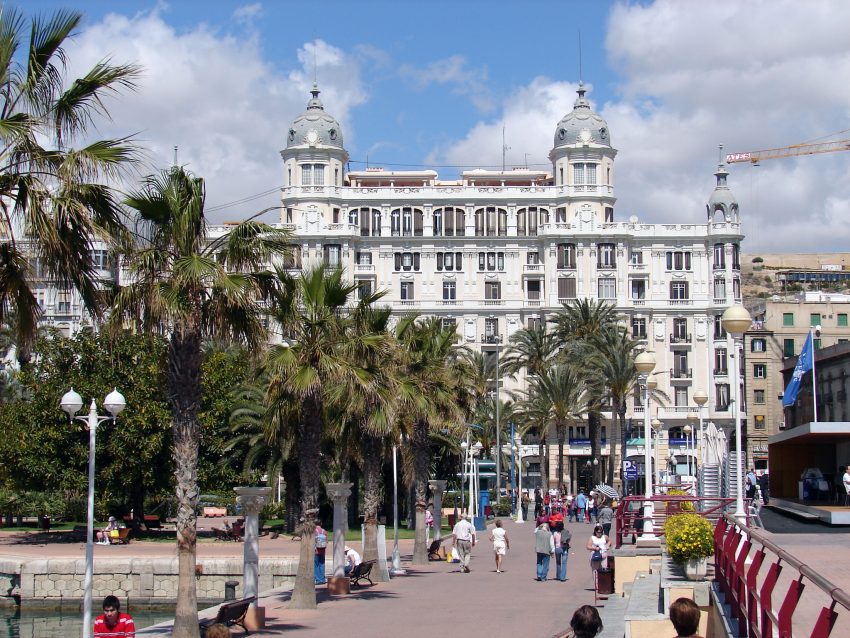
Casa Carbonell, sitting prominently along Alicante’s seafront, is one of the city’s best-known early 20th-century buildings and a symbol of the period when Alicante projected modernity through elegant, European-influenced urban design. Commissioned by a wealthy owner and designed to be both prestigious and visible, it reflects the era’s taste for ornate façades and grand residential-commercial architecture along prime coastal promenades. Its enduring fame comes from exactly that intention: it was built to be noticed.
What to see now is primarily the exterior. The façade’s decorative detailing, balconies, and overall composition stand out against the openness of the waterfront setting, making it one of Alicante’s classic photo backdrops. It is also a useful marker for understanding how the city’s relationship with the sea evolved—from purely working port functions to leisure-oriented promenading and civic display.
For visitors, Casa Carbonell is best treated as a “pause point” on the Explanada. Stop for photos, then use it as a cue to slow down and enjoy the promenade properly: a long walk, a café stop, and a sense of Alicante’s everyday coastal rhythm. If you are interested in architecture, it pairs well with a broader look at the city’s modernist and early 20th-century building stock around the central avenues.
Location: Passeig Esplanada d'Espanya, 1, 03002 Alacant, Alicante, Spain | Hours: 24 Hours. | Price: Free.

2. Alicante Town Hall
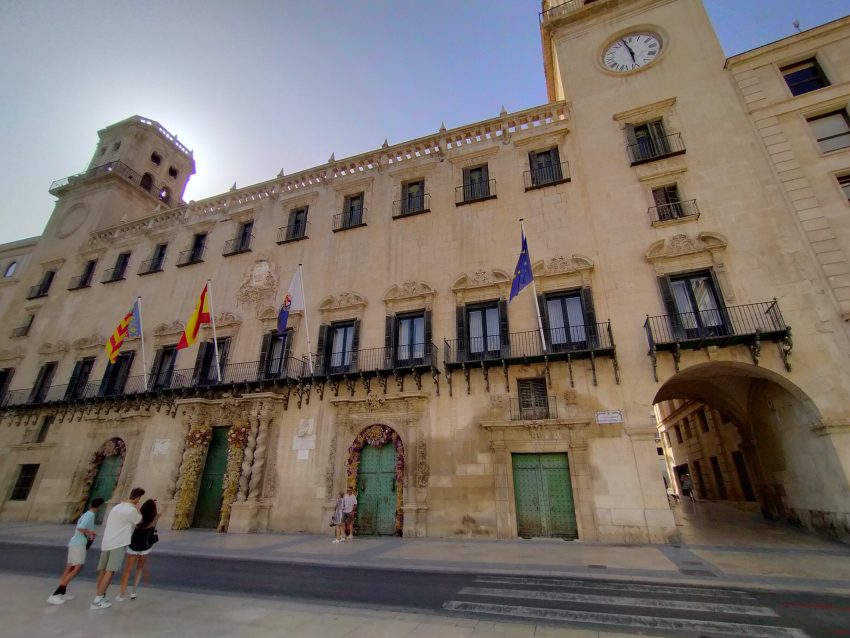
Alicante Town Hall is a statement of civic identity, representing the era when Spanish cities expressed authority and pride through imposing municipal architecture. Its construction and later embellishments reflect Alicante’s growth as a port city and administrative centre, where power and commerce needed a public face. Even if you are not an architecture specialist, the building communicates what it was meant to communicate: stability, order, and an institutional presence at the heart of the old town.
Today, it is one of the most straightforward “walk-by and understand the city” stops in Alicante. The façade and the plaza setting make it easy to appreciate as part of the urban scene—an anchor point that helps you orient yourself as you move between church sites, small squares, and lanes leading toward the waterfront. If the building is open for visitors, stepping inside can add texture with ceremonial spaces and period details that show how civic life was staged.
As part of a route, pair it with the Basilica of Santa María and the nearby old-town squares for a compact cluster that blends civic and religious history. It is also a good spot for a short break, because the surrounding area tends to have nearby cafés and a comfortable “linger” atmosphere that suits slow travel.
Location: Plaça de l'Ajuntament, 1, 03002 Alacant, Alicante, Spain | Hours: (October – June) Monday – Friday: 09:00–14:00. Closed on Saturday, Sunday. (July – September) Monday – Friday: 09:00–13:00. Closed on Saturday, Sunday. | Price: Free. | Website
3. Basilica of Santa María
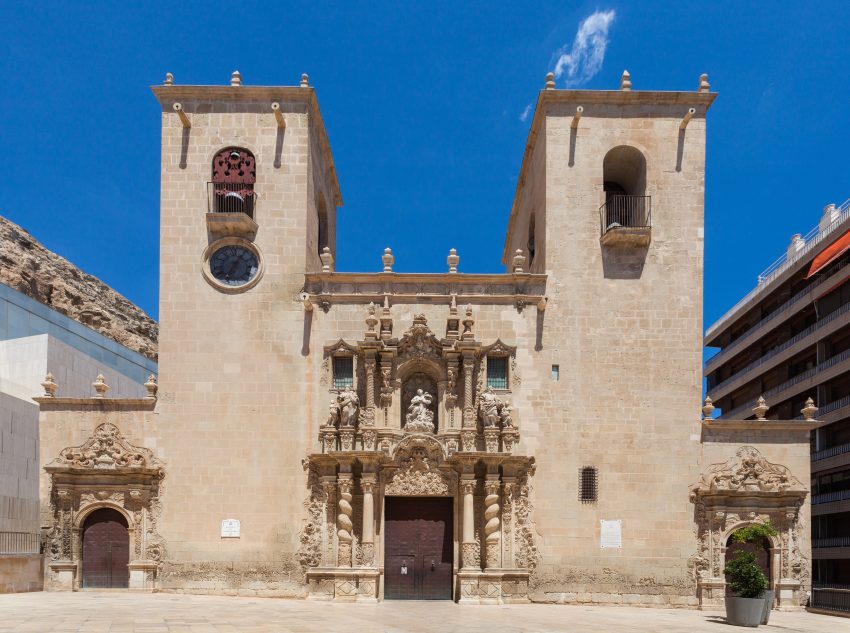
The Basilica of Santa María is often described as Alicante’s oldest active church, rooted in the city’s medieval transformation after Christian conquest. Built on the site of a former mosque, it carries that layered Iberian story of religious continuity and urban redefinition. Over time, elements were added or modified, reflecting evolving tastes and liturgical priorities, which is why the building can feel like a composite of periods rather than a single “pure” style.
What stands out now is the sense of age and material presence. Look for stonework details and the way the façade and interior elements reflect different phases of construction. The church’s atmosphere tends to be more intimate than a cathedral, making it a good stop if you like spaces that feel rooted and slightly quieter, where you can appreciate small altars, devotional corners, and the softness of interior light.
To visit well, treat it as a short but intentional pause on an old-town circuit. Pair it with the Town Hall and nearby lanes, and consider stopping when you need a break from sun and noise. If you enjoy photography, the best shots often come from exterior angles that include surrounding streets, because they situate the basilica within the tight urban fabric that gives Alicante’s old town its character.
Location: Pl. Sta. María, 1, 03001 Alicante (Alacant), Alicante, Spain | Hours: Monday – Saturday: 10:00–19:00. Sunday: 13:00–19:00. | Price: Adults (18–64): €6; Seniors (65+): €5; Youth/Students: €4; Under 12: free (with an adult). | Website
4. Santa Bárbara Castle
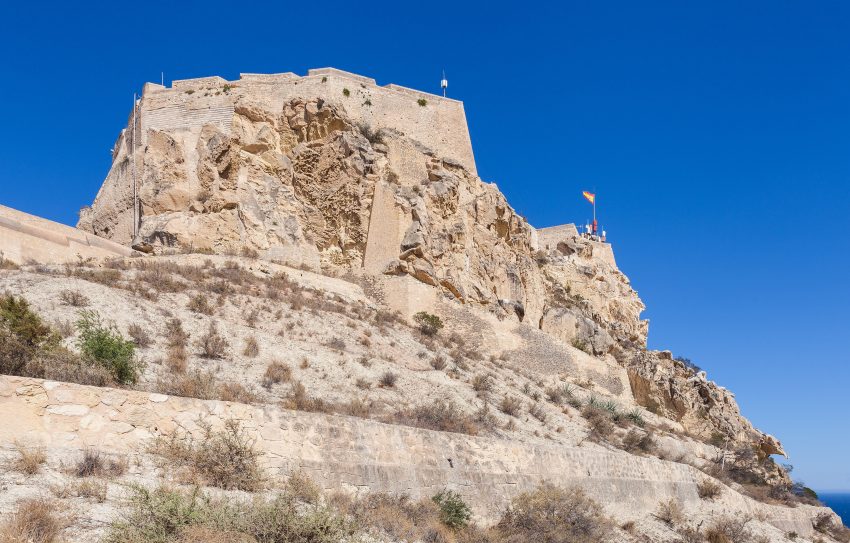
Perched on Mount Benacantil, Santa Bárbara Castle is the defining silhouette of Alicante and one of the largest medieval fortifications in the region. The site’s strategic value goes back far earlier than the castle you see today: the hill was used in antiquity, and the fortifications were substantially developed under Islamic rule before later Christian expansion reshaped it after the Reconquista. Over the centuries it was repeatedly modified to match new military realities, leaving a layered complex where bastions, courtyards, and artillery platforms reflect different eras of siege warfare and coastal defence.
Walking the castle now is essentially a self-guided journey through Alicante’s military geography. Start with the upper levels for the broadest panoramas over the port, beaches, and the old town, then work your way down through the terraces and defensive lines to appreciate how the complex is organised. The viewpoints are the main event, but the real reward comes from noticing the small details—thick walls, angled ramparts, and the way the architecture is designed to control movement and sightlines.
To get the most out of a visit, time it to match the light: mornings are crisp and clear, while late afternoon is ideal for warmer tones over the harbour and city. If you want minimal effort, use the lift access where available, and if you prefer the “earned view,” take one of the climbing paths from the old town. Either way, budget enough time to linger at the viewpoints and walk multiple levels, because the castle reads differently from each terrace.
Location: Castillo de Santa Bárbara, 03002 Alicante (Alacant), Alicante, Spain | Hours: (November 15 – February 27) Monday – Sunday: 10:00–18:00. (February 28 – June 16) Monday – Sunday: 10:00–20:00. (June 17 – September 4) Monday – Sunday: 10:00–23:00. (September 5 – November 14) Monday – Sunday: 10:00–20:00. | Price: Free entry; lift: €2.70. | Website
5. Alicante’s Central Market
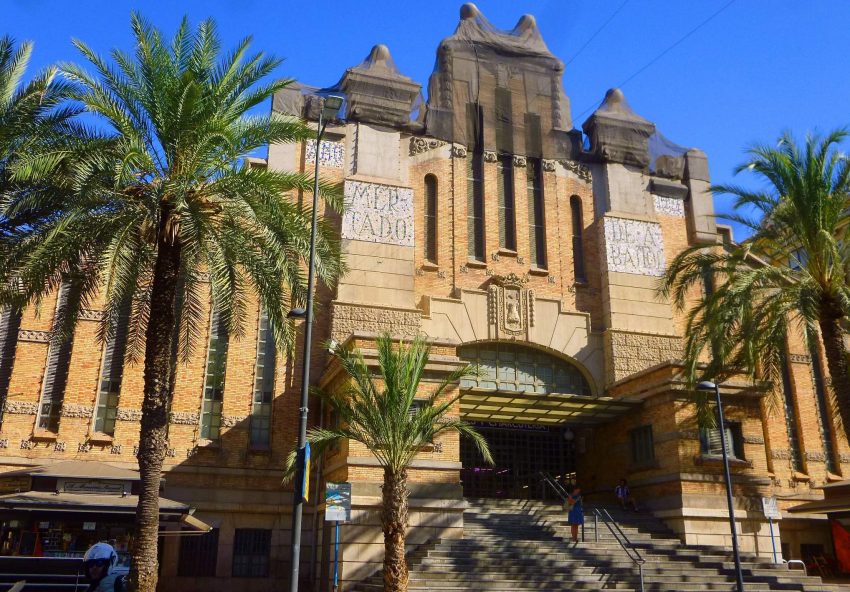
Alicante’s Central Market (Mercado Central) is both a daily-use food market and a snapshot of early 20th-century civic pride, built to formalise and modernise the city’s traditional trading culture. The building’s architecture reflects the era when European cities invested in grand public markets as symbols of hygiene, order, and prosperity—functional spaces designed to serve the whole city, but also to impress. Like many Spanish markets, it has remained a social institution as much as a retail one, linking local agriculture, fishing, and household routines to the rhythms of the city centre.
Visiting now is an easy way to understand Alicante beyond monuments. Inside, you’ll typically find stalls built around the essentials: seasonal produce, cured meats, cheeses, olives, spices, and seafood that reflects the city’s Mediterranean identity. It is the best place to see what is in season, pick up picnic supplies, and get a practical sense of local eating habits—what people cook, what they snack on, and what they buy daily versus occasionally.
The best approach is to go earlier in the day when the market is busiest and the selection is at its peak. If you are doing a walking itinerary, use the market as your “flavour stop” between churches and museums—quick enough to fit into a schedule, but memorable because it engages the senses. Even if you do not buy much, a short loop through the aisles gives you a grounded, lived-in counterpoint to Alicante’s more photogenic waterfront and castle views.
Location: Av. Alfonso El Sabio, nº 10, 03004 Alicante (Alacant), Alicante, Spain | Hours: Monday – Friday: 07:00–14:30. Saturday: 07:00–15:00. Closed on Sunday. | Price: Free. | Website
6. Rambla Méndez Núñez
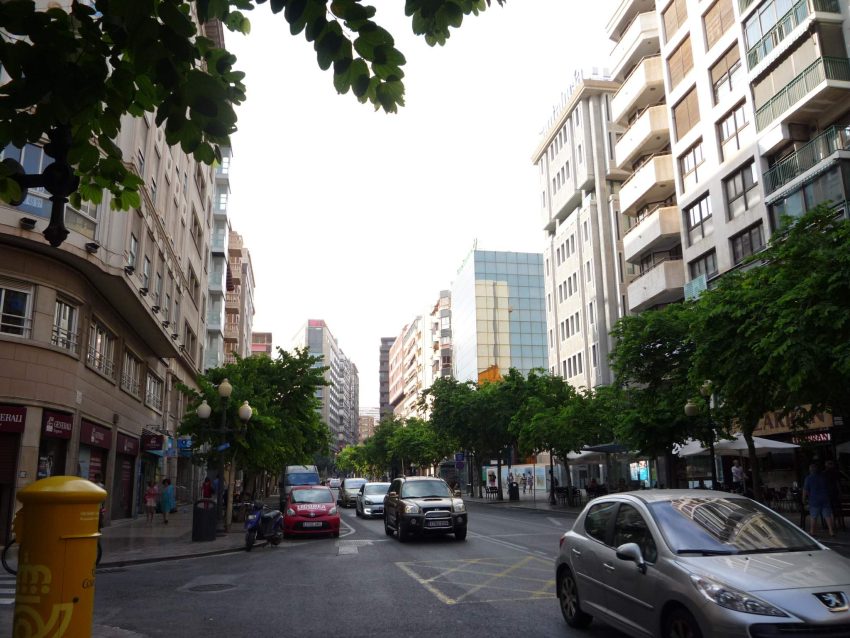
Rambla Méndez Núñez is one of Alicante’s key city-centre arteries, shaped by the Mediterranean tradition of broad promenades that channel movement, shade, and social life through an urban core. The “rambla” concept often traces older watercourses or drainage routes that were later urbanised, and over time these corridors became natural stages for parades, public gatherings, and everyday strolling. In Alicante, the Rambla’s role is to connect districts and attractions while maintaining that distinctly Spanish rhythm of walking, pausing, and watching the city move.
Today, the Rambla is less about a single landmark and more about how Alicante functions day to day. It is a practical route between the old town, shopping areas, and the waterfront zone, lined with cafés, kiosks, and the kind of city infrastructure that makes strolling comfortable—benches, shade patches, and frequent cross-streets that pull you toward side attractions. It is also a strong place to notice Alicante’s architectural mix, where civic buildings and apartment façades reflect different phases of growth.
For visitors, the Rambla works best as a “connector with benefits.” Use it to stitch together stops—Central Market, the old town streets, and the Explanada—without feeling like you are simply transiting. If you time it for early evening, it becomes part of the city’s social theatre, when locals head out and the street feels more like a living room than a road.
Location: Rbla. de Méndez Núñez, Alicante (Alacant), Alicante, Spain | Hours: 24 Hours. | Price: Free.
7. Co-cathedral of Saint Nicholas of Bari
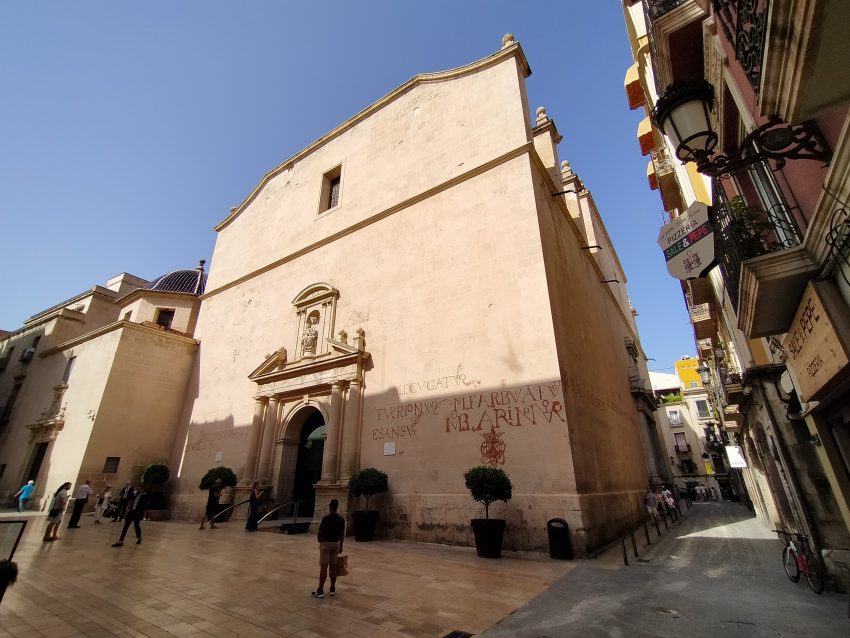
The Co-cathedral of Saint Nicholas of Bari is one of Alicante’s most important religious monuments, anchored in the city’s post-Reconquista development and later shaped by the architectural languages of the Counter-Reformation era. Built on the site of an earlier mosque, it reflects the common Iberian pattern of sacred continuity: new Christian structures rising where Islamic ones stood, both to serve the growing city and to formalise a new religious and civic identity. Its design, combining sober exterior lines with a more expressive interior, speaks to a period when churches were expected to be both doctrinally clear and visually persuasive.
Inside, the cathedral’s spatial drama becomes more apparent. Look for the proportions of the nave, the dome, and the way chapels and altarpieces punctuate the interior with bursts of ornament. Even if you are not deeply interested in church art, the building rewards attention because it is a calm, cool counterpoint to Alicante’s bright streets, and it offers a concentrated lesson in how Spanish religious architecture balances restraint with emphasis.
A strong way to include it now is as an old-town anchor stop: visit, step back out into the lanes, and then continue to nearby squares for a café break. If you can, time your visit for a quieter window so you can appreciate the acoustics and the “stillness” effect that these spaces were designed to create. It is not a long visit, but it adds cultural depth to a route that might otherwise focus on viewpoints and promenades.
Location: Plaza de, Pl. del Abad Penalva, 2, 03002 Alicante (Alacant), Alicante, Spain | Hours: Monday – Friday: 07:30–13:00 & 17:30–20:00. Saturday: 08:30–13:00 & 17:30–20:30. Sunday: 08:30–13:30 & 17:30–20:30. | Price: Church entry: Free. Cultural/audioguided visit (cloister + upper areas + bell tower): €8. | Website
8. Explanada de España
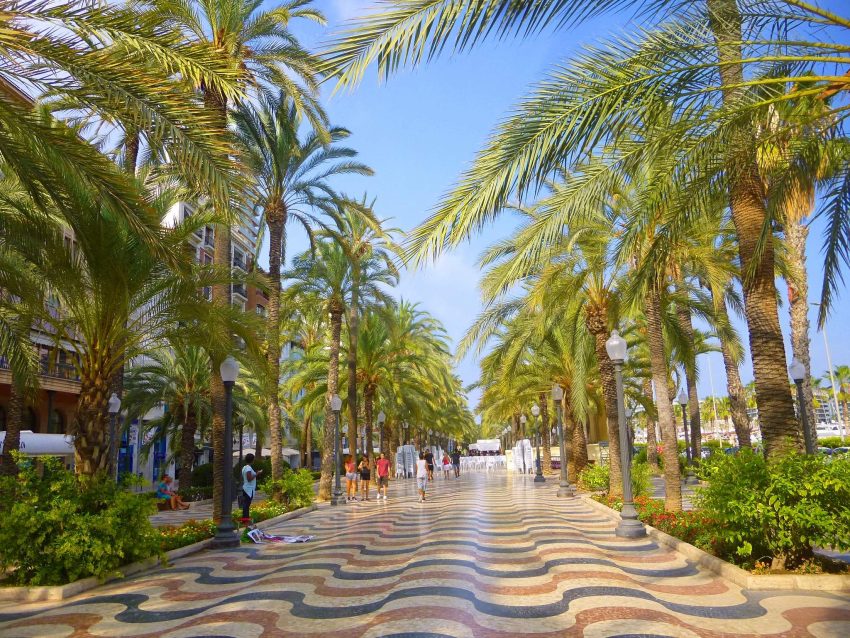
The Explanada de España is Alicante’s signature promenade and the city’s most recognisable public space, designed for strolling by the marina with a distinctly Mediterranean sense of leisure. Its famous wave-pattern mosaic and palm-lined layout reflect an urban ideal: the waterfront as an everyday living room, where locals and visitors share the same slow rituals—walking, talking, people-watching, and pausing for coffee or ice cream. Historically, promenades like this formalised the city’s relationship with the sea, turning the port edge into civic space rather than purely functional infrastructure.
What to do now is intentionally simple, and that is the point. Walk the full length rather than treating it as a photo stop, because the Explanada works as an experience of pacing and atmosphere. You will often find market stalls, street performers, and small events that change the feel of the promenade depending on season and time of day. It is also one of the best places in Alicante to “do nothing well,” which is a legitimate travel skill.
For itinerary planning, use the Explanada as your connector between the old town cluster and the harbour zone. It works well as a morning start, a midday reset, or an evening wind-down, and it pairs naturally with nearby architecture like Casa Carbonell. If you time it for sunset, the light over the marina and palm silhouettes makes even a simple walk feel like a highlight.
Location: Passeig Esplanada d'Espanya, Alacant, Alicante, Spain | Hours: 24 Hours. | Price: Free.

Moira & Andy
Hey! We're Moira & Andy. From hiking the Camino to trips around Europe in Bert our campervan — we've been traveling together since retirement in 2020!
This website uses affiliate links which earn a small commission at no additional cost to you.
Walking Tour Summary
Distance: 4 km
Sites: 8