Warsaw Uprising Monument
Monument in Warsaw
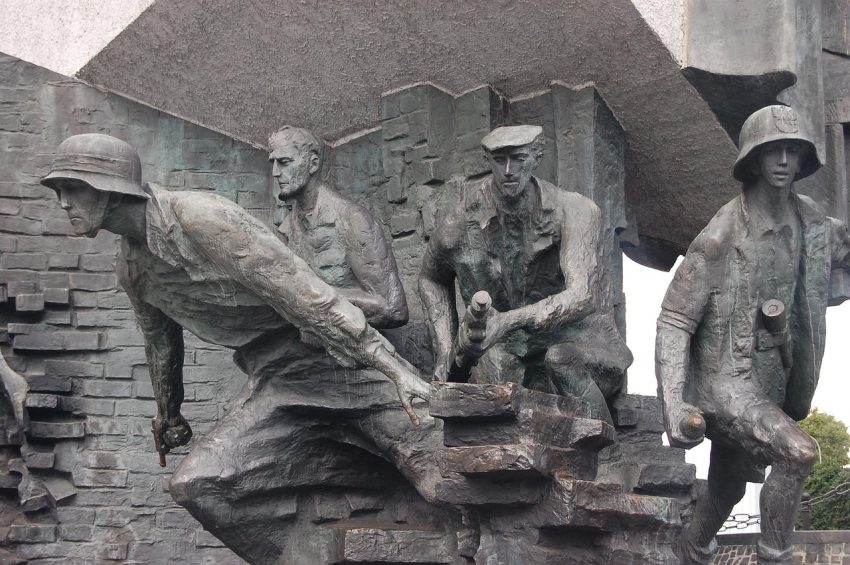
The Warsaw Uprising Monument (Pomnik Powstania Warszawskiego) is one of those places in Warsaw that stops you mid-walk. Set on the southern edge of Krasiński Square, right in front of the Supreme Court complex, it's an open-air memorial that feels less like a statue and more like a scene frozen in motion-insurgents surging forward, the city breaking around them, and the terrible stakes written into every detail.
Even if you're following a relaxed walking tour of Warsaw, this is one of the must-see places in Warsaw because it anchors the city's WWII story in a way museums and plaques can't quite replicate. You don't need to “do” anything here beyond slow down, circle both sculpture groups, and let the composition tell its story-heroism, fear, urgency, and the brutal reality of street-by-street fighting.
Table of Contents
- History and Significance of the Warsaw Uprising Monument
- Things to See and Do in the Warsaw Uprising Monument
- How to Get to the Warsaw Uprising Monument
- Practical Tips on Visiting the Warsaw Uprising Monument
- Where to Stay Close to the Warsaw Uprising Monument
- Is the Warsaw Uprising Monument Worth Visiting?
- For Different Travelers
- FAQs for Visiting Warsaw Uprising Monument
- Nearby Attractions to the Warsaw Uprising Monument
History and Significance of the Warsaw Uprising Monument
The monument commemorates the Warsaw Uprising of 1944, when the Polish underground Home Army launched an attempt to liberate the capital during the final, chaotic phase of German occupation. The fighting lasted from 1 August to 2 October 1944 and ended in catastrophe for the city and its people, followed by systematic destruction and looting as Warsaw was emptied and levelled.
For decades after the war, public commemoration of the uprising was politically fraught, and the story of the Home Army was pushed aside in official narratives. The fact that the monument was only realised late in the communist period-and unveiled on 1 August 1989-matters, because it explains why this site feels like both a memorial and a reclaiming of memory in public space.
Designed by architect Jacek Budyń and sculpted by Wincenty Kućma, the Warsaw Uprising Monument is often treated as a key post-war landmark in the city's memorial landscape. Its realism is deliberate: rather than abstract mourning, it chooses dramatic immediacy, pulling the events of 1944 into the present tense for anyone who stands in front of it.
Things to See and Do in the Warsaw Uprising Monument
Start with the larger sculptural group: insurgents burst from the suggestion of a collapsing structure, weapons raised, bodies leaning forward as if the next step might spill into the square. The scale and staging make it feel cinematic, and the best way to read it is to move slowly from left to right, noticing how faces, hands, and posture communicate exhaustion and determination more than triumph.
Then walk to the smaller group near the manhole-arguably the most haunting element of the entire memorial. Here, the figures slip underground, referencing the sewers used for movement and survival during the uprising, including evacuations from the Old Town area. It’s a powerful reminder that Warsaw’s wartime “routes” were often hidden, claustrophobic, and desperate.
Finally, look outward to the setting itself. The monument's position near the Field Cathedral of the Polish Army and the wider Krasiński Square area makes it easy to combine with a reflective loop through the Old Town edge and Muranów, especially if you're building a day around Warsaw's remembrance sites rather than ticking off landmarks at speed.
How to Get to the Warsaw Uprising Monument
The monument sits in Krasiński Square (plac Krasińskich) in central Warsaw, on the edge of the Old Town and within easy reach of Śródmieście and Muranów, so it's often simplest to arrive on foot as part of a city-centre walk.
If you're flying in, the closest airports are Warsaw Chopin Airport (WAW) and Warsaw Modlin Airport (WMI). For the best deals and a seamless booking experience, check out these flights to Warsaw on Booking.com.
If you’re arriving by rail, start from Warszawa Centralna and continue by tram/metro plus a short walk, or take a direct taxi if you’re short on time. You can easily check schedules and book tickets through the PKP Intercity website. However, for a smoother experience, we recommend using Omio, which simplifies the booking process and lets you compare prices and schedules all in one place.
By bus and tram, aim for stops around the Old Town edge and Muranów/Śródmieście corridors, then walk the last stretch into Krasiński Square where the monument opens up in front of you.
If you’re travelling by car, it’s usually easiest to park in a paid city-centre garage and treat this as a walk-up stop rather than trying to pull up directly beside the square. If you are looking to rent a car in Poland I recommend having a look at Discover Cars, first, as they compare prices and review multiple car rental agencies for you.
Practical Tips on Visiting the Warsaw Uprising Monument
- Entrance fee: Free
- Opening hours: 24 Hours
- Best time to visit: Early morning is best if you want space to take in the details; late afternoon works well if you’re pairing it with a longer Old Town walk.
- How long to spend: Plan for 15-30 minutes for a meaningful visit, or longer if you’re stopping for photos and context-reading.
- Accessibility: The square is generally flat and walkable, but surfaces can be uneven around steps and curbs, so take it slowly if you have mobility constraints.
- Facilities: There are no dedicated on-site visitor facilities, so treat this as an outdoor stop and use nearby cafés and public amenities in the city centre.
Where to Stay Close to the Warsaw Uprising Monument
For a culture-heavy itinerary, base yourself in the Old Town/Śródmieście area so you can walk to major historic sights, while a Nowy Świat-Centrum base suits nightlife and fast transport connections.
If you want to be close enough to weave the monument into early-morning or evening walks, Hotel Bellotto places you right on the Old Town edge with an easy stroll to Krasiński Square. Hotel Bellotto For a classic, central stay with strong links to the wider city, Sofitel Warsaw Victoria is a dependable option near key routes and parks. Sofitel Warsaw Victoria And if you’re prioritising value and convenience near the Old Town/Muranów side, ibis Warszawa Stare Miasto is practical, straightforward, and well-positioned for walking days. ibis Warszawa Stare Miasto
Is the Warsaw Uprising Monument Worth Visiting?
Yes-especially if you want to understand Warsaw beyond its reconstructed beauty. The monument compresses the uprising's story into a single, unforgettable visual narrative, and it gives emotional weight to the dates and facts you'll encounter elsewhere.
It's also a high-impact stop that doesn't demand much time or planning, which makes it easy to include even on a tight itinerary. If you visit just one WWII memorial in central Warsaw outside a museum setting, this is an excellent choice.
What Other Travellers Say...

The Warsaw Uprising Monument on plac Krasinskich in central Warsaw is a landmark bronze memorial honoring the sacrifice of anti‑Nazi resistance fighters in the 1944 uprising; visitors describe it as a powerful, jaw‑dropping and artistically striking tribute—open and accessible without tickets—situated adjacent to the Polish Supreme Court, with columns bearing inscriptions and nearby ground markings indicating the path of the old ghetto walls for those who explore to the left of the monument.


For Different Travelers
Families with Kids
For younger kids, treat this as a short, calm stop: describe what they’re seeing in simple terms (a city in danger, people helping each other, a hidden route underground) and keep the focus on empathy rather than graphic detail. A quick “spot the different figures” walk-around can help them engage without being overwhelmed.
For older kids and teens, this is a strong place to talk about choices, courage, and consequences, especially if you connect it to broader Warsaw history you'll encounter in the Old Town and museum districts. If you're planning a deeper learning day, pair it with a visit that adds context through exhibits and personal stories.
Couples & Romantic Getaways
This isn’t a “romantic” attraction in the usual sense, but it can be a meaningful shared stop-particularly early in the day, when the square is quiet and you can take it in without distraction. It’s the kind of place that shifts a trip from sightseeing to understanding.
Afterward, it’s easy to reset the mood with a gentle walk toward the Old Town streets or a café break nearby. If you enjoy travel that mixes beauty with substance, this stop adds depth to a couple’s city itinerary.
Budget Travelers
The monument is ideal for budget itineraries because it's high-value, central, and doesn't require paid entry-perfect for building a powerful walking day through Warsaw. If you're pacing costs, make this part of a DIY route that includes free viewpoints, parks, and historic streets.
To keep the day efficient, plan the stop between neighbourhoods you’re already covering, rather than making a special detour. It also pairs well with low-cost local eats nearby, so you can keep the schedule full without inflating your spend.
FAQs for Visiting Warsaw Uprising Monument
Getting There
Tickets & Entry
Visiting Experience
Tours, Context & Itineraries
Photography
Accessibility & Facilities
Food & Breaks Nearby
Safety & Timing
Nearby Attractions to the Warsaw Uprising Monument
- Krasiński Garden: A peaceful city park nearby that's ideal for a reset after a heavy memorial stop.
- Warsaw Old Town: The UNESCO-listed historic core, rebuilt with remarkable precision and full of walkable lanes and viewpoints.
- Royal Castle in Warsaw: A major landmark and museum that adds context to Warsaw's political and cultural history.
- POLIN Museum of the History of Polish Jews: A world-class museum exploring centuries of Jewish life in Poland, not far from Muranów.
- Warsaw Rising Museum: The essential deep-dive into the 1944 uprising through immersive exhibits and personal stories.
The Warsaw Uprising Monument appears in our Complete Guide to Visiting Warsaw!

Moira & Andy
Hey! We're Moira & Andy. From hiking the Camino to trips around Europe in Bert our campervan — we've been traveling together since retirement in 2020!
This website uses affiliate links which may earn a commission at no additional cost to you!
Planning Your Visit
24 Hours
Free
Nearby Attractions
- Field Cathedral of the Polish Army (0.1) km
Cathedral - Warsaw Ghetto Boundary Markers (0.1) km
Historic Site - Krasiński Palace (0.1) km
Palace - Krasiński Garden (0.3) km
Gardens - Mały Powstaniec, Little Insurgent Monument (0.3) km
Monument - Maria Skłodowska-Curie Museum (0.3) km
Museum - Warsaw Barbican (0.3) km
Castle - Jan Kiliński Monument (0.4) km
Monument - Old Town Market Square (0.4) km
Square - Mermaid of Warsaw (0.4) km
Statue