The Death Railway, Kanchanaburi
Railway near Kanchanaburi

Built during World War II, the Thailand-Burma Railway, often called the Death Railway, is a poignant reminder of human endurance and suffering. It is said that one life was lost for every sleeper laid along the track. The railway, restored after the war, still operates passenger services up to Nam Tok, north of Kanchanaburi. Its most iconic section is the Bridge on the River Kwai, which attracts visitors from around the world. While the railway beyond Nam Tok no longer exists, significant locations such as Hellfire Pass have been preserved as historical sites. These areas, accessible via tours, provide insights into the railway's construction and its critical role in World War II. Enthusiasts can also spot old locomotives outside Kanchanaburi and River Kwai stations, a tribute to the railway's enduring legacy.
The Building of the Death Railway
The railway was built between Nong Pladuk in Thailand (50 km southeast of Kanchanaburi) and Thanbyuzayat in Burma, spanning approximately 415 km. Construction began in June 1942 and was completed in just 15 months. Over 60,000 Allied POWs and 180,000 forced laborers from across Asia were subjected to brutal conditions, with more than 90,000 laborers and 16,000 POWs dying from disease, malnutrition, and mistreatment.
Wang Po Viaduct
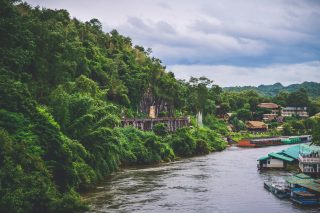
One of the most striking sections of the railway is the Wang Po viaduct, a series of wooden trestles curving alongside cliffs with the river flowing below. Taking a train journey along this stretch offers breathtaking views of Kanchanaburi's countryside, but it also serves as a somber reminder of the unimaginable hardship faced by the men who built it. Many lost their lives during the construction of this section, making it one of the most tragic parts of the Death Railway's history.
Hellfire Pass
While the passenger railway ends at Nam Tok, a short 20-minute drive leads to the historic Konyu Cutting, famously known as Hellfire Pass. This stretch of the Death Railway was an immense challenge for the POWs and forced laborers who carved through solid rock and dense jungle to create openings and embankments. Hellfire Pass, the longest of these cuttings, earned its haunting name from the fires that illuminated the night, enabling relentless, around-the-clock construction.
Today, thanks to the efforts of a dedicated Australian-Thai volunteer group, Hellfire Pass has been transformed into a moving memorial walk. Visitors can explore the preserved cutting and reflect on its history, with an informative museum located at the entrance providing context to the hardships endured during its creation.
What Other Travellers Say...

Hellfire Pass (Konyu Cutting), Thai-Burma Death Railway, is a preserved wartime memorial and walking site in Kanchanaburi where Allied prisoners were forced to cut a railway pass; the reception area shows a film about its history and provides audio guides and headsets to follow interpretive information along two marked trails (a short blue route and a longer green route), with radios issued for those on the long walk and staff checking for safety; entry is free and donations are welcome, the site is easy to reach from the road between Kanchanaburi and Sangkhlaburi and is described by visitors as moving, well maintained, and respectfully presented.


The The Death Railway appears in our Complete Guide to Visiting Kanchanaburi!

Moira & Andy
Hey! We're Moira & Andy. From hiking the Camino to trips around Europe in Bert our campervan — we've been traveling together since retirement in 2020!
This website uses affiliate links which may earn a commission at no additional cost to you!
Planning Your Visit
Nearby Attractions
- Hellfire Pass (0) km
Walk - Erawan Waterfall (23.0) km
Waterfalls - Elephant’s World Sanctuary (50.3) km
Animal Sanctury - Bridge on the River Kwai (72.3) km
Bridge - JEATH War Museum (72.4) km
Museum - Thailand–Burma Railway Centre (74.8) km
Museum - Kanchanaburi War Cemetery (74.9) km
Cemetery - Wang Po Viaduct (76.0) km
Railway - Tiger Cave Temple, Wat Tham Sua (86.8) km
Buddhist Temple - Damnoen Saduak Floating Market (146.4) km
Market