Terrace of the Elephants, Siem Reap
Historic Site in Siem Reap
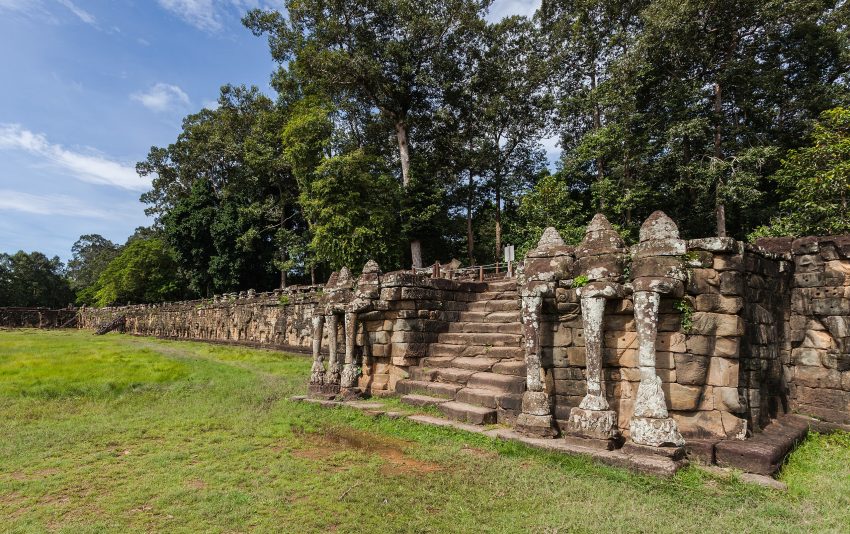
Set inside the walled city of Angkor Thom, the Terrace of the Elephants is a long ceremonial platform that feels made for wandering: a raised stone stage lined with carvings, facing the open square where crowds once gathered for royal processions. It is one of those Angkor stops that works even if you are “templed out,” because the experience is more about the rhythm of walking along the reliefs than standing still in one sanctuary.
The terrace's fame comes from its elephant procession carvings and the sense of scale-this is not a small decorative panel, but a major piece of civic theatre in stone. Positioned near the Royal Palace area (including Phimeanakas), it also sits naturally on the classic Angkor Thom route, making it an easy, high-reward detour between bigger headline temples.
Table of Contents
- History and Significance of the Terrace of the Elephants
- Things to See and Do in the Terrace of the Elephants
- How to Get to the Terrace of the Elephants
- Practical Tips on Visiting the Terrace of the Elephants
- Where to Stay Close to the Terrace of the Elephants
- Is the Terrace of the Elephants Worth Visiting?
- For Different Travelers
- FAQs for Visiting Terrace of the Elephants
- Nearby Attractions to the Terrace of the Elephants
History and Significance of the Terrace of the Elephants
The Terrace of the Elephants dates to Angkor's great city-building period and is closely associated with Jayavarman VII's Angkor Thom, when public ceremony, royal authority, and urban space were tightly linked. It functioned as a viewing platform where the king and court could preside over parades, receptions, and state occasions, turning the central square into a formal stage for the empire.
What you see today is the enduring stone face of a larger complex that originally included substantial wooden structures above the platform-pavilions and architectural elements that have not survived in the same way as the carved retaining walls. That contrast is part of the site’s appeal: the carvings are vivid enough to suggest the spectacle, while the open platform lets you imagine the temporary structures that once completed the scene.
The terrace is also significant as “reading material” for Angkor. The carvings are not only decorative; they communicate power and order through repeated procession imagery, guardian figures, and mythic symbolism, reminding you that Angkor Thom was a functioning capital, not just a cluster of monuments.
Things to See and Do in the Terrace of the Elephants
The best way to experience the terrace is to walk its full length at a slow pace, scanning for shifts in carving style and scenes as you go. The elephants and their mahouts are the headline, but the texture comes from the supporting cast-garudas, lions, and layered decorative motifs that reward close looking rather than quick photos.
Pay attention to how the terrace “performs” as architecture. It is designed to be seen front-on from the square, so step back when you can to understand why the reliefs are so bold and rhythmic. Then move closer again to spot details that disappear at distance, especially around stairways and projecting sections.
It also pairs well with a simple Angkor Thom mini-route: Bayon for the central impact, the Terrace of the Elephants for procession imagery, and then the nearby Terrace of the Leper King for a tighter, more enclosed relief experience. This sequence gives you variety without long travel time inside the city.
How to Get to the Terrace of the Elephants
The nearest airport is Siem Reap-Angkor International Airport (SAI), and most visitors reach Angkor Thom by arranging a tuk-tuk or taxi from Siem Reap, then entering the park via the main approaches toward Angkor Thom's gates. For the best deals and a seamless booking experience, check out these flights to Siem Reap on Booking.com.
There is no practical train service directly to Siem Reap for most itineraries, so overland routes typically rely on buses or private transfers rather than rail connections. Train schedules and bookings can be found on Omio.
The easiest way to visit is by tuk-tuk for a flexible, stop-and-start day, or by hiring a car with driver if you want air-conditioning between temples and a smoother plan for longer circuits.
Practical Tips on Visiting the Terrace of the Elephants
- Entrance fee: Included with the Angkor Archaeological Park pass (1-day: US$37; 3-day: US$62; 7-day: US$72).
- Opening hours: Daily: 07:30–17:30.
- Official website: https://www.angkorenterprise.gov.kh/en
- Best time to visit: Aim for early morning or late afternoon when the light brings out the carvings and the heat is lower. If you can, time your visit for a quieter window between tour groups so you can take in the length of the terrace without feeling rushed.
- How long to spend: Plan on 30-60 minutes if you want to walk the full terrace, study the elephant reliefs, and take photos from several angles. If you are doing a broader Angkor day, it fits well as a shorter 20-30 minute stop paired with nearby temples.
- Accessibility: Expect uneven stone surfaces, steps, and occasional narrow or crowded passages, which can be challenging for wheelchairs and tricky for anyone unsteady on their feet. Sturdy footwear helps, and it is worth moving slowly on worn stones, especially after rain.
- Facilities: Facilities are limited at the monument itself, so rely on the wider Angkor complex for restrooms, drinks, and shade stops. Bring water and sun protection, and consider a light scarf or mask if dust and heat are an issue during the dry season.
Where to Stay Close to the Terrace of the Elephants
For a culture-heavy itinerary, base yourself centrally in Siem Reap (Old Market/Pub Street side) so you can mix temples with food, cafés, and evening walks; if your main focus is early starts and quick park access, choose the quieter north/road-to-Angkor side where morning departures feel simpler.
For a classic, high-comfort base with strong service and an easy run to Angkor, consider Raffles Grand Hotel d'Angkor. For a quieter, boutique-style stay that suits early mornings and downtime between temple days, Jaya House River Park is a strong option. If you want a well-located, modern hotel for a walkable city base, Lynnaya Urban River Resort & Spa places you close to dining while keeping Angkor days straightforward.
Is the Terrace of the Elephants Worth Visiting?
Yes-this is one of Angkor Thom’s most satisfying “walkable” monuments, with carvings that read clearly even without a guide and a layout that naturally fits into a Bayon-to-Royal-Palace route. It is also an excellent change of pace from tower-climbing and interior chambers, because the experience is open-air, linear, and easy to take in at your own rhythm.
The honest pivot is that you can skip it if you are doing a very compressed, highlights-only Angkor day and feel overloaded by stone reliefs after Bayon. In that case, treat it as a quick pass-by viewpoint from the central square rather than a full-length walk, and save your time for one major temple where you want to linger.
What Other Travellers Say...

Terrace of the Elephants, located in Krong Siem Reap, is a long open stone platform famed for its intricate elephant carvings and statues where kings once stood to view parades and public ceremonies; visitors praise its impressive scale, detailed reliefs (including Garuda panels), open views across Angkor Thom, and a sense of the nearby jungle with large trees and occasional monkeys, though surfaces can be uneven and some upper sections may be closed at times.


For Different Travelers
Families with Kids
This is a good family stop because it is simple to understand visually: elephants, lions, and “procession” imagery are easy for kids to spot without needing long explanations. Keep it short and game-like-walk a section, find the clearest elephants, then move on before heat and fatigue set in.
Strollers can be frustrating on uneven stone and dusty paths, so plan for carrying younger children or using a lightweight option. The terrace also works well as a breather between bigger temples because it is outdoors and less claustrophobic than darker interior galleries.
Couples & Romantic Getaways
For couples, the terrace shines as a slow, scenic walk with a strong sense of place-especially in softer light when the carvings gain depth and the square feels calmer. It is ideal for unhurried photos, then a gentle transition to nearby stops without the pressure of “must-see” interiors.
If you are building a romantic Angkor day, place this between two bigger temples so your itinerary has breathing room. The terrace gives you a shared “walk and talk” segment that balances the intensity of the major sanctuaries.
Budget Travelers
This is excellent value because it is included in the Angkor pass and does not require extra transport beyond what you are already using for Angkor Thom. You can get a lot out of it simply by walking slowly, using the carvings as your “guided tour” without paying for additional add-ons.
To keep costs down, combine it with other Angkor Thom highlights on the same loop and avoid backtracking. A focused Angkor Thom circuit (Bayon, Elephant Terrace, Leper King Terrace, gates) can be one of the most efficient days in the park.
FAQs for Visiting Terrace of the Elephants
Getting There
Tickets & Entry
Visiting Experience
Tours, Context & Itineraries
Photography
Accessibility & Facilities
Food & Breaks Nearby
Safety & Timing
Nearby Attractions to the Terrace of the Elephants
- Bayon Temple: Angkor Thom's central masterpiece, famous for its serene stone faces and layered bas-reliefs.
- Terrace of the Leper King: A compact terrace packed with intricate carvings that feels more enclosed and detailed than the Elephant Terrace.
- Phimeanakas: A small temple-pyramid inside the Royal Palace area that adds context to how Angkor Thom's court zone was organised.
- Baphuon: A large temple-mountain with elevated views and a grand, axial approach that contrasts nicely with the terrace walk.
- South Gate of Angkor Thom: The most iconic entry point, lined with giant figures and perfect for a dramatic arrival or exit photo.
The Terrace of the Elephants appears in our Complete Guide to Visiting Siem Reap!

Moira & Andy
Hey! We're Moira & Andy. From hiking the Camino to trips around Europe in Bert our campervan — we've been traveling together since retirement in 2020!
This website uses affiliate links which may earn a commission at no additional cost to you!
Planning Your Visit
Daily: 07:30-17:30.
Included with the Angkor Archaeological Park pass (1-day: US$37; 3-day: US$62; 7-day: US$72).
Nearby Attractions
- Terrace of the Leper King (0.2) km
Historic Site - Phimeanakas (0.3) km
Buddhist Temple - Baphuon (0.3) km
Buddhist Temple - Prasat Bayon (0.5) km
Buddhist Temple - Bayon Temple (0.5) km
Buddhist Temple - Preah Palilay (0.5) km
Buddhist Temple - Victory Gate of Angkor Thom (1.5) km
City Gate - Kmoch Gate (Gate of the Dead) (1.6) km
City Gate - Thommanon Temple (2.0) km
Buddhist Temple - South Gate of Angkor Thom (2.0) km
City Gate