Temple d'August, Barcelona
Roman Site in Barcelona
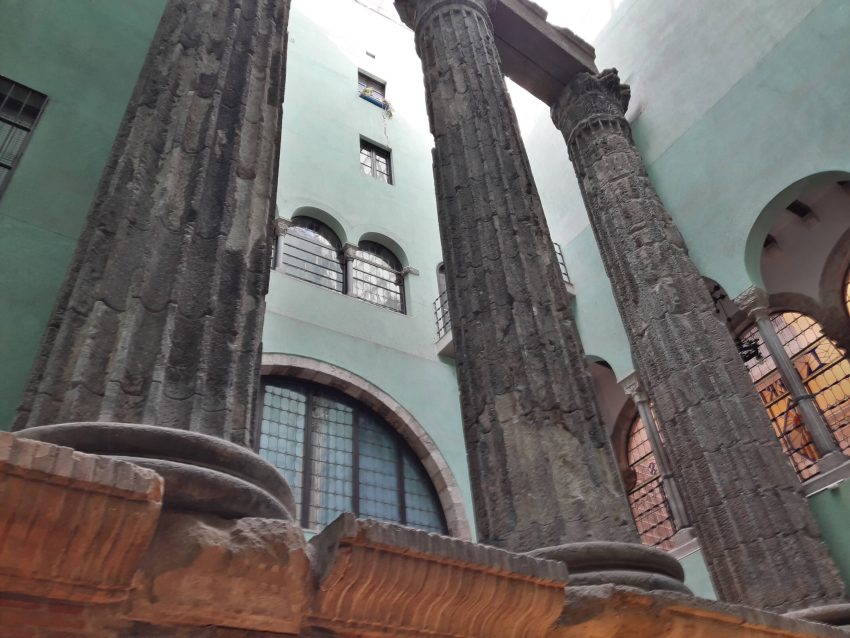
The Temple of Augustus is the kind of Barcelona sight you'd never “accidentally” see unless someone told you where to look. Behind an unassuming doorway on Carrer del Paradís, a small courtyard opens up to reveal four soaring Roman columns-survivors from ancient Barcino, still standing quietly in the middle of the Gothic Quarter.
It's one of the best quick stops to slot into a walking tour because the payoff is immediate and the time commitment is tiny. Pair it with the Cathedral area, Plaça Sant Jaume, and the MUHBA Roman remains nearby for a compact route that makes Barcelona's oldest layer feel real, not just theoretical.
Table of Contents
- History and Significance of the Temple of Augustus
- Things to See and Do in the Temple of Augustus
- How to Get to the Temple of Augustus
- Practical Tips on Visiting the Temple of Augustus
- Where to Stay Close to the Temple of Augustus
- Is the Temple of Augustus Worth Visiting?
- For Different Travelers
- FAQs for Visiting Temple of Augustus
- Nearby Attractions to the Temple of Augustus
History and Significance of the Temple of Augustus
These columns are remnants of the Roman temple that once dominated the forum of Barcino, the Roman city that evolved into modern Barcelona. Built in the late 1st century BC and dedicated to Emperor Augustus, the temple stood on the city's highest point, a small rise known as Mont Tàber-strategic, symbolic, and meant to be seen.
Over the centuries, the temple was gradually swallowed by the medieval city: new buildings rose around it, stones were repurposed, and the structure disappeared into the dense urban fabric. What makes the Temple of Augustus special today is not only its age, but the way it has been preserved inside the living city-Roman architecture literally embedded within later layers.
The surviving columns sit inside a medieval building courtyard, making the visit feel intimate rather than museum-like. It's a rare moment in Barcelona where you can stand almost face-to-face with the Roman past, without barriers, ticket halls, or the sense that you're on a conveyor belt of highlights.
Things to See and Do in the Temple of Augustus
The main event is the four columns themselves-tall, weathered, and surprisingly elegant up close. Step back to appreciate their scale in the tight courtyard, then move around to see how the stone catches light differently from each angle; it’s one of those places where a slow circle gives you more than a quick snapshot.
Just outside (and nearby), look for small clues that mark the Roman footprint in the Gothic Quarter. One of the most satisfying details is noticing how the “hidden” temple sits at the core of today's street plan-proof that ancient Barcelona is not somewhere else, it's underneath and inside what you're already walking through.
Treat this as a link in a Roman-themed mini-route: temple columns first, then the cathedral zone and MUHBA sites nearby. Done that way, the visit stops feeling like a curiosity and starts feeling like a clear story-Barcino to medieval Barcelona to the modern city.
How to Get to the Temple of Augustus
Barcelona-El Prat Airport (BCN) is the nearest major airport, and the simplest route is to get into the city centre and continue to the Gothic Quarter by metro, taxi, or a short walk from central hubs. For the best deals and a seamless booking experience, check out these flights to Barcelona on Booking.com.
If you arrive by train at Barcelona Sants, the metro is the easiest backbone into the centre; from there, continue to the Jaume I area and walk into the small lanes of the Gothic Quarter for the final minutes. Train schedules and bookings can be found on Omio.
The closest metro stop is Jaume I (L4), and from there it’s an easy walk-though the last stretch is through narrow, winding streets, so a map pin helps. The temple is tucked inside a courtyard at Carrer del Paradís, so the “hard part” isn’t distance, it’s spotting the discreet entrance.
Driving is not recommended in the Gothic Quarter due to restricted streets, slow traffic, and limited parking; arrive by metro and walk the final stretch instead. If you are looking to rent a car in Spain I recommend having a look at Discover Cars, first, as they compare prices and review multiple car rental agencies for you.
Practical Tips on Visiting the Temple of Augustus
- Entrance fee: Free.
- Opening hours: Monday: 10:00–14:00. Tuesday – Saturday: 10:00–19:00. Sunday: 10:00–20:00. Closed on 1 January; 1 May; 24 June; 25 December.
- Official website: https://www.barcelona.cat/museuhistoria/ca
- Best time to visit: Go earlier in the day for a quieter courtyard and cleaner photos, especially if you're visiting in peak season when the Gothic Quarter lanes get busy.
- How long to spend: 10-20 minutes is enough for the temple itself; plan 45-90 minutes if you're pairing it with nearby Roman and Gothic Quarter stops.
- Accessibility: Access is through a historic building entrance and a small courtyard, which can involve steps and tight turning space. If you need step-free access, check current on-site conditions before committing, as heritage layouts can change what’s practical day-to-day.
- Facilities: There's no dedicated visitor centre feel here-think “quick, quiet courtyard visit.” Plan restrooms, water, and longer breaks at nearby cafés around the Cathedral area or Plaça Sant Jaume.
Where to Stay Close to the Temple of Augustus
For a culture-heavy itinerary where you want to walk everywhere, base yourself in the Gothic Quarter or El Born so you can reach this stop (and most of the old city) in minutes; if your trip prioritizes easy transport links and a calmer night's sleep, stay on the edge of Eixample and commute in for short, focused old-city walks.
For a polished base right in the Gothic Quarter, consider H10 Madison. If you want a more intimate, boutique feel in the old city lanes, Hotel Neri is a strong pick. For a reliable, central option with easy walking access to the Cathedral and surrounding streets, Catalonia Catedral works well.
Is the Temple of Augustus Worth Visiting?
Yes-because it's one of the fastest, most surprising “wow” moments in central Barcelona. You're not looking at ruins behind glass; you're standing in a real courtyard with Roman columns towering above you, and that immediacy makes the city's ancient story feel tangible.
Honest pivot: if you dislike hunting for hidden entrances or you’re trying to maximize only big, expansive sights, you might skip it and focus on the Cathedral, major museums, or Gaudí landmarks instead. This stop rewards curiosity more than it rewards checklist travel.
What Other Travellers Say...

Temple d'August (Carrer del Paradís, 10, Ciutat Vella) is one of Barcelona's best “blink and you'll miss it” Roman sights: a small inner courtyard holding a cluster of restored Corinthian columns from the Temple of Augustus, originally built in the 1st century BCE. It's rated 4.6/5 from about 1,500 reviews, and the consistent reaction is surprise—people wander in off the Gothic Quarter streets and suddenly find ancient Rome tucked between medieval buildings. Visitors describe it as a free, quiet little stop where you can stand close to the columns and read the plaques explaining what you're looking at. A recurring detail is that the courtyard itself is small and accessed by steps down, so it doesn't feel like a full “temple visit” as much as a concentrated glimpse of the Roman city. Several reviews mention that only some columns were found on the spot, with others recovered from around the historic centre and assembled here, which helps explain why it feels like a curated fragment rather than a sprawling ruin. Practical takeaways are straightforward: it can be peaceful, but it can also feel suddenly crowded when a walking tour group arrives, so it's best timed for a quiet moment (early in the day or between tour waves). People also recommend lingering for small details—looking up through the surrounding apartments to the slice of sky overhead, spotting little marks in the stone, and noticing the “highest point” reference nearby that hints at why Romans chose this location in the first place.


For Different Travelers
Families with Kids
This is a great “short attention span” history stop: it’s quick, visual, and feels like discovering a secret. Keep the visit brief, then turn it into a game-ask kids to imagine what the temple looked like when it was a full building, not just columns.
Because the lanes around it are narrow and busy at peak times, aim for earlier hours if you can. Pair it with a larger open-space stop nearby afterward so the day doesn’t become all tight streets and slow walking.
Couples & Romantic Getaways
For couples, the appeal is the atmosphere: a quiet courtyard hidden in the Gothic Quarter that feels worlds away from the main tourist flow. It's a small, memorable moment that photographs well, especially if you arrive when the light is soft and the space isn't crowded.
Combine it with a slow old-city wander-Cathedral area, a café break in El Born, then an evening tapas plan-so the temple becomes part of a day that feels intentionally paced rather than rushed.
Budget Travelers
This is a top-tier budget stop because it’s genuinely interesting, central, and free. Use it as a “high value” highlight between paid attractions, and build a Roman-and-Gothic walking loop that costs nothing beyond snacks.
Because it’s so quick, the main budget tactic is efficiency: group it with nearby sights so you’re not spending extra transit time (or money) for a single ten-minute visit.
History Buffs
If you like Roman urban history, this is one of the most satisfying small stops in Barcelona because it sits right where Barcino's political heart once was. The columns are a direct physical link to the forum-era city, and the surrounding street fabric helps you visualize how later Barcelona grew over the Roman core.
To deepen the visit, connect it with MUHBA’s nearby Roman remains and the Cathedral zone-taken together, you get a layered narrative from Rome to medieval power to the modern city.
FAQs for Visiting Temple of Augustus
Getting There
Tickets & Entry
Visiting Experience
Photography
Accessibility & Comfort
Nearby Attractions to the Temple of Augustus
- Barcelona Cathedral: A Gothic landmark nearby with grand architecture and a lively surrounding plaza scene.
- Plaça Sant Jaume: The political heart of the old city, great for understanding Barcelona's civic geography.
- MUHBA Plaça del Rei: A deep dive into Barcino's Roman remains and medieval layers in one compact museum area.
- Roman Wall of Barcino: Fragments of the city's ancient defenses that make the Roman footprint easier to visualize.
- Basilica of Santa Maria del Mar: A standout Gothic church in El Born that pairs naturally with an old-city walking loop.
The Temple d'August appears in our Complete Guide to Visiting Barcelona!

Moira & Andy
Hey! We're Moira & Andy. From hiking the Camino to trips around Europe in Bert our campervan — we've been traveling together since retirement in 2020!
This website uses affiliate links which may earn a commission at no additional cost to you!
Planning Your Visit
Monday: 10:00-14:00.
Tuesday - Saturday: 10:00-19:00.
Sunday: 10:00-20:00.
Closed on 1 January; 1 May; 24 June; 25 December.
Free.
Nearby Attractions
- Palau del Lloctinent (0.1) km
Archive, Historic Building and Palace - Pont del Bisbe (0.1) km
Attraction and Bridge - Plaça de Sant Jaume (0.1) km
Square - Palau de la Generalitat de Catalunya (0.1) km
Historic Building, Historic Site and Palace - Plaça del Rei (0.1) km
Square - Capella de Santa Àgueda (0.1) km
Church, Historic Building and Museum - Museu Frederic Marès (0.1) km
Historic Site, Museum and Sculpture - Cathedral of Barcelona (0.1) km
Cathedral, Historic Building and Religious Building - Plaça de Sant Just (0.1) km
Square - Barcelona Roman Walls (0.1) km
City Walls and Roman Site