Teatro Romano di Lecce
Roman Site in Lecce
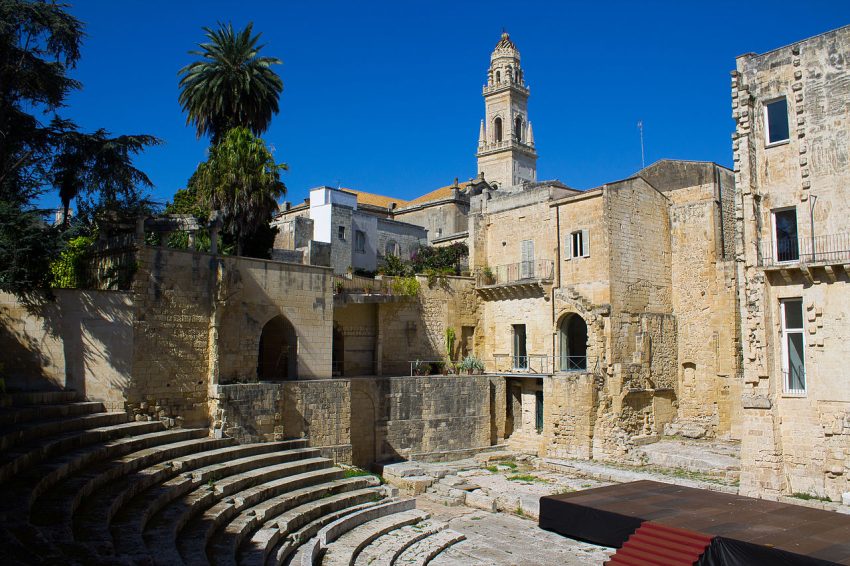
The Roman Theatre of Lecce is one of the things to do in Lecce for travellers searching for quieter ancient sites steeped in history and mystery. Tucked within the narrow streets behind Santa Chiara, this compact theatre remained hidden for centuries until its accidental discovery in 1929 during garden excavations. Today, its curved seating, limestone steps, and evocative setting make it a great place to visit on a walking tour of Lecce, offering a serene counterpart to the grander Roman Amphitheatre in Piazza Sant'Oronzo.
Though smaller in scale, the theatre provides a rare glimpse into the city’s cultural life during the Roman era, where audiences once gathered for comedies, tragedies, and musical performances in an intimate yet atmospheric setting.
Table of Contents
- History and Significance of the Roman Theatre of Lecce
- Things to See and Do in the Roman Theatre of Lecce
- How to Get to the Roman Theatre of Lecce
- Practical Tips on Visiting the Roman Theatre of Lecce
- Where to Stay close to the Roman Theatre of Lecce
- Is the Roman Theatre of Lecce Worth Visiting?
- FAQs for Visiting the Roman Theatre of Lecce
- Nearby Attractions to the Roman Theatre of Lecce
History and Significance of the Roman Theatre of Lecce
The theatre may owe its origins to Octavian-later Emperor Augustus-who, according to tradition, took refuge in Lupiae after the Battle of Philippi and expressed his gratitude by ordering the construction of both the theatre and the amphitheatre. While not all details can be confirmed, decorative fragments suggest that at least part of the structure dates to the Augustan age.
Additional findings, including marble statues discovered at the site, belong to the Antonine era (138-182 AD), revealing centuries of artistic and architectural layers. Unlike the amphitheatre with its violent spectacles, the Roman Theatre hosted cultured performances such as comedies, tragedies, poetry readings, and choral recitals, making it an important civic and cultural venue.
Forgotten and buried under later buildings, the theatre only re-emerged in the 20th century, transforming our understanding of Roman Lupiae and its urban landscape.
Things to See and Do in the Roman Theatre of Lecce
The theatre’s cavea is divided into six wedges, each with twelve steps, forming a semi-circular arrangement typical of Roman theatrical design. Visitors can admire the three white limestone steps in front of the orchestra, once reserved for elite spectators. Behind these lies a low dividing wall, and further back, the stage area where actors performed.
A narrow gallery gives access to the orchestra, adding to the site’s charm and sense of discovery. The theatre’s modest scale-holding around 5,000 people-creates an intimate atmosphere that distinguishes it from Lecce’s larger amphitheatre.
The on-site museum, located in nearby buildings, displays statues, fragments, and reconstructions that help visitors imagine the theatre during its peak, including its decorative programme from the Antonine period.
How to Get to the Roman Theatre of Lecce
The Roman Theatre is located in Lecce's old town, near the Church of Santa Chiara and Via Arte della Cartapesta. The closest major airport is Brindisi Airport, with shuttle and bus connections into Lecce. For the best deals and a seamless booking experience, check out these flights to Lecce on Booking.com.
Lecce’s main railway station provides regular regional and national links. From the station, visitors can walk to the historic centre or take a local bus to reach the theatre more quickly. Use Omnio to easily compare schedules, book train tickets, and find the best prices all in one place for a hassle-free journey across Italy.
Those arriving by car can park outside the historic centre and continue on foot, as the theatre lies within pedestrianised streets. If you are looking to rent a car in Italy I recommend having a look at Discover Cars, first, as they compare prices and review multiple car rental agencies for you.
Practical Tips on Visiting the Roman Theatre of Lecce
- Suggested tips: Pair your visit with the nearby Roman Amphitheatre to appreciate Lecce's two ancient performance spaces.
- Best time to visit: Early morning or evening when the site is most peaceful.
- Entrance fee: Varies; often included in combined archaeological tickets.
- Opening hours: Typically open during museum hours; seasonal variations apply.
- Official website: Refer to Lecce’s archaeological site listings.
- How long to spend: 20-40 minutes.
- Accessibility: Narrow lanes and steps may pose challenges for visitors with mobility needs.
- Facilities: Small museum nearby; cafés within a short walk.
- Photography tip: Capture the curve of the cavea from the top for a sweeping view.
- Guided tours: Available through local heritage groups or city walking tours.
- Nearby food options: Excellent cafés and trattorias around Santa Chiara.
Where to Stay close to the Roman Theatre of Lecce
For a refined stay near Lecce’s archaeological heart, Risorgimento Resort offers luxury comfort within walking distance. Travellers may also enjoy the charm of Patria Palace Hotel, close to Santa Croce. For an artistic retreat, La Fiermontina provides a tranquil garden setting.
Is the Roman Theatre of Lecce Worth Visiting?
Yes. The Roman Theatre is one of the best places to visit in Lecce for travellers who enjoy quieter archaeological sites rich with atmosphere. Its intimate scale, fascinating history, and peaceful setting offer a rewarding contrast to the city's larger monuments.
What Other Travellers Say...

The Roman Amphitheater in Piazza Sant'Oronzo, Lecce, is a partially excavated 2nd-century A.D. site open around the clock where city-run guided tours are available; visitors describe it as a compact but impressive ruin set in the historic centre, visible near a contemporary church, with much of the structure lying beneath the pavement, and note it can be great for photos though it would benefit from better signage and care to provide more context.


FAQs for Visiting the Roman Theatre of Lecce
Nearby Attractions to the Roman Theatre of Lecce
- Roman Amphitheatre: The city's larger ancient arena in Piazza Sant'Oronzo.
- Basilica di Santa Croce: Lecce's most iconic Baroque façade.
- Piazza Sant'Oronzo: The main civic square of Lecce.
- Castle of Charles V: A Renaissance fortress with cultural exhibitions.
- Church of Santa Chiara: A beautiful Baroque church near the theatre.
The Teatro Romano di Lecce appears in our Complete Guide to Visiting Lecce!

Moira & Andy
Hey! We're Moira & Andy. From hiking the Camino to trips around Europe in Bert our campervan — we've been traveling together since retirement in 2020!
This website uses affiliate links which may earn a commission at no additional cost to you!
Planning Your Visit
Nearby Attractions
- Lecce Cathedral (0.1) km
Cathedral - Chiesa di Santa Chiara (0.1) km
Attraction, Church and Religious Building - Chiesa di San Matteo (0.2) km
Church - Anfiteatro Romano di Lecce (0.2) km
Amphitheatre - Sedile (0.2) km
Palace - Piazza Sant'Oronzo (0.2) km
Square - Museo Faggiano (0.3) km
Museum - Porta San Biagio (0.3) km
City Gate, Historic Site and Monument - Castle of Charles V (0.4) km
Castle - Jewish Museum (0.4) km
Museum