Ta Prohm (Tomb Raider Temple), Siem Reap
Buddhist Temple in Siem Reap
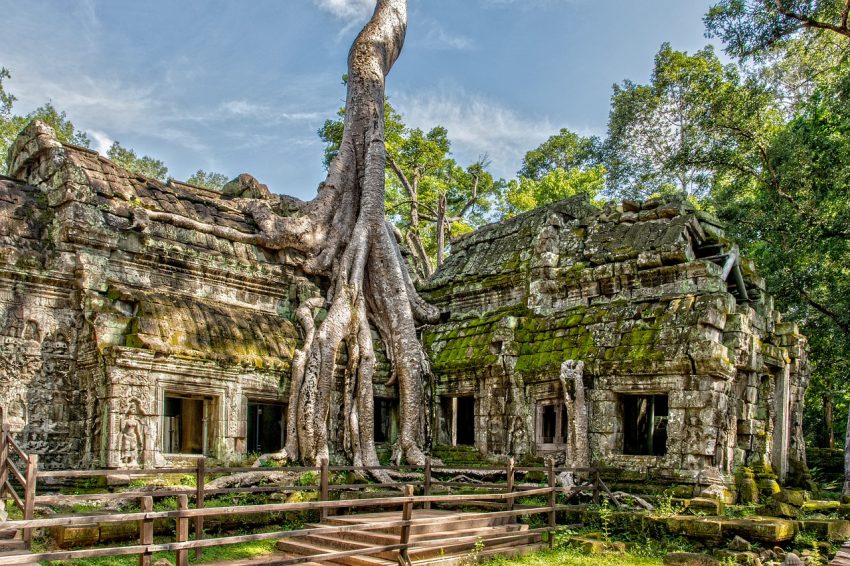
Ta Prohm Temple is one of Angkor's most atmospheric stops: a sprawling, low-slung monastery where the jungle doesn't just surround the ruins-it actively grips them. Enormous strangler figs and silk-cotton trees spill over galleries and doorways, their roots pinning stones in place like living buttresses. The result is both beautiful and slightly surreal, the kind of place that makes you slow down and look twice at every corner.
You'll find Ta Prohm inside the Angkor Archaeological Park, a straightforward ride from Siem Reap and an easy fit on the classic “Small Circuit” route that links the headline temples in a single day. Even if you're not normally a “temple person,” this one tends to land differently because it feels less like a museum piece and more like a scene that's still unfolding-stone, moss, shade, birdsong, and the quiet creak of roots under tension.
Table of Contents
- History and Significance of the Ta Prohm Temple
- Things to See and Do in the Ta Prohm Temple
- How to Get to the Ta Prohm Temple
- Practical Tips on Visiting the Ta Prohm Temple
- Where to Stay Close to the Ta Prohm Temple
- Is the Ta Prohm Temple Worth Visiting?
- For Different Travelers
- FAQs for Visiting Ta Prohm Temple
- Nearby Attractions to the Ta Prohm Temple
History and Significance of the Ta Prohm Temple
Ta Prohm was founded in the late 12th century under King Jayavarman VII, the great builder-king of Angkor, and it originally functioned as a major monastery and learning centre. In its working life, it was part religious complex, part administrative engine-supported by surrounding communities and sustained by a large network of people who kept rituals, education, and daily operations running.
What makes Ta Prohm especially significant today is the preservation philosophy that shaped how most visitors experience it. Rather than “resetting” the temple into a fully reconstructed monument, conservation efforts have often aimed to stabilise the structure while keeping the sense of ruins reclaimed by nature. Modern restoration and safety work continues (notably with Cambodian authorities and international partners), but the goal is typically to protect the site without stripping away the famous jungle-ruin character that defines Ta Prohm.
Things to See and Do in the Ta Prohm Temple
Start with the temple's defining feature: the giant trees. The most memorable viewpoints are usually where roots cascade down over walls and door frames, creating a dramatic contrast between organic curves and hard, carved stone. Expect a lot of “stop, look, photograph, move a few steps, stop again”-Ta Prohm is best enjoyed at a slower pace than more open, grandly symmetrical temples.
As you wander, keep an eye out for long corridors, enclosed courtyards, and partially collapsed galleries that create a constant rhythm of light and shade. Ta Prohm’s carvings are not as narrative-heavy as some other Angkor sites, but you’ll still find decorative details and sacred motifs tucked around doorways and lintels-often easier to spot when you pause and let your eyes adjust in the darker passageways.
For a more satisfying visit, treat it like a short route rather than a single “main view.” Enter, loop through a few interior sections, then deliberately seek out one or two of the best root-covered structures before you leave. It prevents the experience from turning into a crowded shuffle and helps you come away with a clearer sense of the temple’s scale and layout.
How to Get to the Ta Prohm Temple
The closest airport is Siem Reap-Angkor International Airport (SAI), and most visitors continue to Siem Reap by taxi, shuttle, or hotel transfer before heading into the Angkor Archaeological Park. For the best deals and a seamless booking experience, check out these flights to Siem Reap on Booking.com. Phnom Penh International flights can also work if you're linking Cambodia overland, but it adds a longer road journey to reach Siem Reap. For the best deals and a seamless booking experience, check out these flights to Siem Reap on Booking.com.
There is currently no convenient passenger train service to Siem Reap, so overland travel is typically by bus or private transfer from Phnom Penh, Battambang, or the Thai border area depending on your route.Train schedules and bookings can be found on Omio. If you're already in town, shared and private tuk-tuks are the simplest option, and many visitors combine Ta Prohm with Angkor Thom and Angkor Wat as part of the “Small Circuit.”
From central Siem Reap, Ta Prohm is usually a straightforward 25-40 minute ride depending on traffic and how many temple stops you add along the way. Cycling is also possible for confident riders, but the heat and distances make an early start important.
Practical Tips on Visiting the Ta Prohm Temple
- Entrance fee: Entrance fee Included with the Angkor Pass: 1 day US$37; 3 days US$62; 7 days US$72. Children under 12 are free with passport proof of age.
- Opening hours: Daily: 07:30–17:30.
- Official website: https://apsaraauthority.gov.kh/2021/08/12/ta-prohm/
- Best time to visit: Go early for cooler temperatures and fewer tour groups, or aim for later afternoon when the light softens and the crowds thin.
- How long to spend: Plan 60-90 minutes if you want a relaxed loop with photo stops; longer if you prefer to explore every gallery slowly.
- Accessibility: Expect uneven ground, steps, and root-lifted stones; it can be challenging for wheelchairs and anyone with limited mobility.
- Facilities: Basic facilities are limited at the temple itself; bring water, sun protection, and anything you need before you set out.
Where to Stay Close to the Ta Prohm Temple
For a culture-heavy Angkor itinerary, base yourself in central Siem Reap around the Old Market/Wat Bo area for easy early starts and simple evening logistics; if your priority is peace and downtime between temple days, choose a quieter riverside pocket slightly away from Pub Street's nightlife.
For a high-comfort, walkable base in the heart of town, consider Park Hyatt Siem Reap, which puts restaurants and shops close by while keeping temple logistics easy. If you prefer boutique style with a calmer, leafy feel near the river, Viroth's Hotel is well-placed for evenings in town without feeling hectic. For a quieter, retreat-like stay that still keeps you within a manageable ride of Angkor, Jaya House River Park is a strong option for travellers who want downtime as part of the trip.
Is the Ta Prohm Temple Worth Visiting?
Yes-Ta Prohm is one of the most distinctive temples in Angkor because it delivers something you don't get elsewhere in quite the same way: the visual drama of nature overtaking stone, at a scale that feels immersive rather than staged. It's also an easy “wow” even for travellers who are limiting their temple count, because the atmosphere is immediate and the experience is compact.
The honest pivot: if you strongly dislike crowds, have very limited mobility, or feel you've already “had enough ruins” after Angkor Wat and Bayon, Ta Prohm can feel like a congested detour at peak times. In that case, skip it or visit only at opening, then trade the saved time for a quieter, more spacious temple where you can linger without the bottlenecks.
What Other Travellers Say...

Ta Prohm Temple in Krong Siem Reap is a jungle-enshrouded Buddhist ruin where massive tree roots have grown through and around the stonework, creating a mysterious, photogenic atmosphere distinct from nearby sites; visitors praise the dramatic trees and overgrown walls, note the site's cinematic fame, find the terrain easy to walk with family, and recommend spending about an hour to explore and capture the entwined roots and ancient structures.


For Different Travelers
Families with Kids
Ta Prohm works well for families because it feels like an exploration site rather than a formal monument-roots, corridors, and “spot the carvings” moments keep kids engaged. Bring snacks and water, set a simple route (in, one main loop, out), and watch footing closely because the uneven stones can trip up excited runners.
If you’re visiting with a stroller, plan to park it and carry smaller children for the most root-tangled sections. A short, early visit is usually the smoothest: cooler air, less crowd pressure, and fewer moments where you’re trying to shepherd everyone through narrow passageways.
Couples & Romantic Getaways
For couples, Ta Prohm is at its best when you treat it as a mood piece-arrive early, take your time, and look for quieter corners rather than chasing the busiest “famous root” angle immediately. The mix of shade, silence between groups, and that slightly cinematic atmosphere makes it feel more intimate than some of the grander, more open temples.
Pair it with a slow café breakfast back in Siem Reap or a sunset plan elsewhere (Ta Prohm isn't the classic sunset spot), and you'll get a day that feels balanced rather than rushed. If photography matters, prioritise gentle light and fewer people over a strict schedule.
Budget Travelers
Ta Prohm is a strong value stop because it's included in the Angkor Pass and sits on routes you're likely doing anyway. To keep costs down, share a tuk-tuk for the day with other travellers, or hire one driver to run the full circuit rather than paying point-to-point for multiple rides.
Bring your own water and light food, because convenience buys near the temples can add up quickly. If you're choosing a shorter pass, Ta Prohm is one of the best “high impact per hour” visits, so it earns its place even on a tight schedule.
History Buffs
Ta Prohm is especially rewarding if you look beyond the trees and think of it as a functioning institution-monastery, school, and administrative centre rolled into one. The layout, repeated galleries, and enclosed spaces make more sense when you imagine daily movement through teaching, ritual, and work rather than a one-off ceremonial site.
If you want deeper context, combine Ta Prohm with Bayon and Angkor Thom on the same day to compare Jayavarman VII's religious and artistic priorities across different temple types. It helps you read Ta Prohm not just as “the jungle temple,” but as a key piece of the late-Angkor story.
FAQs for Visiting Ta Prohm Temple
Getting There
Tickets & Entry
Visiting Experience
Tours, Context & Itineraries
Photography
Accessibility & Facilities
Food & Breaks Nearby
Safety & Timing
Nearby Attractions to the Ta Prohm Temple
- Angkor Wat: The flagship temple of Angkor, best for grand architecture, bas-reliefs, and the classic causeway approach.
- Bayon Temple: Famous for its serene stone faces and layered galleries inside Angkor Thom's walled royal city.
- Angkor Thom: A vast complex of gates, terraces, and royal-era monuments that rewards slow exploration beyond Bayon alone.
- Banteay Kdei: A quieter, atmospheric temple nearby that pairs well with Ta Prohm for a less crowded mini-route.
- Srah Srang: A scenic reservoir with broad steps and reflective water views, ideal for a calm pause between temples.
The Ta Prohm (Tomb Raider Temple) appears in our Complete Guide to Visiting Siem Reap!

Moira & Andy
Hey! We're Moira & Andy. From hiking the Camino to trips around Europe in Bert our campervan — we've been traveling together since retirement in 2020!
This website uses affiliate links which may earn a commission at no additional cost to you!
Planning Your Visit
Daily: 07:30-17:30.
Entrance fee Included with the Angkor Pass: 1 day US$37; 3 days US$62; 7 days US$72. Children under 12 are free with passport proof of age.
Nearby Attractions
- Banteay Kdei (1.1) km
Buddhist Temple - Ta Keo (1.3) km
Buddhist Temple - Prasat Leak Neang (1.5) km
Buddhist Temple - Thommanon Temple (1.9) km
Buddhist Temple - Kmoch Gate (Gate of the Dead) (1.9) km
City Gate - Srah Srang & Kandal Srah Srang (1.9) km
Historic Site and Reservoir - Ta Nei Temple (2.0) km
Buddhist Temple - Prasat Kravan (2.0) km
Hindu Temple - Victory Gate of Angkor Thom (2.2) km
City Gate - Neak Pean (3.2) km
Buddhist Temple