South Gate of Angkor Thom, Siem Reap
City Gate in Siem Reap
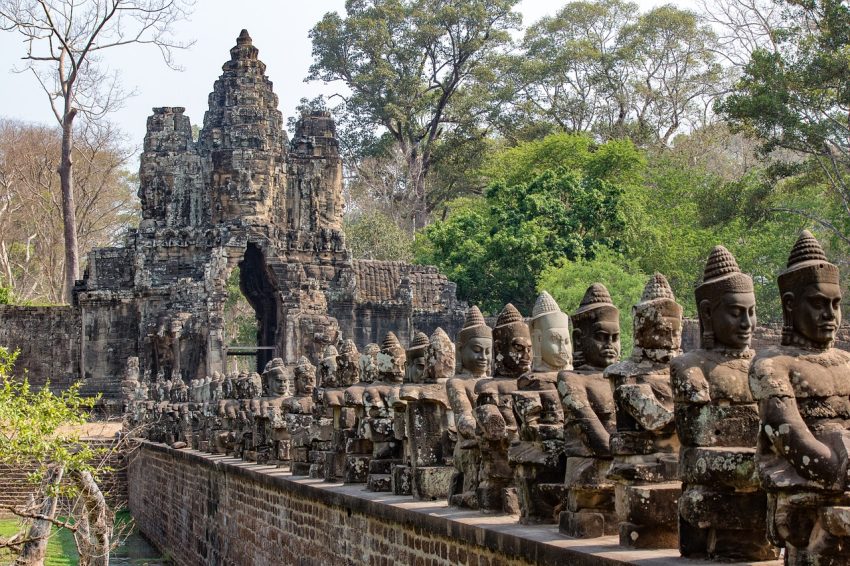
The South Gate of Angkor Thom is the classic “arrival moment” at Angkor: a long stone causeway over the moat, lined with powerful figures hauling a naga serpent, leading straight to a monumental gate tower. Even if you've seen photos, it lands differently in person-scale, symmetry, and atmosphere combine in a way that makes you instinctively slow down and look up.
Also known as the Tonle Om Gate, it’s the most visited of Angkor Thom’s entrances for a reason. You’re not just walking toward a doorway; you’re crossing a threshold designed to impress, intimidate, and frame the city as something more-than-human-an ordered sacred capital with the Bayon at its conceptual centre.
Table of Contents
- History and Significance of the South Gate of Angkor Thom
- Things to See and Do in the South Gate of Angkor Thom
- How to Get to the South Gate of Angkor Thom
- Practical Tips on Visiting the South Gate of Angkor Thom
- Where to Stay Close to the South Gate of Angkor Thom
- Is the South Gate of Angkor Thom Worth Visiting?
- For Different Travelers
- FAQs for Visiting the South Gate of Angkor Thom
- Nearby Attractions to the South Gate of Angkor Thom
History and Significance of the South Gate of Angkor Thom
Angkor Thom was built as the great walled capital of Jayavarman VII, and its gates were engineered as statements of authority as much as practical entry points. The South Gate sits on the city's most iconic approach, and the experience is deliberately theatrical: water, causeway, guardian figures, then the cruciform gate structure rising from the wall.
The naga balustrade is the key symbolic device. The lined figures pulling the serpent are commonly read through the lens of Khmer cosmology and the great mythic tug-of-war between divine and demonic forces, often linked by interpretation to the Churning of the Sea of Milk. Whether or not you arrive with the mythology in mind, the visual language is clear: this is a guarded, sacred boundary, not an ordinary city gate.
Architecturally, the gate is also a compact lesson in Angkor's “city-temple” thinking. The gate tower's serene faces echo the wider Angkor Thom visual programme-calm, all-seeing, and protective-while the cruciform layout and side chambers hint at real-world control of movement: who enters, how they're channelled, and how the city presents itself to outsiders.
Things to See and Do in the South Gate of Angkor Thom
Begin on the causeway rather than rushing through the arch. Walk slowly down the centreline, then step to each side to study the contrast between the two rows: the composed devas versus the more ferocious-looking asuras. The details vary more than you might expect-different expressions, different damage patterns, and subtle shifts in carving that reward a closer look.
When you reach the gate, pause before passing under it and look up at the face tower. This is one of the best places in the park to understand how Angkor uses “faces” as a protective, watchful motif, and why travellers often describe the city as feeling like it’s observing you as much as you observe it.
Finally, take a few minutes to read the gate as a functioning structure. The cruciform plan, the side chambers, and the thickness of the laterite wall help you imagine the gate in use-guards, controlled entry, and the sense that you're stepping into an enclosed royal world. If you're building an Angkor Thom loop, the South Gate also works as a natural “start line” before Bayon and the terraces.
How to Get to the South Gate of Angkor Thom
Most travellers fly into Siem Reap-Angkor International Airport (SAI), then continue by road to Siem Reap and the Angkor Archaeological Park. For the best deals and a seamless booking experience, check out these flights to Siem Reap on Booking.com. Phnom Penh International Airport (PNH) is another workable entry point if you're combining Angkor with a wider Cambodia route, with onward travel by bus, private transfer, or domestic flight. For the best deals and a seamless booking experience, check out these flights to Siem Reap on Booking.com.
There is no widely-used passenger train option into Siem Reap for most visitors, so buses and private transfers are the standard overland choices between major Cambodian cities. Train schedules and bookings can be found on Omio. From Siem Reap, the South Gate is typically reached by tuk-tuk or hired driver as part of an Angkor Thom itinerary, and it's an easy first stop before continuing deeper into the walled city.
If you're travelling by car, the simplest plan is to hire a driver for a half-day or full-day route so you can string the South Gate together with Bayon, Baphuon, and the terraces without logistical friction.
Practical Tips on Visiting the South Gate of Angkor Thom
- Entrance fee: Included with the Angkor Pass (1-day: US$37; 3-day: US$62; 7-day: US$72).
- Opening hours: Daily: 07:30–17:30.
- Official website:
- Best time to visit: Early morning is best for softer light on the statues and fewer crowds; late afternoon is strongest for atmosphere once tour waves thin out.
- How long to spend: 20-40 minutes is ideal if you want to walk the causeway slowly, study both statue rows, and take photos from multiple angles.
- Accessibility: The approach is mostly flat, but surfaces can be uneven and crowded; take extra care on worn stone and near the edges of the causeway.
- Facilities: Treat this as an on-route stop-carry water, and plan restrooms and food breaks around your wider Angkor day rather than at the gate itself.
Where to Stay Close to the South Gate of Angkor Thom
For a culture-heavy itinerary, base yourself in central Siem Reap so you can walk to dinners, markets, and evening life after temple time; if your priority is early starts and a quieter reset, choose a hotel on the Angkor-side of town for quicker access to the park gates.
For a polished, central base with easy logistics for dawn departures, Park Hyatt Siem Reap puts you close to the city’s best dining while still making Angkor mornings straightforward. If you want classic heritage atmosphere and a location that naturally suits temple-focused days, Raffles Grand Hotel d'Angkor is a long-standing favourite. For a stylish boutique stay that balances comfort with calm, Shinta Mani Angkor is a strong option for travellers who want design and service without feeling removed from town.
Is the South Gate of Angkor Thom Worth Visiting?
Yes-this is one of the highest “impact-per-minute” stops in the entire park. The South Gate delivers the sensation of arriving at Angkor Thom the way historical visitors would have: crossing water, meeting guardians, and passing under a monumental tower that feels like an announcement of power.
Honest pivot: if you dislike crowd pressure or you're already overloaded with “big temple moments,” the South Gate can feel like a busy photo corridor rather than a contemplative site. In that case, visit very early, keep it brief, and prioritise quieter corners of Angkor Thom where you can slow down without the flow of vehicles and groups.
What Other Travellers Say...

South Gate Angkor Thom in Siem Reap is a well-preserved, imposing entrance to the ancient city featuring long causeways flanked by two rows of statues; visitors praise it as a picturesque spot for photos (including wedding portraits reflected in the water), note you can climb onto the wall and walk to the corners, and recommend allowing time to properly explore the extensive site rather than just a few minutes.


For Different Travelers
Families with Kids
This is a strong family stop because it’s visual and immediate: statues, a serpent, a huge gate, and a clear “story” even without deep history. A simple game-spot the friendliest face, count how many figures you can see intact, find the most dramatic expression-keeps kids engaged without turning it into a lecture.
The main challenge is safety and pacing. Keep children close on the causeway edges, avoid rushing when vehicles or groups funnel toward the arch, and plan a short water-and-snack pause right after so the stop stays positive rather than tiring.
Couples & Romantic Getaways
For couples, the South Gate is best approached as an atmospheric entrance rather than a checklist photo. Walk the causeway slowly, take turns photographing each other with the statues receding into the background, and enjoy the moment where the gate tower fills your view.
Timing matters more than people realise. Early light can feel almost cinematic here, while late afternoon often delivers a warmer, calmer mood-ideal if you want a more intimate experience before heading onward to Bayon or the terraces.
Budget Travelers
Budget travellers should treat this as a “free bonus” once you already have the Angkor Pass, because it delivers iconic visuals without requiring extra time or paid add-ons. It also works well as a quick stop even on a tightly packed one-day circuit.
To keep costs low, share a tuk-tuk for the day or join a small-group Angkor route that includes Angkor Thom. The South Gate is easy to include efficiently, and planning it as your first Angkor Thom stop reduces backtracking.
History Buffs
History-focused travellers will appreciate how clearly the South Gate communicates state ideology: boundary-making, guardianship, and the choreography of arrival. It's a quick way to grasp Angkor Thom not just as ruins, but as a planned capital with controlled movement and symbolic messaging.
To go deeper, pair the gate with Bayon and the terraces so you can connect the “threshold” experience to the civic-ceremonial heart of the city. The gate makes more sense when you feel what it was guiding you toward.
FAQs for Visiting the South Gate of Angkor Thom
Getting There
Tickets & Entry
Visiting Experience
Photography
Accessibility & Facilities
Food & Breaks Nearby
Safety & Timing
Nearby Attractions to the South Gate of Angkor Thom
- Bayon Temple: The face-tower temple at Angkor Thom's centre, famous for its serene stone smiles and dense bas-reliefs.
- Baphuon: A grand temple-mountain nearby with a dramatic climb and wide, city-like views over Angkor Thom.
- Terrace of the Elephants: A long ceremonial platform with bold carvings, designed for royal processions and public display.
- Ta Prohm: The iconic jungle temple where massive tree roots wrap the stone, creating Angkor's most dramatic nature-and-ruin scenes.
- Angkor Wat: The essential anchor temple of the park, best paired with Angkor Thom for a full “classic Angkor” day.
The South Gate of Angkor Thom appears in our Complete Guide to Visiting Siem Reap!

Moira & Andy
Hey! We're Moira & Andy. From hiking the Camino to trips around Europe in Bert our campervan — we've been traveling together since retirement in 2020!
This website uses affiliate links which may earn a commission at no additional cost to you!
Planning Your Visit
Daily: 07:30-17:30.
Included with the Angkor Pass (1-day: US$37; 3-day: US$62; 7-day: US$72).
Nearby Attractions
- Angkor Thom North Gate (3.1) km
City Gate - Phnom Bakheng (0.6) km
Buddhist Temple - Ta Prohm Kel (1.3) km
Buddhist Temple - Prasat Bayon (1.5) km
Buddhist Temple - Bayon Temple (1.5) km
Buddhist Temple - Baphuon (1.8) km
Buddhist Temple - Angkor Wat (1.9) km
Buddhist Temple - Terrace of the Elephants (2.0) km
Historic Site - Phimeanakas (2.1) km
Buddhist Temple - Kmoch Gate (Gate of the Dead) (2.1) km
City Gate