Roman Amphitheater of Catania
Amphitheatre, Roman Site and Ruins in Catania

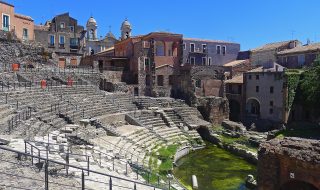
The Roman Amphitheater of Catania (Anfiteatro Romano) is one of the city's most surprising ancient sights: a Roman-era arena partially revealed right in the middle of modern Catania, at Piazza Stesicoro. From street level you can already peek into the ruins for free, but the real experience happens below, where you descend into corridors and seating remains that hint at the amphitheater's original scale.
Because it sits on a central square, it's easy to include on a walking tour of Catania's historic core, pairing it with nearby Baroque streets, markets, and churches. For the best views without a ticket, linger along the railings at Piazza Stesicoro; for the most immersive visit, go inside to explore the underground passages and interpretive panels.
Table of Contents
- History and Significance of the Roman Amphitheater of Catania
- Things to See and Do in the Roman Amphitheater of Catania
- How to Get to the Roman Amphitheater of Catania
- Practical Tips on Visiting the Roman Amphitheater of Catania
- Where to Stay Close to the Roman Amphitheater of Catania
- Is the Roman Amphitheater of Catania Worth Visiting?
- For Different Travelers
- FAQs for Visiting Roman Amphitheater of Catania
- Nearby Attractions to the Roman Amphitheater of Catania
History and Significance of the Roman Amphitheater of Catania
Built during the Roman period, Catania’s amphitheater once hosted public spectacles and gatherings typical of major Roman cities. What makes it especially fascinating today is how thoroughly the modern city grew over it—leaving only a portion visible above ground while much more survives below street level.
The site is a vivid example of Catania's layered history: Greek and Roman foundations, medieval and Baroque rebuilding, and contemporary life all stacked in the same compact center. Visiting helps you understand how ancient Catania was organized and why Piazza Stesicoro remains such a natural “meeting point” in the city.
Even if you’ve seen bigger arenas elsewhere, this one stands out for its urban setting and the feeling of discovery—stepping down from busy streets into a quieter, cooler archaeological space.
Things to See and Do in the Roman Amphitheater of Catania
Start outside in Piazza Stesicoro to get your bearings: the exposed section lets you grasp the curvature of the arena and how it sits beneath surrounding buildings. It's also a great spot for quick photos and for deciding whether you want the full underground visit.
Inside, the highlight is the descent into the amphitheater’s interior spaces—corridors, darker passageways, and sections of seating and structure that reveal how much larger the monument is than what you see from above. The contrast between ancient stonework and the modern city overhead is part of the appeal.
Take time with the information panels to visualize the original layout and scale. If you can, read a little background beforehand or join a guided walk, since context makes the ruins feel far more “complete” than they first appear.
How to Get to the Roman Amphitheater of Catania
Catania–Fontanarossa Airport (CTA) is the nearest airport, with frequent connections to Italian and European cities. For the best deals and a seamless booking experience, check out these flights to Catania on Booking.com.
Catania Centrale is the main rail hub; from there you can reach the city center by local transport or a straightforward walk/taxi ride depending on your luggage and heat. Use Omnio to easily compare schedules, book train tickets, and find the best prices all in one place for a hassle-free journey across Italy.
If you're driving, aim for a garage on the edge of the center and continue on foot to Piazza Stesicoro to avoid ZTL restrictions and tight streets. If you are looking to rent a car in Italy I recommend having a look at Discover Cars, first, as they compare prices and review multiple car rental agencies for you.
Practical Tips on Visiting the Roman Amphitheater of Catania
- Official website: https://parchiarcheologici.regione.sicilia.it/catania-valle-aci/en/biglietti/anfiteatro-romano-catania/
- Entrance fee: Adults: €4; Reduced: €3.
- Opening hours: Monday – Sunday: 09:00–17:00.
- Best time to visit: Go early in the day for cooler temperatures and a calmer feel underground, then continue your walk through the historic center. If you only want a quick look, street-level viewing works well at any time.
- How long to spend: Plan 30–60 minutes for the interior visit, or 10 minutes if you’re only stopping for the free viewpoint from the square.
- Accessibility: Expect uneven surfaces, steps, and narrow passages; it’s not a good fit for wheelchairs or anyone who struggles with stairs or heights.
- Facilities: Facilities are limited on-site; plan for restrooms, snacks, and longer breaks at nearby cafés around Piazza Stesicoro and Via Etnea.
Where to Stay Close to the Roman Amphitheater of Catania
Base yourself in central Catania around Piazza Stesicoro and Via Etnea for the easiest walking access to major sights, restaurants, and evening strolls.
Palace Catania | UNA Esperienze A polished, central option steps from Via Etnea—ideal if you want comfort, reliable service, and a prime location for walking tours.
Duomo Suites & Spa A stylish stay near Piazza Duomo that works well for couples and travelers who want a more boutique feel plus easy access to the old town.
Liberty Hotel A character-rich hotel in a quieter pocket of the center, good for light sleepers who still want to be close to Piazza Stesicoro.
NH Catania Centro A practical, well-known chain choice with straightforward amenities—handy if you value predictability and quick transport connections.
Bastio Private Suites A modern suites-style option near the waterfront side of the center, great if you like extra space and an easy walk to markets and evening food spots.
Is the Roman Amphitheater of Catania Worth Visiting?
Yes—especially because it’s inexpensive, centrally located, and genuinely different from “open-air” ruins. The best part is the underground access: it turns what looks like a small fragment from the street into a memorable, atmospheric visit that feels like discovering a hidden layer of the city.
Honest Pivot: if you dislike stairs, tight archaeological spaces, or dim corridors, you may prefer to enjoy the free street-level viewpoint and spend your time at more accessible sites like Catania’s main squares, churches, or seaside promenades.
What Other Travellers Say...

Reviews are strongly positive overall, with travelers highlighting that the street-level view shows only a small fraction of the site and that paying to go inside is well worth it. Common praise focuses on the underground exploration, the striking contrast between ancient ruins and modern buildings above, and the site’s surprisingly good preservation for such a central location. A few visitors note drawbacks: limited accessibility due to stairs/uneven surfaces, and the experience can feel intimidating for those uncomfortable with heights or tight, dim corridors.


For Different Travelers
Different travelers get different value here: some will love the quick, central stop on a walking route, while others will appreciate the deeper story of ancient Catania beneath the modern streets. It's an easy “yes” if you enjoy ruins and want a compact, high-impact visit.
Families with Kids
For kids who like exploring, the descent into the amphitheater can feel like an adventure, especially because it’s right in the middle of the city. Keep expectations set: it’s not a big interactive museum, but the atmosphere is engaging.
If you're visiting with very young children, plan for hand-holding on steps and uneven surfaces. Consider pairing it with a gelato stop on Via Etnea to keep the outing fun and low-stress.
Couples & Romantic Getaways
Couples will enjoy how easy it is to weave this into a day of wandering—ruins, cafés, and evening aperitivo all within a short walk. The underground sections can feel surprisingly cinematic, especially when it’s quiet.
For a simple romantic plan, visit the amphitheater earlier, then stroll Via Etnea toward Piazza Duomo and finish with a relaxed dinner nearby.
Budget Travelers
This is one of the best-value paid sights in central Catania, and you can still see a portion for free from the square if you're watching every euro. It's also a great “filler” stop between bigger attractions without adding transport costs.
To stretch your budget, combine it with a self-guided walking loop: Piazza Stesicoro, Via Etnea, Piazza Duomo, and the nearby markets.
History Buffs
History lovers will appreciate the site's urban archaeology: the way the amphitheater is embedded into the living city is the story. It's a strong reminder that Roman Catania wasn't a small outpost—it had the infrastructure of a significant settlement.
To deepen the visit, read a short overview of Roman entertainment architecture beforehand, then use the on-site panels to map what you’re seeing to the original arena layout.
FAQs for Visiting Roman Amphitheater of Catania
Getting There
Tickets & Entry
Visiting Experience
Tours, Context & Itineraries
Photography
Accessibility & Facilities
Food & Breaks Nearby
Safety & Timing
Nearby Attractions to the Roman Amphitheater of Catania
- Via Etnea: Catania's main shopping and strolling street, lined with Baroque façades and views toward Mount Etna on clear days.
- Piazza Duomo: The city's centerpiece square with iconic architecture and a lively atmosphere day and night.
- Catania Cathedral (Duomo di Sant'Agata): A major landmark dedicated to the city's patron saint, worth visiting for its interior and setting.
- La Pescheria (Catania Fish Market): A loud, colorful market experience that captures the city's everyday energy.
- Roman Theatre and Odeon: Another key Roman site in Catania, offering a deeper look at the city's ancient entertainment venues.
The Roman Amphitheater of Catania appears in our Complete Guide to Visiting Catania!

Moira & Andy
Hey! We're Moira & Andy. From hiking the Camino to trips around Europe in Bert our campervan — we've been traveling together since retirement in 2020!
This website uses affiliate links which may earn a commission at no additional cost to you!
Planning Your Visit
Monday - Sunday: 09:00-17:00.
Adults: €4; Reduced: €3.
Nearby Attractions
- Chiesa di San Biagio in Sant'Agata alla Fornace (0.0) km
Church, Historic Building and Religious Building - Statue of Vincenzo Bellini (0.1) km
Memorial, Sculpture and Statue - Villa Cerami (0.1) km
Historic Building, Historic Site and Palace - Church of St. Camillus (0.2) km
Attraction, Church and Religious Building - Via Etnea (0.2) km
Area, Street and Walk - Church of Saint Julian (0.3) km
Church, Religious Building and Viewing Point - Basilica della Collegiata (0.4) km
Basilica, Church and Historic Building - Chiesa di San Francesco Borgia (0.4) km
Church and Religious Building - Villa Bellini (0.4) km
Attraction, Gardens and Park - Church of Saint Benedict (0.4) km
Church, Historic Building and Religious Building