Punta della Dogana, Venice
Gallery and Historic Building in Venice
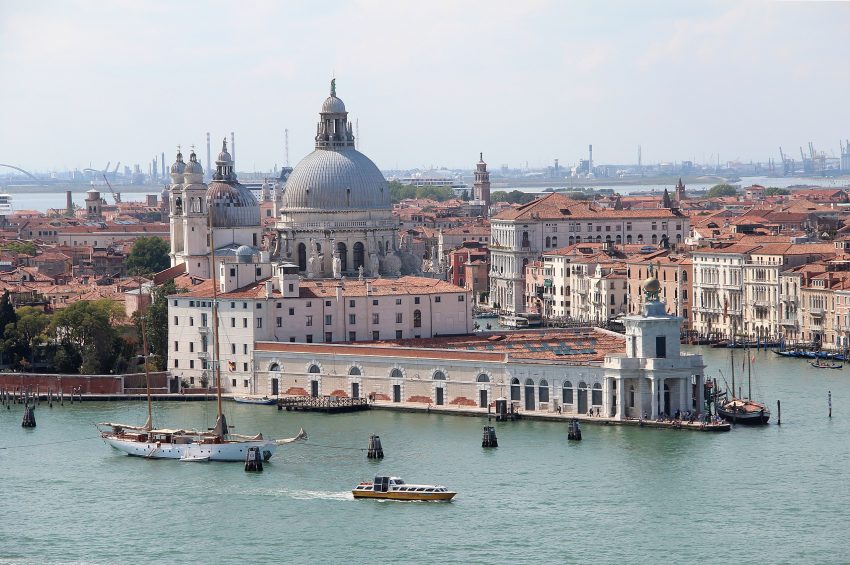
Punta della Dogana sits at one of Venice's most theatrical geographic moments: the sharp, triangular point where the Grand Canal opens out toward the lagoon and the Giudecca Canal. The building itself is the former Dogana da Mar, Venice's old maritime customs house, and even before you go inside you can feel the “gateway” energy of the place, with water on both sides and postcard views toward San Marco and across to San Giorgio Maggiore.
Inside, it's a contemporary art museum that feels distinctly Venetian rather than generic white-box minimalism, making it one of the things to see in Venice if you want a modern counterpoint to churches and palazzi. It also fits naturally into a walking tour of Venice because you can arrive by scenic lanes through Dorsoduro, then leave via the Salute area and drift back toward the Accademia or San Marco without backtracking.
Table of Contents
- History and Significance of the Punta della Dogana
- Things to See and Do in the Punta della Dogana
- How to Get to the Punta della Dogana
- Practical Tips on Visiting the Punta della Dogana
- Where to Stay Close to the Punta della Dogana
- Is the Punta della Dogana Worth Visiting?
- For Different Travelers
- FAQs for Visiting Punta della Dogana
- Nearby Attractions to the Punta della Dogana
History and Significance of the Punta della Dogana
For centuries, the Dogana da Mar was a working building tied to Venice’s identity as a maritime trading power, positioned precisely where arriving ships and goods met the city’s administrative machinery. The location is not an accident: this is the threshold between the city and the wider world, and the architecture was built to be seen, functioning as both infrastructure and statement.
In the 21st century, the building's story took a decisive turn when Venice sought to convert it into a contemporary art museum. The project was won by François Pinault, whose Pinault Collection manages a major international contemporary art collection and its exhibition sites, and the building was revived after decades of dormancy.
The renovation, led by architect Tadao Ando, is a big part of the appeal. The intervention keeps the rough industrial character and monumental scale of the customs house while refining circulation, light, and gallery rhythm, so the building remains present as an object in its own right rather than disappearing behind the art.
Things to See and Do in the Punta della Dogana
The first pleasure is simply how the museum handles space: long sightlines, changing ceiling heights, and a sense of moving through a sequence of rooms that still carries the building’s original purpose. Even if you visit without deep knowledge of the current exhibition, the architecture does a lot of the work, guiding your attention and giving the art a kind of breathing room that can be hard to find in Venice’s denser historic interiors.
Exhibitions here are typically drawn from the Pinault Collection and lean toward large-scale contemporary works that benefit from the building’s proportions. Expect installations, sculpture, and conceptual pieces that play with light, sound, and perspective, often creating “rooms within rooms” that feel almost stage-designed.
Do not rush the exterior terraces and the tip-of-the-city feeling around the site. The immediate surroundings are part of the experience: the waterline views, the Salute silhouette nearby, and the constant movement of boats make a contemporary museum visit feel grounded in Venice’s living landscape.
How to Get to the Punta della Dogana
The nearest airports are Venice Marco Polo (VCE) and Treviso (TSF), both with straightforward bus and taxi connections into Venice via Piazzale Roma. For the best deals and a seamless booking experience, check out these flights to Venice on Booking.com.
By train, arrive at Venezia Santa Lucia, then take Vaporetto Line 1 toward Salute for the most direct public-transport approach, or walk if you want to enjoy Dorsoduro on foot and you are travelling light. Use Omnio to easily compare schedules, book train tickets, and find the best prices all in one place for a hassle-free journey across Italy. From Piazzale Roma (where airport buses also arrive), the vaporetto plus a short walk is typically the smoothest option.
If you're arriving by car, park at Piazzale Roma or Tronchetto and continue into the historic centre on foot or by vaporetto, since Venice is car-free beyond the terminals. If you are looking to rent a car in Italy I recommend having a look at Discover Cars, first, as they compare prices and review multiple car rental agencies for you.
Practical Tips on Visiting the Punta della Dogana
- Entrance fee: Full price €18; reduced €15; ages 20–26 €7; free under 20.
- Opening hours: Wednesday – Monday: 10:00–19:00. Closed on Tuesday.
- Official website: https://www.pinaultcollection.com/palazzograssi/en
- Best time to visit: Late morning on a weekday is ideal for a calmer gallery flow, while late afternoon often feels quieter as day-trippers shift back toward the main San Marco routes.
- How long to spend: Allow 1.5-2.5 hours for a satisfying visit, especially if you like contemporary installations that reward a second look.
- Accessibility: This is one of the more manageable major museums in Venice for accessibility, with step-free access from the Salute vaporetto stop and good internal circulation once inside.
- Facilities: Plan for a focused visit and then take your break outside nearby, because the Salute area and Dorsoduro lanes offer better “reset” options than lingering indoors.
Where to Stay Close to the Punta della Dogana
For a culture-heavy itinerary, base yourself in Dorsoduro or central San Marco for maximum walkability to museums and classic sights, while Cannaregio is often the best base if you prioritise a quieter local feel and strong transport links.
If you want to stay within easy walking distance of Punta della Dogana and keep the Salute waterfront in your daily routine, Centurion Palace is a strong choice right by the canal edge and ideal for early-morning or late-evening walks. For a boutique base that keeps you firmly in Dorsoduro’s museum-and-café rhythm, Ca' Pisani Hotel makes it easy to combine contemporary art with relaxed neighbourhood exploring. If you prefer a slightly calmer pocket while staying very well connected on foot to both Dorsoduro and the transport terminals, Hotel Moresco is a comfortable, practical option.
Is the Punta della Dogana Worth Visiting?
Yes, particularly if you want Venice to feel contemporary as well as historic. The combination of a world-class setting, serious exhibition programming, and a uniquely Venetian location makes it far more memorable than “just another modern art stop.”
It is also an excellent palette cleanser in a Venice itinerary. After ornate interiors and Renaissance narrative painting, Punta della Dogana resets your eye and gives you a different way to experience the city's scale, light, and spatial drama.
For Different Travelers
Families with Kids
This can work well for families if you treat it as a short, curiosity-led visit rather than a complete exhibition deep dive. Large installations and bold spaces often hold attention better than dense wall text, especially if you let kids choose a few pieces to “decode” together.
Plan a simple before-and-after rhythm: museum first, then open air around the Salute waterfront. That keeps the day feeling like Venice rather than a long indoor block.
Couples & Romantic Getaways
Punta della Dogana is an excellent couples stop because it pairs contemporary culture with some of the city's best waterline atmosphere. The approach along Dorsoduro and the views at the tip make it feel like an experience, not just an entry ticket.
For a romantic flow, visit later in the day and then continue on foot toward the Salute area for softer light and quieter lanes. It is an easy way to build a refined, unhurried afternoon.
Budget Travelers
Contemporary museums can feel risky on a tight budget, but this one often delivers because the building itself is part of what you are paying for. If you choose one paid contemporary art stop in Venice, this is typically the most “only-in-Venice” version of that experience.
To keep costs controlled, build the rest of the day around free Venice pleasures: long walks, campos, and viewpoints. Punta della Dogana then becomes your single curated highlight rather than one of many admissions.
History Buffs
Even for travellers who are not primarily into contemporary art, the customs-house history and the building’s strategic position can justify the visit. It is a rare chance to see Venice’s maritime identity reframed through a modern cultural lens rather than preserved as a static relic.
Pay attention to how the renovation balances old material character with new geometry and light. The conversation between historic infrastructure and contemporary use is part of the story here.
FAQs for Visiting Punta della Dogana
Getting There
Tickets & Entry
Visiting Experience
Tours, Context & Itineraries
Photography
Accessibility & Facilities
Food & Breaks Nearby
Safety & Timing
Nearby Attractions to the Punta della Dogana
- Basilica di Santa Maria della Salute: Venice's iconic domed church next door, best appreciated for its exterior drama and the way it anchors the canal entrance.
- Peggy Guggenheim Collection: A compact modern-art museum in a Grand Canal palazzo setting, ideal for a contemporary-art double feature.
- Gallerie dell'Accademia: Venice's essential museum for pre-19th-century Venetian painting, a strong contrast to Punta della Dogana's contemporary focus.
- Accademia Bridge: One of the city's best Grand Canal viewpoints, perfect for photos and boat-watching in changing light.
- Zattere Promenade: A relaxed waterfront walk with open lagoon air, ideal for decompressing after indoor exhibitions.
The Punta della Dogana appears in our Complete Guide to Visiting Venice!

Moira & Andy
Hey! We're Moira & Andy. From hiking the Camino to trips around Europe in Bert our campervan — we've been traveling together since retirement in 2020!
This website uses affiliate links which may earn a commission at no additional cost to you!
Planning Your Visit
Wednesday - Monday: 10:00-19:00. Closed on Tuesday.
Full price €18; reduced €15; ages 20-26 €7; free under 20.
Nearby Attractions
- Basilica di Santa Maria della Salute (0.1) km
Church - Harry's Bar (0.2) km
Historic Building - Museo Correr (0.3) km
Historic Building and Museum - Procuratie Nuovissime (Newest Procuracies) (0.3) km
Historic Building - Peggy Guggenheim Collection (0.3) km
Arts Venue - National Archaeological Museum (0.3) km
Museum - Teatro La Fenice (0.3) km
Opera House - Procuratie Nuove (0.3) km
Historic Building - Caffè Florian (0.4) km
Café - Biblioteca Marciana (0.4) km
Historic Building and Library


