Pre Rup Temple

Hindu Temple

Pre Rup, Angkor, Camboya
CC BY-SA 3.0 / Diego Delso

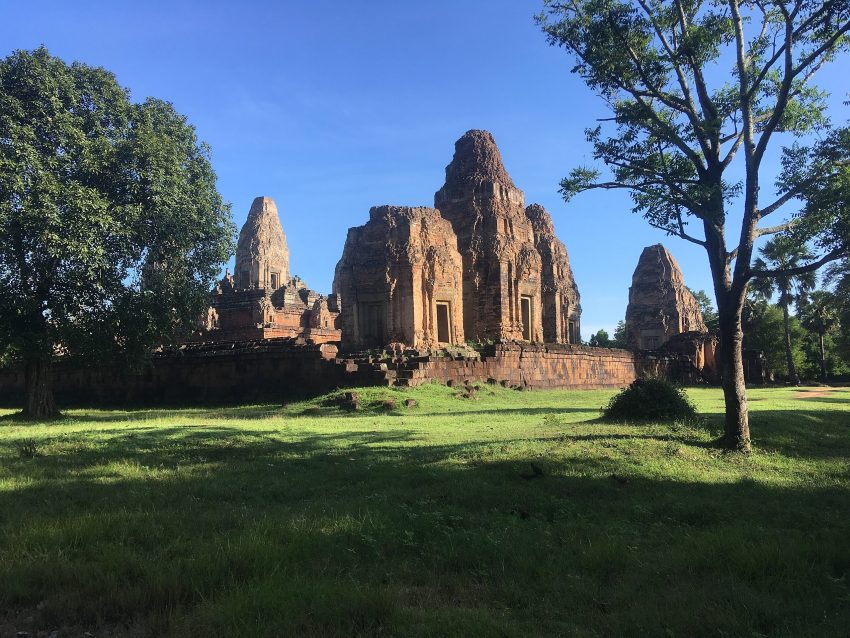
Pre Rup Temple is a classic Angkor “temple mountain” built in the 10th century, rising in stepped tiers to a cluster of towers at the summit. It's made largely of warm-toned brick and laterite, which gives it a different texture and colour from the sandstone-heavy temples-especially beautiful in late-afternoon light when the whole structure seems to glow.

You’ll find Pre Rup on the Grand Circuit in Angkor Archaeological Park, close to other excellent stops such as East Mebon, Ta Som, and Preah Khan. It’s popular, but it rarely feels as congested as Angkor Wat or Bayon, and because it’s climbable and open to the sky, it’s a temple that rewards you most when you slow down, look outward, and let the landscape become part of the experience.

History and Significance of the Pre Rup Temple

Pre Rup was founded in 961 during the reign of King Rajendravarman II, at a time when Angkor was consolidating its power and refining its temple-building traditions. The site aligns with other major monuments from the same reign, and its pyramid form reflects a Khmer interpretation of the sacred mountain idea-an ascent through increasingly elevated terraces toward the divine.

Religiously, Pre Rup is a Hindu temple associated with Shiva, and it once housed an important linga in its central sanctuary. Its long inscriptions and carefully planned layout underscore that this was not a peripheral monument but a state-level statement: part temple, part political theatre, and part cosmic diagram built in brick, laterite, and stone.

What makes Pre Rup especially meaningful for visitors today is how clearly it communicates its intent. Many Angkor temples are sprawling and maze-like; Pre Rup is more direct. You see the tiers, you climb the tiers, and at the top you understand why the Khmer built upward-because elevation changes the way a sacred place feels, and it changes how you see the world around it.

Things to See and Do in the Pre Rup Temple

Approach Pre Rup with a “climb and pause” mindset. The lower levels are great for warming up your eyes: doorways framing doorways, carved details you’ll miss if you rush, and the satisfying geometry of a monument built to be read in layers. As you move upward, the temple becomes more open, windier, and brighter, and the experience shifts from intimate corridors to wide-air space.

The summit is the main reward. From the top tier, you get one of the best panoramic feelings on the Angkor circuit-less about a single postcard view and more about seeing the park as a living landscape of trees and ruins. It’s also a strong photography temple because you can work with symmetry, strong lines, and warm materials, then switch to skyline shots from the edges.

If you’re building a route, Pre Rup pairs very well with East Mebon (nearby, and similarly “architectural” rather than overgrown) and then with a more atmospheric stop like Ta Som or Preah Khan. Done in that order, you get a day that moves from bold structure to softer, more immersive ruins without feeling repetitive.

How to Get to the Pre Rup Temple

The nearest airport is Siem Reap Angkor International Airport (SAI). For the best deals and a seamless booking experience, check out these flights to on Booking.com. From the airport, you transfer into Siem Reap town and then continue into Angkor Archaeological Park.

Cambodia’s limited rail network does not provide a practical route into Siem Reap for most visitors. Train schedules and bookings can be found on Omio. Overland arrivals are typically by long-distance bus or private transfer from Phnom Penh or the Thai border areas, followed by local transport in Siem Reap.

From Siem Reap, most people hire a tuk-tuk or car-and-driver and run Pre Rup as part of the Grand Circuit, often combining it with East Mebon, Ta Som, Neak Pean, and Preah Khan.

Practical Tips on Visiting the Pre Rup Temple

  • Entrance fee: Angkor Archaeological Park Pass required: 1-day US$37; 3-day US$62; 7-day US$72.
  • Opening hours: Daily: 07:30–17:30.
  • Official website: https://apsaraauthority.gov.kh/2021/08/12/pre-rup-temple/
  • Best time to visit: Late afternoon is ideal for colour and softer contrast on the brickwork, while mid-morning can feel calmer than the early rush to the biggest temples.
  • How long to spend: 45-75 minutes works well for a relaxed climb with time at the top; add more if you like slow photography and detail-hunting.
  • Accessibility: Expect steep steps, uneven stone, and high sun exposure on the upper tiers; confident walking shoes make a noticeable difference here.
  • Facilities: Bring water and sun protection, and plan proper food breaks back in Siem Reap rather than relying on services at the temple.

Where to Stay Close to the Pre Rup Temple

For a culture-heavy itinerary, base yourself in central Siem Reap near the river and Old Market area so you can start early, return easily for breaks, and keep evenings walkable; if your main focus is downtime between temple sessions, choose a resort-style stay slightly out of town for quieter nights and better pool time.

If you want a polished, central base with an easy rhythm for Angkor days, FCC Angkor by Avani is a strong option that keeps you close to town life without feeling hectic. For a high-comfort boutique stay with a calm, adult feel after long temple hours, Heritage Suites Hotel fits travellers who want service and quiet. If you’d rather prioritise space and a resort atmosphere, Zannier Hotels Phum Baitang works well as a reset base between big circuit days.

Is the Pre Rup Temple Worth Visiting?

Yes-Pre Rup is one of the most rewarding “second-tier” Angkor temples because it combines a clear architectural idea with a genuinely satisfying climb. It’s compact enough to feel doable on a busy day, but substantial enough to feel like a real highlight, especially if you like views, strong geometry, and warm materials.

Honest pivot: if you strongly dislike steep stairs or you’re already feeling temple fatigue, this is an easy one to skip because the best payoff is at the top. In that case, you may be happier prioritising flatter, more corridor-based temples where the experience isn’t dependent on climbing.

What Other Travellers Say...

Reviews Summary

Hindu temple ruins with ornate carvings, shrines & scenic views popular with sunset watchers.

Soeurm Soeun
in the last week
"Best temple Sunset view. Headed to Pre Rup for sunset. Many people, easy to get there with motorbike or tuktuk. Those steep stairs are intense, becareful your step coming down but the view is epic. Temple glowing red-orange against jungle and rice fields as the sun sets. Sky explodes in pinks and golds – super peaceful and magical. Highly recommend for a chill Angkor sunset. Best way to get there take the backroad...."
Soy Vanrita (Rita)
a month ago
"I visited Pre Rup on a rainy day, so I didn’t get the chance to watch the sunset — but the temple itself is absolutely amazing! It’s very high, andclimbing the ancient stone stairs made the experience feel truly adventurous, while coming back down on the wooden stairs (for safety) added an extra touch of excitement. The rain created a mystical vibe, making the temple feel like a hidden world from another time. I loved every step and the sense of history all around me. An uncle police officer even helped take my picture — such a kind gesture that made the visit even more memorable!..."
Renay Mermaid
a month ago
"This is quite a memorable temple because it includes a climb that tests your mettle! A hard climb on a very steep incline with steps that areextremely narrow! I didn't make it to the highest level, the steps looked even narrower here. Spectacular views regardless (I imagine from the to level the views would be even better!🤷‍♀️) A grade experience!..."

For Different Travelers

Families with Kids

Pre Rup can be a great family temple if everyone is comfortable with stairs and you treat it like a small adventure rather than a history lesson. The stepped layout makes it easy to set mini-goals-reach the next terrace, find a good viewpoint, then take a short break before continuing.

The main challenge is safety on steep steps and the heat on exposed upper tiers. A shorter, well-paced visit with water breaks tends to work better than trying to explore every corner, especially with younger kids who tire quickly on uneven stone.

Couples & Romantic Getaways

Pre Rup suits couples because it feels open and cinematic without being overly crowded. The climb naturally slows you down, and the upper tiers give you space to linger, talk, and take in the view in a way that’s harder at the headline temples.

If you’re aiming for a romantic rhythm, use Pre Rup as your “golden light” stop and keep the rest of the day simpler. It’s a temple that feels best when you’re not rushed, because the atmosphere is as much about the sky and the wind as it is about the towers.

Budget Travelers

Pre Rup is excellent value because it’s included in the Angkor Pass and delivers a big experience without extra add-ons. It also tends to feel less bottlenecked than the most famous sites, which means you often get more enjoyment per hour-an underrated win when you’re trying to maximise what you see on a pass.

To keep costs down, fold it into a Grand Circuit day with a single driver rather than bouncing back to town between temples. A well-planned circuit day is usually cheaper than multiple short trips, and it keeps your time investment efficient.

History Buffs

For history-focused travellers, Pre Rup is a strong window into 10th-century Angkor, when brick and laterite construction still dominated many major monuments. It also helps you “read” the evolution of the temple mountain idea-how Khmer builders staged ascent, hierarchy, and sacred focus in a way that later periods would expand and refine.

Look beyond the summit and pay attention to the planning: repeated gateways, nested levels, and the way the temple turns movement into meaning. Pre Rup isn’t just a nice view-it’s a structured argument in architecture about kingship, cosmos, and ritual.

FAQs for Visiting Pre Rup Temple

Getting There

It’s on the Grand Circuit, close to East Mebon and within easy reach from Siem Reap by tuk-tuk or car. It’s a convenient mid-day stop because it connects naturally to several other strong temples nearby.
The easiest approach is to treat it as a Grand Circuit anchor and add two or three nearby temples around it. That keeps driving time low and gives you a day that feels coherent rather than scattered.
Yes, it’s one of the smoother combinations in Angkor because the temples sit in the same general circuit flow. Most drivers will suggest this pairing automatically once you mention you want a Grand Circuit day.

Tickets & Entry

In normal conditions, your Angkor pass is what matters at checkpoints in the park. If any special access rules are in place due to restoration, staff on site will direct you to the correct areas.
You buy it through the official Angkor ticket office/enterprise process, not at individual temples. Most drivers know exactly where to take you, and it’s routine to stop there first on your first park day.
Sections can be cordoned off when conservation is underway, especially around fragile towers. The visit still works well even with partial access, because the core experience is the tiered climb and open upper levels.

Visiting Experience

Pre Rup is a strong contender because it’s compact, visually distinctive, and quick to understand. It often feels more relaxed than the temples that attract the biggest tour-group momentum.
Yes-Pre Rup is more about clean lines, open space, and warm materials than about trees and atmosphere. It’s a good counterbalance if your day includes a heavily overgrown or corridor-heavy temple.
A simple, satisfying half-day loop is Pre Rup plus East Mebon and one additional stop such as Ta Som or Preah Khan. That gives you variety without turning the day into a long drive.

Tours, Context & Itineraries

It’s easy to enjoy independently because the structure is intuitive and the climb creates a clear beginning-to-end flow. A guide adds value if you want deeper context on 10th-century Angkor and temple-mountain symbolism.
Many Grand Circuit tours do, but it’s not always included on a first-time “highlights only” day. If it matters to you, mention it early so it’s built into the route rather than squeezed in.

Photography

The best “temple mountain” shots come from lower levels looking upward to capture the stacked terraces and towers. For wider frames, use the upper tiers and shoot outward across the treetops rather than trying to force a single iconic angle.
It can be, especially if your priority is space and warm light rather than a tightly controlled viewing platform. The experience tends to feel less like a queue and more like a self-paced climb.

Food & Breaks Nearby

Most travellers do a proper café or lunch stop back in Siem Reap because the choice and comfort are far better. If you’re staying in the park all day, keep breaks simple and short so you don’t lose the best moving hours on the circuit.

Safety & Timing

People underestimate how steep the steps feel on the descent, especially when tired or in harsh light. A slow, deliberate pace down is the difference between a confident finish and an avoidable slip.
It depends on your energy, because the payoff improves with the climb. If you’re fading, it’s better earlier in your circuit day, then end with a flatter temple where the experience doesn’t depend on stairs.

Nearby Attractions to the Pre Rup Temple

  • East Mebon: A temple on the same circuit that complements Pre Rup with a more compact layout and excellent stone detailing.
  • Ta Som: A smaller, atmospheric temple that’s easy to enjoy quickly and pairs well with a Grand Circuit route.
  • Neak Pean: A distinctive island-style sanctuary reached by a walkway, offering a very different mood from the pyramid temples.
  • Preah Khan: A large, maze-like complex that delivers classic “Angkor corridors” energy and a deeper sense of scale.
  • Banteay Kdei: A calmer, monastery-like temple with layered galleries that works well when you want quieter wandering.

The Pre Rup Temple appears in our Complete Guide to Visiting !

Moira & Andy
Moira & Andy

Hey! We're Moira & Andy. From hiking the Camino to trips around Europe in Bert our campervan — we've been traveling together since retirement in 2020!

Read our full story here

This website uses affiliate links which may earn a commission at no additional cost to you!

Planning Your Visit

Hours:

Daily: 07:30-17:30.

Price:

Angkor Archaeological Park Pass required: 1-day US$37; 3-day US$62; 7-day US$72.

Nearby Attractions

Similar Blogs