Porta Montanara di Rimini
City Gate in Rimini
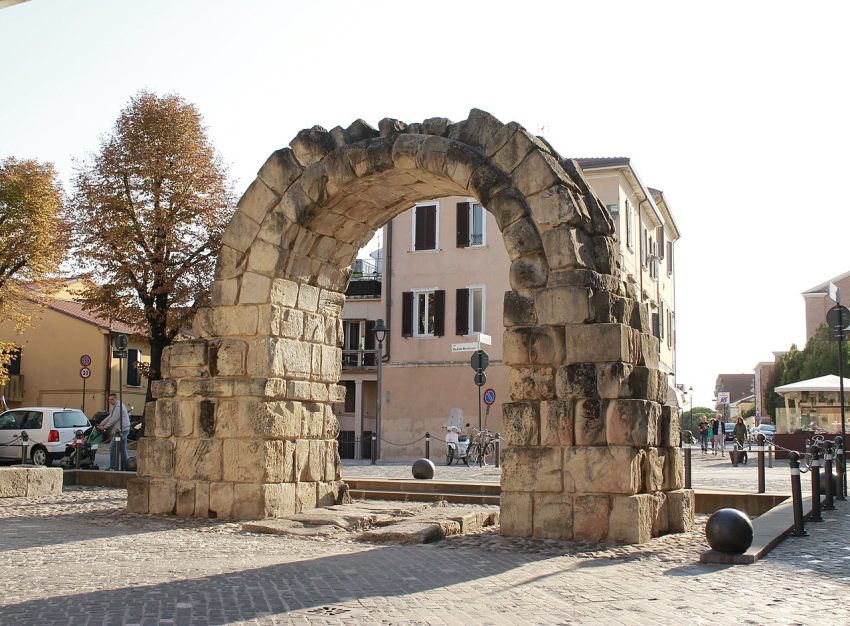
Porta Montanara is one of Rimini’s most meaningful “street-level” Roman remnants: an ancient city gate rebuilt back into its original setting on Via Garibaldi, marking a historic entrance line into Ariminum. It’s close to the old town core, easy to reach on foot, and the kind of landmark you can appreciate in a few minutes-yet it carries centuries of change in a single glance.
What makes it special is its sense of place. You're not looking at a gate behind glass or tucked away in a museum courtyard; you're standing where people have entered and exited Rimini for generations, which is why it's one of the things to see in Rimini on a walking tour of Rimini that focuses on the city's Roman grid and layered history.
Table of Contents
- History and Significance of the Porta Montanara
- Things to See and Do in the Porta Montanara
- How to Get to the Porta Montanara
- Practical Tips on Visiting the Porta Montanara
- Where to Stay Close to the Porta Montanara
- Is the Porta Montanara Worth Visiting?
- For Different Travelers
- FAQs for Visiting Porta Montanara
- Nearby Attractions to the Porta Montanara
History and Significance of the Porta Montanara
Porta Montanara dates to the Roman Republican era, traditionally associated with the 1st century BC and the period of Sulla. It was one of the city’s key entry points into Ariminum, part of a system of gates that controlled movement, trade, and security along the edges of the Roman settlement.
For centuries, its role became even more concentrated. From the 1400s until 1809, it served as the primary upstream access into Rimini, sitting at the end of the ancient Cardo Maximus line, which today corresponds to Via Garibaldi. Historically it consisted of two arches, reinforcing its importance as a busy threshold rather than a minor passage.
Its modern story is inseparable from World War II. The gate was heavily damaged in 1943, leaving only part of an arch surviving. That surviving section was rescued and reassembled in a protected setting near the Tempio Malatestiano, a practical act of preservation at a time when Rimini's historic fabric was under intense strain.
In the early 2000s, a major restoration project returned the gate to its original context on Via Garibaldi. The process involved dismantling and cleaning the stones and reconstructing the structure so it could once again function as a symbolic city entrance. The surrounding streetscape was also carefully treated, reinforcing the sense that this is not just a relic, but a recovered piece of Rimini’s urban identity.
Things to See and Do in the Porta Montanara
Start by approaching it as you would any city gate: from a short distance away, so you can feel the “threshold” effect. The most satisfying moment is often the simplest one-walking through or alongside it and imagining the centuries of arrivals and departures it has witnessed, from everyday traders to travelers moving between the coast and the inland routes.
Take a minute to look at the stonework and proportions. Because the gate has been restored and repositioned, the experience is partly architectural and partly interpretive: you’re reading a structure that has survived damage, relocation, and careful reassembly, which adds an unusual layer of modern meaning to an ancient object.
It also works beautifully as a connector stop. Porta Montanara is ideal as part of a short “line walk” along Via Garibaldi and into the historic center, where you can link Roman geometry to later medieval and Renaissance layers. If you enjoy small, coherent routes, this is a perfect starting point for building a loop that ends in a piazza café break.
How to Get to the Porta Montanara
Federico Fellini International Airport (Rimini Airport) is the closest airport for reaching the city, while Bologna Guglielmo Marconi Airport is a common alternative with more flight options. For the best deals and a seamless booking experience, check out these flights to Rimini on Booking.com. From either airport, you can continue into central Rimini by local bus, taxi, or train connections depending on your arrival time and schedule.
Rimini’s main train station is a convenient arrival point, and Porta Montanara is reachable on foot via central streets that lead naturally toward Via Garibaldi and the historic center. Use Omnio to easily compare schedules, book train tickets, and find the best prices all in one place for a hassle-free journey across Italy. If you prefer public transport, local buses can shorten the walk and leave you with a simple final approach.
If you’re driving, it’s usually easiest to park on the edge of the centro storico and walk the final stretch, as central access rules and parking availability can make the last kilometer slower than it looks on a map. If you are looking to rent a car in Italy I recommend having a look at Discover Cars, first, as they compare prices and review multiple car rental agencies for you.
Practical Tips on Visiting the Porta Montanara
- Entrance fee: Free.
- Opening hours: 24 Hours
- Best time to visit: Early morning is ideal for a quiet, uncluttered view and easy photos, especially if you want to appreciate the gate as a standalone landmark. Early evening also works well because it fits naturally into a pre-dinner stroll through the old town.
- How long to spend: Plan 10-20 minutes for a focused stop with a few photos and a slower look at the stonework. If you’re using it as a route marker on a longer walk, it becomes a natural “pause point” rather than a timed visit.
- Accessibility: The gate is on an urban street route, so access is generally straightforward on foot, but expect typical historic-center paving and curbs. If you have limited mobility, approaching at a quieter time makes it easier to choose the smoothest path without crowd pressure.
- Facilities: There are no dedicated visitor facilities at the gate itself, so treat it as an outdoor landmark stop. Cafés, restrooms, and services are best found a few minutes away as you continue into the historic center.
Where to Stay Close to the Porta Montanara
For a culture-heavy itinerary, the best base is Rimini’s centro storico near the main sights; if your trip is more focused on beach time, nightlife, and promenade energy, Marina Centro is usually the better area to stay.
If you want to be able to step out and build easy walking loops through the old town, DuoMo Hotel is a stylish central option. For travelers prioritizing transport links while keeping the historic center walkable, Card International Hotel is a practical choice. If you prefer a seafront-leaning stay that still keeps the old town within easy reach, Hotel Luxor is a solid base.
Is the Porta Montanara Worth Visiting?
Yes, especially if you enjoy the kind of history that's embedded in the street plan rather than isolated in a museum. It's a quick stop with a strong narrative: Roman Rimini, wartime damage, careful preservation, and a return to its original context.
It’s also worth it because it helps your walk make sense. Seeing a gate on a real approach street gives you a more tangible feel for how the ancient city was entered and organized, and it adds a satisfying “beginning point” to an old-town route.
What Other Travellers Say...

Antica Porta Montanara on Via Giuseppe Garibaldi in Rimini is a modest surviving city gate: a re-set arch marking the former southern entrance to Roman Ariminum where the road climbed toward the Marecchia valley. Once featuring two vaulted passages and a guard courtyard that filtered traffic, it was partially bricked up and absorbed by later houses and Malatesta palaces, suffered war damage and dispersal of its stones, then was returned near its ancient line to quietly mark the edge between town and countryside; visitors note it's small but worth seeing.


For Different Travelers
Families with Kids
This is an easy family stop because it’s outdoors, quick, and naturally sparks imagination about “city gates” and ancient walls. You can keep it simple by treating it like a short story stop-who came through here, what would the city have looked like, and where would you go next.
Because it doesn’t require long attention spans, it fits well between bigger sights. Pair it with a snack stop in the center and it becomes a smooth, low-stress part of a walking day.
Couples & Romantic Getaways
For couples, Porta Montanara works best as a gentle “start point” for an evening wander, when the streets feel calmer and the old town lights begin to soften the scene. It’s a small landmark, but it creates a satisfying sense of crossing into the historic center together.
Use it as a cue to slow down rather than rush to the next attraction. A simple route from the gate toward a piazza for aperitivo makes the visit feel intentional without being overplanned.
Budget Travelers
This is a perfect budget-friendly stop because it costs nothing and still delivers a meaningful piece of Rimini’s story. It’s also easy to build into a free self-guided walk that links multiple landmarks without paid entry.
Think of it as a “high-context” sight: a short stop that improves your understanding of everything else you see in the historic center. That’s excellent value for a few minutes of time.
FAQs for Visiting Porta Montanara
Getting There
Tickets & Entry
Visiting Experience
Tours, Context & Itineraries
Photography
Accessibility & Facilities
Food & Breaks Nearby
Safety & Timing
Nearby Attractions to the Porta Montanara
- Tempio Malatestiano: A standout church where Rimini's Renaissance identity comes through in strong architectural details and atmosphere.
- Arch of Augustus: A landmark Roman gateway that pairs naturally with Porta Montanara for a “city entrances” theme.
- Piazza Tre Martiri: A central square with Roman roots and modern commemorative history, ideal for understanding Rimini's layered identity.
- Piazza Cavour: The city's main civic square, perfect for cafés and a quick architectural loop among major palaces.
- Castel Sismondo: A powerful Malatesta-era fortress that adds medieval weight to an old-town walk.
The Porta Montanara di Rimini appears in our Complete Guide to Visiting Rimini!

Moira & Andy
Hey! We're Moira & Andy. From hiking the Camino to trips around Europe in Bert our campervan — we've been traveling together since retirement in 2020!
This website uses affiliate links which may earn a commission at no additional cost to you!
Planning Your Visit
24 Hours
Free.
Nearby Attractions
- Castel Sismondo (0.3) km
Castle and Museum - Piazza Tre Martiri (0.3) km
Historic Site and Square - Piazza Cavour (0.4) km
Square - Palazzo Garampi (0.4) km
Palace - Palazzo del Fulgor (0.5) km
Museum - Arch of Augustus (0.5) km
Historic Site - Tempio Malatestiano (0.5) km
Church - Domus del Chirurgo (0.6) km
Historic Site - Rimini Caput Viarum (0.6) km
Visitor Centre - Museo della Città di Rimini (0.6) km
Historic Building and Museum