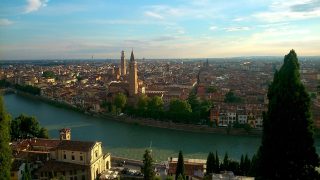
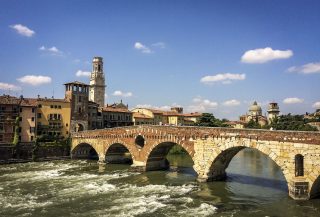
Ponte Scaligero, Verona
Bridge in Verona

Ponte Scaligero (also known as the Castelvecchio Bridge) is Verona at its most cinematic: a red-brick fortified bridge that strides across the Adige with three bold arches and battlemented walls that feel more like a castle corridor than a simple crossing. It links directly to Castelvecchio, and walking it is one of those moments where the city's medieval power feels tangible, with the river below and Verona's rooftops unfolding upstream and down.
It's one of the things to see in Verona because it works on multiple levels at once: history, engineering, river views, and that satisfying feeling of stepping slightly off the main shopping streets without going out of your way. It also fits naturally into a walking tour of Verona, especially if you like building a route that mixes big headline sights with atmospheric “pause and look” spots.
Table of Contents
- History and Significance of the Ponte Scaligero
- Things to See and Do in the Ponte Scaligero
- How to Get to the Ponte Scaligero
- Practical Tips on Visiting the Ponte Scaligero
- Where to Stay Close to the Ponte Scaligero
- Is the Ponte Scaligero Worth Visiting?
- For Different Travelers
- FAQs for Visiting Ponte Scaligero
- Nearby Attractions to the Ponte Scaligero
History and Significance of the Ponte Scaligero
The bridge was built in the mid-14th century under Cangrande II della Scala, designed as a fortified escape route from Castelvecchio in case the city turned against him. That defensive purpose is written into the structure: high walls, controlled access points, and a design that feels deliberately secure rather than decorative.
At the time of construction, its largest span was a remarkable engineering achievement, giving the bridge a reputation for ambition as well as strength. Even today, the proportions feel confident, and the way the arches step down toward the far bank adds to the sense that this was built by rulers who wanted their power to be seen.
The story takes a dramatic turn in the 20th century: the bridge was destroyed in 1945 during the German retreat and then painstakingly reconstructed after the war, completed in the early 1950s. When you walk across now, you're seeing a faithful recovery of a landmark that Verona chose to reclaim as part of its identity.
Things to See and Do in the Ponte Scaligero
The best simple plan is to walk across slowly in both directions, because the views change: one way you get Castelvecchio’s fortress mass behind you, and the other you get a wider sweep of the Adige bending through the city. The battlements create ready-made viewing frames, so it’s easy to stop for a few photos without feeling like you’re blocking the whole bridge.
If you want a deeper experience, pair the crossing with time at Castelvecchio next door, then use the bridge as your “reset” between museum focus and river-breeze wandering. On the far side, take a short stroll along the riverside paths for quieter angles back toward the arches, which is where the bridge looks most dramatic as a full structure rather than a walkway.
Sunset is the classic moment, but early morning is underrated: fewer people, softer light on the brick, and a calmer river scene. Either way, it’s a stop that rewards lingering rather than rushing, even if your total visit is only 15 minutes.
How to Get to the Ponte Scaligero
Ponte Scaligero is in central Verona beside Castelvecchio on Corso Castelvecchio, an easy walk from Piazza Bra and the Arena. The nearest airports are Verona Airport (VRN) for the quickest access, with Milan Bergamo (BGY) and Venice Marco Polo (VCE) as useful alternatives if flights are better on your dates. For the best deals and a seamless booking experience, check out these flights to Verona on Booking.com.
From Verona Porta Nuova train station, you can walk in roughly 15-20 minutes, or take a quick local bus/taxi if you want to save steps before a full day of sightseeing. Use Omnio to easily compare schedules, book train tickets, and find the best prices all in one place for a hassle-free journey across Italy..
If you're arriving from elsewhere in the Veneto, Verona's rail connections make it straightforward to build the bridge into a half-day city visit, especially when paired with the Arena and the historic centre.
By car, plan to park outside the tightest historic-core streets and walk the last stretch, because central traffic and limited zones can slow you down more than you expect. If you are looking to rent a car in Italy I recommend having a look at Discover Cars, first, as they compare prices and review multiple car rental agencies for you.
Practical Tips on Visiting the Ponte Scaligero
- Entrance fee: Free
- Opening hours: 24 hours
- Best time to visit: Go early for calm views and clean photos, or aim for late afternoon when the brick tones glow and the river feels most atmospheric.
- How long to spend: 15-30 minutes is perfect for a relaxed crossing and viewpoint stops, or 60-90 minutes if you combine it with Castelvecchio and a riverside walk.
- Accessibility: The surface is generally manageable, but the bridge is narrow in places and can feel busy, so slower-paced visitors may prefer quieter times of day.
- Facilities: Treat it as an outdoor sight and plan cafés and restrooms around Castelvecchio, Piazza Bra, or the nearby historic-centre lanes.
Where to Stay Close to the Ponte Scaligero
For a culture-heavy itinerary, base yourself in Verona's Centro Storico near Piazza Bra and Castelvecchio so you can walk to the main sights at quieter hours; if your trip focuses on transport efficiency, stay near Porta Nuova station for quick arrivals and easy day trips.
For a very central base that keeps you close to the bridge, the Arena, and evening strolls, Hotel Milano & Spa is a strong all-round option. If you want something practical and well-located for walking the core sights without paying top-end prices, Hotel Mastino is a dependable choice. For a more boutique feel in the historic centre with easy access to Castelvecchio and riverside walks, NH Collection Palazzo Verona works well for a refined, sight-heavy stay.
Is the Ponte Scaligero Worth Visiting?
Yes, because it's one of those sights that delivers immediately: you do not need a tour, a ticket, or specialist knowledge to enjoy it. The bridge is both a landmark and an experience, and the combination of fortress architecture and river panoramas makes it feel uniquely “Verona” rather than just another pretty crossing.
It's also an ideal connector in your day, letting you move between Castelvecchio, the historic centre, and riverside viewpoints while turning a simple walk into a highlight.
What Other Travellers Say...

Castelvecchio Bridge, on Corso Castelvecchio 2 in Verona, is a picturesque red brick and marble medieval bridge with three spans and arches that links to the Castelvecchio fortress; reconstructed after World War II using its original materials, it is now pedestrian-only and rewards visitors with striking views over the Adige River—especially at sunset—and details like worn wheel marks in the stone that hint at its long use.


For Different Travelers
Families with Kids
This is a great family stop because it feels like walking through a castle, with walls, towers, and a strong sense of “adventure crossing.” Keep it fun by making it a short mission: cross, pick a favourite view, then continue to a gelato stop nearby rather than forcing a long linger.
If you’re visiting at peak times, hold hands and move steadily, because the narrow walkway can get congested. Quieter hours make the experience calmer and easier for kids to enjoy.
Couples & Romantic Getaways
For couples, Ponte Scaligero is at its best as a slow, scenic stroll with a pause midway to watch the river and the city edges. It's especially good at golden hour, when the brick warms up and Verona's skyline feels softer and more cinematic.
Pair it with a riverside wander and then an aperitivo back in the historic centre, using the bridge as a gentle transition from “sightseeing mode” to “evening mode.” It’s a simple plan that feels effortlessly romantic.
Budget Travelers
This is an excellent budget highlight because it costs nothing and still feels iconic. Put your spending into experiences around it instead, like a museum visit at Castelvecchio or a low-key riverside snack, and you'll still feel like you had a full Verona moment.
If you're doing Verona as a day trip, the bridge is also a smart “high impact, low time” stop that doesn't require reservations. It rewards early starts and walking, which keeps costs down while improving the experience.
FAQs for Visiting Ponte Scaligero
Getting There
Tickets & Entry
Visiting Experience
Tours, Context & Itineraries
Photography
Accessibility & Facilities
Food & Breaks Nearby
Safety & Timing
Nearby Attractions to the Ponte Scaligero
- Castelvecchio Museum - A major Verona museum inside the fortress complex, ideal for pairing history and art with your bridge walk.
- Arco dei Gavi - A Roman-era arch nearby that makes a quick, satisfying stop on the way back into the centre.
- Piazza Bra and the Arena di Verona - Verona's big landmark square and amphitheatre, perfect for continuing your route after the bridge.
- Ponte Pietra - The city's most famous historic river crossing, especially beautiful for views and evening atmosphere.
- Castel San Pietro viewpoint - A classic panorama over Verona that complements the river views you get from Ponte Scaligero.
The Ponte Scaligero appears in our Complete Guide to Visiting Verona!

Moira & Andy
Hey! We're Moira & Andy. From hiking the Camino to trips around Europe in Bert our campervan — we've been traveling together since retirement in 2020!
This website uses affiliate links which may earn a commission at no additional cost to you!
Planning Your Visit
24 hours
Free
Nearby Attractions
- Castelvecchio Museum (0.1) km
Castle and Museum - Arco dei Gavi (0.1) km
- Porta Borsari (0.5) km
Historic Building - Piazza Brà (0.5) km
Square - Arena di Verona (0.6) km
Amphitheatre - Basilica of San Zeno Maggiore (0.7) km
Church - Palazzo Miniscalchi (0.8) km
Museum - Piazza Delle Erbe (0.8) km
Square - Torre dei Lamberti (0.9) km
Tower - Juliet's House (0.9) km
Historic Building